
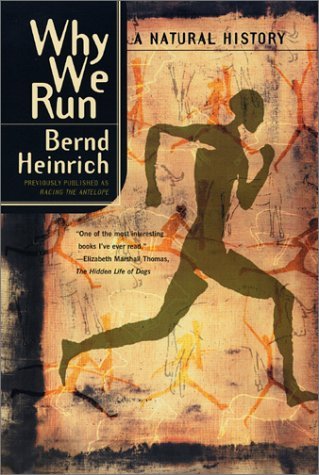
It’s funny how a book may come at a time in your life when most appropriate. I saw “Why We Run” mentioned on a mailing list of minimalist runners (barefoot, vibram five fingers, hauraches, or minimal shoes), had a “sample” delivered via Amazon’s Kindle, and then had to read the whole thing. You see, in a few weeks I am about to try my 1st “ultra,” my first running race that goes beyond the marathon distance of 26.2 miles. Now, I have done longer distances on foot as part of Adventure Races or Rogaine’s (24 hour orienteering events), but I have never gone past 26.2 in a running race. And the last trail marathon I completed, nearly 7 years ago really bothered my knee, and it has been a loooonnnnnggggg road back.
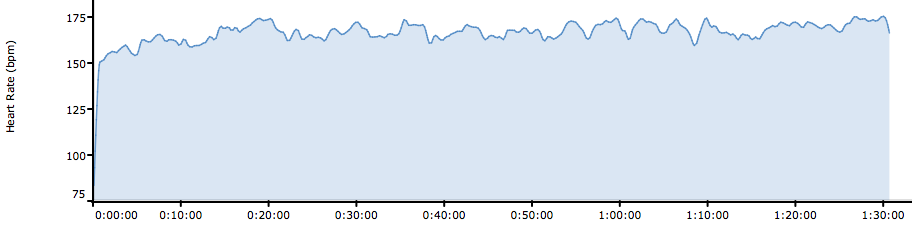
But here I am, just having finished a 7 mile trail race a month and half ago, and then a 10 mile trail race in the past two weeks, and then a 20 mile training “adventure run” in the past few days. And in less than three weeks I will be attempting to finish 40 miles in Uhwarrie, a very rugged trail in the middle of North Carolina. Here is the elevation profile to show you what I mean:

If you can get past the first few chapters of the book, which focuses on cooling, respiratory, fueling, and cardio-vascular systems in bugs and animals, with a little human running mixed in, it becomes a great read about Bernd Heinrich who is attempting his first ultra (at the 100k distance) at age 41, and not only that, but attempting to break the US record at the distance. (I actually loved the sections on animals, but it may not be for everyone.) Heinrich has studied different animals and how their bodies are suited for endurance, from moths, to bees, to antelope, to camels, and on and on, and goes through each animal and the pros and cons of the systems they have developed. He then uses these aspects in his own training, which he calls an experiment of one. Some of the experiments are crazy, when he tried to drink one beer each mile for 18 miles, or when he downed a quart of honey before heading out for a 20+ mile run. Many of them were not successful, as you can imagine!
The book culminates with his race in the 100k. I won’t give you the outcome here. 🙂
I had highlighted many quotes on the Kindle, and imported those into my Evernote note book, but I’ll just include some of the better ones here. I’ve left out the ones I highlighted related to the science of training, for the most part.
- I love running cross-country. You come up a hill and see two deer going, “What the hell is he doing?” On a track I feel like a hamster. —ROBIN WILLIAMS, film star
- An anonymous runner captured the notion in this now-famous aphorism: “Every morning in Africa, an antelope wakes up. It knows it must outrun the fastest lion, or it will be killed. Every morning in Africa, a lion wakes up. It knows it must run faster than the fastest antelope, or it will starve. It doesn’t matter whether you’re a lion or an antelope—when the sun comes up, you’d better be running.”
- We are, deep down, still runners, whether or not we declare it by our actions. And our minds, as much as our lungs and muscles, are a vital force that empowers our running. Whenever one of us jogs down a road or when we line up to race in a marathon, we are not only celebrating life in general and our individual aliveness but we are also exercising our fantasies while acknowledging reality. We are secure in the knowledge that there is no magic. Which is not to say the world is only of simple logic, because although it may be simple in its design, it is awesomely complex in its details.
- There is nothing quite so gentle, deep, and irrational as our running—and nothing quite so savage, and so wild.
- I wanted to do something different. However, that is a difficult thing if you see no opportunity. On the other hand, it is hard not to try when you think you can do something when you have a chance at success, even though it is often hazardous to strike out on one’s own. That seldom goes unpunished. Any mark of difference may become a target. Even my own father, to whom I owe so much, had taught me this harsh lesson.
- “America is an experiment,” he said, and after a long pause continued, “where the driving force is individuals chasing money. I would not risk my bones for a society guided by this principle.”
- The test is the race, where credentials mean nothing and performances everything.
- Every parting gives a foretaste of death, every reunion a hint of resurrection. —ARTHUR SCHOPENHAUER, German philosopher
- Plato, who participated in the Isthmian Games as a wrestler, as well as Socrates, who was said to keep himself in excellent condition by training in a gymnasium, emphasized the necessity of physical training in a sound education.
- “The beaver,” we were told, “works when he works, plays when he plays, is strong in individual effort, yet labors for the community good.” The beaver cuts trees individually, yet its dams and lodges are built and maintained communally by the whole clan. Efforts from one generation of beavers contribute also to the well-being of future generations.
- If we can’t find allies in one context, we will in another. But there is a prerequisite: in order to forge alliances, we first need worthy adversaries. Without adversaries, no alliances are necessary.
- There is nothing that can make one feel smaller than seeing someone big, which is why many try to talk down those who are more capable than they are. In running, you can’t deceive yourself or anyone else.
- although animals can reveal mechanisms, our performance, whether it is in a painting or in a race, is ultimately art because there is so much that varies.
- Furthermore, the key to endurance, as all distance runners know, is not just a matter of sweat glands. It’s vision. To endure is to have a clear goal and the ability to extrapolate to it with the mind—the ability to keep in mind what is not before the eye. Vision allows us to reach into the future, whether it’s to kill an antelope or to achieve a record time in a race.
- If some animals’ brain hormone production can be triggered by mere flashes of light and other numerous and seemingly trivial external cues, then it does not seem preposterous to consider that just maybe we can be molded by fierce dreams that allow us to perform what we’d otherwise be incapable of accomplishing.
- Perhaps I had discovered my strength. To not use it fully to try for an inspiring goal seemed wasteful, if not disrespectful, like foolishly squandering a precious gift.
- To psych oneself up takes self-delusion.
- Not to give an inch is to give everything.
- “Now if you are going to win the battle, you have to do one thing. You have to make the mind run the body. Never let the body tell the mind what to do. The body will always give up.” The body can handle only little steps. The mind can take great leaps.
- “Suffering is the sole origin of consciousness,” Dostoyevsky wrote.
Wow, I better stop there…. Well worth the read if you are into running in any way!




 2sparrows