Read about it here:

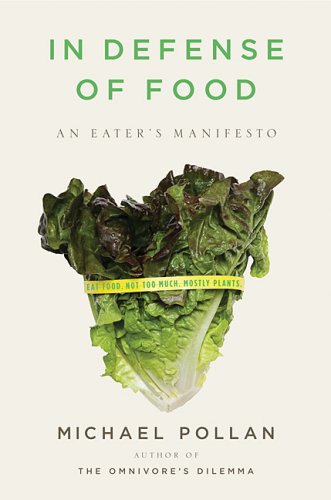
After reading Pollan’s The Omnivore’s Dilemma, and enjoying it so much, I thought I should read his follow up book. In the introduction, he explains the purpose of writing In Defense of Food:
But many readers wanted to know, after they’d spent a few hundred pages following me following the food chains that feed us, “Okay, but what should I eat? And now that you’ve been to the feedlots, the food-processing plants, the organic factory farms, and the local farms and ranches, what do you eat?
He goes on to give the answer early:
Eat food. Mostly plants. Not too much.
Of course, that answer needs a lot of explanation, which the rest of the book does.
Again in this book, Pollan shows he is a good writer, though I enjoyed the “adventure” aspect of The Ominvore’s Dilemma a bit more. But this is still worth a read, and a fascinating account of the many problems with conventional wisdom, especially with respect to USDA guidelines for eating and, more specifically, with the food pyramid. There is some repetition, of course, but that is expected.
I won’t say much more here, but will leave you with a few quotes:
Scientific reductionism is an undeniably powerful tool, but it can mislead us too, especially when applied to something as complex, on the one side, as a food and on the other a human eater. It encourages us to take a simple mechanistic view of that transaction: Put in this nutrient, get out that physiological result. Yet people differ in important ways. We all know that lucky soul who can eat prodigious quantities of fattening food without ever gaining weight. Some populations can metabolize sugars better than others. Depending on your evolutionary heritage, you may or may not be able to digest the lactose in milk. Depending on your genetic makeup, reducing the saturated fat in your diet may or may not move your cholesterol numbers. The specific ecology of your intestines helps determine how efficiently you digest what you eat, so that the same 100 calories of food may yield more or less food energy depending on the proportion of Firmicutes and Bacteroides resident in your gut. In turn, that balance of bacterial species could owe to your genes or to something in your environment. So there is nothing very machinelike about the human eater, and to think of food as simply fuel is to completely misconstrue it. It’s worth keeping in mind too that, curiously, the human digestive tract has roughly as many neurons as the spinal column. We don’t yet know exactly what they’re up to, but their existence suggests that much more is going on in digestion than simply the breakdown of foods into chemicals
Foods that lie to our senses are one of the most challenging features of the Western diet.
Nine percent of the calories in the American diet today come from a single omega-6 fatty acid: linoleic acid, most of it from soybean oil.
People eating a Western diet are prone to a complex of chronic diseases that seldom strike people eating more traditional diets. Scientists can argue all they want about the biological mechanisms behind this phenomenon, but whichever it is, the solution to the problem would appear to remain very much the same: Stop eating a Western diet.
Finally, he has this to say about Gary Taube’s Good Calories, Bad Calories, which I just happen to be reading now:
*Gary Taubes describes the developing carbohydrate hypothesis at great length in Good Calories, Bad Calories. According to the hypothesis, most of the damage to our health that has been wrongly attributed to fats for the past half century—heart disease, obesity, cancer, diabetes, and so on—can rightly be blamed on refined carbohydrates. But the healthy skepticism Taubes brought to the lipid hypothesis is nowhere in evidence when he writes about the (also unproven) carbohydrate hypothesis. Even if refined carbohydrates do represent a more serious threat to health than dietary fat, to dwell on any one nutrient to the exclusion of all others is to commit the same reductionist error that the lipophobes did. Indeed, Taubes is so single-minded in his demonization of the carbohydrate that he overlooks several other possible explanations for the deleterious effects of the Western diet, including deficiencies of omega-3s and micronutrients from plants. He also downplays the risks (to health as well as eating pleasure) of the high-protein Atkins diet that the carbohydrate hypothesis implies is a sound way to eat. As its title suggests, Good Calories, Bad Calories, valuable as it is, does not escape the confines of nutritionism.

Last year, Run at the Rock was a total mud-fest. This year, it was a bit chilly, with the starting temp around 35F, though that isn’t nearly as cold as last year’s Little River Run which was 16F. I opted for my CW-X 3/4 tights, and an icebreaker 200 body-fit top (non-zip — I like the zipper kind better). I’ve only run short distances in the CW-X’s, and then only when leaving directly from home. This time, I put them on, and then drove into town to meet Bridget and Kent, before driving the 45 minutes to the park. When we got there and I got out of the car, my feet felt a little tingly. I was really cold so I decided to go back to the car for a few minutes and crank the heat. I even took my shoes off to rub my feet to try to get them to come to life. I could not figure out why they were tingling!
Eventually I had to go back to the start, where I hung out with a few people chatting away. Somehow I ended up on the 2nd row, and with both a 7 mile loop and 14 mile loop, with nearly 100 in the 14 and nearly 300 in the 7, I was in front of a lot of people. Too many people!
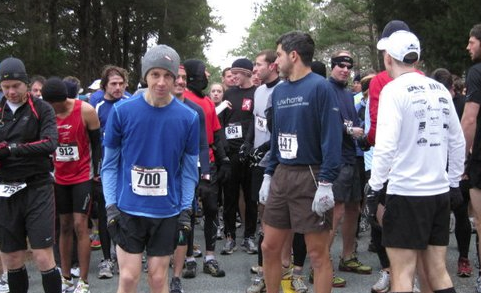
Shannon, as always, carried her camera and got a ton of shots. Here is one of me at the start. Not a very flattering photo, but at least I look happy. 🙂

And an even funnier one… #700 in blue right at the front — he ends up winning the race. That face right behind him – -that’s me. What am I doing up there?
My plan was to run hard for the 1st 1/2 mile or so, which is on paved road and then an open field, before you hit the single track. By hard I mean sub 7 pace, so I could get some distance and separation and not be held up on the single track. I wanted the 1st mile to be in the 7:30 pace range. I managed both of those goals, though I may have been closer to 6:30 pace in the beginning, but I reached the 1 mile mark in 7:27.
My feet had gone from tingly to numb, and between miles 3 and 4 I was seriously considering dropping out after the 1st 7 mile loop. I don’t think it is a good idea to run when you can’t feel your feet! Talk about lack of ground feel, feed back, and proprioception!! I backed off the pace a little more and just took it easy. Over the next 10 minutes, my feet came back to me, and I settled into a comfortable groove, and even picked it up a bit.
Looking back, I am not sure why my feet got so numb, but my current theory is that the CW-X tights are the culprit. Wearing them for a couple hours, including about an hour of drive time, where my legs were bent, may have done it. The CW-X’s have “targeted support” bands that line the quads. I think those bands may have cut circulation a little. But I’m really not sure. I do know my shoes were not too tight, as I loosened them a couple times, and when I took them off and rubbed my feet, nothing changed.
Anyway, back to the race… As you near the end of the 1st loop, you can typically tell the 7 milers vs. the 14ers, as the 7 milers really speed up. I was in a group of about 5 or 6 ladies spread out over 20 meters, but the only one that sped up kept going on the 14 mile course! Odd. I passed the 7 mile finish in 57:0x or so, or 6 minutes faster than last year. However, the Garmin showed 6.5 miles not 7, so it appears the course was short, and later most runners agreed. I also later found that Bridget was about 20 seconds behind me, coming in 2nd place in the female masters.
Not much to report on the 2nd loop. One lady flew by in the 1st mile. I later spoke to her and she is training for Uhwarrie 40 and wanted to negative split, which she did by over 5 minutes! I found a good groove and settled in. Between miles 10-12, my legs really started to wobble on the climbs. And the climbs are really pretty small compared to what’s coming (Uhwarrie). You can see the elevation profile below, and there’s never more than a 100 foot climb!
When I saw the mile 6 marker and knew I was almost done, then I got some energy back and began to cruise again. The lady who had taken off at the end of the 1st loop — we had been passing each other every mile or so since then. I had a good 20 second lead on her when my shoe came untied. I was tempted to run the last mile with it untied, but felt that was a little too far. So I stopped, took off the gloves, tied the shoes, put the gloves back on…. She of course passed me, and I never could catch her coming in to the finish.
I crossed the line in about 1:55:xx, though the clock said 1:56:39. Everyone agreed the race clock was about a minute off, and that the distance was off by about 1/2 mile per loop. So 13 miles in 1:55 — not too bad all things considered. That put me in 29th out of 96 overall, but 5th in the 40 age group. 
I hung out at the end with Bridget, Shannon, and Anthony, as well as a few others, waiting for Kent to come in. When he did, we headed over to the tent, which was warm, and had hot soup. The soup smelled terrible, but tasted good. Strange.
I used the inov8 f-lite 195’s with a metatarsal pad in place on the left foot and was happy with them for the most part. Last year was a mud fest and I used the go-lite sun dragons, which are very luggy, and they were awesome. It has been dry here, so I decided against the x-talon 190’s which are almost a cleat, and other than one or two muddy spots, that was a good choice.


There was an official race photographer, but the photos have yet to be posted. I may update this post when they come in….
 2sparrows