2010 Book Shelf

Here’s a picture of my book shelf — books read in 2010…  Several of these are missing on my individual book review posts.  I am behind and really don’t know that I can catch up, so I may just have a clean up post or two.

A lot more running books and food/diet books than I ever would have guessed at the beginning of the year!  And where’s the classics?  Well I guess I did get in a couple from Chesterton.  And I might have to put the biographies/histories into a similar category.

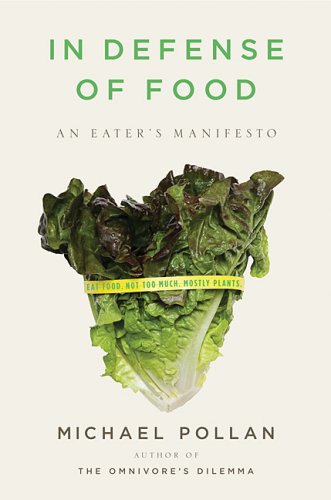
In Defense of Food. Michael Pollan.

After reading Pollan’s The Omnivore’s Dilemma, and enjoying it so much, I thought I should read his follow up book.  In the introduction, he explains the purpose of writing In Defense of Food:

But many readers wanted to know, after they’d spent a few hundred pages following me following the food chains that feed us, “Okay, but what should I eat? And now that you’ve been to the feedlots, the food-processing plants, the organic factory farms, and the local farms and ranches, what do you eat?

He goes on to give the answer early:

Eat food.  Mostly plants.  Not too much.

Of course, that answer needs a lot of explanation, which the rest of the book does.

Again in this book, Pollan shows he is a good writer, though I enjoyed the “adventure” aspect of The Ominvore’s Dilemma a bit more.  But this is still worth a read, and a fascinating account of the many problems with conventional wisdom, especially with respect to USDA guidelines for eating and, more specifically, with the food pyramid.  There is some repetition, of course, but that is expected.

I won’t say much more here, but will leave you with a few quotes:

Scientific reductionism is an undeniably powerful tool, but it can mislead us too, especially when applied to something as complex, on the one side, as a food and on the other a human eater. It encourages us to take a simple mechanistic view of that transaction: Put in this nutrient, get out that physiological result. Yet people differ in important ways. We all know that lucky soul who can eat prodigious quantities of fattening food without ever gaining weight. Some populations can metabolize sugars better than others. Depending on your evolutionary heritage, you may or may not be able to digest the lactose in milk. Depending on your genetic makeup, reducing the saturated fat in your diet may or may not move your cholesterol numbers. The specific ecology of your intestines helps determine how efficiently you digest what you eat, so that the same 100 calories of food may yield more or less food energy depending on the proportion of Firmicutes and Bacteroides resident in your gut. In turn, that balance of bacterial species could owe to your genes or to something in your environment. So there is nothing very machinelike about the human eater, and to think of food as simply fuel is to completely misconstrue it. It’s worth keeping in mind too that, curiously, the human digestive tract has roughly as many neurons as the spinal column. We don’t yet know exactly what they’re up to, but their existence suggests that much more is going on in digestion than simply the breakdown of foods into chemicals

Foods that lie to our senses are one of the most challenging features of the Western diet.

Nine percent of the calories in the American diet today come from a single omega-6 fatty acid: linoleic acid, most of it from soybean oil.

People eating a Western diet are prone to a complex of chronic diseases that seldom strike people eating more traditional diets. Scientists can argue all they want about the biological mechanisms behind this phenomenon, but whichever it is, the solution to the problem would appear to remain very much the same: Stop eating a Western diet.

Finally, he has this to say about Gary Taube’s Good Calories, Bad Calories, which I just happen to be reading now:

*Gary Taubes describes the developing carbohydrate hypothesis at great length in Good Calories, Bad Calories. According to the hypothesis, most of the damage to our health that has been wrongly attributed to fats for the past half century—heart disease, obesity, cancer, diabetes, and so on—can rightly be blamed on refined carbohydrates. But the healthy skepticism Taubes brought to the lipid hypothesis is nowhere in evidence when he writes about the (also unproven) carbohydrate hypothesis. Even if refined carbohydrates do represent a more serious threat to health than dietary fat, to dwell on any one nutrient to the exclusion of all others is to commit the same reductionist error that the lipophobes did. Indeed, Taubes is so single-minded in his demonization of the carbohydrate that he overlooks several other possible explanations for the deleterious effects of the Western diet, including deficiencies of omega-3s and micronutrients from plants. He also downplays the risks (to health as well as eating pleasure) of the high-protein Atkins diet that the carbohydrate hypothesis implies is a sound way to eat. As its title suggests, Good Calories, Bad Calories, valuable as it is, does not escape the confines of nutritionism.

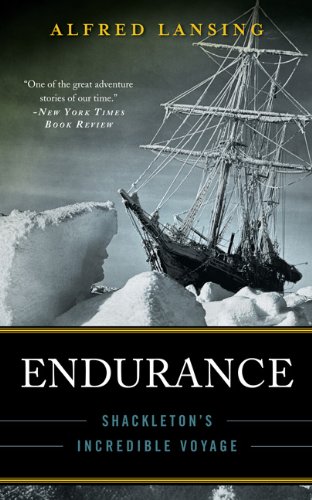
Endurance: Shackleton’s Incredible Voyage. Alfred Lansing.

Fortitudine vincimus – “By endurance we conquer.”

Endurance is the incredible true story of Ernest Shackleton and his crew’s amazing escape from disaster in Antartica — so incredible in some places it seems improbable that it all really occurred.  However, the journals of all the men and testimonies afterward seem to corroborate one another fully.  Every adventure racer, every endurance paddler, every navigator, etc. should read this story immediately.  🙂  It really is that good and that fascinating.  That men could survive in such conditions over such a long period of time, that they could travel the distances they traveled in the most unlikely of methods, and live to tell about it, is beyond comprehension.  And the book is so well written, it really grips you from the start and never lets you go.

For the navigators, imagine this…  When 6 of the men had to leave the rest of the crew, sailing from Elephant Island through perhaps the most treacherous ocean in the world, in a small boat not meant for that kind of thing:

They would travel perhaps a thousand miles across the stormiest ocean on the globe. The ultimate goal was an island no more than 25 miles wide at its widest point. To guide an open boat that distance, under conditions that were frightening even to contemplate, and then to strike a pinpoint on the chart was a task that would sorely tax even Worsley’s skill as a navigator.

For the orienteering population out there, imagine this… When they had to climb up and over South Georgia Island, an island with 10,000 foot peaks, glaciers, crevices, freezing cold weather, fog, etc….

“I do not know how they did it, except that they had to-three men of the heroic age of Antarctic exploration with 50 feet of rope between them-and a carpenter’s adze.”

Other quotes:

But it was inescapable. He was the Boss. There was always a barrier, an aloofness, which kept him apart. It was not a calculated thing; he was simply emotionally incapable of forgetting-even for an instant-his position and the responsibility it entailed. The others might rest, or find escape by the device of living for the moment. But for Shackleton there was little rest and no escape. The responsibility was entirely his, and a man could not be in his presence without feeling this.

In some ways they had come to know themselves better. In this lonely world of ice and emptiness, they had achieved at least a limited kind of contentment. They had been tested and found not wanting.

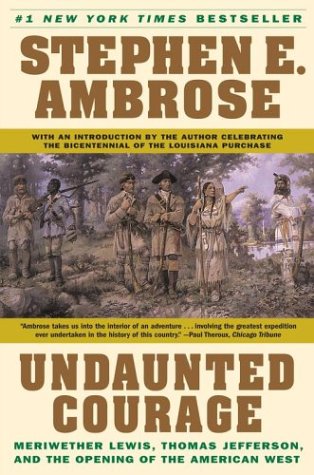
Undaunted Courage. Stephen E. Ambrose.

I had to read the story of Lewis and Clark, after paddling across most of the state of Missouri in the MR340, and finishing at the Lewis and Clark Museum in St. Charles.  I bought this book right at the museum, paying full list price which is probably twice as much as it would cost at Amazon, but I did want to support the museum.  It was a lot of fun to walk through the exhibits and read everything there was to read.

This was a very well written biography of Lewis, not just the expedition years, though that is where the focus is, but really is whole life.  I had not recalled from when I learned of the trip back in grade school the relationship had with Jefferson, which was refreshing.  As far as biographies, many of which can be quite dull, this book read more like a novel.  I wouldn’t put it in quite the class of John Adams, but it was close, and my 2nd favorite biography.

If you have any interest in the history of America, in expeditions and exploring, you should read this book.  As an endurance athlete who has races up to 3 days in the woods, I’m amazed at what these guys were able to accomplish.  Granted, they had a lot of help from the Indians a long the way — mores o than their journals may portray, but what they accomplished is still quite impressive.  There were times they were averaging over 30 miles on foot in the mountains.  I know from my recent 1/2 SCAR attempt what 42 miles feels like, so I know the Corp of Discovery men were in excellent shape!

Only a few quotes…

“This day I complete my thirty first year, he [Lewis] began.  He figured he was halfway through life’s journey.  “I reflected that I had as yet done but little, very little indeed, to further the hapiness [sic] of the human race, or to advance information of succeeding generation.  I viewed with great regret the many hours I have spent in indolence, and now soarly [sic] feel the want of that information which those hours would have given me had they been judiciously expended.”

“To victory over the wilderness, which is more interesting than that over man!”  – Barlow

And finally, what Jefferson himself route in 1813:

Of courage undaunted, possessing a firmness & perseverance of purpose which nothing but impossibilities could divert from it’s direction, careful as a father of those committed to his charge, yet steady in the maintenance of order & discipline, intimate with the Indian character, customs & principles, habituated to the hunting life, guarded by exact observation of the vegetables & animals of his own country, against losing time in the description of objects already possessed, honest, disinterested, liberal, of sound understanding and a fidelity to truth so scrupulous that whatever he should report would be as certain as if seen by ourselves, with all these qualifications as if selected and implanted by nature in one body, for this express purpose, I could have no hesitation in confiding the enterprize to him.

Gilead. Marilynne Robinson.

Reading Gilead was like eating a sweet fruit — but in the form of an onion.  Imagine a fruit as sweet as a kiwi, but with each bite, another layer is revealed.  As you read Gilead, layers of the characters and plot are subtlety pulled away.  The story is of a 76 year old man, writing to his young son, about his life, and it is fascinating.  The father is a preacher, and is insightful into his own character as well as life in general.  I’ll leave it at that.

I must admit, I had much higher expectations for the last quarter of the story than what was actually written.  The possibilities for the main conflict, for the characters to grow and overcome, were so strong.  But what happened was a bit of a let down after my expectations had built during the first three quarters of the book.  Still, the story was good, and the writing exceptional and beautiful.

Quotes

  • You can know a thing to death and be for all purposes completely ignorant of it. A man can know his father, or his son, and there might still be nothing between them but loyalty and love and mutual incomprehension.
  • But I’ve developed a great reputation for wisdom by ordering more books than I ever had time to read, and reading more books, by far, than I learned anything useful from, except, of course, that some very tedious gentlemen have written books
  • When people come to speak to me, whatever they say, I am struck by a kind of incandescence in them, the “I” whose predicate can be “love” or “fear” or “want,” and whose object can be “someone” or “nothing” and it won’t really matter, because the loveliness is just in that presence, shaped around “I” like a flame on a wick, emanating itself in grief and guilt and joy and whatever else.
  • A good sermon is one side of a passionate conversation. It has to be heard in that way. There are three parties to it, of course, but so are there even to the most private thought—the self that yields the thought, the self that acknowledges and in some way responds to the thought, and the Lord. That is a remarkable thing to consider
  • People talk about how wonderful the world seems to children, and that’s true enough. But children think they will grow into it and understand it, and I know very well that I will not, and would not if I had a dozen lives.
  • Each morning I’m like Adam waking up in Eden, amazed at the cleverness of my hands and at the brilliance pouring into my mind through my eyes—old hands, old eyes, old mind, a very diminished Adam altogether, and still it is just remarkable.
  • Sometimes the visionary aspect of any particular day comes to you in the memory of it, or it opens to you over time
  • I’m trying to make the best of our situation. That is, I’m trying to tell you things I might never have thought to tell you if I had brought you up myself, father and son, in the usual companionable way. When things are taking their ordinary course, it is hard to remember what matters. There are so many things you would never think to tell anyone. And I believe they may be the things that mean most to you, and that even your own child would have to know in order to know you well at all.
  • Our dream of life will end as dreams do end, abruptly and completely, when the sun rises, when the light comes. And we will think, All that fear and all that grief were about nothing. But that cannot be true. I can’t believe we will forget our sorrows altogether. That would mean forgetting that we had lived, humanly speaking. Sorrow seems to me to be a great part of the substance of human life.
  • This is an important thing, which I have told many people, and which my father told me, and which his father told him. When you encounter another person, when you have dealings with anyone at all, it is as if a question is being put to you. So you must think, What is the Lord asking of me in this moment, in this situation? If you confront insult or antagonism, your first impulse will be to respond in kind. But if you think, as it were, This is an emissary sent from the Lord, and some benefit is intended for me, first of all the occasion to demonstrate my faithfulness, the chance to show that I do in some small degree participate in the grace that saved me, you are free to act otherwise than as circumstances would seem to dictate. You are free to act by your own lights. You are freed at the same time of the impulse to hate or resent that person. He would probably laugh at the thought that the Lord sent him to you for your benefit (and his), but that is the perfection of the disguise, his own ignorance of it.
  • It seems almost a cruelty for one generation to beget another when parents can secure so little for their children, so little safety, even in the best circumstances. Great faith is required to give the child up, trusting God to honor the parents’ love for him by assuring that there will indeed be angels in that wilderness.
  • The Tenth Commandment is unenforceable, even by oneself, even with the best will in the world, and it is violated constantly.

This is long but well worth high-lighting.  I am still processing it:

  • But to return to the matter of honoring your mother. I think it is significant that the Fifth Commandment falls between those that have to do with proper worship of God and those that have to do with right conduct toward other people. I have always wondered if the Commandments should be read as occurring in order of importance. If that is correct, honoring your mother is more important than not committing murder. That seems remarkable, though I am open to the idea.  Or they may be thought of as different kinds of law, not comparable in terms of their importance, and honoring your mother might be the last in the sequence relating to right worship rather than the first in the series relating to right conduct. I believe this is a very defensible view.  I believe the Fifth Commandment belongs in the first tablet, among the laws that describe right worship, because right worship is right perception (see especially Romans 1), and here the Scripture commands right perception of people you have a real and deep knowledge of. How you would honor someone differs with circumstances, so you can only truly fulfill a general obligation to show honor in specific cases of mutual intimacy and understanding. If all this seems lopsided in favor of parents, I would point out again that it is the consistent example of parents in the Bible that they honor their children. …
  • But I wished to say certain things about the Fifth Commandment, and why it should be thought of as belonging to the first tablet. Briefly, the right worship of God is essential because it forms the mind to a right understanding of God. God is set apart—He is One, He is not to be imagined as a thing among things (idolatry—this is what Feuerbach failed to grasp). His name is set apart. It is sacred (which I take to be a reflection of the sacredness of the Word, the creative utterance which is not of a kind with other language). Then the Sabbath is set apart from other days, for the enjoyment of time and duration, perhaps, over and above the creatures who inhabit time. Because “the beginning,” which might be called the seed of time, is the condition for all the creation that follows. Then mother and father are set apart, you see. It seems to me almost a retelling of Creation—First there is the Lord, then the Word, then the Day, then the Man and Woman—and after that Cain and Abel—Thou shalt not kill—and all the sins recorded in those prohibitions, just as crimes are recorded in the laws against them. So perhaps the tablets differ as addressing the eternal and the temporal.
  • But I believe also that the rewards of obedience are great, because at the root of real honor is always the sense of the sacredness of the person who is its object. In the particular instance of your mother, I know that if you are attentive to her in this way, you will find a very great loveliness in her. When you love someone to the degree you love her, you see her as God sees her, and that is an instruction in the nature of God and humankind and of Being itself. That is why the Fifth Commandment belongs on the first tablet. I have persuaded myself of it.

And just a few more:

  • We know nothing about heaven, or very little, and I think Calvin is right to discourage curious speculations on things the Lord has not seen fit to reveal to us.
  • Adulthood is a wonderful thing, and brief. You must be sure to enjoy it while it lasts.
  • “Do you ever wonder why American Christianity always seems to wait for the real thinking to be done elsewhere?”
  • Because nothing true can be said about God from a posture of defense.
  • I fell to thinking about the passage in the Institutes where it says the image of the Lord in anyone is much more than reason enough to love him, and that the Lord stands waiting to take our enemies’ sins upon Himself. So it is a rejection of the reality of grace to hold our enemy at fault. Those things can only be true. It seems to me people tend to forget that we are to love our enemies, not to satisfy some standard of righteousness, but because God their Father loves them.
  • Love is holy because it is like grace—the worthiness of its object is never really what matters.
  • Theologians talk about a prevenient grace that precedes grace itself and allows us to accept it. I think there must also be a prevenient courage that allows us to be brave—that is, to acknowledge that there is more beauty than our eyes can bear, that precious things have been put into our hands and to do nothing to honor them is to do great harm. And therefore, this courage allows us, as the old men said, to make ourselves useful. It allows us to be generous, which is another way of saying exactly the same thing. But that is the pulpit speaking.

A Million Miles in a Thousand Years. Donald Miller.


I’ll tell these things to God, and he’ll laugh, I think, and he’ll remind me of the parts I forgot, the parts that were his favorites. We’ll sit and remember my story together, and then he’ll stand and put his arms around me and say, “Well done,” and that he liked my story. And my soul won’t be thirsty anymore.

What if your life was a story?  What if your life was a story and you were the author, or at least co-author (but main-author)?   How would you change your current story?  How would you make memorable scenes?  How would you invite others into your story?    In the book Miller discusses life as a story, and how the elements of story come together in each of our lives.  We can have a captivating story, or a dull story — we choose, as we are the main author.   Many of us are guilty of not changing our life story, because we have become content, or we are afraid of change.  (Or both.)  But should we be content with where we are today?  Could greater things be in store?

He didn’t discuss it much, but of course other people are part authors of our story as well.  I had this revelation a few weeks ago when Kelly threw a surprise party for me on my 40th birthday, and I got to see so many people from my life — family, of course, and friends from college, friends from nearby, and friends from far, some of whom I see often, and some of whom I see rarely (these days).  And they are all a a part of my life story.  I have many “memorable scenes” with all of the people I saw, and there will (hopefully!) be many more.  But, as the main author of our life story, we have so much to do with those scenes…  What more can we do to create more and more of those scenes that stand out from the dull monotony of every day life?   Not that every day needs to be an adventure of some type — there are opportunities for memorable scenes more often than we typically think.

Another key point, for me, was how we choose to invite others into our stories — and how we help create memorable scenes for them.  I want to be better about this.

I have to admit that this book unexpectedly made me be quite introspective, which is rare for me.  I’m not an introspective person by nature.  But when you think of your life as a story, you think about the quality of the story.  Is it a good story?  Is there character development?  (“I wanna have friends I can trust… that love me for the man I’ve become not the man that I was…” — Avett Brothers)  Is there conflict that is overcome, preferably for “the good (noble?)”.   (“I have fought the good fight….”  2 Timothy 4:7)

The quote I opened this post with struck me…  It is from the very end of the book, and is key.   Don’t we all want to hear “well done” from God on that last day, and that “He liked my story?”  I can’t wait to be reminded of those parts of my story that I’ve forgotten, but that were important not just to me, but to Him.

The Primal Blueprint. Mark Sisson.

This was mentioned on the Google minimalist list a few times, and the latest thoughts on wheat (outside of Conventional Wisdom) are pretty interesting to me right now.  Sisson outlines 10 rules of the primal life style, ranging from nutrition, to exercise, to sleep, and play. I won’t get into all of them here but just focus on a couple that are most important to me, nutrition and exercise (though I love to sleep and play too!)
Since I am behind, these are just some quick thoughts…  Also, as an “experiment of one,” it will take some time to digest (pun intended) all of the information in this book!
I agree with much of what he writes about food such as the avoidance of all high fructose corn syrup, highly processed and refined foods, etc.  I am starting to believe more and more his feelings on veggie oils other than olive oil. I am not so sure I agree with him on beans and legumes.  I am curious about his feelings on wheat and other grains.  I do think that the body’s insulin response should be considered in light of the whole meal, not just individual parts of the meal.
I also feel similar to how he feels about what he calls “Chronic Cardio…”  My take is world class athletes are often not that healthy, as they have to push their bodies so hard to be world class.  His argument is that what most Americans do for exercise — those that do exercise — do too much hard cardio, where he defines cardio as > 75% MHR.  He suggests long slow cardio of a few hours at 55 – 75% MHR, which is what you would get on a decent hike.  He also advocates sprinting and “lifting heavy things,” which goes along with my exercise philosophy of doing lots of different things.  For me that includes running, hiking, biking, paddling, weights, yoga, plyometrics, etc.  He also states if you are in good Primal Shape, you should be able to jump into events as long as ultras and do ok.  Sounds good to me!  🙂
Along the lines of Real Food by Nina Plank.

And now for a few select quotes:

  • The doctor of the future will give no medicine, but instead will interest his patients in the care of the human frame, in diet, and in the cause and prevention of disease. —Thomas Edison
  • My goal with the Primal Blueprint is to expose much of the lucrative health and fitness industry as ethically and scientifically bankrupt.
  • “Perfection is impossible. However, striving for perfection is not. Do the best you can under the conditions that exist. That is what counts.” —John Wooden
  • Americans will always do the right thing—after they’ve exhausted all the alternatives. —Winston Churchill
  • Experience teaches us how difficult it is, if not impossible, to be lean, fit, energetic, and healthy following Conventional Wisdom.
  • However, too many lengthy workouts at elevated heart rates (between 75 percent and 95 percent of maximum) can put you at risk of exhaustion, burnout, injury, and illness.
  • The high-carbohydrate diet required to perform these workouts day-in and day-out only adds to the problem. At the extreme—such as with the overtrained marathon runner or ironman triathlete—a commitment to fitness can actually accelerate the aging process.
  • A man’s health can be judged by which he takes two at a time—pills or stairs. —Joan Welsh
  • pursuing specialized athletic goals is inherently destructive to your health.
  • When I take responsibility for my actions, my misfortune becomes a growth experience—an appealing alternative to feeling like a victim or placing any importance on the notion of bad luck.
  • Increase your daily activity level in every possible way—walking or cycling instead of driving for nearby errands, taking the stairs, parking at the edge of the lot, strolling the neighborhood after dinner, and enjoying leisurely hikes on the weekends.

Way behind on posting about the books I’ve read…

I’m way behind writing about the books I’ve read.  At least six books behind.   😦   I’ll try to catch up, but that means I’ll probably write less than I normally do.  With Kindle Highlights, I just put them in Evernote note’s, which is great, though the process is manual and leaves a lot to be desired!   I hope someone comes up with an automated way to do it soon!  🙂   That also means I only grab a few quotes to put here, while the rest I have forever in Evernote.

The Runners Guide to the Meaning of Life. Amby Burfoot.

This book didn’t have a lot of meat, and I read it well over a month ago (meaning I have lost my 1st impressions, since it wasn’t that impressionable)  so I won’t write much now.  (I’m about 3 or 4 books behind in writing about the books I’ve read!)   So how about just some quotes?  I know that is boring and lazy, but there are some good quotes!  I’ll even highlight some of my favorite.

  • As runners, we all go through many transitions-transitions that closely mimic the larger changes we experience in a lifetime. First, we try to run faster. Then we try to run farther. Then we learn to accept ourselves and our limitations, and at last, we can appreciate the true joy and meaning of running.
  • Every workout reveals new truths and releases new dreams.
  • Running has long suffered, in my opinion, from an early attitude best described and captured by the classic novella and movie of the same name: The Loneliness of the Long-Distance Runner.
  • I wasn’t yet wise enough to see how traditions make us stronger.
  • Now I began to see these transitions differently. In a world that perpetually moves faster, never slower, we need all the anchoring points we can find.
  • I have heard a million people say that running is the most boring activity that they can possibly imagine. Since I’m sure I’m not any smarter or wittier than these people, I can only guess that they never learned to listen as they run. If they did, they would surely he entertained and informed by their own thoughts.
  • I have learned that there’s no such thing as an easy decision. But I have also learned that it’s much better to make decisions and move on than to he trapped in the agony of the process.
  • Indeed, only about 5 to io percent of the overall marathoning population is fast enough to qualify for Boston. [ Hmm, I’m still pondering going for a 3:20 which is my BQ time! ]
  • The answers lie within, not outside. The best solutions are achieved from personal resolve, not from multiple credit cards.
  • “Bid me run, and I will strive with things impossible.” -WILLIAM SHAKESPEARE
  • The simple approach is often the best. As we enter ever more technical times, with ever increasing levels of complexity and decision making, we need to remember that the simple path can harness great powers.
  • During his much-read and discussed life at Walden Pond, Henry David Thoreau preached simplicity above all else. He felt that the unencumbered life was paradoxically the fullest.
  • While running at first appears to depend on great physical strength and endurance, it is, in fact, based almost entirely on strength of mind. Those who have the will will succeed.
  • “It is distance, not speed, that holds the answers. The reward comes with crossing and confronting the boundaries of fatigue. For these runners, satisfaction is measured in miles, not minutes.”
  • many wise people have observed that you can’t accomplish something if you don’t believe you can. Or the converse: If you believe something is beyond you, it is.
  • While you always have to stay focused on your goal, you also need to stay flexible enough to adapt to different conditions. When in the mountains, enjoy the mountain scenery. Nobody achieves his goal without having some fun along the way. Without fun, we’d give up long before the finish
  • … parents can’t be cookie cutters. We can’t mold our children into ourselves or anyone else. We have to let them run free to discover themselves. It’s the greatest gift we can give them.
  • if I were handed a couple of decades, I would cherish them so. I would give every moment the honor and respect it deserves

p.s. I was quite surprised when Burfoot mentions the following book as one of his favorite all time books!   GODEL, ESCHER, BACH: AN ETERNAL GOLDEN BRAID, BY DOUGLAS R. HOFSTADTER

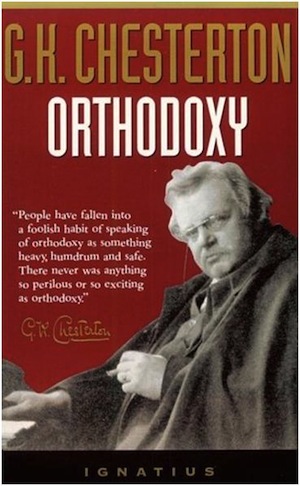
Orthodoxy. GK Chesterton.

GK Chesterton quotes show up all over classical Christian education, so one of my goals this year was to read some of his works.  I have already read one fiction work (The Man Who Was Thursday), so this was my non-fiction work.  Orthodoxy is sometimes mentioned in the same sentence as CS Lewis’s Mere Christianity, so it does seem to be held in high regards.

This was a difficult book to read.  There were long stretches were it was extremely tough, and just when I thought I should give up, there were a few pages that became lucid and clear, and were well worth reading.  Like finding Nirvana when you least expect it.

So, is it worth it?  I’d have to say that I can’t recommend this book to everyone, but if you like reading difficult books, if you are a Christian looking for some interesting slants on theology that differ from the norm, and that sort of thing, than go for it!  🙂

And with that, I’ll just include a few (select) quotes…

  • This at least seems to me the main problem for philosophers, and is in a manner the main problem of this book. How can we contrive to be at once astonished at the world and yet at home in it?
  • We need so to view the world as to combine an idea of wonder and an idea of welcome. We need to be happy in this wonderland without once being merely comfortable.
  • The poet only asks to get his head into the heavens. It is the logician who seeks to get the heavens into his head. And it is his head that splits.
  • Mysticism keeps men sane. As long as you have mystery you have health; when you destroy mystery you create morbidity.
  • He admired youth because it was young and age because it was not. It is exactly this balance of apparent contradictions that has been the whole buoyancy of the healthy man. The whole secret of mysticism is this: that man can understand everything by the help of what he does not understand.
  • A man was meant to be doubtful about himself, but undoubting about the truth; this has been exactly reversed.
  • For the old humility made a man doubtful about his efforts, which might make him work harder. But the new humility makes a man doubtful about his aims, which will make him stop working altogether.
  • The test of all happiness is gratitude; and I felt grateful, though I hardly knew to whom.
  • An optimist could not mean a man who thought everything right and nothing wrong. For that is meaningless; it is like calling everything right and nothing left. Upon the whole, I came to the conclusion that the optimist thought everything good except the pessimist, and that the pessimist thought everything bad, except himself.
  • Courage is almost a contradiction in terms. It means a strong desire to live taking the form of a readiness to die. “He that will lose his life, the same shall save it,” is not a piece of mysticism for saints and heroes. It is a piece of everyday advice for sailors or mountaineers.
  • A soldier surrounded by enemies, if he is to cut his way out, needs to combine a strong desire for living with a strange carelessness about dying. He must not merely cling to life, for then he will be a coward, and will not escape. He must not merely wait for death, for then he will be a suicide, and will not escape. He must seek his life in a spirit of furious indifference to it; he must desire life like water and yet drink death like wine.
  • Now here comes in the whole collapse and huge blunder of our age. We have mixed up two different things, two opposite things. Progress should mean that we are always changing the world to suit the vision. Progress does mean (just now) that we are always changing the vision.
  • We are not altering the real to suit the ideal. We are altering the ideal: it is easier.
  • The modern young man will never change his environment; for he will always change his mind.
  • Unfortunately, if you regard Nature as a mother, you discover that she is a step-mother. The main point of Christianity was this: that Nature is not our mother: Nature is our sister. We can be proud of her beauty, since we have the same father; but she has no authority over us; we have to admire, but not to imitate.
  • If I am asked, as a purely intellectual question, why I believe in Christianity, I can only answer, “For the same reason that an intelligent agnostic disbelieves in Christianity.” I believe in it quite rationally upon the evidence. But the evidence in my case, as in that of the intelligent agnostic, is not really in this or that alleged demonstration; it is in an enormous accumulation of small but unanimous facts. The secularist is not to be blamed because his objections to Christianity are miscellaneous and even scrappy; it is precisely such scrappy evidence that does convince the mind.
  • The man who lives in contact with what he believes to be a living Church is a man always expecting to meet Plato and Shakespeare to-morrow at breakfast. He is always expecting to see some truth that he has never seen before.
  • All other philosophies say the things that plainly seem to be true; only this philosophy has again and again said the thing that does not seem to be true, but is true. Alone of all creeds it is convincing where it is not attractive;