The Reluctant Leader.

I liked this quote so much, I wanted to put it here, and I think I’ll read the book.

We should bless men and women who have done their level best to escape leadership but who have been compelled to return and put their hand on the tiller. We should expect anyone who remains in a formal leadership context to experience repeated bouts of flight, doubt, surrender, and return. Why would this be God’s plan? Why does God love the reluctant leader? Here is one reason: the reluctant leader is not easily seduced by power, pride, or ambition.

Dan Allender in Leading With a Limp, p18.

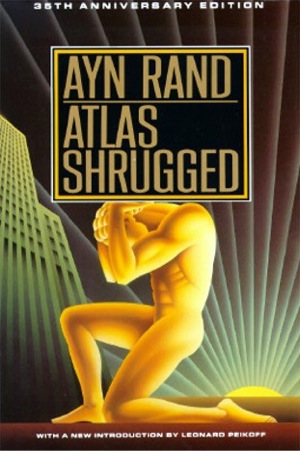
Atlas Shrugged. Ayn Rand.

atlas_shrugged

I finished this at least a month ago, but I have been busy and, to some extent, I have putting off writing about it.  I have so many dog-eared pages, and there are so many interesting passages and concepts I could discuss.  I am not promising that I will write all that I want to, but perhaps it will be sufficient.

First, what is so coincidental for me is to have read this during the current financial crisis and subsequent government bailout, and the economic policies of our president-elect (Obama).  Atlas Shrugged portrays an America that is moving dangerously close to socialism, through more and more government regulations, subsidies from those that are successful to those that are not (“from each according to his ability, to each according to his need”), etc.; and that is frightfully close to what has recently transpired and what might transpire depending on how our policies progress.

Now, on to the book…. What an epic!  My version is a little over 1150 pages, and with the exception of a 60 page “speech” by one of the books main characters — John Galt, the stories true hero — it was very readable as a novel.  Of course, there is plenty of thought provoking philosophy mixed in, but it reads really well throughout the story.   But that speech!  Man, I had to skip ahead and come back to it over a few days… There wasn’t really much that he said that wasn’t already covered, at least at a somewhat high-level, elsewhere in the book, but this dug way way down — and seemed like it was not going to stop.  So I skipped ahead to the story, and came back to the speech as I felt like it, and I don’t think it hurt my reading in anyway.

The speech finally ends with “I swear — by my life and my love of it — that I will never live for the sake of another man, nor ask another man to live for mine.”

The main premise of the book is first brought to light by this exchange a few hundred pages in, and is where the book got its final name:

… if you saw Atlas, the giant who holds the world on his shoulders, if you saw that he stood, blood running down his chest, his knees buckling, his arms trembling but still trying to hold the world aloft with the last of his strength, and the greater his effort the heavier the world bore down upon his shoulders — what would you tell him to do?”

“I … don’t know.  What … could he do?  What would you tell him?”

“To shrug.”

And here Atlas represents those few men who are the high achievers, the doers, the one’s that keep the world moving, progressing, living.  The book’s draft name was “The Strike,” and these top performing people all go on strike from working in the world.  The fall-out is incredibly quick as the state of the world degenerates terribly in just twelve years.

Rand puts this same thought another way when she says:

John Galt is Prometheus who changes his mind.  After centuries of being torn by vultures in payment for having brought to men the fire of the gods, he broke his chains and he withdrew is fire — until the day when men withdraw their vultures.”

The premise is excellent and is challenging to our pre-conceived notions of society.  Who are the real doers — those that have kept the world moving? And who are the leeches, the second raters, who live off the doers?  And what would our world be like without them?  How quickly would we fall — or would some in the middle tier step up and become the doers?  (This one Rand does not discuss, but it is a thought I had…)  And what happens when government steps in and tries to help the second raters at the expense of the doers?  Or when many of the primary doers go on strike, and the remainder find they are no longer competing in a capitalistic society, but instead fighting by someone else’s rules that are stacked against you?

The adversary she found herself forced to fight was not worth matching or beating; it was not superior ability which she would have found honor in challenging; it was ineptitude…”

As I have been reading through all of Rand’s books the past few months, I find many aspects which I can agree on to some extent, but others which I can not.  For example, I do believe that there are real doers and real second handers/leeches, that live off the doers.   I do believe a society built on the premise of “from each according to his ability, to each according to his need” would (relatively) quickly become a nightmare society to live in.   I believe in a love of life and of living it, and of living it to your highest potential.

Where I have my biggest issue is where she would place gratitude. For example, see the following quotes:

…man’s spirit gives meaning to insentient matter by modling it to serve one’s chosen goal.”

Try to obtain your food by my means of nothing but physical movement — and you’ll learn that man’s mind is the root of all the goods produced and all the wealth that has ever existed on earth.”

I thought by the time the sun was exhausted, men would find a substitute.”

..to place nothing above the verdict of my own mind…”

That which others claimed to feel at the sight of the stars — stars safely distant by millions of years and thus imposing no obligation to act, but serving as the tinsel of futility — she had felt at the sight of electric bulbs lighting the streets of town.”

As you can see, all gratitude is in Man, and Man’s ability to reason and to act.  In both this book, and in The Fountainhead, the heroes never see beauty in the natural world outside of their ability to change it via their very humanism.  For Rand, as a professed atheist, I guess that is all there is.   But I see beauty in the world and am grateful to a creator.  And even if our world and universe were the result of random events, I would still be grateful to something other than man.  And I certainly see beauty in man’s creations when we have used material from the natural world, but I am still grateful to the gifts of that natural world that clearly have not come from man.  I never see gratitude in Rand’s heroes for the materials themselves, or where they came from.

Just as in The Fountainhead, she is strongly against altruism, self-sacrafice, and humility:

If you wish to achieve full virtue, you must seek no gratitude in return for your sacrifice, no praise, no love, no admiration, no self-esteem, not even the pride of being virtuous; the faintest trace of any gain dilutes your virtue.”

Discard the protective rags of that vice which you call a virtue:  humility — learn to value yourself, which means: to fight for your happiness — and when you learn that pride is the sum of all virtues, you will learn to live like a man.”

On virtue, I agree that a perfect sacrifice would seek no praise, love, etc.  But I also know that as humans, that is hard (impossible!) to achieve, no matter how hard we try.  But I still think that it is a desirable goal and an approachable one.  On humility, I think it goes back to where we place our gratitude for our skills.  If we have no one (or no One) to thank for our skills (gifts), than all we have is pride in ourselves, and that can become dangerous.  But if we are grateful to someone or something other than ourselves, for our skills, but still use them as they should be used, then we can approach humility properly.

On Man’s fall as portrayed in the Judea-Christian world view, and other religious topics, she has some excellent points (this is mostly in the 60 page speech by Galt), though, in my opinion, they often lack the proper perspective.  I have chosen not to go into all of those here, at least at this time,  as this post is getting long enough as it is.  🙂  But the book is well worth the read just for this!  I will give just a hint with the following quotes:

…a free will saddled with a tendency [towards evil] is like a game with loaded dice…”

“Faith in the supernatural begins as faith in the superiority of others”

Other miscellaneous quotes that I wanted to record, but don’t want to write more about at this time…

There is no escape from justice, nothing can be unearned and unpaid for in the universe, niether in matter or in spirit — if the guilty do not pay, then the innocent have to pay it.”

Bill Brent knew nothing about epistemology; but he knew that man must live by his own rational perception of reality, that he cannot act against it or escape it or find a substitute for it — and that there is no other way for him to live.”

This was Mulligan’s concept of wealth, she thought — the wealth of selection, not of accumulation.”

  • here she is referring to a person who had a few very fine items — classics or masterpieces so-to-say — but just not many of them

What I’ve learned is that a lie is an act of self-abdication, because one surrenders one’s reality to the person to whom one lies, making that person one’s master, condemning oneself from then on to faking the sort of reality that person’s views requires to be faked.  And if one gains the immediate purpose of the lie — the price one pays is the destruction of that which the gain was intended to serve.  The man who lies to the world, is the world’s slave from then on.

There’s nothing of importance in life — except how well you do you work.  Nothing.  Only that.  Whatever else you are, will come from that.  It’s the only measure of human value…”

  • Ok, on this one, I have to write something…   While I agree that we are called to work to the best of our ability, I in no way agree that our work, at least in terms of a career, is the only measure of human value.  Now if you expand work to include more than just your job, and include your family, your friends, your community, and perhaps beyond, then you may be able to measure value by that “work”

What is morality?…  Judgement to distinguish right and wrong, vision to see the truth, courage to act upon it, dedication to that which is good, integrity to stand by the good at any price.  But where does one find it?”

… people don’t think… And the deeper they get into trouble, the less they want to think.  But by some sort of instinct, they feel that they ought to and it makes them feel guilty.  So they’ll bless and follow anyone who gives them a justification for not thinking. “

..the hallmark of a second rater… It’s resentment of another man’s achievement.  Those touchy mediocrities who sit trembling lest someone’s work prove greater than their own — they have no inkling of the loneliness that comes when you reach the top.  The loneliness for an equal — for a mind to respect and an achievement to admire.”

The hours head, like all her nights with him, would be added, she thought, to that savings account of one’s life were moments of time are stored in the pride of having lived.”

One thing that I really want to explore is the concept of “my brother’s keeper.”  “I am not my brother’s keeper” came up here and in The Fountainhead, and we just happened to be studying Genesis when Cane says this as answer to God when God asked if he knew where Abel was (just after Cane had murdered him).  And it came up in the recent campaign.  So, when I have time, I want to explore the context of the answer in the New Testament to see how it relates to Rand’s views, altruism, Obama, and my own views.  Maybe I’ll even post on it someday.

Anthem. Ayn Rand.

I actually finished Atlas Shrugged a few weeks ago but have not written anything yet — it was 1200 pages and I have a lot to say – If I can find the time!

Anyway, I ran out of reading material on a recent trip and grabbed this book at Borders.  (It is so hard to pay list price for a book these days, after years of discounts at on-line retailers with free shipping but sometimes in a pinch when I don’t have anything to read, I have to.  😦  )

This was a very fast read (I read it in a day) and not nearly as deep or complex as Rand’s other books that I have finished, but it was still quite good.  Almost sci-fi like.  The basic premise is that of mankind in the future, where all sense of individualism is lost.  Even when the characters are talking of themselves, they use “we,” or “us,” or “our,” but never “I” or “me” or “mine.  Any work towards all mankind is good, and any work, thought, desire for an individual is evil.  The triumph of the main character (whose name is Equality 7-2521) is when he finally, truly discovers his “ego,” his self, and uses the word I.”

Just one quote, and it goes along with past discussions of freedom:

But what is freedom?  Freedom from what?  There is nothing to take a man’s freedom away from him, save other men.  To be free, a man must be free of his brothers.  That is freedom.  This and nothing else.

Note that in The Fountainhead, Rand defines freedom as “want nothing, expect nothing, depend on nothing.”

Old newspaper cut-out found…

I found this old news paper clipping in my Bible the other day and thought I’d put it here rather than continue to carry it around there.  I don’t know how old this is but I am guessing 8+ years.

I believe there is an important distinction between two senses of the word “religion” that many decent people don’t understand, and I’m not being sarcastic about this.  Religion can be understood and practiced in two very different ways:  as a routine act and as a reflective act.

As a routine act, religion is an object of worship in its own right, an excuse not to think and a justification for violence against those who are not of the same religion.  In this routine sense prayer is a weapon to be used against “pagans,” “heathens,” and “infidels.”  Rent Schindler’s List and watch what happens when any religion becomes an object of worship by its practitioners, a routine to be enforced against unbelievers at any cost including war.

On the other hand, religion as a thoughtful, reflective practice, which is what I hope most people have in mind, is a process of standing back from all of the everyday routines of our lives (including our religious routines) and inquiring whether the results of those routines are likely to be acceptable in the eyes of a being of infinite knowledge, power, and goodness.  In this sense prayer is a means of achieving the highest level of personal responsibility.

— Jim Perry

Two Christian Parenting Books.

Parenting by The Book. John Rosemond.

Shepherding a Child’s Heart. Tedd Tripp.

I finished these books quite some time ago — at least 6 or 8 weeks, and they’ve been sitting on my desk ever since, waiting for me to blog about them.  I actually started Shepherding a Child’s Heart a long time ago, and got about 70% through it, when it drifted to the bottom of my reading pile for some reason.  Then Kelly brought home Parenting by The Book, and after reading that, I wanted to go back to Shepherding…

Because it has been a while, the books are not as fresh in my mind so there may not be much depth to this post.  Let me start by saying that I highly recommend both of these books to any Christian parents.

I used to read Rosemond’s weekly news paper column, and read a few of his books a while back…  See my old reading notebook here.  I always liked him, but none of his books were Biblical.  Just Old-Fashioned.  (And there is nothing wrong with being old fashioned in terms of parenting in my book!)  It was quite surprising to read this new book, which is 100% Biblical, after reading all his old stuff, which never even mentioned God, that I recall.

I also read “Don’t Make Me Count to Three,” by Ginger Plowman, which was based on Shephereding (though for some unknown reason, I don’t appear to have a blog post on it).  Tripp’s book is better than Plowman’s, in my opinion.

The basic premise of Shepherding is that we don’t want to utilize behavior modification to improve behavior, we want to reach the heart of the child — i.e. appeal to the conscious.  When the heart is right, good behavior will follow.  And Rosemond says that humans are not subject to behavior modification techniques anyway, which appears to be true to me, after parenting Riley for 6 years.  🙂

In some ways I like Parenting by the Book better, but I think they should be combined.  Shepherding was much more about corporal punishment, followed by discussion/communication, whereas Parenting talks about different forms of punishment (including corporal).  Both are big on consistency in parenting, in terms of what actions are accpetable and what are not, but likes to vary the discipline  — in a way to “shake things up” even more for the child.  (Be a bit unpredictable in what the consequences are. This is somewhat harder for me to do, but maybe that will change as the kids get older.  At 3 and 6, I think it would be somewhat unfair to be too unpredictable.  But he says again and again, life is not fair.  🙂  )

Both talk about success being about the person’s character, not about material and social success, but that our current culture is all about the later two, even if we say we want success for the former as well.  He gives examples about this over and over, suchas having a 3 year old be able to recite the alphabet (so they will do well in school, so they will get a good job, so they will have material success), but that we don’t have them work on simple manners.

Some quotes:

  • Shepherding:  “The genius of Phariseeism was that it reduced the law to a keepable standard of externals that any self-disciplined person could do.”   [ I don’t know that I agree with that — the rules got to be too unwieldy.  But more importantly they became a way to “boast” of oneself or to put down others. ]
  • Shepherding:  “You must be a person of long-term vision.  You must see your children’s need for shepherding, not simply in terms of here and now, but in terms of long-range vision.”  [ Rosemond talks about this too, in terms of caring what your child is like in 20 or 30 years, not just right now. ]
  • Parenting:  “By the mid-1970s, the United States had become a full-fledged “progressive” culture.  Progressivism holds that just as most new technolgies (such as computers) are better than old technologies (such as typewriters), new ideas are better than old ideals.  For the most part, the progressive mind-set rejects tradition.  It fails to recognize that there is, in truth, “nothing new under the sun,” as a wise man wrote thousands of years ago.
  • Parenting:  “Leadership sometimes involves making hopeful predictions  But a good leader always, no matter what, acts as if he has no doubt concerning the correctness of his decisions.”  [ Rosemond is big on children needing strong leadership from their parents, and talks about traits of good leaders extensively (for a parenting book!).]
  • Parenting:  On Gen X — what he calls Gen E for “Entitlement.”   “They cannont distinguish between what they want and what they truly need, so they consume indiscriminately, everything from food to entertainment.  They have little tolerance for frustration or ability to delay gratification, so they lack frugality.  What they want, they think they deserve to have…”

Rand Quote

I’m about 450 pages into Atlas Shrugged, and ran across this quote somewhere else, but thought I’d post it here.

My philosophy, in essence, is the concept of man as a heroic being, with his own happiness as the moral purpose of his life, with productive achievement as his noblest activity, and reason as his only absolute.

– Ayn Rand

In Her Shoes.

I’ve read a couple of Jennifer Weiner’s books (Good in Bed and Little Earthquates), with posts on those back in 2005 before I started using a real blogging platform.  This movie is based on one of her books I have not read, and I thought it would be a good one to watch vs. read and/or watch and read.  After the 1st 30 or 45 minutes, I thought it was going to be terrible!  About that time is when Maggie (Cameron Diaz) goes to FL and meets her Grandma (Shirley MacClaine).   It got much better after that.

There were a couple of poems in it that I thought I would include here.

One Art

— Elizabeth Bishop

The art of losing isn’t hard to master;
so many things seem filled with the intent
to be lost that their loss is no disaster.

Lose something every day. Accept the fluster
of lost door keys, the hour badly spent.
The art of losing isn’t hard to master.

Then practice losing farther, losing faster:
places, and names, and where it was you meant
to travel. None of these will bring disaster.

I lost my mother’s watch. And look! my last, or
next-to-last, of three loved houses went.
The art of losing isn’t hard to master.

I lost two cities, lovely ones. And, vaster,
some realms I owned, two rivers, a continent.
I miss them, but it wasn’t a disaster.

—Even losing you (the joking voice, a gesture
I love) I shan’t have lied. It’s evident
the art of losing’s not too hard to master
though it may look like (Write it!) like disaster.

I carry your heart

— e. e. cummings
I carry your heart with me(i carry it in
my heart)i am never without it(anywhere
i go you go,my dear;and whatever is done
by only me is your doing,my darling)
i fear
not fate(for you are my fate,my sweet)i want
no world(for beautiful you are my world,my true)
and it’s you are whatever a moon has always meant
and whatever a sun will always sing is you

here is the deepest secret nobody knows
(here is the root of the root and the bud of the bud
and the sky of the sky of a tree called life;which grows
higher than soul can hope or mind can hide)
and this is the wonder that’s keeping the stars apart

i carry your heart(i carry it in my heart)

The Fountainhead. Ayn Rand.


Ayn Rand’s books, The Fountainhead and Atlas Shrugged, have come across my path several times over the past couple of years as books that were very influential in people’s lives — people like Alan Greenspan and other business leaders that I admire.  They have been on my list to read for a while, but I kept passing them up a  when I saw how long they were!  However, since I did want to read them in 2008, I figured I’d better get started.

The version of The Fountainhead that I read had an introduction by Rand herself, that she wrote 25 years after the first publication.  I have to admit that after reading it, I was a bit put off — or perhaps fired-up! — over it.  Some of the things she said were incredible to me (and not in such a good way), while others were quite interesting…

For example, at some points in the introduction, Rand is awfully high on herself and her work.  And that becomes largely apparent in the book’s hero, Howard Roark.   I have always thought that humility is a virtue, while she thinks that humility is a “sin”  (though a sin against oneself, not God).  One example from the intro on this is the last paragraph:

It does not matter that only a few in each generation will grasp and achieve the full reality of man’s proper stature — and that the rest will betray it.  It is those few that move the world and give life its meaning — and it is those few that I have always sought to address.  The rest are no concern of mine; it is not me or The Fountainhead that they will betray – it is their own souls.

And then some interesting quotes from the intro:

On novels as they should be:

Novels, in the proper sense of the word, are not written to vanish in a month or a year.  That most of them do, today, that they are written and published as if they were magazines, to fade rapidly, is one of the sorriest aspects of today’s literature, and one of the clearest indictments of its dominant esthetic [sic] philosophy:  concrete-bound, journalistic Naturalism which has now reached its dead end in the inarticulate sounds of panic.

On Romanticism

Longevity — predominately, though not exclusively — is the prerogative of a literary school which is virtually non-existent today:  Romanticism.

… It deals, not with the random trivia of the day, but with the timeless, fundamental, universal problems and values of human existence.  It does not record or photograph; it creates and projects.  It is concerned — in the words of Aristotle — not with things as they are, but with things as they ought to be.

I made a note to myself to make sure I read the intro again when I finished the novel, and I am glad I did.  While some statements still are a bit off-setting to me personally, overall my perspective on it had changed for the better.   I had hoped I would have the discernment to separate my personal views from those of hers, and in the end, I thought she did a fantastic job of portraying her views, ideals, and philosophy in the story itself.  And that is what is most important.  Not that I don’t agree with her on many points.

The basic premise of the book (and to a lesser extent her philosophy objectivism) is that man’s ego is the fountain head of all human progress.  There is so much more to it, and Rand does an excellent job of presenting her ideas through the novel, and typically through dialogue rather than (long/boring) prose.  Rand also explains that her main reason in writing is to “present the ideal man.”  To do so, she has to define and present the characteristics which make him possible and which his existence requires…   But she also wants to make sure the story is worth reading… “Is the pleasure of contemplating these characters an end in iteslf?”

While I don’t agree with several of her tenets, I thought the book was excellent.  In some ways I’d like to add it to my all time favorites, but I need to wait a few years and read it again to see if it really stands the test of time.

One such tenet that I don’t care for his her idea that altruism is not a virtue.  (In fact, her main character that dedicates her life to altruism ends up a wreck!  As a side note, most of her characters are very black and white, with no shades of gray.  While that is useful to expose archetypes through the novel, it is not very realistic.)  The characters that do portray altruism always end up unhappy — because it becomes an ego driver in itself — the more they can help and give — the bigger their ego (wants to become).  But they realize that one’s ego should not be the goal in altruism, and that begins to destroy their view of altruism and of themselves.  I think this would go with Paul’s view of salvation by faith alone, not by works, so that none can boast…  If any virtue is used to build ego, it is a recipe for disaster.

Another tenet that is hard for me to accept is that man’s ego is an ultimate virtue.  However, she uses the term to mean more than what we normally associate with it — namely that it is remaining true to one’s ideals against the influence of others.  I can agree with that.  However, I think it is taken to an extreme.  While we should not pander to everyone out there if they don’t live up to our ideals, it is not a sin to keep others feelings in mind.  I can see that it is a fine line to walk — if you try not to hurt others, you may have to sometimes sacrifice some of your ideals.  But then again, there are times when your ideals may be more important than how others feel, if they are pulling you from the ideal.

All in all a very thought provoking and provocative book that I highly recommend.

I had a ton of dog-eared pages for quotes, and I’ll include a few of them here.

1) From the intro, a quote from Nietzsche that she had originally planned to include as a preface to the novel, but that she took out because she was afraid the interpretation of the quote would not be what she desired by most readers.  She goes off on Nietzsche a little — sometimes praising him — but more often bashing him — in discussing why she pulled the quote.

It is not the works, but the belief which is here decisive and determines the order of rank — to employ once more an old religious formula with a new and deeper meaning — it is some fundamental certainty which a noble soul has about itself, something which is not to be sought, is not to be found, and perhaps, also, is not to be lost.  The noble soul has a reverence for itself. — Friedrich Nietzsche.

2) Rand used architecture as her motif, as the base of her story, and I felt like it was the perfect choice for what she wanted to portray.  No other occupation lends itself so well to the story and ideals she presents.

The Parthenon did not serve the same purpose as its wooden ancestor.  An airline terminal does not serve the same purpose of the Parthenon.  Every form has its own meaning.  Every man creates his meaning and form and goal.  Why is it so important — what others have done?  Why does it become sacred by the mere fact of not being your own?  Why is anyone and everyone right — so long as it’s not yourself?…

3) One of the characters, Ellsworth Toohey, who happens to be the “anti-hero,” uses critics and editorials to shape the public in a mind numbing way — by promoting the average, the mediocre, or even the downright awful, all while criticizing true genius.  The character is afraid of the genius because he can not control it.  But I wonder how true this is today… How many people like a book, or a movie, or an album, because critics have raved on it?

“It is the critic’s job to interpret the artist .. even to the artist himself.”

4) Miscellaneous… Also on a book of Ellsworth’s.

He demonstrated that there was no such thing as free will, since men’s creative impulses were determined, as all else, by the economic structure of the epoch in which the lived.

5) This one goes along with the theme of “man worship” in the sense of admiring good work as performed by an individual:

People meant very little to Mike, but their performance a great deal.  He worshiped expertness of any kind.  He loved his work passionately and had no tolerance for anything save for other single-track devotions.

6) A few more, in which an ideal person should have an occupation that is not dependent in anyway on others:

If I found a job, a project, an idea or a person I wanted — I’d have to depend on the whole world.  Everything has strings leading to everything else.  We’re all so tied together…

Your life doesn’t belong to you if you’re really aiming high.  [This is spoken to one of the anti-hero’s, not to the hero! ]

7)  A few miscellaneous ones:

When facing society, the man most concerned, the man who is to do the most and contribute the most, has the least to say.

Integrity is the ability to stand by an idea.  That presupposes the ability to think.  Thinking is something one doesn’t borrow or pawn.

A quest for self-respect is proof of its lack.

I had so many more dog-eared pages, but I think that is enough for now.  The Fountainhead is a long book, but it is a good book.  And even if you don’t agree with Rand’s views on many subjects, as I suspect many of you won’t, anything that challenges your own views is worth a read in my opinion.  This book will definitely do that if you give it a chance.

Quote…

“I understood how a man who has nothing left in this world still may know bliss, be it only for a brief moment, in the contemplation of his beloved. In a position of utter desolation, when man cannot express himself in positive action, when his only achievement may consist in enduring his sufferings in the right way – an honorable way – in such a position man can, through loving contemplation of his beloved, achieve fulfillment.”

— Viktor Frankl

He said this after suffering through the Nazi concentration camp of Auschwitz.

More here.