Yoga for Healthy Knees. Sandy Blaine.

 knees.gif

I have to admit that when I first skimmed this book, and looked at the poses, I thought there wasn’t much to them. They were all fairly basic, and things that I use in my practice all the time. However, when I took the time to go through each one, reading exactly what she wrote to do and what to think about, I changed my mind. There is a lot of good information, and what I thought were easy poses were actually sometimes quite challenging.

The list of poses is somewhat short so I’ll go through them all here:

  • Staff Pose/Dandasana
  • Not much to say on this one, other than that holding a contracted quad without pressing down on the back of the knee for 60 seconds is not as easy as it sounds. I’ve done this a lot for a few seconds at a time, especially right after surgery, or right after the injury got so bad I could barely walk, but never for 60 seconds.

  • Comfortable Seated Cross-legged pose/sukhasana
  • I did both comfortable seated, and half lotus variations. Before surgery I could do full lotus, but not any more. One hip is obviously tighter.

  • Cross-legged, forward bend
  • Same comments as above. One side definitely needs to be evened out with the other!

  • Half downward facing dog
  • I thought this would be silly since I do full down dog all the time, and really love the stretch it can give on the back of the R knee, especially when bending the left. But this variation, in which the hands are on a wall and you are standing, is really quite good. Just gives different sensations than normal.

  • Seat of Power Pose / Utkatasana
  • This is basically a wall squat — using a wall to support your back. But the number of things to think about with your feet and knees is a lot, and holding it for 60 seconds or more is quite challenging.

  • Tree Pose
  • Not much to say. Standard Tree Pose. I didn’t feel much different than I normally do.

  • challenging balance: eyes closed
  • This is much harder than it sounds. You stand on both feet, hands on hips, close the eyes, and lift one foot slightly. Hold for 10 breaths. She says this is great for overall lower leg support, and I believe it. You can really feel al the little muscles that hold things together firing. 10 breaths is hard!

  • extended triangle/utthita trikonasana
  • Standard Triangle.

  • Warrior II
  • Standard warrior II. But when you take the time to work on all the little things, I can certainly see why the legs/knees will become much stronger and more stable.

  • Warrior I
  • Standard warrior I. Same comments as for Warrior II.

  • Half Frog
  • A simple quad stretch, but I really feel like this is a great knee opener for me post surgery. Sometimes after surgery, the patella tendon can “shrink” or pull in, and I feel like that has happened to mine, since most of my soreness is now under the patella tendon area, on the infrapatellar fat pad.

  • Hero / virasana
  • This is pretty hard for me post surgery. Definitely need a pillow/bolster to sit on. But again, it feels like a great opener on the R knee which is where I had surgery.

  • Downward Facing Dog
  • Just the standard pose, but this is one of my favorites for my knees. It really allows me to see my bio-mechanical deficiensies — the R femur rotating in, the R foot flaying out. I really can work on bringing those back into alignment — at least as much as possible doing soft-tissue work like this.

  • Thread the needle I and II
  • Just a simple hip opener. I’m definitely tight here, and even though these are the basic poses and I often do the more advanced ones like pigeon and 1/2 pigeon, I can tell these are still working for me. And I can again see how much tighter one side is!

  • Reclining Twist Pose
  • Feels great on the lower back to twist at the end of practice, but in this one, you wrap one leg over/around the other, so you get a slight ITB twist.

  • Relaxation Pose / Savasana
  • A time to rest and relax, but also to mentally probe your body to see what sensations you have and what has changed during the practice. 🙂

For < $10 off Amazon, this is a good book for anyone suffering knee pain that wants to explore yoga, and for even somewhat experience practitioners that want to learn more about how to use and modify these poses for knee issues, and how they can help your knees.
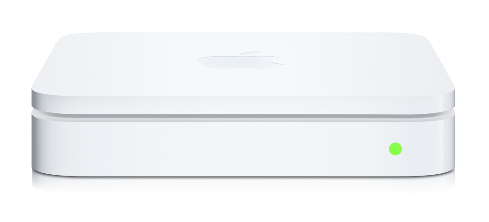
Apple Airport Extreme Base Station (AEBS) 802.11n

aebs1.png

I ordered this right after I ordered my Apple TV. In theory I could use the Ethernet cable that I’ve (partially) run from the office to the family room for that, but the AEBS had some other nice features, and running 802.11n to the Apple TV should work fine. It runs on 5 Ghz instead of 2.4, so the microwave and phone interference I’ve experienced playing music should (hopefully) go away. If not, I’ll get around to finishing the ethernet run.

The other features that it has that are nice are the ability to use the USB port for adding a printer, or a hard drive, or adding both a printer and a hard drive or drives via a USB hub, as networked devices, accessible to all pc’s/macs in the hosue.

Of course the Apple TV has still not shipped, but as soon as I got the AEBS, I set it up.

I changed my network around some, to eliminate some devices that I no longer need. One thing that could go was my very old 802.11a access point! Also, the AEBS has 3 Ethernet/Fast Ethernet ports, and I’ve been able to eliminate a FastE switch I was running. I do wish there were 4 ports, instead of 3, as I did have to go wireless on one of my devices that I had wired, but so far, so good with that. Second, it would have been nice to have GigE instead of FastE. Considering 802.11n’s speeds, the bottleneck to the wired devices will now be the FastE.

Adding a printer and hard drive via the usb hub was a snap. Just had to install Bonjour for windows on the XP box, and the mac saw it all easily. I am going to get one of the Lacie or ministack HD drives that are the exact same form factor as the mac mini, which is the same as the AEBS and the @TV. Thsoe drives have a USB hub built in, so I’ll just plug the drive into the AEBS, and then the printer into the drive. And I can easily add drives as necessary.

There are a ton of options on the AEBS — much more than with most home routers. So this could easily be used in a small business. One nice touch is that it has SNMP on it, so I am able to graph my DSL line usage. This allowed me to run my DSL modem in bridge mode instead of router mode. That actually makes synergy run nicer in my (somewhat) strange setup. And the interface to configure the AEBS is much nicer than the DSL modem, but can do all of the same things.

I have heard reports of VPN issues when using the AEBS, but I have not experienced any with the Cisco VPN client my work laptop uses.

I was hoping the range on it would be enough to get to my neighbors house so we could do cross house backups, but it doesn’t quite make it. But our homes are probably 275-300 feet apart, through woods. My AEBS is not in an ideal position to reach them. I haven not yet walked around outside with my laptop to test the range.

Knee update

I was just looking back and realized I haven’t had a knee specific update since September. I know I’ve posted on Adventure Racing and Orienteering, so there’s been a little info, but I thought I’d write a quick post just about the knee.

I did the AR back on 9/24. It was supposed to be an 8 hour race, of both biking and orienteering (plus a short swim), but it turned into a 7 hour bike for me, and my knee got quite sore after that. Before the race, I was able to ride pain free for more than an hour, and running was the problem. After the race, it was somewhat the opposite. I was running better, but riding was out. In fact, I had to cut short a couple of rides, and even had to get up and walk out of a spin class. So I cut out riding totally for 4 or 5 weeks.

Over November and December, and into January, I’ve done a lot more strengthening and stretching (though not as much as I should!). I really feel I need to be doing a lot more yoga, but it has been hard to find the motivation to do tapes at home, and going to a studio is not easy as there are none close by that do the type of yoga I want to do. I did try the YMCA one night, and it was ok, but not great.

The knee has been much better the past few weeks. I have now run 23 minutes (albeit slow!), and even made it through spin class ok. I could tell I had pushed it when in one 3 day span I ran 20 minutes, did some leg strengthening excercises, did spin class, and went to a 90 minute yoga class (in Cambridge), but overall it handled it pretty well. I also walked with a pack on a lot, and even ran an O-event with Riley in a pack (~ 40 minutes).

So it is getting better — very slowly. But I still don’t have confidence that I can get back to doing the really long endurance stuff I used to do. 😦

Gulliver’s Travels

I just finished reading Gulliver’s Travels using DailyLit, which emails a small, 5 minute reading, of many unpublished works, on a schedule you give it such as week days at 7 a.m. Gulliver’s Travels was split into 115 such installments.

This is a somewhat odd way of reading, but over time I got used to it. There were times when I got behind, but just let the emails stack up, until I got to them. And other times where I had a little extra time, so I’d have DailyLit send me the next in the series immediately.

I have to admit that much of the satire in the book would have been beyond me, if I had not read the Wikepedia article located here. What is somewhat interesting about that is I am now about 90% with Neal Stephonson’s nearly 3000 page story that is all about that period, including lots about the Royal Society, which apparently, one small section of GT was satiring.

At any rate, the book is an ok read. I’m sure it was much better when it was written, as many of the allusions and satires would be much more obvious.

And as alwasy, a few small bullet points that I have from the read:

  • When he was describing wine to someone from one of the countries he visited:

    “That wine was not imported among us from foreign countries to supply the want of water or other drinks, but because it was a sort of liquid which made us merry by putting us out of our senses, diverted all melancholy thoughts, begat wild extravagant imaginations in the brain, raised our hopes and banished our fears, suspended every office of reason for a time, and deprived us of the use of our limbs, till we fell into a profound sleep; although it must be confessed, that we always awaked sick and dispirited; and that the use of this liquor filled us with diseases which made our lives uncomfortable and short.

  • This one may be scary since Reece has red hair!

    It is observed, that the red haired of both sexes are more libidinous and mischievous than the rest, whom yet they much exceed in strength and activity.

  • And this from the land of Houyhnhnms, in which horses are beings of extreme reason, and Yahoo’s are a form of human in their basest form. I have to admit that I found this part of the book the strangest!

    I should here observe to the reader, that a decree of the general assembly in this country is expressed by the word hnhloayn, which signifies an exhortation, as near as I can render it; for they have no conception how a rational creature can be compelled, but only advised, or exhorted; because no person can disobey reason, without giving up his claim to be a rational creature.

Orienteering: January 7th, 2007

I took Riley to this event and she rode in the back-pack. This is the 1st time I’ve raced with her (rather than just hike) since knee surgery, but I did pretty well. I’m guessing that the weight of her, plus the pack, plus water, and a snack, is around 40 lbs.

I chose to do the orange course, which is the last intermediate course, vs. one of the advanced for two reasons. First, Lake Johnson is small and is difficult to have a technically challenging advanced course, so they made it more challenging by double or triple controls. For example, if a control was in a re-entrant, and there were 2 or 3 re-entrants in a row, then they put controls in each of them. So you really had to be spot on! Second, I was worried about how my knee would handle running with Riley, and how long Riley would want to be out there.

Well, the results below show we did quiet well. 🙂 I was able to run most of the course. I have to admit, she is getting really heavy, or I am really out of shape, or both! I was really getting tired at the end. The orange controls are slightly easier then green or red, which I normally run, so that also helped us go fast.

One final note. Riley had carried a little green bag full of goodies (toys, trinkets, etc.) but she dropped it at some point. We were about to go try to look for it after the race, one a husband wife team came in with it. Considering the size of the area, and the fact that I was slight off when I think she dropped it, we got really lucky that someone found it and returned it. Riley was really happy about getting it back.

orange.jpg

Orienteering: Red Course 12/03

I guess if I’m going to post the good results, I might as well post the bad ones. But this one does come with a caveat.

I again ran the Red course when I had 1st intended to run Green. Normally Red is the longest, and Green the 2nd longest. Every once in a while there is a Blue, which is a 1-2 Km longer than a red. Since there was again a blue, I decided to run red instead of green.

Anyway, after finishing 2nd on red last month, this month’s result was dissappointing to say the least. I was running well, but navigation was not quite right. I waisted a lot of time on control #5 and was about to give up, but decided to attack it from the lake, rather than the road trail intersection, which is probably what I should have done from the beginning. Once I found it, I was back on track, and got 6 and 7 easily. But 8 was another matter. After spending much too much time looking for it, another racer came up, and together we still could not find it. We finally decided to bail. He decided to go on to 9, 10, and 11, and I decided to just call it a day. I had already been out almost 2 hours and saw it was nearing 3 p.m., which is when the courses are normally cut off.

So I headed back in, splitting between 9 and 10, and going to the finish. I got there and told them I was a DNF due to #8, and they said no one had gotten it, and it had likely been taken by someone! So if I had actually gotten 9, 10 and 11, I would not have been a DNF. Based on the distance left for those controls, I probably would have come in around 2 hours and 20 minutes if all had gone ok.

So the moral of the story is, don’t spend too much time on one control when it is pretty obvious you are in the right spot, and always finish the course, even if you do bail on one.

red-course.jpg

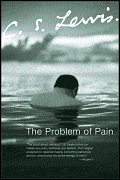
The Problem of Pain. C.S. Lews.

pain.gif

I finished this at least a month ago, and really should have written about it then. But I’ve been busy and neglected it until now.

For most of the book, “pain” should be re-labeled “suffering” for our modern usage, but at times our use of physical pain is also included. Lewis summarizes the problem as follows:

If God were good, He would wish to make His creatures perfectly happy, and if God were almighty He would be able to do what He wished. But the creatures are not happy. Therefore God lacks either goodness, or power, or both.”

Then throughout the book he explores all aspects of suffering and how that relates to beliefe in an omniscient, omnipotent, benevolent, God. His main argument is that Man suffers because of original sin, and that original sin really comes down to “turning from God to self.” I won’t go into more detail than that here, but I do think the book is well worth the read. It is not as exciting to read as something like the Screwtape Letters, reviewed here, but it is still very good.

Here’s my normal list of quotes and thoughts on some of them:

  • I found this one interesting as it is something different that you’d likely here most present day pastor’s say. Lewis was not necessarily a theologin, at least a trained one, but I always find his insight very well formulated and often right.

    And I certainly think that Christ, in the flesh, was not omniscient, if only because a human brain could not, presumably, be the vehicle of omniscient consciousness, and to say that Our Lord’s thinking was not really conditioned by the size and shape of his brain might be to deny the real incarnation…

  • I found his discussion of eternity as something I had not really thought of before. I guess it is hard, or maybe impossible, to grasp eternity, because of how we typically view time as a line… Here is what he had to say:

    If we think of time as a line — which is a good image, because the parts of time are successive and no two of them can co-exist; i.e. there is no width in time, only length — we probably ought to think of eternity as a plane or even a solid. Thus the whole reality of a human being would be represented by a solid figure. That solid would be mainly the work of God, acting through grace and nature, but human free will would have contributed the base-line which we call the earthly life: and if you draw your base-line askew, the whole solid will be in the wrong place. The fact that life is short, or, in the symbol, that we contribute only one little line to the whole complex figure, might be regarded as a Divine mercy. For if even the drawing of that little line, left to our free will, is sometimes so badly done as to spoil the whole, how much worse a mess might we have made of the figure if more had been entrusted to us.

  • But if suffering is good, ought it not to be pursued rather than avoided? I answer that suffering is not good in itself. What is good in any painful experience is, for the sufferer, his submission to the will of God, and, for the spectators, the compassion aroused and the acts of mercy to which it leads.

  • I’ve never been into fasting, but recently, I’ve read several things on it that have made me think about it in new ways. I’m not ready to do it yet, but my mind is certainly thinking about it.

    Fasting asserts the will against the appetite — the reward being self-mastery and the danger pride…

  • The spectacle of the universe as revealed by experience can never have been the ground of religion: it must always have been something in spite of which religion, acquired from a different source, was held.

  • I have been trying to make the believe that we actually are, at present, creatures whose character must be, in some respects, a horrot to God, as it is, when we really see it, a horror to ourselves.

  • On God’s love for Man… (Or really, any beings love for another…)

    Love, by definition, seeks to enjoy its object.

I had many other dog-eared quotes in the book, but I won’t bore you anymore with them.

Orieteering. Ian Bratt.

 orienteering.gif

I borrowed this from my Dad’s collection of outdoor adventure type books a long time ago, but finally got around to reading it. It is really all about the sport, and there is almost no navigation technique in it. For someone totally new to orienteering, it can teach you a lot about where the sport comes from, variations on it, gear, etc. But there is no real map and compass skill taught. The appendix in the back that lists all the map symbols and control descriptions is great, though.