Quick Knee Update

Just wanted to post a quick update that I ran for 30 minutes on the treadmill today. I have been slowly building up towards that. I have been doing the long (60 -120) minute orienteering events, in which I do run a lot, and those have been pretty good to my knee. While it would get sore back in September when I 1st started them, it has not been bad at all in the last couple events– even with Riley on my back. But the treadmill has been a little different. I may be a little tender later, but hopefully not. Granted, I am very slow. At 8:30 min/mile pace, my heart was pushing 170! I used to be able to run 6:30’s at that rate. And I only ran at that pace a minute or two. I averaged about 10 min/mile, though that includes both a 5 minute warm up and cool down at walking pace.

Beyond running, I have not done much biking the past couple of months other than one sping class. I do elliptical now and then, but maybe just once a month. I have been doing PT type strengthening and stretching one or two times a month, and I have been getting back into Yoga — but still just once a week or so. I have been mixing in more yoga to the PT routines, though.

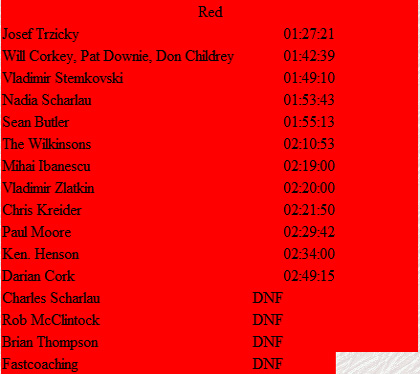
Orienteering: Raven Rock Red Course 2/11/07

red.jpg

In the past, I have a couple of very bad performances at Raven Rock. It’s a park the club only uses once a year, so I’m much less familiar with it, though in theory, that shouldn’t matter. This time around, though, I did relatively well. There was only one control I struggled with that cost me maybe 10-15 minutes. But other than that, I was running well, navigating ok (not great!), and my knee felt fine. I was somewhat disappointed with 5th place, as I thought I would have been a little higher. But the times were relatively close between 2nd and 5th.

Raven Rock is a beautiful park, and doing an advanced course means you get to see some places that people don’t go very often. The course setters did an outstanding job with control placement that allowed us to really go to some neat places. They also used the European style of laying the controls in such a way that you really need to find the feature, not the control. So if you are not navigating well, it would be very hard to get through the advanced courses.

Yoga for Healthy Knees. Sandy Blaine.

 knees.gif

I have to admit that when I first skimmed this book, and looked at the poses, I thought there wasn’t much to them. They were all fairly basic, and things that I use in my practice all the time. However, when I took the time to go through each one, reading exactly what she wrote to do and what to think about, I changed my mind. There is a lot of good information, and what I thought were easy poses were actually sometimes quite challenging.

The list of poses is somewhat short so I’ll go through them all here:

  • Staff Pose/Dandasana
  • Not much to say on this one, other than that holding a contracted quad without pressing down on the back of the knee for 60 seconds is not as easy as it sounds. I’ve done this a lot for a few seconds at a time, especially right after surgery, or right after the injury got so bad I could barely walk, but never for 60 seconds.

  • Comfortable Seated Cross-legged pose/sukhasana
  • I did both comfortable seated, and half lotus variations. Before surgery I could do full lotus, but not any more. One hip is obviously tighter.

  • Cross-legged, forward bend
  • Same comments as above. One side definitely needs to be evened out with the other!

  • Half downward facing dog
  • I thought this would be silly since I do full down dog all the time, and really love the stretch it can give on the back of the R knee, especially when bending the left. But this variation, in which the hands are on a wall and you are standing, is really quite good. Just gives different sensations than normal.

  • Seat of Power Pose / Utkatasana
  • This is basically a wall squat — using a wall to support your back. But the number of things to think about with your feet and knees is a lot, and holding it for 60 seconds or more is quite challenging.

  • Tree Pose
  • Not much to say. Standard Tree Pose. I didn’t feel much different than I normally do.

  • challenging balance: eyes closed
  • This is much harder than it sounds. You stand on both feet, hands on hips, close the eyes, and lift one foot slightly. Hold for 10 breaths. She says this is great for overall lower leg support, and I believe it. You can really feel al the little muscles that hold things together firing. 10 breaths is hard!

  • extended triangle/utthita trikonasana
  • Standard Triangle.

  • Warrior II
  • Standard warrior II. But when you take the time to work on all the little things, I can certainly see why the legs/knees will become much stronger and more stable.

  • Warrior I
  • Standard warrior I. Same comments as for Warrior II.

  • Half Frog
  • A simple quad stretch, but I really feel like this is a great knee opener for me post surgery. Sometimes after surgery, the patella tendon can “shrink” or pull in, and I feel like that has happened to mine, since most of my soreness is now under the patella tendon area, on the infrapatellar fat pad.

  • Hero / virasana
  • This is pretty hard for me post surgery. Definitely need a pillow/bolster to sit on. But again, it feels like a great opener on the R knee which is where I had surgery.

  • Downward Facing Dog
  • Just the standard pose, but this is one of my favorites for my knees. It really allows me to see my bio-mechanical deficiensies — the R femur rotating in, the R foot flaying out. I really can work on bringing those back into alignment — at least as much as possible doing soft-tissue work like this.

  • Thread the needle I and II
  • Just a simple hip opener. I’m definitely tight here, and even though these are the basic poses and I often do the more advanced ones like pigeon and 1/2 pigeon, I can tell these are still working for me. And I can again see how much tighter one side is!

  • Reclining Twist Pose
  • Feels great on the lower back to twist at the end of practice, but in this one, you wrap one leg over/around the other, so you get a slight ITB twist.

  • Relaxation Pose / Savasana
  • A time to rest and relax, but also to mentally probe your body to see what sensations you have and what has changed during the practice. 🙂

For < $10 off Amazon, this is a good book for anyone suffering knee pain that wants to explore yoga, and for even somewhat experience practitioners that want to learn more about how to use and modify these poses for knee issues, and how they can help your knees.

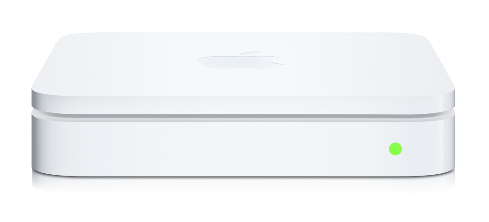
Apple Airport Extreme Base Station (AEBS) 802.11n

aebs1.png

I ordered this right after I ordered my Apple TV. In theory I could use the Ethernet cable that I’ve (partially) run from the office to the family room for that, but the AEBS had some other nice features, and running 802.11n to the Apple TV should work fine. It runs on 5 Ghz instead of 2.4, so the microwave and phone interference I’ve experienced playing music should (hopefully) go away. If not, I’ll get around to finishing the ethernet run.

The other features that it has that are nice are the ability to use the USB port for adding a printer, or a hard drive, or adding both a printer and a hard drive or drives via a USB hub, as networked devices, accessible to all pc’s/macs in the hosue.

Of course the Apple TV has still not shipped, but as soon as I got the AEBS, I set it up.

I changed my network around some, to eliminate some devices that I no longer need. One thing that could go was my very old 802.11a access point! Also, the AEBS has 3 Ethernet/Fast Ethernet ports, and I’ve been able to eliminate a FastE switch I was running. I do wish there were 4 ports, instead of 3, as I did have to go wireless on one of my devices that I had wired, but so far, so good with that. Second, it would have been nice to have GigE instead of FastE. Considering 802.11n’s speeds, the bottleneck to the wired devices will now be the FastE.

Adding a printer and hard drive via the usb hub was a snap. Just had to install Bonjour for windows on the XP box, and the mac saw it all easily. I am going to get one of the Lacie or ministack HD drives that are the exact same form factor as the mac mini, which is the same as the AEBS and the @TV. Thsoe drives have a USB hub built in, so I’ll just plug the drive into the AEBS, and then the printer into the drive. And I can easily add drives as necessary.

There are a ton of options on the AEBS — much more than with most home routers. So this could easily be used in a small business. One nice touch is that it has SNMP on it, so I am able to graph my DSL line usage. This allowed me to run my DSL modem in bridge mode instead of router mode. That actually makes synergy run nicer in my (somewhat) strange setup. And the interface to configure the AEBS is much nicer than the DSL modem, but can do all of the same things.

I have heard reports of VPN issues when using the AEBS, but I have not experienced any with the Cisco VPN client my work laptop uses.

I was hoping the range on it would be enough to get to my neighbors house so we could do cross house backups, but it doesn’t quite make it. But our homes are probably 275-300 feet apart, through woods. My AEBS is not in an ideal position to reach them. I haven not yet walked around outside with my laptop to test the range.