MR 340 Part II, The Race

It is a bit difficult to write a race port on this race in my typical adventure race format.  In AR’s, I am normally able to keep all of the details and happenings straight in my head — I think due to the transitions from one event to another.  I’m also typically more involved in planning and navigation than I was in the MR 340 — in this race I was just a paddling grunt.  (Happily, I might add!  It was nice to not have to do a ton of planning as is typical.)

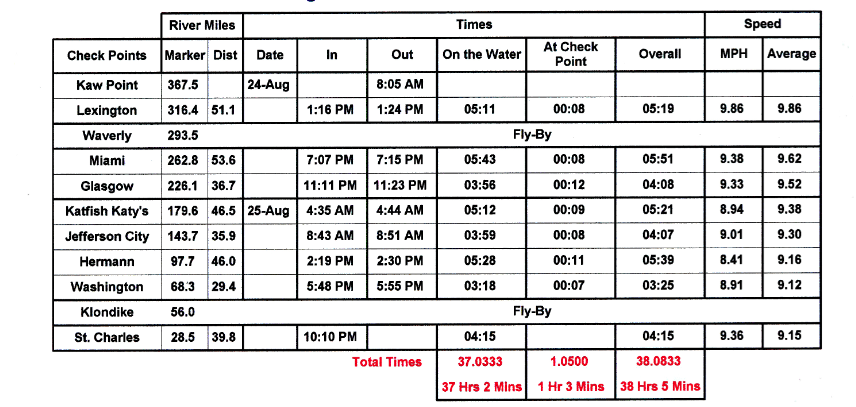
So, to put it another way, since I’m normally reading maps and the passport, heavily involved in the navigation during the race, and because there are clear transitions, it is much easier to keep things straight in a normal AR than in this race.  In the MR340, while we stopped 7 times, I didn’t even get out of the boat a couple of times, and the ramps all kind of blend together in my mind.   So in this post, I’ll give a breakdown of times per checkpoint as kept by our ground crew, perhaps include a quick point or two, and throw in some photos here and there.

I’ll also include the same photo from the last post (part I) here for reference.


Race Start – Kaw Point

The race started at Kaw Point.  We chose to not go to the far river bank so that we could stay close enough to shore to allow us to enter the boat fairly late (close to the start time).  While the far shore definitely gives you a jump on the other competitors in terms of cutting the corner and getting to the fast water quicker, we felt that an additional 45-60 minutes sitting in the boat and fighting the currents was not worth it — especially when we were looking at a 40 hour or more race.

We all got in the boat a few minutes before 8 a.m., pushed off a bit, and then waited.  It was a bit difficult to hold the boat in the current and not collide with other boats, but overall we did pretty well.  At 8:02 the national anthem started, and at 8:05 the canon was fired and we were off!


It was certainly crowded, and when the Kansas River joins the Missouri River within a minute or two of the start, the high/fast current of the Missouri was playing havoc with some of the boats.  While we made it through fairly clean, we later learned that five boats capsized at this point, including eventual female solo winner and star paddler, Robin Benecassa.

I’d like to say we quickly settled into a groove, but in reality, it took hours and hours for that to happen.  However, with 20 paddlers, even though we were pushing nearly 5000 pounds through the water, we had enough power to get into a good groove and start picking off some of the boats that had gotten a jump on us.


Kaw Point to Lexington

The 1st checkpoint was Lexington, 51.1 miles from Kaw Point.  See the chart below for all the times in, times out, etc.

I recall from this section a few things:

Santo:  Santo Albright, the eventual men’s solo winner, drafted us almost the whole way on this section.  Every time I looked back, he was within a foot or two of our stern.  At times, there were several other boats drafting behind him.  This was a solid strategy for him — even though we were losing a little time to the front runners, including a couple of solo men in his division, he was biding his time and taking it easy.  340 miles is a long ways, and he would be fresh on the 2nd day.

Brad:  I noticed a solo man in front of us that was having trouble staying straight.  He was fighting the water the entire way, it seemed.  I couldn’t understand how he could be in front of us — I guess whenever he could keep it straight, he was flying!  We eventually pulled up beside him, and he asked us if his rudder was working.  As best we could see, it was.  A few minutes later I looked back and saw him pulling over, I suppose to check the rudder.  We never saw him, but later learned that he had dropped from the race.  The headline that was picked up nationally, and eventually, internationally read “Asian Carp Knocks Paddler” from race.  The actual story pointed more to the rudder as the main problem, but speculation around the post race area was on boat choice.

Lexington to Wavery to Miami to Glasgow … to St. Charles

Now it all starts to get a little fuzzy.  :-/

I can say going in to the 1st check point at Lexington, I thought our time off the water (at the check points) would be pretty high, as much as 20-25 minutes per stop.  Going in to our 1st CP, I said a stretch goal would be 12 minutes, but we made it out in 8!  Overall, we had amazing checkpoint times considering our crew had to refuel 20 people every time, and in many cases we could not get the boat in broadside — so everything had to come in from the bow.  Or people just jumped.

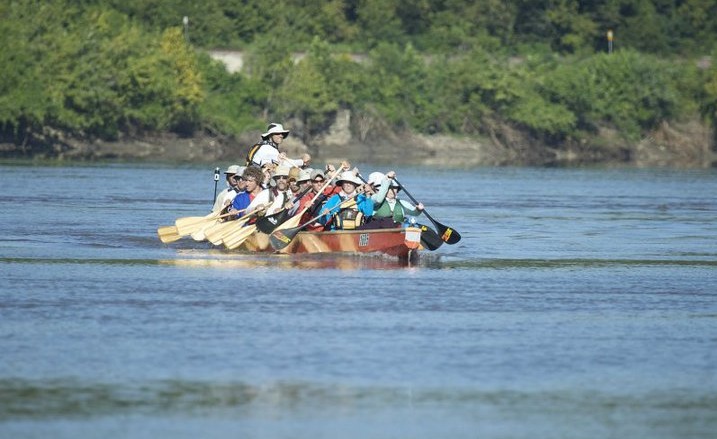
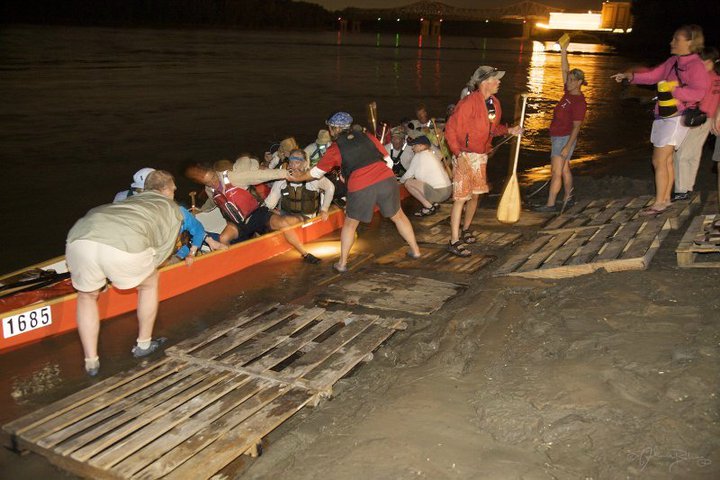
This is what we looked like coming in to a typical CP:
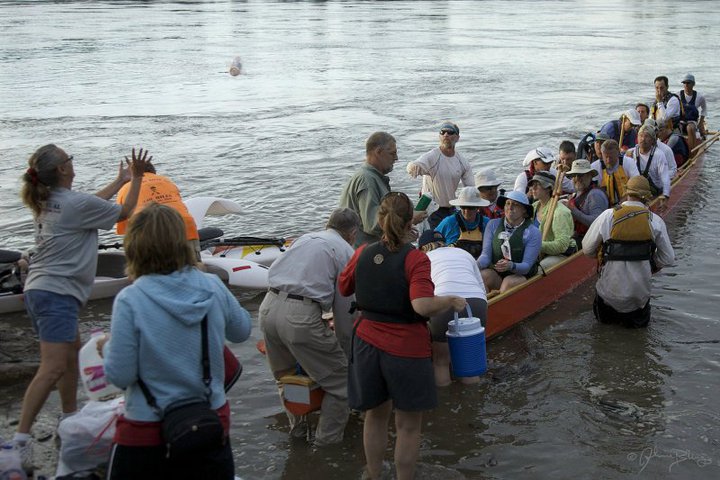
And this next photo shows a little of the controlled chaos of a CP — note the bottle being thrown in the air.  This is actually early in a CP before it got really chaotic.  At only one check point did everyone get out — typically a quarter to as much as half of us would stay in.  Others would jump out to use the restroom, or help with gear, or to just to stretch their legs.  Yet our longest CP was only 12 minutes.  Most of the credit has to go to the crew for this amazing feat.

And here we are just about to leave:

Here is a chart of all the CP’s and other relevant data, showing our average mph, time in the CP, etc.
Finish
We pushed hard the last 40 miles from Klondike in — well, really we pushed hard the last 100 miles or more.  Once we had crept into 3rd place, we did not want to give that up!  And even before then, I recall Will saying a few times “We only need to pass two more boats to secure our place on the podium,” so we pushed hard for a long long ways.

We tried really hard to break 38 hours when we realized how close we were, but we came up just short at 38:05.  I have to say the last couple miles was an amazing, exhilarating time.  We really came together, paddling hard an in sync, and the energy level was unreal.  I think the whole boat was yelling and screaming, and chanting out various words such as “hit,” “stroke,” “arrrgh” an the like, to keep us all in sync.  I certainly hope someone has a video of us coming in under the last bridge.  They said they could hear us long before they could see us.

We had a bit of an anti-climatic finish, as we misjudged the current in the eddie, so we got pushed back up river about 20 feet instead of hitting the shore right at the finish.  But it was only a few strong paddles to put us right where we needed to be.

Considering our original optimal time goal was 40:00 hours, and I thought we could be as much as 48 hours, we really rocked it!  It was good enough to win our division (well, we were the only Dragon Boat!), and get 3rd overall, behind two incredibly fast and talented tandem boats.  We were all certainly pleased, and I think we proved to the entire paddling community that not only is it possible to finish a race like this in a dragon boat, but that in future years, a dragon boat just may win it.  With a few tweaks here and there, I’m certain that is the case.  And, while we were at it, we just happened to shatter the previous world record for distance covered by a dragon boat!

Here is a photo of me getting out at the end — falling back into the boat.  I knew my legs were going to be rubber — in fact, when Joey and I had been switching seats the past few hours, I only did it while sitting and him standing.  I had tried once on the last leg to stand, and the legs just weren’t there.  It wasn’t that I was that exhausted or anything, I just didn’t have land legs.  So I had grabbed my paddle to brace myself as I came out, but it still wasn’t quite enough!
Again, much of the race is a blur, and I don’t recall everything that happened in the order it happened, so in my next post, I’ll offer a few anecdotes and post some other photos…

(to be continued)

MR 340 Part I, Pre-Race

June 15th, 2010

I was just ten days past my Half SCAR Plus run, recovering nicely, trying hard not to think about what might be next, though the thought of a Fall 50 miler (running) kept creeping into my mind, when I received an email from my old Florida teammate Will, from team “Are We There Yet,” that simply read:

“I am on a team that is paddling a dragon boat in the Missouri River 340 at the end of July. If we finish it will be the world record for longest race in a dragon boat. We lost a person. There are some folks in line to take the spot, but there is probably a chance for another opening. Are you interested?”

Do you know what my response back was? “I don’t even know what a Dragon Boat is!”

To which he responded:

“It is, for our purposes (even though not technically accurate), a big, ceremonial canoe that, in its most common form in the US, seats 20 paddlers in 10 rows of 2, with a drummer in the front who helps with timing, motivation and communication, and a steersperson in the back who steers with an oar through a lock on a steering arm. So it would be like canoeing with a lot of teammates, except that you only paddle on one side at a time. We will be switching sides periodically.”

My first response was “No!” I have enough experience in 2 – 3 day adventure races with 1 to 3 other teammates to understand how difficult team dynamics can be with that few number of people – who could imagine what it would be like with 20? I also like the aspect of adventure racing that allows you to change sports, from running to biking, or paddling to running, etc. Doing one sport for 48 hours (plus or minus), did not sound fun at all. I also thought about the utter chaos we would have at check points — trying to re-supply 21 people in a short amount of time seemed to be an impossible task.  And I hate wasting time at check points!

But, the two words “World Record” kept coming back to me. So a couple of days later, I let Will know, who in turn let the team captain, Christina (later named the Imperial Commandress), know, and a couple of days after that, a spot opened and I was on the team.

And best of all, we’d be raising money for the Shriners Hospital of St. Louis.  Please consider donating here to this cause here.

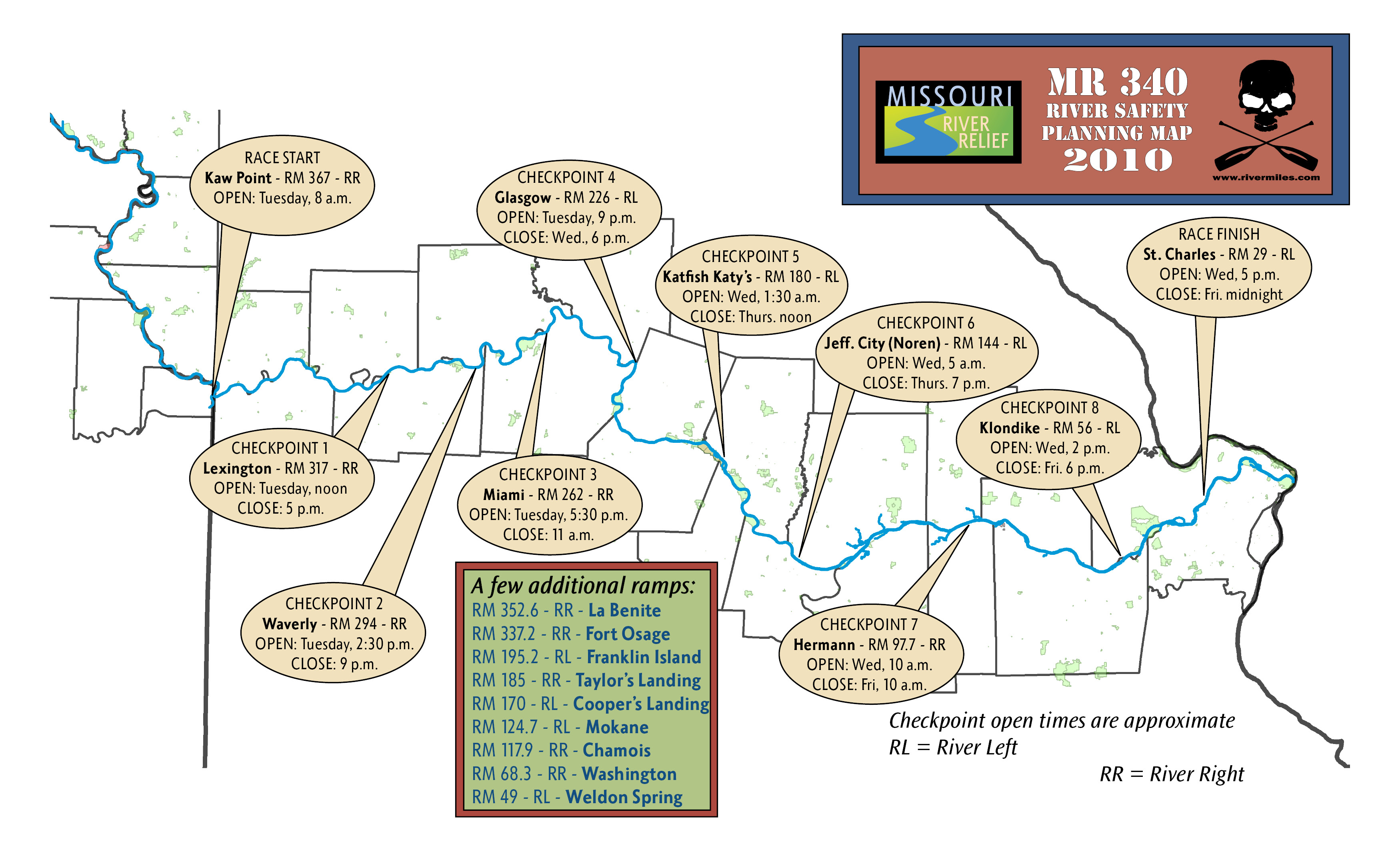
Here is the logo from this year’s shirt, which shows the map of the course.  We’d be paddling from Kaw Point in Kansas City, all the way to St. Charles.  The other points on the map would be the check points where we’d have to check in with race staff, and where we could stop and refuel.  We were also allowed to “fly by” these as long as our ground crew made visual contact with us to check in for us.

And another:

Training
Wow, here I am entering an extremely long paddling race, with what appeared to be a serious paddling crew, and I’m thinking, “I’ve only paddled once this year, and that was to take the kids out on the canoe for an hour!” Hmm, how to get in shape in less than 5 weeks! Well, I had a good aerobic base from the ultra run, and I had been keeping my strength training up so I felt like I had a decent strength base as well. What was left? Paddle, paddle, paddle! And paddle some more!

Looking back at my training log, it looks like I was able to get in 8 rowing specific workouts, with canoe paddling as long as 3 hours on Jordan Lake, though most were in the 90 – 120 minute range. I had to get up at 5 a.m. a few times to fit in these kind of time commitments around work and personal life schedules. That is not a whole lot of paddling!

Here is a photo of the dragon boat in action… Our team was able to get in a couple of training runs on it, though getting 16 – 20 paddlers together is tough schedule wise!

Postponement
About a week before the race, we got a clue from the race director that the race would likely be postponed. The Missouri River was at or above flood levels, and many of the check points would be inaccessible. And the river could be dangerous. And then it happened. The race was put off until 8/24.

There was a mad dash scrambling to put the pieces of a team back together. Many members had commitments in August such as school, work, etc., but a core group remained, and we eventually were able to secure a team with 20 people on it — leaving one seat empty.  (We later found that one empty seat was essential to allow the 3 steers the ability to rotate on the fly in a safe fashion. If that back row and been completely full, it would have been much tougher to make changes!)

You would think that would be a good thing for someone like me, who had very little paddle specific training in place. But I had an extremely busy time right around then, with a couple of trips planned, and I was only able to get in three more paddling workouts in!

Travel
It came time to travel west to Kansas City. I took an early morning flight to DFW, where I hooked up with Will and Ryan. I had not seen Will in several years, and was introduced to Ryan. Our DFW to KC flight was delayed about 40 minutes, as a seat belt was broken. On a half empty flight, that should not have caused any problems since you can just move someone to a new seat — but the broken seat belt was the pilot’s! That delay was a bit concerning as we were supposed to meet the team at the race start and take the boat out for a quick practice, before the mandatory safety meeting, and now we were cutting in to that time. But we got picked up and went straight to the start, where we quickly changed clothes, where introduced to everyone, and jumped in the boat.

Practice
We paddled the boat as a full team for the 1st time for about 45 minutes. (Actually, I think we were missing one or two people…) At this time, I hate to admit it, but my realistic side was kicking in… Or, perhaps more accurately, it was pessimistic side! Our paddling was awful — we were not synchronized in any way, and there were several in the boat that had paddling strokes that left a lot to be desired. One of the team mates in front of me happened to be a very accomplished adventure racer, ultra-runner, and paddler, and we started talking about attrition rates. We both guessed as high as 20-25%, which would be 4-5 paddlers. A boat as big as that would be difficult to move quickly if we dropped that low. And while we never openly discussed the particular people that we individually thought would not make it, I’m sure we were both thinking about it. This turned out to be a great lesson in “Don’t Judge a Book by its Cover,” because I was dead wrong. The entire crew made it to the finish, and some that I thought would be weak, turned out to be strong.

Dinner
Doug, one of the paddlers, who lived a couple of miles from the race start, had opened up his place to several of us, which was very generous considering he didn’t know most of us at all. I rode to his place with Christina, and then the three of us, as well as Doug’s wife, went to a casino buffet dinner, where we (well, me, at least) stuffed ourselves silly. 🙂 Apparently, river boats were awarded the right to offer gambling a long time ago, and the law was written such that as long as there is a little water between the land and the casino, that’s legal. So the “boat” we were on was a building with a little bridge over a 5′ span of water.

Pre-race safety meeting
We headed to the safety meeting, checked in, and were briefed by the race director on what to expect, the rules, etc. We heard “high fast water” about 100 times during the safety video — while the water had certainly dropped since the postponement in July, it was still very high. And fast. “Drink!” (He had suggested making a drinking game out of the video… 🙂 )

Final Preparations
After the meeting, I went to the grocery store with Eric and Michael for some last minute food grabs — for me that included famous amos cookies, some mixed nuts, etc. Then we headed over to Doug’s, where the 5 racers and 1 support crew member made our final preparations. There were a lot of zip lock bags and food flying around. We finally got to bed around 10:30 or 11. I used my buff to cover my eyes since not everyone was quite ready to turn out the lights when I was — is there no end to the uses of a classic buff? 🙂 I love mine!

Wake-up call
I woke up about 5 a.m., before the alarm went off, and started to get ready. It had not been a great night of sleep, but certainly wasn’t terrible. Just like the night before most races, I’m always anxious and wake up a few times during the night, only to check the clock and realize there is plenty of time. Doug’s wife walked Michael and me to a nearby cafe, only to find it was closed. 😦 I really wanted needed my coffee. Then she drove us a bit further to a very nice grocery store that had a large breakfast buffet. And coffee. Now I was ready!

We had to make two trips to the start with all the paddlers, crew, and gear, but we were there in plenty of time to put everything together for the start…

(to be continued…)

A Million Miles in a Thousand Years. Donald Miller.


I’ll tell these things to God, and he’ll laugh, I think, and he’ll remind me of the parts I forgot, the parts that were his favorites. We’ll sit and remember my story together, and then he’ll stand and put his arms around me and say, “Well done,” and that he liked my story. And my soul won’t be thirsty anymore.

What if your life was a story?  What if your life was a story and you were the author, or at least co-author (but main-author)?   How would you change your current story?  How would you make memorable scenes?  How would you invite others into your story?    In the book Miller discusses life as a story, and how the elements of story come together in each of our lives.  We can have a captivating story, or a dull story — we choose, as we are the main author.   Many of us are guilty of not changing our life story, because we have become content, or we are afraid of change.  (Or both.)  But should we be content with where we are today?  Could greater things be in store?

He didn’t discuss it much, but of course other people are part authors of our story as well.  I had this revelation a few weeks ago when Kelly threw a surprise party for me on my 40th birthday, and I got to see so many people from my life — family, of course, and friends from college, friends from nearby, and friends from far, some of whom I see often, and some of whom I see rarely (these days).  And they are all a a part of my life story.  I have many “memorable scenes” with all of the people I saw, and there will (hopefully!) be many more.  But, as the main author of our life story, we have so much to do with those scenes…  What more can we do to create more and more of those scenes that stand out from the dull monotony of every day life?   Not that every day needs to be an adventure of some type — there are opportunities for memorable scenes more often than we typically think.

Another key point, for me, was how we choose to invite others into our stories — and how we help create memorable scenes for them.  I want to be better about this.

I have to admit that this book unexpectedly made me be quite introspective, which is rare for me.  I’m not an introspective person by nature.  But when you think of your life as a story, you think about the quality of the story.  Is it a good story?  Is there character development?  (“I wanna have friends I can trust… that love me for the man I’ve become not the man that I was…” — Avett Brothers)  Is there conflict that is overcome, preferably for “the good (noble?)”.   (“I have fought the good fight….”  2 Timothy 4:7)

The quote I opened this post with struck me…  It is from the very end of the book, and is key.   Don’t we all want to hear “well done” from God on that last day, and that “He liked my story?”  I can’t wait to be reminded of those parts of my story that I’ve forgotten, but that were important not just to me, but to Him.