
Biggest infographic ever…
Reply


Like the 2nd book, this one took a little longer to reach the stage of “can’t put it down,” and the 1st book was by far my favorite. I was not crazy about the ending in this one, though at least part of it was expected and needed. Can’t say more than that without spoiling.
I will say that if you need to take a break from heavy reading or non-fiction, this series is a fun, entertaining read all around. I am looking forward to the movie The Hunger Games coming out in March.

Ok, so this one took me 50 or 60 pages to get fully engrossed…
One interesting note is when reading on a Kindle device/app, and you get to see the most highlighted sections… I’m not finding a whole lot here that is quote worthy — in fact I don’t think I’ve highlighted one sentence in either book, yet the Kindle shows lots of stuff highlighted.
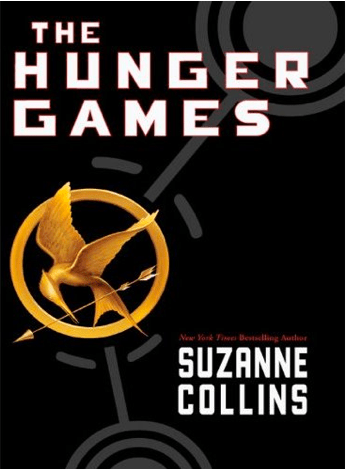
Wow, it’s been quite a while since I’ve not been able to put down a book, but this one captivated me from the 1st page… Only to finish it and find out it is a trilogy! (I’ve already got the next two books in the kindle app!)
And now I see a movie is coming out in March and the trailer looks pretty good.
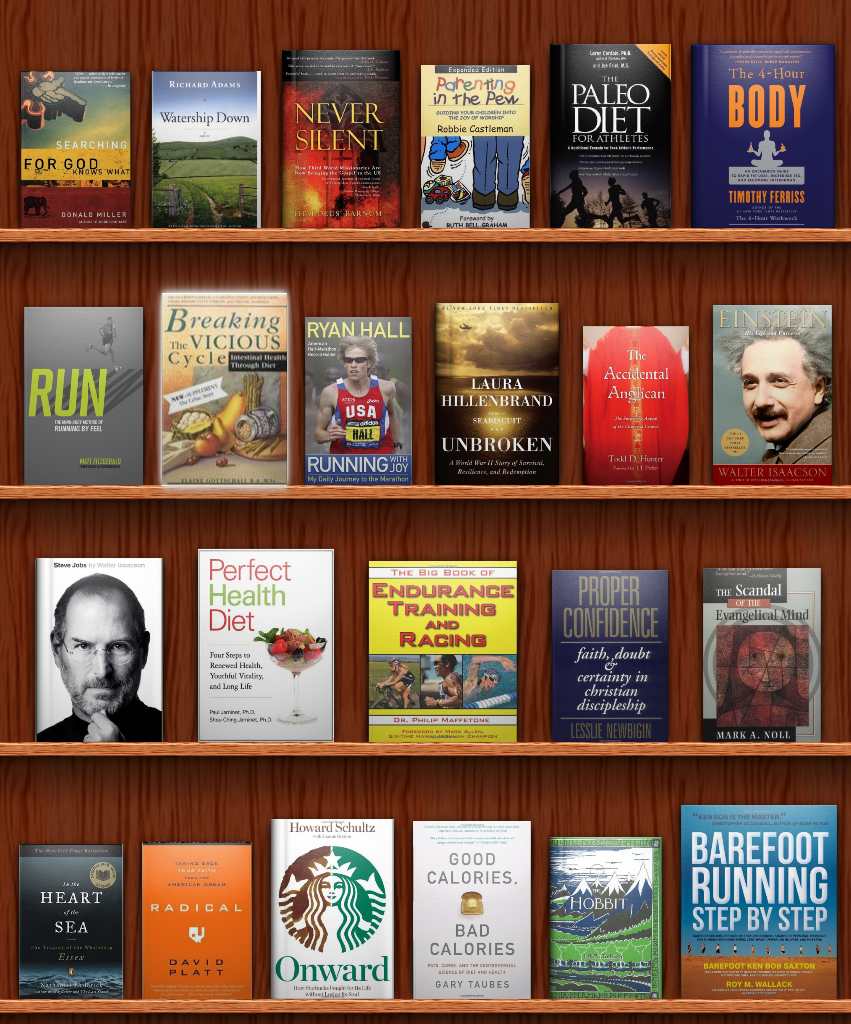
I was pretty bad about my normal reading notebook posts this year, probably only posting about half of the books I’ve read. For that, I apologize, but above you can see a book shelf of the year. Life got pretty busy and it was difficult to find time to write about each book — even to get my own personal notes from each of these books in order. A few of these I didn’t quite finish, and probably never will, such as “Good Calories Bad Calories” and “The Scandal of the Evangelical Mind.” Not that they are bad books, just that I reached a point where I had gotten all I wanted to out of them.
“Watership Down” and “The Hobbit” were re-reads, both classics, the latter read to my 6 year old son Reece. He now wants to move on to the Lord of the Rings trilogy! Of course there were several food/diet related books, as I continue to investigate my own digestion (which has been doing much much better, but is still not quite where I want it to be!)
If I were to make recommendations, “Unbroken,” Watership Down,” and “The Hobbit” are must reads in the fiction category. “Steve Jobs” is an amazing biography of a pretty amazing man that influenced our technologies tremendously during his life. “The Perfect Health Diet” is probably the closest to where I am in my diet right now, though I’d guesstimate I’m only 75-80% PHD compliant. And finally, “Never Silent” is truly an amazing and eye-opening account of where and how the Anglican Church in America has come to be…
While the total number of books read is a bit lower, most of that is due to reading more articles on-line, but it was still a good year in reading for me.

I could write my own review, or I could point you at Tuck’s to save a lot of time. 🙂 There’s not a whole lot I don’t agree with there. Plus, I personally know the sock-doc and agree with most of what he writes, and he has a recommendation/commentary in the Big Book… (Though the sock doc does not agree fully with Dr. Phil…. He’s a bit more attuned to Joe Friel for the better trained athlete in terms of HR zones…)
I would add that I found Dr. Phil a bit all over the place, a bit more “new age-ish” than scientific in spots, which makes it hard to follow, especially if you are more of a logically oriented reader. So it is a good read with a lot of good information, but a bit spaghetti-like; however, if you are looking for a reference book on training and diet, this is not it. I.e. it is not quick to pick up and find something specific that you are looking for. You’d probably have to read a chapter or two; though since the chapters are mostly short, that’s perhaps not too bad of a drawback.
Rather than a typical race report, I think I’ll just go with some random observations..
 The rocks and roots were relentless — there was no time to just zone out. You really had to be mentally engaged with the course 100% of the time, so that was tough. I have 3 blue toenails to prove it… And I’ve never lost a toenail due to running, but I may this time. Additionally, the Oak trees apparently did not like us out there. They were launching (nearly) golf ball size acorn’s at us the whole time. There were huge crashing sounds as these things came flying down at us.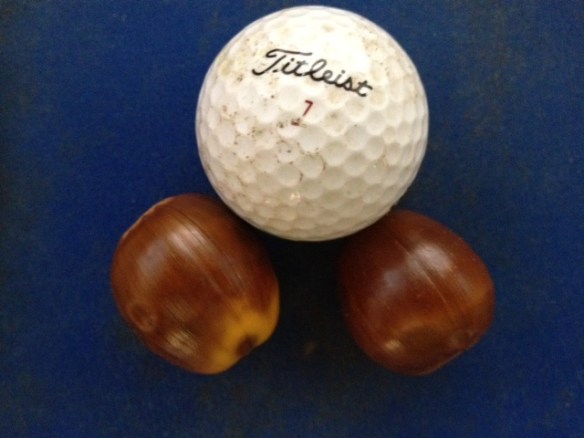


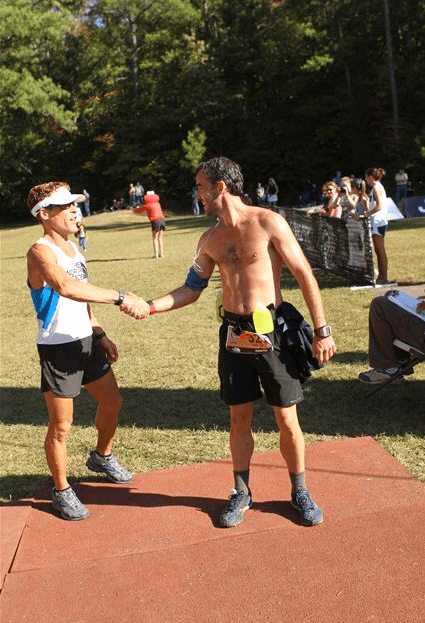
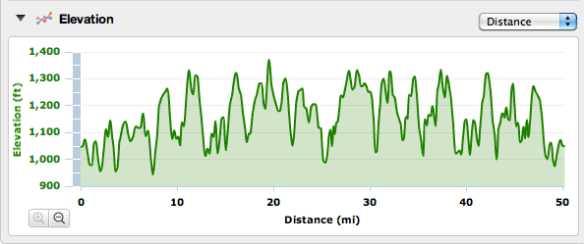
I was able to take part in a running research project, in which 20 runners from each of the following four groups are being analyzed: barefoot/minimalist, traditional shod, Pose, and Chi. Can you guess which group I’m in? 🙂 (I’ve actually read both the Pose and Chi books, and went to one Pose session with a local NC Pose coach, as well as practiced Pose drills a bit, but I would not say that I am a Pose runner in any way…)
I actually got to do the study twice. A month ago I went, and felt extremely uncomfortable on the treadmill. And it was not just because the treadmill has two belts, a left and right, with a 1/2″ gap between them. Nor was it all the ace bandages wrapped around my legs and waist. Something was just off… I had chosen to run in my Vivo Barefoot Ultras (with sock liner), which have tremendous ground feel. And I could feel a slight indention on the left belt and a slight protrusion on the right. These disturbances were enough to make my body react as if I were stepping on something dangerous… After the 1st run and set of samples, I asked to run again because it just felt so off. On the 2nd run, we quickly stopped the treadmill as it was obvious something was drastically wrong. Turns out the right belt had completely come off track!
So I went back a month later when the treadmill had been fixed, and it felt much better and I was much more comfortable. I could still feel a slight indention, now on both tracks, but I tried to not let that bother me much. We stopped at “2.8” on speed which turns out to be about a 9.40 mile though it actually felt much more like an 8:30. I hope that doesn’t skew my results too much and I’d love to see some of the data at a faster rate. I can say that I stopped at 2.8 as it felt the most comfortable in this awkward running situation. For comparison, I ran Boston this year in a 7:52 pace and my current 5k pace is about 6:50…
At some point during my 2-3 minutes of running on each belt, the researcher took video as well as sampled spatial and force data — I think five 3-second samples were taken. The spatial data is something like 240 frames per second using reflector nodes that had been attached to me… The force plates were even higher sample rates at 1200 per second.
The researcher was kind enough to send me a few snippets which I’ll include below.
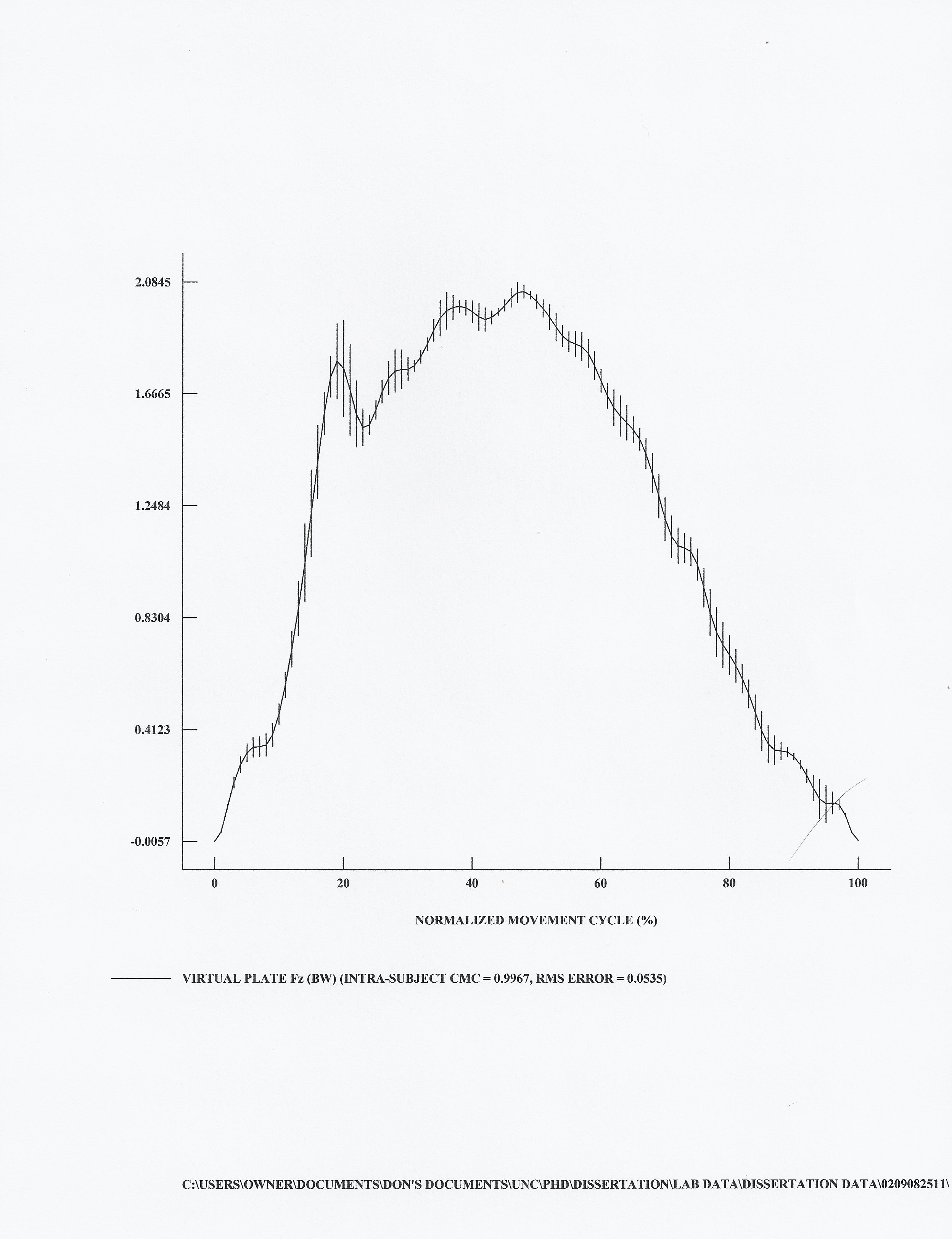
First is a composite of my ground reaction force across all the samples of data. What is interesting to me and the researcher is that most barefoot/minimalist runners do not have an impact transient — but I do, albeit slight. (For a quick summary of my barefoot history, see this post.) Overall my peak ground reaction force is on the very low end at 2X body weight, whereas the normal range for most runners it 2-3X. (This is one area where it would be nice to look at a faster run as I’m sure the GRF would go up at speed…) The researcher did say I have the lowest “bounce” in any runner he’s seen yet…
Next I’ll show the actual video of me running from the side… Unfortunately the lighting is not great and the feet are a bit blurred — this is not a high speed camera! But I think it shows a pretty decent fore to mid-foot strike. I think the VivoBarefoot Ultra’s almost force that…
And finally, I’ll show the “composite stick figure” video. This is the five 3-second samples averaged out… This appears to show more of a mid-foot strike than the video above, though that just may be due to the presentation… The vertical bar is Fz that is the breaking or propulsive (depending on where you are in the stance phase) force you are seeing in the anterior/posterior direction. (I thought it showed the impact transient but that is NOT the case…) It’s really hard to tell without the upper body being shown, but to me it looks like I might landing a bit far in front of my center of gravity and perhaps that could be part of the impact transient… I wonder if this would be different at faster paces? When I did do the Pose session, the one thing the teacher wanted me to work on was the slight forward lean from the ankles, and maybe I’m still running to straight up…
What would be most interesting is to have this kind of data available very quickly and easily, so I could try a few different things and see what would happen. But it is an expensive treadmill that is in high demand, for both research studies like this as well as rehabilitation of stroke victims and the like. And it takes about 30 minutes to get all the measurement reflection nodes attached.
All in all a worthwhile experience and the data you can get back may be useful to you if you are in to analyzing your form.
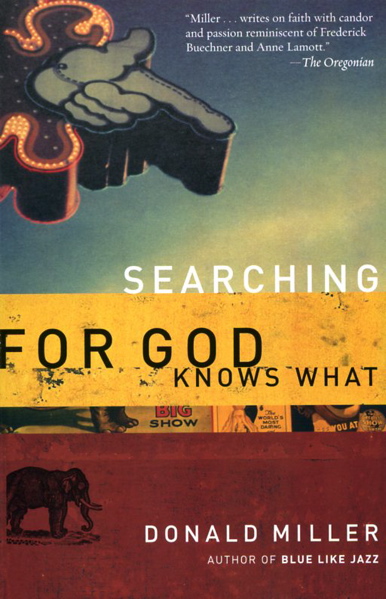
I’ve read a few Don Miller books and liked them all, and this one was no different… While he rambles around a lot, he does provide good insight into issues of the Christian faith in a way not many other authors do (at least, that I’m aware of). In this book he talks a lot about heirarchy’s in humanity, and how we are always striving to “get ahead,” or as the example in the book states, to be the last one left in the life boat…. And how that is so different from what Jesus portrays our lives should be like.
But rather than get into all that (since I’m so far behind), I just want to include one quote that he had of CS Lewis that really stood out to me:
Most of us are not really approaching the subject in order to find out what Christianity syas: We are approaching it in the hope of finding support from Christianity for the views of our own party. We are looking for an ally where we are offered either a Master — or a Judge.
Wow! How true is that. And how convicting. So many of the “arguments” in front of the church today are voiced by people guilty of this. And I’m certainly not saying I’m not guilty of it! But that is one of the reasons that standing on 2000 years of church history for your theology may not be such a bad thing.

[ I’ll preface this Reading Notebook post by once again saying how far behind I am on writing about books I’ve read and that I’ll try to catch up. The one thing I’ve got going for me right now is that I’ve not been reading books as much, so that just might happen!]
I’ve always had a bit of a love-hate relationship with Starbucks, but one thing I do love is the business success story. Imagine starting with a single store just 30 years ago to now seeing one on just about every corner in a big city in the US. But that is also one thing I don’t love — seeing SBUX everywhere. Except when I want/need coffee. 🙂
See? Love/hate. (there’s more to it that just the ubiquity.. there’s the brew… there’s the sugar and all the things they add to coffee, which is just not necessary for good coffee, etc. etc…)
Anyway, this book documents Howard’s return to CEO after having resigned that role a few years prior, returning at a time when the company was really beginning to falter. Some problems were due to the global economic crisis, but many problems had started earlier and were deeply interwoven into the company’s fabric. The success SBUX has had since then has been remarkable, so the book is a good read just for that.
I’ll only comment on a couple of things:
1) Pikes Place: Howard raves about this coffee, how they were trying to reach a larger, mostly American population, and how everybody loves it.
Strategically, Pike Place Roast had the potential to be a powerful catalyst for and symbol of our transformation.
Sadly, I have to disagree… I tried it at least 4 different times just to be certain — but I can’t stand it. These days, if I’m getting a drip/brewed coffee, I’ll always go for the dark roast — anything but Pike’s! And if there is not another option, I’ll order an Americano instead.
2) Clover: I love the clover. The brew this machine makes is excellent. Granted, Starbucks only uses their “reserve” beans in it, and that may be part of the reason Clover coffee is so good, but I also think the process has much to do with it. I was a French press man for years, but then switched to slow drip (since I don’t brew a pot at home as I’m the only drinker…). These days I love slow press — unless I’m near an SBUX with a clover.
First and most important, Clover makes a terrific cup of brewed coffee. A cross between a French press and a vacuum pot, Clover sucks water through the bottom of finely ground coffee instead of pressing water through the top, using a very fine filter that lets the coffee retain its best-tasting oils.
The transcendent little coffee machine born in Seattle’s Ballard neighborhood produces one of the top five best-selling beverages at the more than 100 stores that serve it in cities in the United States and Canada. Clover is finding its way into more locations, giving customers an opportunity to enjoy the nuances of our traditional blends and the flavors of our exotic, smaller-batch Starbucks Reserve coffees.
I have to include a few quotes:
The Starbucks mission: To inspire and nurture the human spirit one person, one cup, and one neighborhood at a time.
Historically, though, it is times like these, times of disruption, where America seems to discover its greatness.
I do think effective leaders share two intertwined attributes: an unbridled level of confidence about where their organizations are headed, and the ability to bring people along.
But in business as in life, people have to stay true to their guiding principles. To their cores. Whatever they may be. Pursuing short-term rewards is always shortsighted
 2sparrows