Food Rules. Michael Pollen.

A VERY quick read of 64 rules about food that Pollan has established after writing his other books on food and nutrition.   These rules lack most of the scientific reasoning of the rules, but the rules themselves are good if you don’t like that kind of thing.  Of course, I do like that stuff, so I’m now reading his more in-depth book “The Omnivore’s Dilemma”
Quotes – only a couple… Most of the rules are quotable!

  • Today foods are processed in ways specifically designed to get us to buy and eat more by pushing our evolutionary buttons—our inborn preferences for sweetness and fat and salt. These tastes are difficult to find in nature but cheap and easy for the food scientist to deploy, with the result that food processing induces us to consume much more of these rarities than is good for us.
  • Not surprisingly, the decline in home cooking closely parallels the rise in obesity, and research suggests that people who cook are more likely to eat a more healthful diet.

Run Less Run Faster

After coming back from Boston, where I watched my Dad and sister run the marathon, I realized I had caught the Boston bug…  Even though Dad can get me in without a qualifying time, I had to check the what my BQ time is to see if I would have a chance.  For me at nearly age 40, I’d have to run a 3:20, or 7:38 minutes per mile for 26.2 miles.  I can run that now for 5 miles, but adding more than 20 would be tough.  I’m also torn, as I don’t really enjoy road running that much, but instead love the trails and right now want to concentrate on trail ultras..

Either way, I had heard about this book so I thought I’d check it out.  The main premise is “3plus2” which is 3 hard runs per week, plus 2 cross training workouts.  The hard runs are all about speed — interval work, short tempos, and long tempos (or at least long runs with tempo like speeds mixed in).  The cross training is mostly about other aerobic work where you are allowed to mix in items that will save your body from some of the pounding of running, such as swimming and biking.  They also show weight workouts and 2 running drills.

The book is filled with all kinds of tables such as:  pace charts for what your times should be for various distance races based on your current 5k race time;  times for your intervals and tempo’s based on current 5k times; training plans for 5k, 10k, and marathon; and on and on.  Lots of tables.

Since I have not actually used the book to train for a particular race, I can’t say if it is effective, though looking around at reviews on-line, many people seem happy with it.

I will say the authors were extremely prompt with responding to a couple questions I had.  For example, I had hoped I could use Heart Rate as an effort indicator instead of just pace, so I could do my long runs on trails.  That would allow me to pursue both my goals of trail ultras and speed work.  Bill Pierce responded within 24 hours that “The principle of specificity dictates that training on trails is good trainng for racing on trails.”    Later, Scott Murr did respond with a much lengthier email all about using heart rate levels, which I still have not finished due to its length!

Right now I am not concentrating on speed at all, as I have SCAR coming up (70 mile run in the Smokies on the Appalachian Trail, though I am pretty sure I will cut it to 33 or 40 miles due to my recent bought with Rocky Mountain Spotted Fever).  After SCAR I will re-assess and decide, and while I will most likely not follow the training schedules in this book exactly, I will incorporate some of the speed work into my training to see how close I can get to that 7:38 over 26 miles!

Romans. RC Sproul

Romans has been thrown at me from every conceivable angle for the past few years, starting with a long conversation with a Catholic priest (in street clothes, on holiday — didn’t come out he was a priest until pretty far into our conversation!) in Gatwick airport, sunday school class, reading it on my own, and seeing various passages from it in much of my other reading.  RC Sproul has become one of my favorite writers.  So when  I saw he had a verse by verse commentary on it, I had to get it!   It is a long read, and I had a hundred or more quotes highlighted on the kindle, but I won’t include them all here.  I will just say that if you want to do a serious study of Romans and have a Reformed bent, this book is for you.

What I talk about when I talk about running. Haruki Murakami.

I saw this book while in the Harvad Co-op while in Boston for the marathon (I was spectating, not running!).  Quickly put a sample on the kindle and when I read that later, had to get the whole book.  Kindle samples are killing me!  🙂

The 1st chapter of this book sounded an awful lot like me, even though Mr. Murakami is in his later 50’s…  The 1st chapter was the best, while the rest were not as interesting to me.  Just about running marathons and/or triathlons, though he did have one ultra. But overall a lot of good insite worth reading and sharing here.  So I’ll just throw out a bunch of quotes:

  • Somerset Maugham once wrote that in each shave lies a philosophy. I couldn’t agree more. No matter how mundane some action might appear, keep at it long enough and it becomes a contemplative, even meditative act.
  • Pain is inevitable. Suffering is optional. Say you’re running and you start to think, Man this hurts, I can’t take it anymore. The hurt part is an unavoidable reality, but whether or not you can stand any more is up to the runner himself. This pretty much sums up the most important aspect of marathon running.
  • I don’t know why, but the older you get, the busier you become.  [ too true! ]
  • the fact that I’m me and no one else is one of my greatest assets.
  • By running longer it’s like I can physically exhaust that portion of my discontent.
  • (Putting off thinking about something is one of my specialties, a skill I’ve honed as I’ve grown older.)
  • I’m struck by how, except when you’re young, you really need to prioritize in life, figuring out in what order you should divide up your time and energy. If you don’t get that sort of system set by a certain age, you’ll lack focus and your life will be out of balance.
  • but the only way to understand what’s really fair is to take a long-range view of things.
  • Life is basically unfair. But even in a situation that’s unfair, I think it’s possible to seek out a kind of fairness. Of course, that might take time and effort. And maybe it won’t seem to be worth all that. It’s up to each individual to decide whether or not it is.
  • The most important thing we ever learn at school is the fact that the most important things can’t be learned at school.
  • As you age you learn even to be happy with what you have. That’s one of the few good points of growing older.
  • Still, it’s pretty wonderful to watch these pretty girls run. As I do, I’m struck by an obvious thought: One generation takes over from the next. This is how things are handed over in this world, so I don’t feel so bad if they pass me. These girls have their own pace, their own sense of time. And I have my own pace, my own sense of time. The two are completely different, but that’s the way it should be.
  • and covered sixty-two miles. It was draining physically, as you can imagine, and for a while afterward I swore I’d never run again. I doubt I’ll try it again, but who knows what the future may hold. Maybe someday, having forgotten my lesson, I’ll take up the challenge of an ultramarathon again. You have to wait until tomorrow to find out what tomorrow will bring.
  • Since I was on autopilot, if someone had told me to keep on running I might well have run beyond sixty-two miles. It’s weird, but at the end I hardly knew who I was or what I was doing. This should have been a very alarming feeling, but it didn’t feel that way. By then running had entered the realm of the metaphysical. First there came the action of running, and accompanying it there was this entity known as me. I run; therefore I am.
  • In this instance, relief outweighed happiness.
  • And one of the privileges given to those who’ve avoided dying young is the blessed right to grow old. The honor of physical decline is waiting, and you have to get used to that reality.
  • Competing against time isn’t important. What’s going to be much more meaningful to me now is how much I can enjoy myself, whether I can finish twenty-six miles with a feeling of contentment. I’ll enjoy and value things that can’t be expressed in numbers, and I’ll grope for a feeling of pride that comes from a slightly different place.
  • Reaching the finish line, never walking, and enjoying the race. These three, in this order, are my goals.
  • On the body of the bike is written “18 Til I Die,” the name of a Bryan Adams hit. It’s a joke, of course. Being eighteen until you die means you die when you’re eighteen.
  • I’ve carried this character around like an old suitcase, down a long, dusty path. I’m not carrying it because I like it. The contents are too heavy, and it looks crummy, fraying in spots. I’ve carried it with me because there was nothing else I was supposed to carry. Still, I guess I have grown attached to it. As you might expect.
  • I’d always thought I was sort of a brazen person, but this issue with hyperventilating made me realize a part of me was, unexpectedly, high strung. I had no idea how nervous I got at the start of a race. But it turns out I really was tense, just like everybody else. It doesn’t matter how old I get, but as long as I continue to live I’ll always discover something new about myself. No matter how long you stand there examining yourself naked before a mirror, you’ll never see reflected what’s inside.
  • Of course it was painful, and there were times when, emotionally, I just wanted to chuck it all. But pain seems to be a precondition for this kind of sport. If pain weren’t involved, who in the world would ever go to the trouble of taking part in sports like the triathlon or the marathon, which demand such an investment of time and energy? It’s precisely because of the pain, precisely because we want to overcome that pain, that we can get the feeling, through this process, of really being alive—or at least a partial sense of it. Your quality of experience is based not on standards such as time or ranking, but on finally awakening to an awareness of the fluidity within action itself. If things go well, that is.
  • My time, the rank I attain, my outward appearance—all of these are secondary. For a runner like me, what’s really important is reaching the goal I set myself, under my own power. I give it everything I have, endure what needs enduring, and am able, in my own way, to be satisfied.

Real Food. Nina Plank.

I saw this book mentioned on the google minimalist (running) list saying it was a bit more approachable than some other books on the paleo diet, though after reading this I don’t know how paleo it really is.  Guess I’d have to read a paleo book after all.  Or maybe it mentioned Weston Price and Price is not paleo??  I don’t know.  I have read so few food/nutrition books in the past few years that maybe it has all passed me by.  Guess I have become pretty comfortable with my diet!

This book touts moving back to the way food was before it was industrialized, including farm animals, milk, eggs, and produce.  Getting away from grain fed beef and chicken when that is not their natural diet, not eating farm raised fish, getting back to locally grown produce, etc.  And I’m all for that, though I don’t eat a lot of meat…  She was very into using butter — which I never used a whole lot of margin but only went for the real thing — butter is better!; whole milk — I normally do skim or 2% but am now considering sticking with just 2%; eggs – i love ’em — but only pastured so they can be omnivorous as they were ment to be.  She was against all industrial oils (which pretty much leaves olive oil as the only oil).  And all in all getting away from as much process and pre-packaged food as possible, which I already try to do.

Just a few quotes:

  • Is drinking milk unnatural? The critics say that cow milk was “designed” for newborn calves, not for humans. That’s true. But this observation does not prove that the human digestive system cannot, or should not, handle milk. After all, the tomato was designed to make more tomato plants, not pasta sauce.  [ i’ve been guilty of saying this in the past, but I would still say we shouldn’t drink it constantly… everything in moderation!]
  • Aren’t some fats unhealthy? Yes. It’s easy to remember the bad ones: they are the industrial fats recently added to our diet. The unhealthy fats are refined vegetable oils, including corn, safflower, sunflower, and soybean oil, and synthetic trans fats. Trans fats are formed by hydrogenation, in which unsaturated oils are pelted with hydrogen atoms to make an artificially saturated fat. That’s how they make firm margarine from liquid corn oil.
  • To reap all the flavor and health benefits of olive oil, buy the best oil you can afford, ideally extra-virgin, cold-pressed, and organic.
  • The sooner we ban trans fats— as Denmark has— the better.

Boston Marathon Liveblog

I am going to attempt a live blog of the Boston Marathon as Dad and Kim race. We’ll see how it goes.

6:50 — saw Dad and Kim off from the hotel. They are taking a taxi to the runner bus station in Boston, where they will take the bus to the start at Hopkinton.    And there they will have an hour or two to wait for their start at 10:30.

8:00 — after a bit of email, loading my pack, getting fed, I am out the door. Taking the red line to South Station where I will pick up the P509 Worcester train @ 8:50 for Framingham. That is the last rail stop where you can get close to the marahon course, and it is at mile 6.

8:30 Waiting at South Station.

if you want text updates from AT&T for when Dad and Kim cross certain points, text “runner” to 31901 and then when you get a reply enter the bib numbers…

Kim — 27665
Dad — 27617

8:51 slight delay in boarding and leaving… mad dash of people ran for the track when it was announced… out bounds in the morning are normally NOT this crowded!
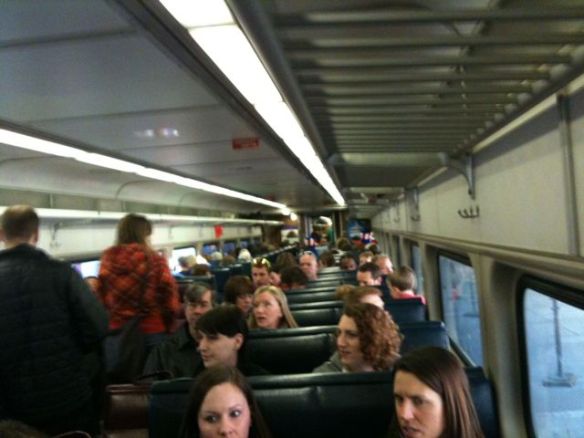
8:57 – the train has left the station!

the science of sport will be doing live splits for the leaders, which should be interesting. Will Ryan Hall have his break out race and win it all?

http://www.sportsscientists.com/2010/04/2010-boston-marathon-live-splits-and.html

9:08 standing room only:

9:26 – a few more stops to Framingham… I’ll have a tough decision to make at some point as there is nearly a two hour gap on inbound trains which could put me in jeopardy of making it back into the city for seeing Dad and Kim finish. :-(. Not sure how much I can trek on foot.

9:55 just got to Framingham…

10:09. lead women just passed where I am in about 38 minutes… I must be further than the 10k which is where I thought I was… going to start heading up the course…

10:28. ran a little over a mile up, now waiting for the lead men. Dad and Kim should be starting in two minutes. I’m just short of the 8 mile mark.

10:38 lead pack of men just passed in a little under 38 minutes — again I am a little short of the 8 mile mark. they are fast! 🙂

10:45. that will be the last of my posts on the elites… think I’ll head up the course some more so I have more options on the trains!

11:02 I’m at the mile 9 marker. I’ve gotten no text updates for 3 wave 1 runners shooting for 3 hr runs so it looks like ther may be too much of a delay to be useful to know when to expect dad and Kim

11:04  random picture of runners

11:06 I have yet to see a barefooted or vibram wearer. but I have not been looking that close!

11:23 wave 1 is finally starting to thin out a bit here at the mile 9 marker… it would be just about impossible to spot someone in particular as thick as it was!

11:37 the beginning of wave 2 is now coming through mile 9…

12:09. Kim just passed mile 9. I’m going to have to make a run for the train station or I am going to be stuck.

12:30 ran 1.5 miles for the station and made it, but now the train is late. I had to make the tough decision to not wait for Dad at mile 9 as the next inbound train is at 2:20 pm and I would not have made it back to Boston until too late! Now I need to figure out when to get off next!

12:39 I think I’ll get off in Newton, just past mile 19. I can make it in from there on foot if needed! Bummed I’m missing “kiss me corner” at Wesley College! 🙂

12:53 ATT texts do not seem to be working for most spectators around me, but Nadia in GA is getting them! she just sent me this:

They’ve both passed the 15k mark–your dad just a little while ago, and
Kim about 10 minutes before him. By my calculations, Kim will be at 20k
before 1:00. Your dad should be there before 1:15.

I think I’ll jump off the train a little sooner than I said in my last update.

13:27. just arrived at the 30k mark — hope I didn’t miss Kim!

13:37. finally saw some bare footers! the lady was in a full body cheetah leotard.

13:43 definitely missed kim according to the splits on the web… by maybe 10 minutes at most, probably a lot less — she sped up! now need to figure out what to do and how to get back!

13:49. looks like a 2 mile run to the 1st subway station… will hang here at 30k a bit to see if I can catch Dad…

14:05. still no Dad here at 30k and the web shows no 25k time… not sure what is going on… Kim past 35k and should be done soon but I am miles form the finish… time to run to the T I guess…

14:34 just past mile 20 waiting o see if dad shows up. based on updates from Nadia he should be here any minute…

14:49 word from Nadia is Kim finished in 3:49. I’m with dad on heart break hill.

15:21 still close to Dad near mile 23. I was going to take the T in but I’m able to keep up with the train because t is moving so slow due to all the people…

15:27 dad is making phone calls from the course.

15:51 passing mile 25, 1.2 to go! I’m still tailing dad from off course.

16:23 at the end waiting to find everyone… the last mile was impossible as a spectator to keep moving and I had to go a few blocks around

16:40 in taxi heading towards hotel
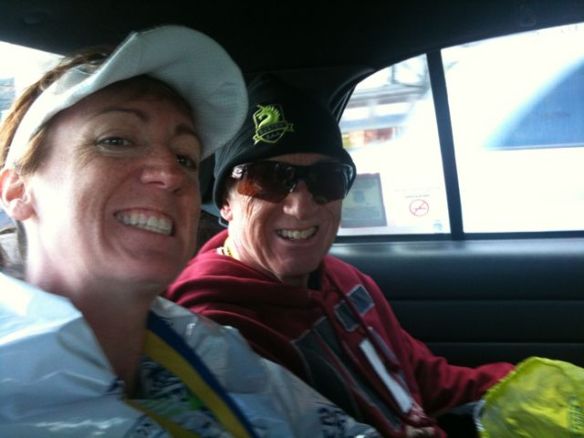
17:22 cleaned up a few typos from a real computer.  the end.  thanks for watching.

Ultramarathon Man. Dean Karnazes.

I finished the last ultra running book too far before my own attempt at an Ultra (Uhwarrie 40 miler — tomorrow!), so I searched around to find another and found this book by Dean Karnazes.  Dean ran as a freshman in high school but pretty much gave it up after that until he was 30.  While feeling unfulfilled, though successful in terms of career and salary, he decided to go for a run after getting home from his 30th birthday celebration (which included Tequila!).  And he didn’t stop running all night — in fact he has been running ever since.

At first it was fairly “normal” running of 5 or 6 miles after work, but then he came across two guys training for the Western States 100.  He felt called to attempt that challenge, and eventually moved on to race Badwater (135 miles starting in Death Valley ascending to the top of Mt Whitney), to completing the 1st marathon run to the South Pole, and finally, the book culminates in running a 199 mile relay race solo!

In some ways the stories are like race reports, but they are woven around his metamorphosis into one of the greatest endurance runners ever.  Fascinating read, good writing, and just what I needed with my race tomorrow!

Here are a few quotes… I highlighted much more than this, but many are about training or things I wanted to look into further…

  • He who suffers remembers. —Fortune cookie
  • The cross-country guys hung out in late-night coffee shops and read books by Kafka and Kerouac.  [ as compared to the track guys…]
  • “Don’t run with your legs. Run with your heart.” On some level, even as a high school freshman, I got his meaning: the human body has limitations; the human spirit is boundless.
  • At that moment I realized that my life was being wasted. Disillusioned with the trappings of the corporate scene, the things that really mattered—friendship and exploration, personal expansion and a sense of meaning—had gotten all twisted around making a lot of money and buying stuff. I hungered for a place where I could explore nature and my capabilities, away from a corporate office in a corporate building in a big city with crowded supermalls and people judging me by the car I drove (which, of course, was a new Lexus).
  • As I limped around my office, trying to appear natural, I reminded myself that pain and suffering are often the catalysts for life’s most profound lessons. A passion I’d ignored for half my existence had been serendipitously reignited in one all-night thirty-mile hullabaloo.
  • You’ve got to bundle up self-doubt and fear and stuff them in your shoe, cutting loose your rational mind as your body is pushed to inconceivable levels of endurance.
  • As Lily Tomlin said, “Exercise is for people who can’t handle drugs and alcohol.”
  • Long-distance running requires a certain discretion and reserve. It’s easy to let your ego get the better of you early on and run beyond your means.
  • Most dreams die a slow death. They’re conceived in a moment of passion, with the prospect of endless possibility, but often languish and are not pursued with the same heartfelt intensity as when first born. Slowly, subtly, a dream becomes elusive and ephemeral. People who’ve let their own dreams die become pessimists and cynics.
  • Only those who will risk going too far can possibly find out how far they can go. —T. S. Eliot
  • Start slow, then taper off. —Walt Stack, Bay Area running legend
  • People think I’m crazy to put myself through such torture, though I would argue otherwise. Somewhere along the line we seem to have confused comfort with happiness. I’ve now come to believe that quite the opposite is the case. Dostoyevsky had it right: “Suffering is the sole origin of consciousness.” Never are my senses more engaged than when the pain sets in. There is magic in misery.
  • But life didn’t seem as vibrant without coffee, so I went back to my morning ritual (okay, maybe I am totally addicted after all). [ sounds like me, though I haven’t even tried to give it up!  🙂 ]

The Promise. Chaim Potok.

ThePromise

After reading “The Chosen” a few weeks ago, I had to follow with another Potok book, and of course went with “The Promise,” which is somewhat of a sequel.  (More just a follow-on book with the same characters later in life than a sequel.)

Two main points stuck me:

  1. the portrayal of different father-son relationships. (How one was so close, at least in terms of studying Talmud but additionally in seeking each other out for guidance and discussion in the struggles of life, while others were strained in various ways.)
  2. the amazing study of their faith as part of a lifelong journey — but so much more dedicated and in depth than what is typical today, at least in the part of society I see around me

Some quotes that are all mostly self explanatory (And I’ve bolded one I that has resonated with me the most recently):

  • “What energies we waste fighting one another…”
  • “It’s always easier to learn something than to use what you’ve learned.”
  • “You understand what it is to make a choice…?  A choice tells the world what is most important to a human being.  When a man has a choice to make he chooses what is most important to him, and that choice tells the world what kind of man he is.”
  • “A person must know who he is.  A person must understand himself, improve himself, learn his weaknesses in order to overcome them.  It is hard for a person to understand hi own weaknesses…”
  • “The Master of the Universe has so created the world that everything that can be good can also be evil.  It is mankind that makes a thing good or evil … depending on how we use the wonders we have been given.”
  • “…men hesitate to talk to their fathers.  A boy always wishes to be able to talk to his father.  And a father waits for the boy to become a man so they can talk as men.  And then the boy becomes a man and no longer needs the father.  It is a strange thing.”
  • “That is the way the world is… Each generation thinks it fights new battles.  But the battles are the same.  Only the people are different.”

Deep Church. Jim Belcher.

deepchurch

I stumbled across the link to The Deep Church on the Inter-webs, and the words on the front page struck a chord…

Feel caught between the traditional church and the emerging church? Discover a third way: deep church. C. S. Lewis used the phrase “deep church” to describe the body of believers committed to mere Christianity. Unfortunately church in our postmodern era has been marked by a certain shallowness.

After reading it, I feel like I have found what I have been looking for, even though I could not pinpoint exactly what it was I was looking before before having read it.  (Does that make sense?)  In several recent posts I have lamented the fact of apparent shallowness in the area in terms of doctrine, so the words above definitely caught my attention.

What is funny is that my pre-conception of “The Emerging Church”was way off.  I had assumed it was the large, mega-church movement with contemporary worship services.  However, that is not it at all… It is a movement that criticizes the traditional church in seven key areas (Captivity to Enlightenment rationalism, a narrow view of salvation, belief before belonging, uncontextualized worship, ineffective preaching, weak ecclesiology, and Tribalism). I will not get into those seven criticisms here — you should read the book for that — other than to say that I found, as I read the details of each, that I shared some aspects of the criticisms myself.

Belcher takes the time to expand on each criticism thoroughly, but then points out where he feels the emerging church (sometimes) goes too far.  I again found myself agreeing with him on many many points — while I share the views of the issues the emerging folks see with the traditional church, I also agree with Belcher’s view on just about every point where he thinks they over do it.

The main purpose of the book is to define a third way, beyond traditional and emerging.  Of course there is no way to summarize the entire book, but one of the basic tenets  is agreeing on the foundations of the faith as outlined in the early creeds, and letting everything else slide a little.  We have tried to follow this principle of primary vs. secondary doctrine with Haw River Christian Academy, and I strongly feel it is always the way to go.

I have started using Evernote to keep my reading notebook (it’s a great service!  keeps my notes synced to the cloud and I can get to them via any computer or my phone, changes sync automagically, etc.)  I have a tremendous amount of notes from this book.  That means a couple of things — there are either great quotes or there are passages that really make me think, and I want to be able to come back to them.

Both fit here…

  • “There is a depth in the ancient church that is very up to date.”  [ and therefore it is worth honoring the tradition of the old church…\
  • “The Enlightenment quest for certainty based on unassailable reason and science is a dead end… It cannot be pulled off.  It has never been done.”  [We (those of us currently alive) are all children of the Enlightenment, and therefore Children of Reason, and that is so difficult to put aside..  But it needs to be in questions of faith.  Not that you can’t use logic and reasoning in apologetic argumentation, but that there are sometimes things that go beyond just that…]
  • “the next day I contacted the Presbyterian Church in America (PCA) … I enquired about church planting.”  [this one stands out because so many CCS schools are backed by PCA churches!  And PCA just keeps coming up in strange places, yet there is no PCA church here…  :-/ ]
  • “oh you are describing Redeemer Presbyterian Church in NYC…”  [This also stood out as I had just read two Tim Keller books, and his church is also PCA…]
  • “We train our members to read discerningly, to think for themselves and to be enriched by other traditions even as they dig deep in the soil of their own tradition.”   [ nice to hear! ]
  • “Hermeneutical Circle”  truth neither starts with knowledge that leads to faith nor with faith that leads to knowledge.  How do we get into this circle?  The starting point lies beyond us, with the Holy Spirit who places us inside the faith – knowledge circle…

I guess that is good for now.  I highly recommend the book for anyone that has never felt 100% at home at their church, and even if you do feel at home, I think this book could provide growth opportunities none-the-less.

King Solomon’s Mines. H. Rider Haggard.

kingsolomon

I saw this mentioned on another blog as a good adventure story, and felt like I needed a break from my non-fiction reading.  Not a bad yarn, but what is up with so many stories using prior knowledge of solar eclipses as escape mechanisms or shows of superiority?

Anyway, some quotes (as there’s not much more to say):

…there is no journey upon this earth that a man may not take if he sets his heart to it.  There is nothing … that he cannot do, there are no mountains he may not climb, there are no deserts he cannot cross, save a mountain and a desert of which you are spared the knowledge, if love leads him and he holds his life in his hands counting it as nothing, ready to keep it or lose it as Heaven above may order.”

What is life?  Tell me … [ you ] who are wise, who know the secrets of the world, and of the world of stars, and the world that lies above and around the stars; who flash your words from afar without a voice; tell me … the secret of our life — whither it goes and whence it comes!  You cannot answer me; you know not.  Listen, I will answer.  Out of the dark we came, into the dark we go.  Like a storm-driven bird at night we fly out of the Nowhere; for a moment our wings are see in the light of the fire, and lo!we are gone again into the Nowhere.  Life is nothing.  Life is all.  It is the Hand with which we hold off Death.  It is the glow-worm that shines in the nighttime and is black in the morning; it is the white breath of the oxen in winter, it is the little shadow that runs across the grass and loses itself at sunset.”

Our future was so completely unknown, and I think that the unknown and the awful always bring a man nearer to his Maker.”

Yet man dies not whilst the world, at once his mother and his monument, remains.  His name is lost, indeed, but the breath he breathed still stirs the pine-tops on the mountains, the sound of the words he spoke yet echoes on through space; the thoughts his brain gave birth to we have inherited today; his passions are our cause of life;  the joys and sorrows he knew are our familiar friends — the end from which he fled aghast will surely overtake us also!”

… how little we think of others when our own safety, pride, or reputation is in questions…”