“Half SCAR Plus”

Introduction

The SCAR run has long been on my mind, when I first heard about it from my old adventure racing teammates Charlie and Ernie.  At the time,  I thought they were pretty crazy, and their first attempt was downright frightful — caught in crazy weather of snow, rain, wind, etc.  You can read Charlie’s account of their second, successful attempt here. I didn’t really think I’d ever attempt it at the time, but then the idea began to grow on me.  And as my knee has been doing better and better the past year or so, and I’ve been running stronger and stronger, including an 8 hour finish at Uhwarrie (38 miles this year on a slightly shortened course), I figured now was as good a time as ever.  When my friends April and Mike said they were interested in helping out, I jumped at the chance.

I did not carry a camera as I didn’t want the added weight or the temptation to stop.  There were many amazing sites that will only live in my head.  So hopefully this post is not too boring!  I do have some photo’s at the camp site where Mike and April were waiting for me and I did take a couple with my phone at clingman’s when I got it out to send a quick update to my wife that I was still alive and well…

The Plan

I had planned to run the full SCAR, all 72 miles, all along.  But the weeks leading up to it led me to believe that was not a wise choice.  First I got some pretty bad blisters on both feet on a barefoot run — I almost never blister!  What gives?  I had some callouses growing, which are no good for distance running, and normally a mile or two on pavement acts like a pumice stone and they are gone.  For some reason, this time I blistered under the callouses and they eventually came off.  So I lost about a week there.  Then I got pretty sick, and lost a week trying to figure out what it was.  The 1st day was really bad, but then I thought I was getting better, only to plateau and then get worse.  A second week down the drain.  When it got worse and I noticed a swollen lymph node, I went to the doctor.  Turns out I had had Rocky Mountain Spotted Fever, and subsequently a bacterial infection from the same bite!   I started antibiotics right away, but recovery was slow and I never really got back to good training.  I had lost about 6 – 8 lbs, which for me is significant since I only weigh about 145, and had trouble putting it back on. Finally, 6 days before my scheduled SCAR date, I got a two hour run in, but it was not strong.  At that point I decided for sure that 1/2 SCAR would be plenty.

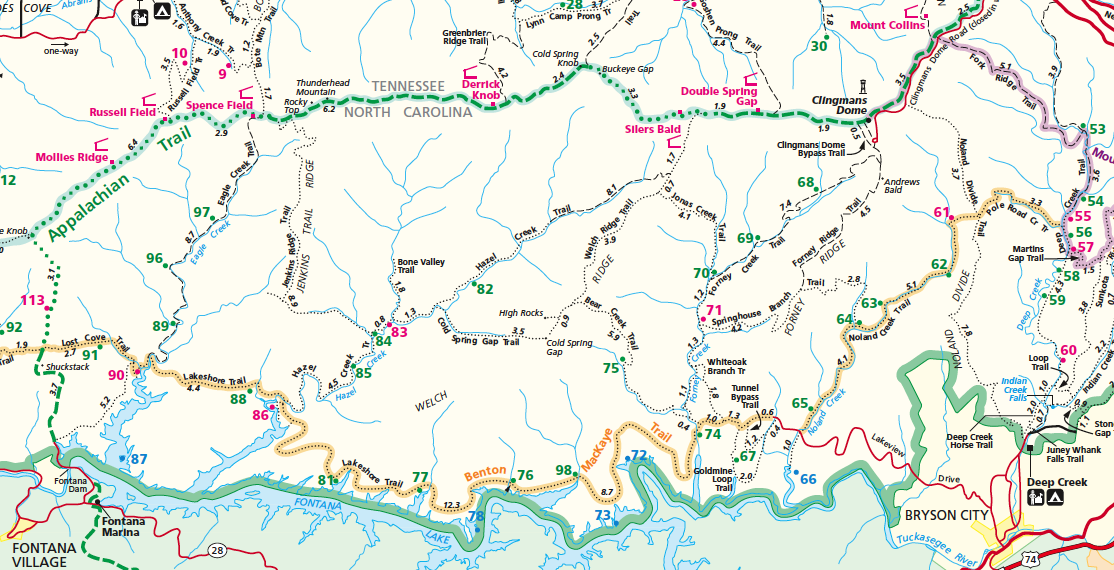
Because Clingman’s Dome road and Mt Collins shelter are closed, the former due to re-paving and the latter due to bear activity, doing a 1/2 SCAR was tough logistically.  I didn’t want to meet April and Mike at US 441/Newfound Gap, as I was not sure when I would be there and did not want to  leave them waiting too long.  We settled on camp site 53, a five mile run down a side trail away from the AT.  Fork Ridge trail hits the AT at just about  the exact half way point for a full SCAR.

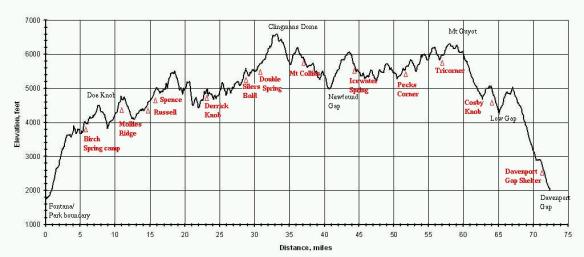
Here is an elevation profile and map… About 3 miles past Clingman’s dome, I would hit the Mt. Collins shelter trail head, and just past find the trail head for Fork Ridge down to the camp site.  I had spoken to a runner who had done the full SCAR just a few days prior and he said there was a sign on the AT for Fork Ridge, but my map did not show that, so I was not sure that would be the case.  But I was hopeful, and if not, Clingman’s Dome road was right next to the AT just past the Mt. Collins shelter split, so I knew I could find it from there.
And a part trail map…  Start at the bottom left at Fontana Dam, run the AT, the green dotted trail all the way to Mt. Collins at the top right, then head down Fork Ridge, the purple trail, to site 53:
Getting There

I picked up April and Mike around 10:30 a.m. and we headed west.  Any trip on I-40 near lunch time warrants a stop at My Father’s pizza in Black Mountain, one of the best pizza joints in the world, so we hit that where I ate a salad, an entire pizza, and had a last beer to wash it all down.   April wondered if I was having a “last meal.”  :-/  She also introduced me to an excellent little chocolate shop a well.  We grabbed 50′ of 3mm cord for a bear rope as I wasn’t sure if the camp site we had agreed to meet at would have cables or not, and we were on our way to Fontana Dam.  We arrived there around 5:30, walked down to the shelter which only had 2 hikers in it, and then walked around the dam, visitor center, across the dam and up the road that leads to the trail head.  We turned back, cooked dinner, chatted with the hikers, went over the meeting place one final time, and I went to sleep as soon as it was dark (about 9:30).

Wake-up Call

I of course tossed and turned.  I normally don’t sleep that well the 1st night out on a back packing trip, and the night before a big race or event is also always difficult.  So I tossed and turned.  And tossed.  And turned.  I looked at my watch many times and it seemed like time was moving in slow motion.  Finally at 4 a.m. I decided I might as well just get up and go rather than wait any longer.  I grabbed my pack, bag, and pad as quietly as I could and walked the 100 meters up to the Fontana Shelter bathroom.  There were some tent campers on top of the hill with a HUGE blazing fire.  At 4 a.m.!  Weird.   Anyway, there I put my sleeping bag and pad in their respective packs, filled my hydration bladder and two hand held bottles, and walked the 200 meters to the car.  There I quickly got a cup of coffee brewing, got dressed, and put my final gear in order.  I opted here to skip my oatmeal breakfast — there was no way I could eat anything right now, so I decided to stuff another bar in my pack and head out.  I hit the restroom at the visitor center, climbed the stairs back to the dam, and started running at 4:38 a.m.  Officially that means I ran an extra 1/2 mile or so since SCAR starts at the border of the GSMNP.  I was cool with that.  🙂

The Climb out of Fontana

After the nice flat run across the dam, the road up to the trail head was gradual and fairly easy.  But as soon as I hit the trail, I knew I was in for quite a climb. I already knew that, at least in theory, from having looked at the elevation profile (see above!).  But wow was this tough… Not much running here.  Every once in a while I’d see the lights of the dam below, getting farther and farther a way.  This was literally a 4 mile climb of 1500 feet before it plateaus just a little, and then continues climbing for 4 more miles before you finally get a down hill.  I tried to run as much as I could, but again, it was tough.

Bear Encounter

About 2 and a half hours in, my first handheld bottle of perpetuem and chia mix was just about empty.  (See below for my fueling strategy.)   I squeezed it into my mouth, and the bottle of course made a squishing empty bottle sound.  I heard a response off to my left — it sounded like a wild pig snorting in the woods maybe 20 meters a way.   A few minutes later I heard what sounded like a very large pig digging for truffles off to my left, and then I thought to myself that it was moving awfully quick.  The next thing I knew, the biggest pig I had ever seen ran across the trail maybe 15 – 20 meters in front of me.  It took all of 3 seconds to realize it was not a pig but a bear — albeit a somewhat skinny bear!  My 1st live/wild bear sighting!  🙂

About 30 minutes later, I saw my 1st hikers of the day.  They asked where I had come from and were surprised when I told them Fontana, which was a good 10 miles away since it was not even 8 a.m. yet!   About 20 minutes later I came up on Mollies Ridge shelter, which kind of has its back to the trail the way I was headed.  I could see a couple people on the far side doing normal morning things like gathering gear and brushing teeth.  It turned out it was a father and daughter (about 13 yrs old I would guess).  Apparently I had given her quite the fright as all she saw was me in my black shorts and shirt, and she thought it was a bear running at them!  I just stopped to say good morning and then kept on running.

First Water stop:  Russell Field Shelter

My 1st planned water stop was Russell Field Shelter, about 15 miles into  the run.  I got there and there were a lot of hikers eating breakfast and the like.  I’m not sure if they all had slept in the shelter the night before, but that would have been packed like sardines if that was the case!  I asked where the water was, and ran down about .2 miles to it.  It was not a piped spring, which was a bummer.  I poured the good water from my bladder into my hand held bottle, then filled the bladder and 2nd bottle.  I was not happy to see all the floaties, but figured I’d not really notice them later!  I put my water treatment pills in, filled the handhelds with my perpetuem chia mix, and headed back up to the shelter.  There I stopped for a minute or two to fix my socks and re-tie my shoes, and chatted with a couple of the hikers.  Then it was back to the trail for more running.  I had my pace down to about 17:15 per mile at this point, but by the time I left after getting water and all, it was up to 17:45!

Thunderhead

From Russell field I passed Eagle Creek trail to Spence Field shelter, Rocky Top, and on up to Thunderhead, which is quite a steep little climb.   Near Rocky top I passed a crew of trail volunteers maintaing the trail, and I thanked them all.  This section of trail was getting quite over grown, and where they had cleared was great, but beyond that, it became difficult to run as the grass was covering all the dangers of the trail like the rocks and roots and washouts.  After Thunderhead, I expected to see two SCAR runners that were supposed to have started at Davenport, the opposite end of where I had started, at midnight.  Based on what I thought their expected time would be, I should have seen them, but I did not… So I kept looking and kept looking….  My pace had slowed into the high 18’s by this point, as this was difficult trail!

Derrick Knob Shelter

I reached Derrick Knob probably around 7.5 hours.  I wanted to get more water here — hopefully for the last time.  This looked to be a really nice shelter, so I’m storing that away in case I ever backpack this section!  The water was just down the hill and was a nice piped spring — the kind I am tempted to not filter or treat.  But I had tablets so I used them.  Once I was back up the hill at the shelter I spent a quick minute re-organizing the gear before I was back at it.

26.2

I hit the marathon point just after 8 hours.  Wow!  I finished Uhwarrie this year, which was 38 miles, in just under 8 hours.  Here I was 12 miles behind that pace.  I had not felt that my sickness leading up to this race was slowing me down that much, and while it may have a little, it just proved to me how tough this trail really is.

It was here that I finally put on the ipod — one ear only as always on the trail so I can hear what is going on around me!  I had originally figured maybe a few hours of no ipod, but I never really needed or wanted it until this point. And then right at 26.2 I just felt like it was time for a little music.  🙂

About 15 minutes later, I finally saw someone that appeared to be a runner not a back packer — he had just a waist belt on with two bottles in it and one hand held.  Since this is such a remote location — we were probably a good 15 miles from the road at Newfound gap — it had to be a runner.   I asked him if he was a SCAR runner and at first he didn’t understand and just said he was running from Davenport to Fontana.  I said “yeah, that is SCAR,” and he said “oh yeah — it’s been a rough night.”  They had left at midnight as planned, but the 1st 12 miles were pretty tough, and his co-runner had gotten sick.  So he tended to him and got him to their support crew, and then continued solo.  His final words stayed with me for a while — “I’m just in survival mode now!”   At this point he had done about 45 miles to my 27 or 28…

Clingman’s Dome

From Derrick’s Knob to Clingman’s is about 10 miles and 2000 feet of climbing.  Would the ascent never end?  It was gradual, but there was so little flat ground to gain some speed!  One thing about the AT is that there are often long sections with very little mountain vistas and views, especially in the summer when the trees are full.

At Double Spring Gap I decided to stop and do some quick foot work.  I felt the blister from 5 weeks earlier on my left BOF start to come back — at this point my feet had been wet most of the day and they turn that white pruney cadaver look, and the old blister lines were splitting a touch.  So I took the time to duct tape that area and put on dry injinji socks for the rest of the run.

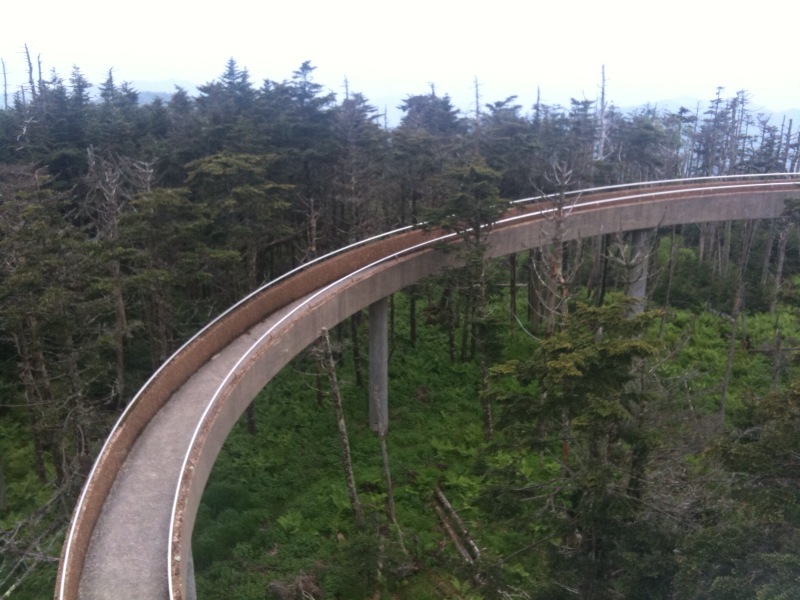
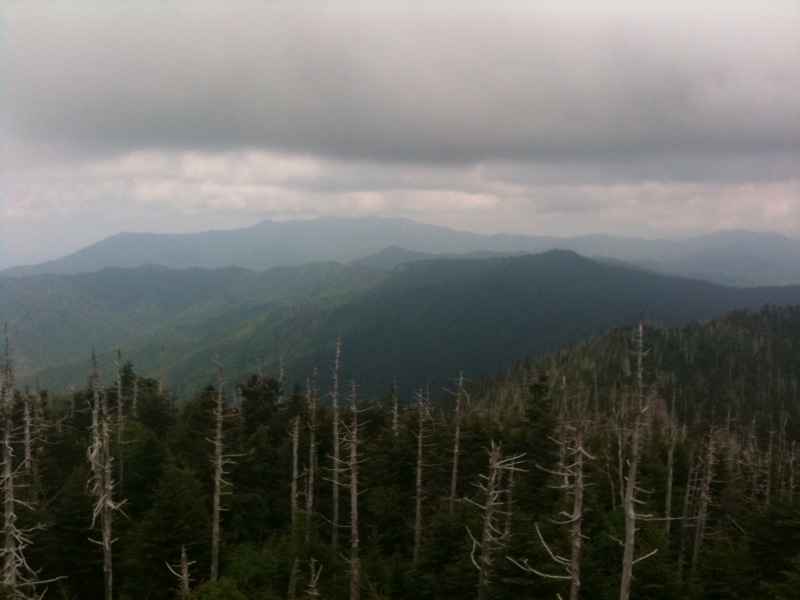
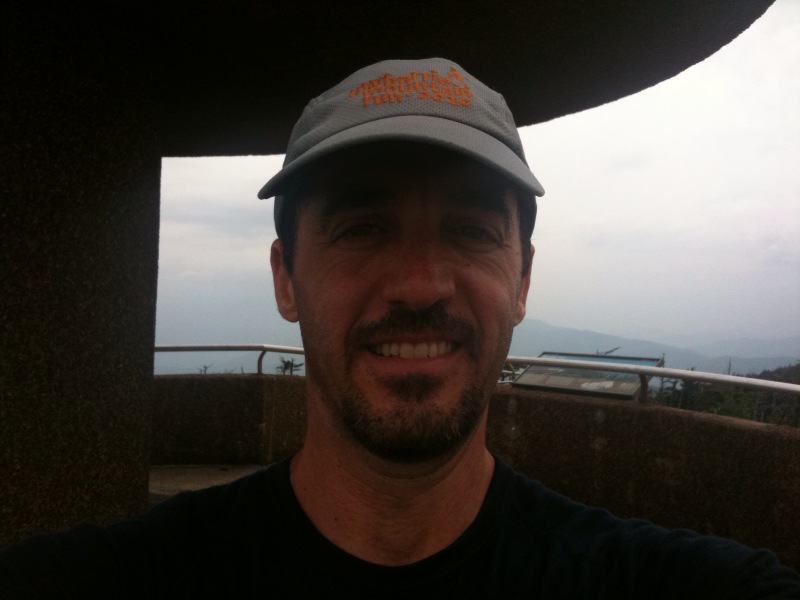
Once I passed Double Spring Gap shelter around mile 31, the trail opened up and there were mountains all around!  It was sad to see so many dying hemlocks, but it was nice to finally see something.  When I finally reached Clingman’s Dome, I had to run up the ramp to the watch tower, even though it was a little off trail.  With the road closed, it was deserted up there — much different than last time when it was crawling with tourists!  I had carried my phone on the off-chance there was service here, but had yet to take it out of my bag.  I pulled it out and there was AT&T E!  I sent a couple quick text messages to Kelly updating here on where I was and decided to snap a couple quick pictures.  For some reason, April and Mike’s phone number was missing, so I could not send them anything.  I doubt they would have received any messages from me as they would have been hiking down into the valley by now.

The ramp:
Mountain vista:
Me, not looking too bad after 34 miles!  🙂
Mt Collins

From Clingman’s I had to descend down the AT to the trail towards Mt. Collins, about 3.5 miles away.  This section of trail was very tough — it was steep and muddy and rocky, and it started to sprinkle.  And then it started to pour.  I finally had to break out the black trashbag I had brought… I brought it instead of a rain jacket to save space and weight, and the trash bags can be useful in many ways.  I quickly poked a hole in it for my head, put it on, put my buff around my neck to keep water from dripping down, and put my hat on.  Now it was raining so hard the trail was literally a stream bed…  After a while I thought for sure I should have come to the Mt Collins split, but it was nowhere to be found.  I really had hoped I had not passed it.

And then I met Gandalf.  Well, he reminded me of Gandalf.  All of a sudden, there he was.  A man in a yellow 3/4 length poncho with the hood on, and a large staff in his left hand.  At first I thought it was Mike, and I was impressed that he had hiked nearly 8 miles to find me! Then I realized it wasn’t Mike.  I asked Gandalf if he had passed the trail to Mt Collins.  “I don’t know,” was his response.  :-/  I said either I passed it or you did.  And he said “Maybe it is 20 minutes beyond for you.”  Ok, thanks for the info, and I head out.  He was thoughtful enough to yell “Stay Dry!”  Right, this was like the Biblical Flood happening and I have a black trash bag as a rain jacket.  Stay dry!  I thought of lots of responses but in the end just ran off.  I was more worried about staying warm at this point!  Cold rain at 6000+ can be chilly!

Two minutes later, I hit the trail split!  I guess he must have been out of it to have not noticed.  The beautiful thing here was a sign for Fork Ridge trail 0.2 miles further along the AT!  Here I was at the 1/2 way point of SCAR, just about at 20:00 pace which is a 24 hour run if you do all 72 miles.  I had really slowed on the climb up and down Clingman’s!  From here, though, the rest of SCAR is mostly downhill.  Should have been easy to maintain that pace or even speed up a little, right?!  Except night would hit in about 4 hours, so I’d have a good 7 or 8 hours in the dark.  Anyway, the plan today was for Half SCAR, so maybe next time!

Fork Ridge Trail

I reached the sign for Fork Ridge Trail 0.2 miles later just as the sign at Mt Collins had said.  Only here was a problem.  There was now another sign that said Fork Ridge was closed due to the road construction on Clingman’s.  Now I had a dilemma.   If it was closed where Mike and April were to park and hike down on Deer Creek Trail, would they be at the bottom?  My choice was to run 4.6 miles on the AT to US 441 and head down that road to the trailhead they should have been parked at which would have been maybe 3 or 4 miles more on the road.  If the car was there, I’d run down the trail and meet them.  That would be about 12 more miles of running.  Or I run down the closed trail 5 miles, and if they are there, I am done, and if not, I have 4 miles to run up to the road and hopefully find some clue to where they might be.

I decided to stick to the original plan and run down Fork Ridge.  If they were not there, it was less running for me.  If they were there, it was a lot less running for me.  I went from the AT another 20 meters to Clingman’s Dome Road, crossed, and went to the trail head for Fork Ridge.  Here another sign slightly caught my attention — it said the bridge at Deer Creak was out and not usable.  Hmm… It’s a creek, right?  I can cross a creek without a bridge…  That thought stuck with me much of the way down this trail.

So, the bad thing about a trail being closed is that it is not maintained.  Well, this trail turned out to be  bushwhacking adventure in some places, there were so many down trees.  And there were a couple of washouts where there was not a whole lot of trail left.  But when the trail was open, it was good.  5 miles down with nearly 3000 feet of descent.  It was here that my knees finally let me know that they  were getting a little tired of all the pounding!  Overall they had held up really well, though, so not much to complain about….

As I got closer and closer to end, I kept wondering what would happen if April and Mike were not there… Or if the bridge was out and the creek was more than I bargained for.  And the sound of water kept getting louder and louder.  And LOUDER.  So now I had some serious concerns about creek crossing with no bridge.

When I finally got to the bottom and came to the creek — there April and Mike were!!  Woohoo!  13.5 hours and 42 miles later, it was so good to see them, and it was awesome to see they had set up my tent!  🙂

Me at the finish, still smiling!
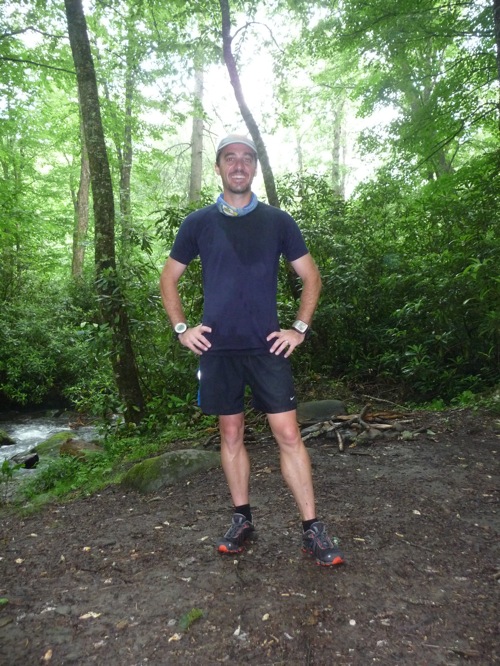
After taking off my shoes, I had to eat before anything else!  🙂
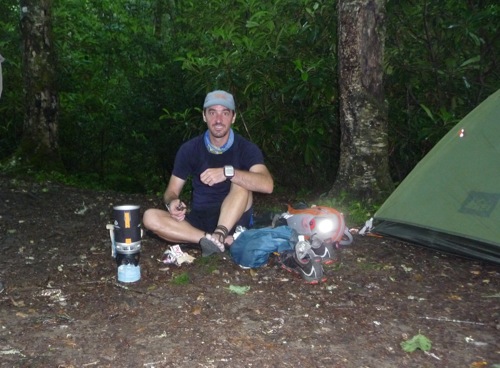
Here is the stream we camped beside… it was crossable!  and Very very cold.  After I ate, I used my buff to rinse off the days sweat and grime.  April even had soap which was a nice surprise and treat.  I had packed a camp towel in the backpack April had carried down, so I dried off with that and got dressed in clean clothes.  I have to give a big thanks here to April and Mike.  They carried all my back packing gear — more food, fresh clean clothes, my tent, sleeping bag, sleeping pad, etc., as well as the gear they needed, all the way down for me.  Awesome!

Garmin Data

Here is the map from Garmin…  Too bad wordpress.com won’t let me embed it here.  Oh well, a picture works too I suppose!

And the elevation profile:
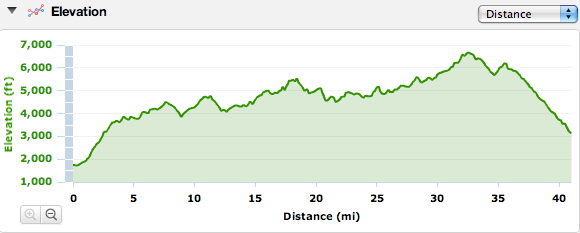
Garmin says I did nearly 14,000 feet of elevation, which I think is about right for this run.   That much climbing and descending made running tough.

Hiking out

After a decent nights sleep, we had breakfast, packed everything up, and hiked out the 4 miles to the car.  Yes, I wore the huaraches out!  🙂  I also carried my backpacking pack and all my gear, as well as my running pack and running shoes.  I just strapped them on to my pack and hiked out.  Overall, my legs felt good, other than my right hip.

Wildlife

Besides the bear encounter described above, I saw the following:

Turkeys — one sitting on a log about eye level just  10-12 feet away.  We stared at each other until I finally said something to him like “Good Morning,” when he proceeded to jump off the log and fly away.  Yes, turkey’s can fly, at least a limited distance!   Then a few hours later I came across two more… One jumped off the trail fairly quickly, the other ran the trail in front of me for a good 30 seconds before it realized it should just get out of the way.  Or maybe he was pacing me.

Fox or coyote — I caught a glimpse of a sandy small dog shaped animal running the trail in front of me, though I could not tell exactly what it was.

Whippoorwill — I didn’t see it, but it kept me company as I climbed out of Fontana in the dark… Reminded me of home, though our Whippoorwill is about 50 db louder than this one!

Toads – many toads on the trail, especially in the morning — one the size of a softball!  I swear!

Gear selection and thoughts

I always like to re-cap my gear and nutrition to help me on future events.

Nutrition

I again used a strong/thick mix of perpetuem — about 500 calories per bottle.  This time I mixed in a couple tablespoons of chia seeds.   I dilute this with water from my hydration bladder as I run, and this allows me to get in a lot of calories with relatively little weight.  This was my main fuel.  Beyond that I had two or three bars, two or three packs of cliff shots, 4 hammer gels, and combos.  If I went longer I would have liked to have something like a PB&J or almond butter and honey.

Gear

  • Ultimate Direction Wasp  — great little pack, rides nice and high, love the vest in front with 4 pockets to give quick access to food and other items…  a touch small if I wanted to do the full SCAR unsupported, but for half SCAR it was fine…  And if I do a full SCAR with support at US 441, it would work fine.  I kept one hand held bottle in reserve in the pack.  The pack did give me a small rash on my back where the bottom of the pack must have been rubbing… I was pretty much wet all day so I am sure that had something to do with it!
  • 64 oz hydration bladder — just for water
  • 2 x 22 oz sport bottles — to carry my perpetuem/chia mix… one in the pack and one in the hand held…
  • Nathan Hand Held — used this to hold one hand held bottle… it also has a small pocket to keep something like a pack of cliff shots and bar or gel.  I would clip this on to a loop on the pack’s shoulder strap now and then when I needed two hands to work with gear, or to use on my legs as I climbed the steep stuff.  Clipping the bottle like this to the pack does not work well when the bottle is full and you are running — there is too much bounce.  But when you are hiking up or down the steep inclines, it works fine.  And if the bottle is empty or close to empty, it is also not too bad.
  • Icebreaker shirt – never leave home without Icebreaker!
  • running shorts & under armor 7″ compression shorts — the compression shorts really helped eliminate chafing.  I was worried about the seams but they rarely bothered me
  • ekko tekko socks – used these for about 30 miles
  • injinji socks – after I taped my left foot, I switched to these for the remainder of the run.  I often use these as a “liner” when the feet start feeling hot spots, but this time I used them alone.
  • NB 790’s – I was worried this might not be quite enough shoe, as it is a trail racing flat, but overall I was pretty happy with them.  There were a few times I would feel the jolt of a rock or root through the bottom, and early on my left ball of foot felt slightly bruised so I switched to a mid foot strike instead of forefoot when the terrain allowed it
  • Pettzl Tikka and Fenix P3D – nice and light yet bright head lamp… the P3D is 120 lumens and helps me find my way quickly if things get tough with the tikka.
  • black plastic trash bag — these have many uses, but on this run, when it started to pour, it became my rain poncho
  • emergency blanket — just in case… I have carried this same blanket on many events and have yet to use it, but some day I know it will come in handy
  • Leatherman skeletool CX — I always carry a leatherman, even though they are heavy.   This one is only 5 oz. so not too bad.  9 times out of 10 I only use the knife, which I did this run for cutting the water treatment tablets.  But having a couple of the other tools, especially the pliers, is a nice safety in my opinion
  • Buff — another item I rarely do long events without.  I mostly used it to wipe the sweat off my face, but it can also be used as a pre-filter for water, as a head covering if you get cold, and around the neck to keep water from dripping down through the trash bag poncho I made.

Final Thoughts

I’m now about 2 days post run, and my muscular soreness is just about gone.  My right hip is still a bit sore, but much better than yesterday.  I have some kind of weird feeling in my left ball of foot — like a metatarsal is popping when I walk barefoot, but it also seems to be getting better.  Overall I am happy with how I felt post-run.  While my knees had started to get sore the last 5 miles or so from all the pounding, they were fine the next day for the hike out and have given me no troubles since then.

I had planned to take at least a week off from running, and I am definitely going to do that, and maybe run just once a week for 2 or 3 miles for a week or two after that.  I still plan to lift more for the next month or so, to try to regain some of the lost muscle from rocky mountain spotted fever.

I am finding it hard not to think of the next big event, and a 50 mile race in the fall sounds tempting.  At the same time, I had said I would take some time off before deciding what to do next, so I need to stick to it.  I could not help but ask Sultan to compare SCAR with some of the ultra’s he has done, and he responded that a full SCAR is more difficult than most 100 mile races.  So that makes me feel better, because Half SCAR was one of the toughest things I have done.

I loved every minute of it, and can’t wait to attempt the full course in the not too distant future!

Thanks for reading!
My name is Zola

This article was shared on the Google Minimalist list, and I thought I’d share it here.  It brought back memories, and my Zola story:

In 1986, when I was a sophomore, my high school started a soccer program for the 1st time in school history.  Rather than hire a soccer coach, they sent over the fitness coach of the football team to be our coach.  We were the fittest team in the county!  But we sucked at soccer.  We lost 17-0 once, though that was to one of the top team in the state.  They were probably taking it easy on us.

Anyway, we had two hour practices, with about an hour of fitness stuff to start, then a little soccer.  (The worst was the dreaded Indian run, were all 20 of us lined up 10 yards a part, jogging slowly, and the person in back had to sprint to the front…  Man those hurt!)  Anyway, we always ended up at the track after practice where we had to run two miles.  I hated running in cleats, and always forgot “sneakers,” so one day I just dropped the cleats and ran barefoot just inside the clay track on the grass.  I did that every day for the rest of that year and subsequent years — which was less often as we eventually got a coach who wasn’t quite so into fitness.

Well, the 1st day I dropped the shoes, one of my teammates started calling me Zola, and it stuck — all through high school and my 1st year of college when I still played indoor on the 18 and under team we had.  I didn’t even recognize the name until someone reminded me of the collision between Zola Budd and Mary Decker in the 1984 Olympics.

You can watch the video of the 1984 Olympic 3000 meter run here, where Decker and Budd collide.

So, other than running barefoot as all kids do, that was the start of my barefoot career.  Granted I got away from it for many years, only to come back about 7 or 8 years ago when I started having knee issues — but only for 5 or 10 minutes on a treadmill or beach every now and then.  I’m glad to be back much more “full time” these days (though I definitely still wear the right shoe for the trail!).

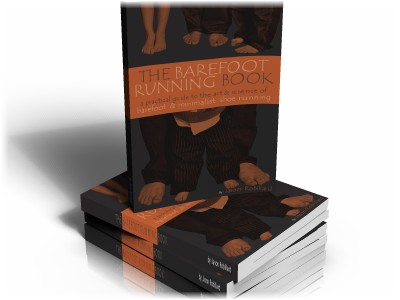
The Barefoot Running Book. Jason Robillard.

Jason is one of the contributors to the Google Minimalist list (http://groups.google.com/group/huaraches/) and when I saw he had a book coming out, even though it is a bit more for beginners, I thought I’d grab a copy.  Over all it is a good read, though it is definitely geared towards the newer barefoot runners out there.  I would definitely recommend it to you if you are in that camp — not withstanding his sense of humor!  😉

Quotes that are worth sharing:

  • Leonardo Da Vinci called the human foot “… a work of art, a marvel of engineering…”
  • wearing shoes decreases the runners ability to judge impact… As such, shod runners produce far greater impact forces [… than barefoot/minimalist]  (I can certainly attest to that, as I currently run barefoot, minimalist, and with traditional shoes…  I can definitely feel the difference.)
  • it will become increasingly difficult to run in traditional shoes.  Your feet will feel incredibly heavy and the rest of your body will rebel against the pounding…  (Another thing that I am finding very true…  Traditional shoes no longer feel comfortable to run in, and my shoes are trending more and more minimalist.  Luckily we are on the precipice of a large variety of minimalist options, something that has not been the case until very recently.)
  • “Each of us is an experiment of one – observer and subject making choices, living with them, recording the effects.” — George Sheehan

Thoughts worth sharing:

  • He brings up the analogy of baby formula vs. mother’s milk, and how an entire generation was lead to believe that formula is better.  But then over time that fallacy was proven, and now it is well known mother’s milk is better (as long as that is possible).  Are we witnessing the same thing with running shoes?  I’m a firm believer in the right tool (shoe) for the job (run/terrain), but also that the more minimalist the better!
  • He suggests running on hard surfaces such as pavement before grass and trails.  I am not so sure I agree.  While trails I would definitely say are “advanced,” I found my short 2-3 minute runs on grass a great way to start the foot strengthening process.   Yet at the same time, I do believe that forgiving surfaces will allow you to miss problems with your form and perhaps delay the transition to proper form…  Its also the case that wearing a minimalist shoe before you have good form can be a recipe for disaster.  So I would recommend 100% barefoot, hard surface running early.  But I also think foot strengthening via exercise, walking barefoot and various surfaces, and yes, running on grass, is good in the early stages.  Just be sure to mix in hard surfaces as well!

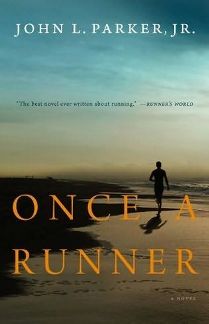
Once A Runner. John L Parker, Jr.

Wow, another running book.  Go figure.  🙂

This one is the first fiction running book I have read, and it is a great story about a college miler.  Beyond the fictitious story, you get a great view into the world of an elite level runner and some view into some of the more intense workouts.  It certainly captured my attention and kept me interested throughout.  And of course I as glad to see Cassidy, the main character, a fan of barefoot running.

Quotes:

  • A runner is a miser, spending the pennies of his energy with great stinginess, constantly wanting to know how much he has spent and how much longer he will be expected to pay. He wants to be broke at precisely the moment he no longer needs his coin.
  • He sought to conquer the physical limitations placed upon him by a three-dimensional world (and if Time is the fourth dimension, that too was his province).
  • If he could conquer the weakness, the cowardice in himself, he would not worry about the rest; it would come. Training was a rite of purification; from it came speed, strength. Racing was a rite of death; from it came knowledge.
  • She found it impossible to tell him that this simply wasn’t the way she had imagined it would be. She was not experienced enough to know that it rarely is.
  • There was no refuge in injury, his body could not be injured in this way. There was no refuge in mercy, there was nothing to forgive and no one to issue dispensation. And at last he saw: there was no refuge in cowardice, because he was not afraid. There was no alternative, it just had to be done.

Worth a read when you need to mix in something fast ,easy, and entertaining into a non-fiction reading list.

Haw River West “Scramble”

I’ve wanted to attempt this run for a while…  Turns out it is much more of a scramble than a run, as there is not a whole lot of trail.  Lots of bushwhacking, bouldering, and even a couple cliff climbs.

Here is what I wrote on Daily Mile:

Ouch! Brutal! Loved it! 🙂

That was much harder than I thought, even though I have done much of the southern sections of this route before, though not all at once. I had not been on the last 2.5 miles or so of the north part before the turn around at Bynum…

Lots of bushwhacking, a few cliff climbs, bouldering. In fact I’d guess that less than 35% of this is on a real trail. And once you pass the power line north of 64, there is NO trail.

I made it to about a quarter mile south of the old Bynum bridge, and I could see the dam at 15/501. But I turned there because I reached someone’s personal property. There were yellow signs showing the “state park” land but with the water as high as it was, I didn’t feel like trespassing. Never know who might pull a shot gun on you! (Next time I’ll just jump on Bynum Beech Road, which I ran next to for a bit.)

I experimented with Chia “fresca” as my only fuel. Two 20 oz bottles of 3-4 TB of chia seeds, a little lime juice, and a little honey, and the rest water.. I will need to try this again. I felt pretty dead by the end, but I can’t tell if that was the course beating it out of me or if it was Chia not fueling me as much as my normal fuel, pPerpetuem.

About 9 minutes slower on the way back, but some of that was route selection. Instead of going “up and over” I went down by the water and with the water level it more bouldering and climbing than I expected!

Looking forward to trying this on the “east” side soon!

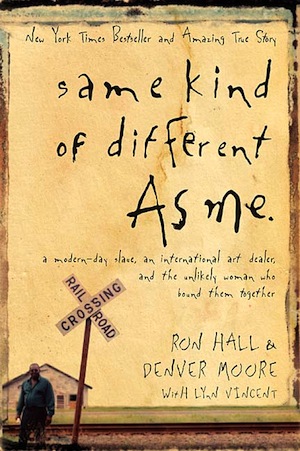
Same Kind of Different As Me. Ron Hall, Denver Moore.

This is another example of how dangerous the Kindle is!  Being able to sample a book, a book I probably would not have glanced at a 2nd time anywhere else, can get you hooked!  I saw this mentioned in blog post by John Piper, where all he said was:

If you want to crawl inside the possible world that opens when a dirt-poor, illiterate, former-share-cropin’, homeless 50-something enters the life of a swank, upscale, southern, Christian art dealer, read Same Kind of Different As Me. These two men tell their increasingly interwoven stories in alternating short chapters that kept me coming back night after night.

So I downloaded the sample, and was hooked a few minutes later.   It was really a great story, well told by the two men who are completely different and write in completely different ways.  Ron, the “rich art dealer,” really strikes a chord with me personally, in how he shows how easy it is to give charitably, but in a distanced manner where you don’t have to risk getting too close, to personally involved.   How true that is!

And Denver is full of wisdom, yet is a person you would never expect it from:

  • There was found in the city a certain poor man who was wise and by his wisdom he saved the city.
  • But you go on down to Louisiana right now, and take a drive on down the back roads in Red River Parish, and you might be able to see how a colored man that couldn’t read and didn’t have no radio, no car, no telephone, and not even ‘lectricity might fall through a crack in time and get stuck, like a clock that done wound down and quit.
  • the more I became convinced we’d enjoy life a whole lot more if we owned a whole lot less
  • on saying yes to being a friend: “Don’t catch and release no matter how difficult it gets.”
  • A successful person is one who is living a joyful life with the hand he or she was dealt.
  • A successful person is one who can thank God for nothin’, and then He’ll give him everything!

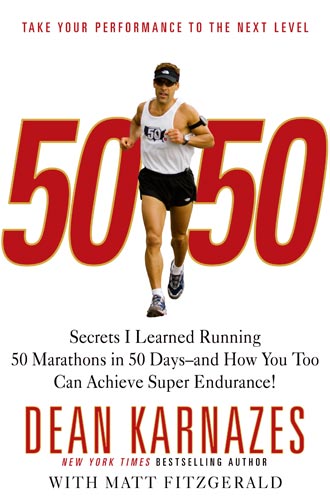
50/50: Secrets I learned running 50 marathons in 50 days…. Dean Karnazes.

After reading Ultramarathon Man, I thought I would read Dean’s second book, which details his journey of running 50 marathons in 50 days in 50 states.  I have to admit, this one did not grab my attention like the other.  I think it is due to the nature of most of the marathon’s — road runs which just don’t excite me.  And the few trail marathons that were thrown in were not of the same level of adventure as the runs in his other book which are more like the long adventure races I prefer.  Still, there were good moments and lots of good quotes, of which I’ll of course include a few.

On “The Awakening” statue:   Most statues, you look at. The Awakening forces you to look in.

(Pretty cool!)

More:

  • “Most people run a race to see who’s the fastest,” he said. “I run a race to see who has the most guts.” — Prefontaine
  • Treat yourself as an experiment of one. Don’t blindly copy the way others train. Try new workouts and methods often; keep those that work for you and discard the rest.
  • I love the motto:  “No Child Left Inside!”
  • Every runner is familiar with the sin of knowing better—of stubbornly pushing ahead despite warnings from the more sensible parts of our minds. The desire to keep running until the task is completed or the goal achieved is so great that it overrides our better knowledge and our self-protective faculties.
  • If everything you knew about life came from TV, your goal would be to live the easiest, most comfortable and unchallenging life you possibly could. You would believe that the only good feelings are sensual pleasures such as the taste of a good soft drink and the fun of driving an expensive car and lying on the beach.
  • … I found myself wondering why so many people like Kris are drawn to marathons and other such challenges these days. I can’t help thinking that the phenomenon is in part a largely unconscious backlash against comfort culture and the easy life. Heated seats and online shopping and robot vacuum cleaners have created a void that we’re all sensing. Our modern comforts and conveniences have accumulated to the point that they have stopped making us feel better and started making us feel worse. Some primal instinct lurking deep inside is trying to tell us that what is needed is a good, hard sweat—some struggle in our lives; some physical challenge.
  • The best way I know to overcome low motivation for running is to get back in touch with the source of my passion to run. Motivation and passion are somewhat different. Passion is an overwhelming love for the experience of a favorite activity. Motivation is a drive to engage in an activity based on some reward the activity offers beyond the simple enjoyment of the experience itself. When you have great passion for running, or anything else, you don’t need any extra motivation. But motivation without passion can only take you so far.
  • As Plato said, “Of all the animals, the boy is the most unmanageable.”
  • Rest was not an option. Endurance never sleeps.
  • He who suffers remembers.

Uhwarrie Mountain Run.

I had tried to get into this race the past few years — the 8 miler or the 20, but never registered in time.  The race typically fills up in 20- 30 minutes.  Due to a registration snafu, I got into the 20 miler twice this year.  I wasn’t sure I’d be ready to run 40, and thought 20 would be plenty.  For a while I thought I might give one of the entries to my sister.  But I also was looking for a reason to run the 40, and when she had plans come up, things fell into place.  All of the old Triangle AR guys were in the 40, and I’ve been running pretty well, so I thought why not go for it.  I could just use the ultra-shuffle to go that distance, right?

The trail and race is notoriously rugged.  Here is an elevation profile:

I’ve run some on the northern section (mile 0-5 or so), though not a whole lot on the trail as we were practicing for a Rogaine, and I had backpacked from the southern end solo last year (miles 20 to 5 or so), so I knew what I was getting into.  Lots of steep climbs, stream crossings (many with no bridges), some without stepping stones, etc.

The week prior Kelly and Reece had not been feeling well.  I used Airbornne all week to try and stay healthy, but the night before the race I got a tickle in my throat, my nose started running, and I just didn’t have much energy.  I went to bed at 8:30 but couldn’t really fall asleep until closer to 10:00.  Luckily on race day I awoke not feeling very sick after all.

I woke up at 3:52 a.m., 3 minutes before my alarm was due to go off.  I got up, made coffee, got dressed, forced down some oatmeal (I hate to eat that soon after waking), and I was out the door by 4:20 or so.

The 90 minute drive to Uhwarrie went by quickly as I jammed to some genius play-list, though I can’t for the life of me recall what song I seeded it with.  None-the-less it was good music and kept me awake.

I arrived at the Church shuttle parking lot a few minutes after 6 a.m.  This year, with the amount of rain there has been, the forrest service did not want racers parking at the start, which is really a trail head with very minimal parking anyway.  I went in to the church to use the facilities, gathered up the gear I wanted, threw on some body glide in the appropriate placeds, got in the shuttle bus, and was at the start by 6:30.

After I quick check-in, I attached my race number to my shorts, made some final gear selections, and hung out.  I ran into Charlie and met Sultan, whose blog I have followed for a while… Here is a link to his race report.

A couple minutes after 7:00 we headed to the road to listen to last minute instructions.   Due to the amount of rain and high streams, some of the crossings on the southern section were deemed too dangerous and we were told that at mile 14 we would have to leave the trail and run a gravel road to the turn-around.  This cut 6 miles of difficult trail out and put in 5 miles of relatively easy) road running in, thus shortening the 40 mile run to 38 and making it a bit easier.  We were also told that depending on conditions they may elect to call the run at 20, which would have been a major disappointment!

Just before the start I decided I should ditch my top layer, a mid weight wool shirt, and just keep my even lighter weight wool base shirt on.  As I ran the 30 meters back to my bag I heard “Get Set! Go!”  Uh-oh, here I am starting the race in last place!   No worries though in a 40 miler, in which my goal is to 1st finish, and then finish in under 10 hours.  (The 10 hour goal was before the course modifications had been put in place.)

The first 50 meters or so is on the paved road up to a short double track trail that then climbs a few hundred feet, before you hit the single track.  I passed some folks on the climb up before we hit the single track, and then settled into an easy pace, passing a few people here and there as the trail permitted.  About 3 miles in I dashed past a pack of 6 or so to get some separation so I could do my own thing.

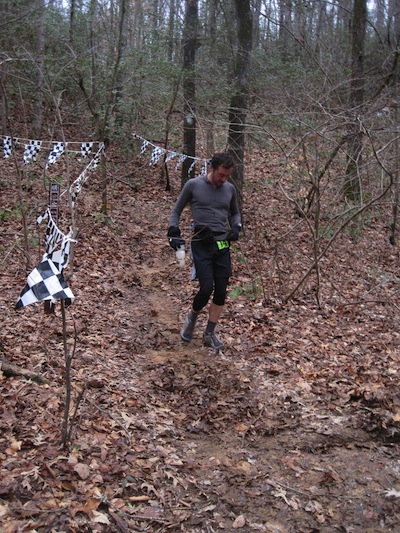
From mile 4 – 9 or so, I ran with Shannon and we talked about a bunch of things, which passed the time.  She had a camera and took a few photos of me, which I’ve included in this post.

Crossing a stream.

Between 4 and 6 miles, snow started to fall and I began to worry about my choice of not wearing any kind of rain/snow shell.  At the last minute I had stuffed it in my turn-around bag, so I had 15 miles or so to go until I could get it, and if the snow turned to rain, I probably would have chilled pretty quickly.   But luckily, the snow stopped and it never rained.  It was beautiful running in the woods with big flakes of snow falling all around.

Shannon had a pretty good fall right after the stream crossing shown here, at about mile 9, and told me to go on.

Just before the aid station at mile 14, the two leaders of the 20 mile run came flyng up behind me – they had started an hour later.  I watched them run off and subsequently tripped and fell pretty hard on my right knee.  Now two days later I don’t know if it is my old patella-femoral syndrome that I feel or the fall!  I lean towards the fall since most of the pain is on the outside of the patella, not underneath, though the PFS is probably contributing a little.

Mile 14 is where we turned on to the 5 mile gravel road instead of continuing on the 6 miles of trail.  Who knows how bad the trail was, but at the end of the day I trust the RD’s.  They put on a great race in not so great conditions, had 8 aid stations well stocked with supplies and volunteers, etc.  And while I would have loved to do the full trail, I still had a great time on the modified course.  Here is the elevation data from the Garmin, which you can compare to the normal course elevation shown above.  Miles 14 – 23 or so are the gravel road…  As you can see pretty level compared to the rest of the course!

The thing with the road, for me, at least, was that I had planned on walking all the steep hills on the trail.  The road, however, only had gradual inclines and declines.  So I ran just about the whole 10 miles, which again, was not really in my race plan and not how I trained.  Watching my average pace on the Garmin showed me go from about a 12:30 minute per mile average down to 11:40 by the turn around, so it was clearly a lot faster.

Only 2 or 3 more twenty milers passed me on the road up to their finish and my turn around.  I was starting to get concerned that maybe the 40 milers were being pulled from the course at the turn, but finally I saw another 40 miler coming back.  And then another, and another, and another… Good, the full race was on!

At the turn around I just put on new socks and grabbed my two extra fuel bottles.  My fueling strategy for this run was to use two 20 oz bottles filled with perpetuem mixed very thickly with water for each half …  One in my hand with water, the other in the pack with just powder, and then drink water at each aid station to dilute it.  I ended up diluting the mix in the bottles by filling them with water at each station.  This strategy worked well and I only had a tiny bit of solid food… About 3/4’s of a bananna at the turn-around; less than one pack of cliff shots, and one hammer gel single serving.  The rest of the run was fueld by my liquid diet of Perpetuem and two or three swallows of Heed the aid stations had.  (About 600 calories per bottle, 4 bottles total, and I never even drank from the 4th bottle!)

Shannon came in to the turn-around and said her leg was fine, and was back out on the road pretty quickly.  After the turn, it was 5 miles back on the gravel road.  I saw many more 20 and 40 milers heading towards the finish/turn, but I could not wait to be back on the trail.  I was really getting sick of the roads!

Sometime around mile 25 or so, a lady in purple came up behind me and we ran together for a while.  She said “that was impressive” when I crossed a stream on high, slipperly log.  I looked back to see her in water up to her thighs, and thought my way was the  better choice.  🙂  After the stream I told her to pass me and she was gone.  She was running some really technical trail like she was a mountain goat — she made it look so easy!  I on the other hand had to walk through some of this section.

From that point on there’s not much to report.  I passed a couple runners, and at least one passed me.  I was just marking time to the aid stations and the finish.

Coming down to the finish is a really rocky section… I was trying to push it to finish in under 8 hours, but it was tough to run here!  I finally came down the last steep descent to finish in something like 7:58.  Here I am coming to the line.  I was trying to make sure my race number was showing so I could find the photo later!  :-/

My goal for the original course was to #1 — finish, and if I finished, to break 10 hours.  I think a 9 hour finish on the original course might have been possible, but pretty tight.  We did a little under 38 miles, and about 9 – 10 of that was on roads.  The roads were definitely easier and faster, though by how much is hard to say.  So add 25-30 minutes for the extra distance, and another 25-30 minutes for the added difficulty, and 9 may have been in reach.

There’s always next year to see!  However, I would really like to do the Mt Mitchell challenge which is another 40 mile run from the town of Black Mountain to the top of Mt. Mitchell and back.  But it is a couple of weeks after Uhwarrie, and I can only handle one of these that close together!

Click here to see the Garmin GPS data…

Why We Run. Bernd Heinrich.

It’s funny how a book may come at a time in your life when most appropriate.  I saw “Why We Run” mentioned on a mailing list of minimalist runners (barefoot, vibram five fingers, hauraches,  or minimal shoes), had a “sample” delivered via Amazon’s Kindle, and then had to read the whole thing.  You see, in a few weeks I am about to try my 1st “ultra,” my first running race that goes beyond the marathon distance of 26.2 miles.   Now, I have done longer distances on foot as part of Adventure Races or Rogaine’s (24 hour orienteering events), but I have never gone past 26.2 in a running race.  And the last trail marathon I completed, nearly 7 years ago really bothered my knee, and it has been a loooonnnnnggggg road back.

But here I am, just having finished a 7 mile trail race a month and half ago, and then a 10 mile trail race in the past two weeks, and then a 20 mile training “adventure run” in the past few days.  And in less than three weeks I will be attempting to finish 40 miles in Uhwarrie, a very rugged trail in the middle of North Carolina.  Here is the elevation profile to show you what I mean:

If you can get past the first few chapters of the book, which focuses on cooling, respiratory, fueling, and cardio-vascular systems in bugs and animals, with a little human running mixed in, it becomes a great read about Bernd Heinrich who is attempting his first ultra (at the 100k distance) at age 41, and not only that, but attempting to break the US record at the distance.  (I actually loved the sections on animals, but it may not be for everyone.)  Heinrich has studied different animals and how their bodies are suited for endurance, from moths, to bees, to antelope, to camels, and on and on, and goes through each animal and the pros and cons of the systems they have developed.  He then uses these aspects in his own training, which he calls an experiment of one.   Some of the experiments are crazy, when he tried to drink one beer each mile for 18 miles, or when he downed a quart of honey before heading out for a 20+ mile run.  Many of them were not successful, as you can imagine!

The book culminates with his race in the 100k.  I won’t give you the outcome here.  🙂

I had highlighted many quotes on the Kindle, and imported those into my Evernote note book, but I’ll just include some of the better ones here.  I’ve left out the ones I highlighted related to the science of training, for the most part.

  • I love running cross-country. You come up a hill and see two deer going, “What the hell is he doing?” On a track I feel like a hamster. —ROBIN WILLIAMS, film star
  • An anonymous runner captured the notion in this now-famous aphorism: “Every morning in Africa, an antelope wakes up. It knows it must outrun the fastest lion, or it will be killed. Every morning in Africa, a lion wakes up. It knows it must run faster than the fastest antelope, or it will starve. It doesn’t matter whether you’re a lion or an antelope—when the sun comes up, you’d better be running.”
  • We are, deep down, still runners, whether or not we declare it by our actions. And our minds, as much as our lungs and muscles, are a vital force that empowers our running. Whenever one of us jogs down a road or when we line up to race in a marathon, we are not only celebrating life in general and our individual aliveness but we are also exercising our fantasies while acknowledging reality. We are secure in the knowledge that there is no magic. Which is not to say the world is only of simple logic, because although it may be simple in its design, it is awesomely complex in its details.
  • There is nothing quite so gentle, deep, and irrational as our running—and nothing quite so savage, and so wild.
  • I wanted to do something different. However, that is a difficult thing if you see no opportunity. On the other hand, it is hard not to try when you think you can do something when you have a chance at success, even though it is often hazardous to strike out on one’s own. That seldom goes unpunished. Any mark of difference may become a target. Even my own father, to whom I owe so much, had taught me this harsh lesson.
  • “America is an experiment,” he said, and after a long pause continued, “where the driving force is individuals chasing money. I would not risk my bones for a society guided by this principle.”
  • The test is the race, where credentials mean nothing and performances everything.
  • Every parting gives a foretaste of death, every reunion a hint of resurrection. —ARTHUR SCHOPENHAUER, German philosopher
  • Plato, who participated in the Isthmian Games as a wrestler, as well as Socrates, who was said to keep himself in excellent condition by training in a gymnasium, emphasized the necessity of physical training in a sound education.
  • “The beaver,” we were told, “works when he works, plays when he plays, is strong in individual effort, yet labors for the community good.” The beaver cuts trees individually, yet its dams and lodges are built and maintained communally by the whole clan. Efforts from one generation of beavers contribute also to the well-being of future generations.
  • If we can’t find allies in one context, we will in another. But there is a prerequisite: in order to forge alliances, we first need worthy adversaries. Without adversaries, no alliances are necessary.
  • There is nothing that can make one feel smaller than seeing someone big, which is why many try to talk down those who are more capable than they are. In running, you can’t deceive yourself or anyone else.
  • although animals can reveal mechanisms, our performance, whether it is in a painting or in a race, is ultimately art because there is so much that varies.
  • Furthermore, the key to endurance, as all distance runners know, is not just a matter of sweat glands. It’s vision. To endure is to have a clear goal and the ability to extrapolate to it with the mind—the ability to keep in mind what is not before the eye. Vision allows us to reach into the future, whether it’s to kill an antelope or to achieve a record time in a race.
  • If some animals’ brain hormone production can be triggered by mere flashes of light and other numerous and seemingly trivial external cues, then it does not seem preposterous to consider that just maybe we can be molded by fierce dreams that allow us to perform what we’d otherwise be incapable of accomplishing.
  • Perhaps I had discovered my strength. To not use it fully to try for an inspiring goal seemed wasteful, if not disrespectful, like foolishly squandering a precious gift.
  • To psych oneself up takes self-delusion.
  • Not to give an inch is to give everything.
  • “Now if you are going to win the battle, you have to do one thing. You have to make the mind run the body. Never let the body tell the mind what to do. The body will always give up.” The body can handle only little steps. The mind can take great leaps.
  • “Suffering is the sole origin of consciousness,” Dostoyevsky wrote.

Wow, I better stop there…. Well worth the read if you are into running in any way!

The Man Who Was Thursday. G.K. Chesterton.

First, it’s great that Amazon makes older books available for free, or sometimes 99 cents.

Second, Chesterton’s Orthodoxy is high on my list to read in 2010, but I thought I’d check out some of his fiction too.  I can tell I am going to like him already.  He is a great writer and this is a nice short read, with a few sections that certainly make you think.  Overall the book keeps you guessing as to what might be going on and how things will end.   And finally there is some good Christian allegory mixed in.

And finally, my quotes…  I need a way to get my Kindle clippings to go direct into an evernote not… I’ve seen a few scripts and hacks, but none of them look that promising.  For now it’s going to be a cut and paste.

  • “The soldier must be calm in the thick of the battle,” pursued the policeman. “The composure of an army is the anger of a nation.”
  • But even the moon is only poetical because there is a man in the moon.
  • “Because I am afraid of him,” said Syme; “and no man should leave in the universe anything of which he is afraid.”
  • He had found the thing which the modern people call Impressionism, which is another name for that final scepticism [sic] which can find no floor to the universe.
  • Bad is so bad, that we cannot but think good an accident; good is so good, that we feel certain that evil could be explained.