The Paleo Diet for Athletes. Loren Cordain and Joel Friel.

Rather than do the kind of review I normally do (which aren’t typical reviews anyway), I’m going to highlight the points in this book that I find different from current paleo/primal views of folks like Robb Wolf and his Paleo Solution (PS) and Mark Sisson and his Primal Blueprint (PB).  Both of those books have been published in the past year or less, while The Paleo Diet for Athletes (PDA) was published back in 2005.  I do understand that Cordain is working on a new book, so I think it will be quite interesting to see what his take is on a few items that are much different in Wolf and Sisson.

The 1st differences I want to talk about are those between endurance athletes and the typical people PS and PB are addressed to.  While Sisson comes from a background as an endurance athlete (competitive Ironman triathlete and marathoner) he now thinks that kind of cardio is bad for you.  In fact, he dubs it Chronic Cardio and outlines the problems associated with it, at least as he sees them(*).  Wolf has more of a background with strength and crossfit type of exercise.  So in both cases, they are pretty high on low carb., which is much different than PDA.  I should note that on Wolf’s podcast he often talks about using carbs such as sweet potatoes and yams immediately following a workout, so that part is not different.  But PDA is much higher on fruits in general.  PDA specifically outlines periods of carb consumption as high as 50 percent, and at some limited periods 60%, of total caloric intake.   I don’t know if I’ve ever seen Wolf give a specific percentage — he’s pretty much against calorie counting for the most part (though there are times he sees the benefits), and Sisson talks of 100 – 150 carbs max as ideal (and sometimes suggests much less).  Even at 2500 calories, 150g of carbs would be 25 percent of intake, so you can see the large difference.

The other recommendations that I am really surprised by are listed below, because these seem quite different from current recommendations:

  • the recommendation of canola oil by PDA.  while PS doesn’t mention it specifically from what I recall, PB is adamantly against it
  • PDA recommends to steer clear of saturated fat, while it seems like the current paleo folks are ok with it, particularly if it is grass fed organic meat.  PDA recommends trimming all visible fats before cooking.
  • PDA recommends lean meats over fatty meats… This is one I’d like to dig more into to see what PB/PS/paleo folks are saying… All I recall are that any meat is ok, and in fact at least one blog (hunter gather love ??) talked about why lean meat won’t cut it on a truly paleo diet.  Seems like most current paleo thought is that fatty meat is actually good and necessary (to get enough caloric load)
  • PDA recommended agains canned fish like sardines and herring, while PS and PB both seem to be for it.
  • PDA says 15 minutes of sunlight per day is enough for adequate vitamin D, even in the winter, while both PB and PS are big into supplementation — as much as several thousand mg per day of D3.  (but both recommend regular blood testing as vit D can be toxic)
  • As mentioned above, PDA is high on any fruit any time, while PS and PB want to limit fruits due to their insulin load.  I do take it from Wolf that this is more individualized, and that if you are lean and healthy, more fruit is ok.  I sure hope so!  🙂
  • PDA has ZERO mention of coconut oil from what I can find, while PB and PS are high on it.  I’ve really enjoyed learning to use it the past couple of months.
  • PDA says to limit eggs to no more than 6 per week.  I explicitly recall on the PS podcast recently that they don’t agree with this unless you have some kind of allergy; otherwise, they are all for lots of eggs.  I make 5 egg omelets for breakfast sometimes!  I definitely eat more than 6 per week most weeks.

Finally, I would just say I was really surprised by PDA’s talk of following the American Heart Associations recommendations of limiting saturated fat to less than 10% of overall calories and limiting dietary cholesterol.  Maybe I’m too deep into Gary Taube’s “Good Calories Bad Calories” right now, which seems to blow apart this hypothesis, but it also seems to go agains PB and PS and all the other paleo blogs out there!

(*) Suffice it to say that I don’t fully agree with Sisson on his views of Chronic Cardio.  I do think that for people that work out 5-6 days per week at 90%+ maximum heart rate, there is a problem.  You definitely need to mix it up with lower effort level aerobics as well as short sprints and “lifting heavy things.”  I wonder if he would be cool if I explained to him my view that my ultra running is part of my “play time.”  🙂
The 4-Hour Body. Timothy Ferriss.

When I first started to hear the buzz about this book, I really was not interested.  I had a feeling I wouldn’t like Tim Ferriss — the title of his first book, which was a best seller, was “The Four Hour Work Week.”  That kind of put me off, for some odd reason.  And while I still have not read that book, I understand now that it s more about time management than actually working just four hours a week, so that changes my initial uninformed thoughts.

Anyway, back  to the buzz.  I really wasn’t interested, even though the original, working title was “Becoming Superhuman.” (Who’s not interested in *that* kind of book?)  But the publishers wanted to play off the success of his first book.  What really got me was the interview Tim did with Robb Wolf and Andy Deas on the Paleo Solution, when Tim started talking about “pre-hab” and the exercises he used to find and correct imbalances in his body.  That has long been a fascination of mine, due to what I already know are weaknesses (imbalances in strength) but weaknesses that I’ve found hard to correct.  It is my assumption that those imbalances are what causes a body to be injury prone — thus the notion of “pre hab.”

So I broke down and bought the book.  It is best to view this book as a reference book.  Read the 1st two chapters or so, and then pick out what you want.  For example, there are chapters on losing all kinds of weight.  I don’t need to do that.  There are chapters about putting all kinds of muscle on, and I also don’t need to do that.  There are chapters on going from a 5k to a 50k in twelve weeks, which were quite interesting to me, though not that useful (since I have already run that distance).  There were chapters on holding your breath for really long periods of time, which were interesting.  (Way back when — when I was a swimmer — I held my breath for 2 minutes 20 seconds.  On my 2nd try with Tim’s method, I hit 2:30!  I’m sure I could go over 3 with a few more practice attempts.)

Tim basically was a self experimenting machine for the past 10 years, and this book recounts his successes (mostly, with a few failures), with all kinds of crazy things that are much outside of conventional wisdom.  I myself find “CW” is often not right, so it was definitely an interesting read, though I’m not sure it is for everyone.  Definitely on the geeky side of things with the science behind the experiments.  (He talks about why new technology is often out of reach of the masses, much of it due to economics.  The cutting edge scientists, with new methodologies and treatments, are maybe 20 years ahead of the mainstream.  They are a limited resource, so it is those with money that get the treatments.  Typically professional athletes and hollywood stars. It takes time for these technologies to trickle down.)

I’m still playing with the pre-hab movements, of which he only gives 4 — the 4 that will have the best effect on the wides audience — and the chop and lift and single arm standing dead lift definitely show what I already know (my right side, especially the hip stabilizers, is week), but I am quite intrigued by having a real “Functional Movement Screening,” done which looks for imbalances and gives specific exercises (beyond the main 4 that Tim discusses) for each such imbalance/weakness.

Some quotes:

  • Does history record any case in which the majority was right? —Robert Heinlein
  • “The future is already here—it is just unevenly distributed.”
  • “Fifty percent of what we know is wrong. The problem is that we do not know which 50% it is.”
  • Somewhere along the line, we seem to have confused comfort with happiness. —Dean Karnazes
  • Ugly, and ultimately painful, postural compensation is unavoidable when wearing shoes that elevate the heels. This simple observation somehow escaped me for 30 years, until CrossFit Chicago instructor Rudy Tapalla introduced me to Vibram Five Finger shoes, which look like gloves for your feet.
  • absorb what is useful, discard what is useless, and add what is uniquely your own. — Bruce Lee
  • Motion is created by the destruction of balance. —Leonardo da Vinci
  • The Cartesian separation of mind and body is false. They’re reciprocal. Start with the precision of changing physical
  • All life is an experiment. The more experiments you make the better. —Ralph Waldo Emerson

I didn’t know there was such a thing as a trailer for a book, but there is, and here’s 4hB’s trailer:

A much longer (and better!) review is located here.

Little River 10 Mile Trail Race

Update 2: 18/69 in the 40-49 male category.  What’s up with nearly 25% of the race being in my division??  55/300 overall.

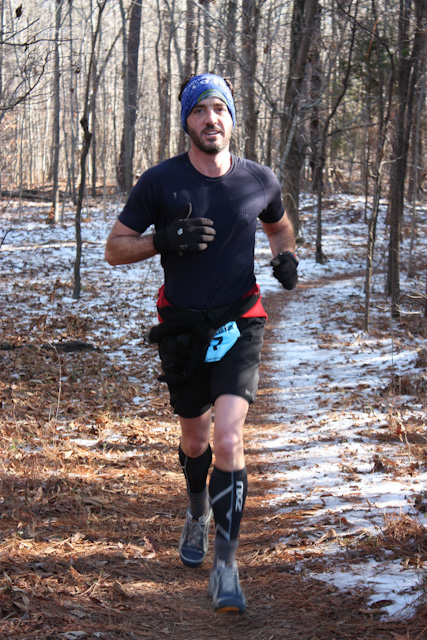
Update: Here is a photo taken of me by the race photographer:

I don’t have a lot of time to write a real race report, so let me just throw in the garmin data and what I sent to the google minimalist list for now…

And what I wrote to the email list:

Just a quick update that I ran the 10 miler and had NO achilles/soleus problems whatsoever. Well, for about two minutes around mile three I felt a little bit on the OTHER leg than the one that got so bad last Saturday and bothered me all week.

So what helped? I did a bunch of things so here goes:

1) Chiro on Monday (she did some ankle adjustments and deep tissue massage on knots and adhesions)
2) Deep tissue/structural integration massage on Wednesday
3) electro stim a couple of times (massage like setting)
4) lots of lower calf rolling with a foam roller like device
5) used topical ointments like mymed or biofreeze a couple of times a day
6) wore the go-lite sun dragon which is a 10-12mm heel lift shoe (this shoe has the added benefits of having cleat like lugs on the bottom, and it was snowy and icy. The inov8 195’s would have been a terrible choice. The 190’s would have been fine.)
7) 2xu calf compression socks… don’t know if these helped the AT but I really liked them. 🙂
8) 600mg ibuprofen two hours before the start

Another thought is that in a race situation, I really don’t have a lot of time to think about foot placement, so there is no real chance to force a particular foot strike. Thinking back to last week, besides the hard stair workout and hard pavement run, the long run on Saturday had a lot of flatter, gravel and old paved roads, and the inov8 195 does not perform well on that, in my opinion. So blame shoe choice a bit, though really it was a culmination of things that brought on the soreness.

Before I had the AT/soleus issue I had a stretch goal of 1:25:00, about 5 minutes faster than last year. I ended up with a 1:26:30, which I am extremely happy with considering how worried I was earlier in the week. For comparison, the course record was broken by 2+ minutes today, in 1:02:54.

I’ll add here that I went out fast — really fast.  My plan was about a 7:00 minute first mile to get some separation, and then back off.   I was in the low sixes at 1/2 mile and just under 7 at one, but then I didn’t back off soon enough..  Part of that is the adrenaline of the race, and part of it is that there is a lot of down the 1st couple miles…  You’ll see in the elevation chart a little climb, but not that much.  So miles 2.5 -5 or 6 were a bit of struggle to find the right zone.  My stretch goal of 1:25:00 would have been 8:30 pace, and I tried hard to hold that.  But I saw it steadily drop from 7:25, to 7:45, to 8:15, etc.  I knew the last half, and especially the last mile, were crazy tough to hold pace on because they are single track mtn bike trail with a lot of short ups and downs and tight turns.

Anyway, I’m quite happy with my time considering the AT/soleus issue earlier in the week.  Still 4 minutes better than last year!

Proper Confidence. Lesslie Newbigin.

This was a fantastic read, though I have to say the 1st half was much better than the 2nd.  The 2nd half, in the conclusions, was a bit of a let down for me personally.  Perhaps after such a well-reasoned and well said introduction, where everything just clicks and makes sense, the second half didn’t lead to any new and startling revelations (for me).   However, I would say it is still worth it for any Christian that wants a better understanding of the world views that existed pre-Christianity in the Western World (namely Greek and Jewish thought), how Christianity challenged and changed them, and how the Enlightenment really changed the game and led us to where we are today.

Newbigin starts with the differences between Jewish and Greek thought, especially with respect to knowledge (epistemology), what changed with Christianity, and then goes through the early centuries following Christ, tracing the changes with respect to knowledge over time.  For example, for Plato, “the ultimate realities were ideas, which are more or less fully realized in the various entities which are the objects of our experience.”  By grasping these ideas and participating in them, the soul attains its true being and salvation.  (The idea of “Good” is the apex of this hierarchy of  ideas.)  Yet, Augustine said “credo ut intelligam,” or “I believe in order to know.”  There is an element of (biblical) faith in knowledge that is lacking in Plato and is a radical departure from Greek thought.

Along came Descarte (many centuries later, of course, but we don’t need to dig too deeply into the Dark Ages, do we?), who had a goal to build indubitable knowledge on the foundation of skepticism.  He says “I think, therefore I am,” and now all knowledge starts with the individual.  (I’m skipping huge chunks of the book and moving fast, but you should be able to see that such a believe leads to post modernism, the lack of objective truth, and relativism.)

Newbigin then follows Western thought through Kant, and Kant’s arguments for God and ultimate reality based on moral and aesthetic experience.  And through the Enlightenment (The Age of Reason), where our view (humanity’s) became that Reason is the only path to reliable knowledge.  (In Deep Church, Belcher talks about Foundationalism, and that was the 1st time when I started to be able to put into words what I had felt for some time — that we sometimes need something beyond Reason — to describe things such as certainly in Faith. (But then again, there is a problem with “Faith without Doubt…”)

He goes on to argue that we are in the midst of a great collapse of confidence due to the ramifications and limitations of the models of the Enlightenment, including the collapse in European culture as well as the collapse of the confidence in the validity of the church’s worldwide missionary enterprise.  (At least he goes after his own…)

Ok, this could get really deep and long if I’m not careful.  That’s not the purpose here.   Maybe the above, along with a few more tidbits below, will be enough to entice you if you like to read this kind of book.

Random thoughts and quotes:

I liked both of these — let’s look for the good on both sides!

From the point of view of the fundamentalist, doubt is sin; from the point of view of the liberal, the capacity for doubt is a measure of intellectual integrity and honesty.

In addition to ascribing these accusations, labels, and genuine differences over doubt to both sides in this quarrel, it is also right to ascribe moral virtues to them: Liberalism at its best is marked by an open mind which is humble and ready to learn. Fundamentalism at its best is marked by a moral courage which holds fast to the truth even when it is assailed by counterclaims from without.

I don’t know why, but the subject object duality that first entered my life in Zen and the Art of Motorcycle Maintenance keeps popping up in strange and unexpected places:

The second dualism, closely related to the first, is that dualism expressed by the words “objective” and “subjective.”

I feel like I am strong on gratitude, but after reading the following quote I wonder if I fall short on Trust:

But it the biblical story is true, the kind of certainty proper to a human being will be one which rests on the fidelity of God, not upon the competence of the human knower. It will be a kind of certainty which is inseparable from gratitude and trust.

I still haven’t figure out why this is the case (:-/):

Kurt Godel’s demonstration that the fundamental axioms of mathematics are not self-justifying does not seem to have weakened the influence of the idea of mathematical certainty.

And a few more:

But we are left in a world which the Chinese writer Carver Yu has summarized in the phrase “technological optimism and literary despair.” Looking at contemporary Western society from his standpoint as a Chinese philosopher and theologian, he sees not only the unstoppable dynamism of our science-based technology but also the bleak nihilism and hopelessness that is reflected in the literature, art, and drama of our society.

With hindsight, it is now easy to see how many of the self-evident truths of the Enlightenment were self-evident only to those who were the heirs of a thousand years of Christian teaching. They were not self-evident to the peoples of India or Africa.

The modern antithesis of observation and reason on the one hand versus revelation and faith on the other is only tenable on the basis of a prior decision that the whole cosmic and human story has no purpose and therefore no meaning. It is possible to make this assumption, but it is not necessary.  The question whether the cosmos and human life within it have any purpose other than the individual purposes we seek to impose on things is one that cannot be decided by observation.


2010 Book Shelf

Here’s a picture of my book shelf — books read in 2010…  Several of these are missing on my individual book review posts.  I am behind and really don’t know that I can catch up, so I may just have a clean up post or two.

A lot more running books and food/diet books than I ever would have guessed at the beginning of the year!  And where’s the classics?  Well I guess I did get in a couple from Chesterton.  And I might have to put the biographies/histories into a similar category.

2010 in review

The stats helper monkeys at WordPress.com mulled over how this blog did in 2010, and here’s a high level summary of its overall blog health:

Healthy blog!

The Blog-Health-o-Meter™ reads Wow.

Crunchy numbers

Featured image

The average container ship can carry about 4,500 containers. This blog was viewed about 15,000 times in 2010. If each view were a shipping container, your blog would have filled about 3 fully loaded ships.


In 2010, there were 39 new posts, growing the total archive of this blog to 401 posts. There were 91 pictures uploaded, taking up a total of 16mb. That’s about 2 pictures per week.

The busiest day of the year was April 19th with 164 views. The most popular post that day was Boston Marathon Liveblog.

Where did they come from?

The top referring sites in 2010 were hundredpushups.com, dailymile.com, facebook.com, 2sparrows.org, and birthdayshoes.com.

Some visitors came searching, mostly for poi si torno all eterna fontana, love song lyrics, springer mountain, into the wild book quotes, and poi si tornò all’eterna fontana.

Attractions in 2010

These are the posts and pages that got the most views in 2010.

1

Boston Marathon Liveblog April 2010

2

Into the Wild. Jon Krakauer. May 2008
6 comments

3

Family Happiness and Other Stories. Leo Tolstoy. June 2008

4

A Grief Observed. C.S. Lewis. October 2006

5

Grandfather Mountain Hike August 2008
8 comments