Sitting is killing you….
1


[ I’m so far behind on my “reading notebook,” but I’ll try to catch up over the next week or two! Or three… ]
Going in to this year’s Boston Marathon, I was a little low on running confidence due to slight lack of motivation and subsequent fairly light training load. The night before I was reading the BAA’s Competitor’s Guide and found an excerpt from Ryan Hall’s new book, Running with Joy. It was pretty good, so I downloaded the book to my kindle app. I thought that if I read the introduction and his entry on race day that very night, that maybe I’d find a little spark…
The book starts with a couple of Bible verses, though this one is most relevant:
These things I have spoken to you so that My joy may be in you, and that your joy may be made full. — JOHN 15:11
Goes well with the 1st catechism in the Westminister Shorter Catechism:
What is the chief end of man? Man’s chief end is to glorify God an to enJOY Him forever…
Most of the book is Hall’s training journal along with his thoughts and reflections leading up to Boston last year. Hall is a very devout Christian and walks (runs?) with God in all he does, as he reflects on his running, racing, and life as he journals his training.
The final entry covers the actual 2010 race for Hall, when, though he didn’t win, he found what he was looking for — Joy in running. I do think the book helped me find my own Joy in the 2011 race. I ran much faster than I expected I would (could!), and I had joy for most of the race! The final six miles were a bit of a slog, but I only slowed a little and I’m still quite happy with how I ran.
A few quotes:
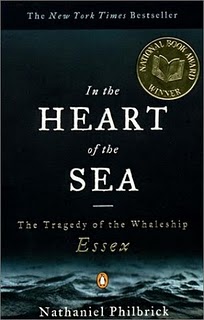
My good friend Chris G. suggested I read this — in fact he bought it for me and dropped it off in my mailbox one day. 🙂 As far as survival stories, it started a bit slow compared to Unbroken and Endurance. But once it got going, it was really good.
The Whaleship Essex and its tale are the basis of Herman Melville’s Mobey Dick. The funny thing is, the whole time I was reading this book, the story seemed so familiar. I thought that was due to me having read Mobey Dick, but it turns out, according to my “reading notebook” from 2000, I read it all the way back then! See this web page — before there were blogging tools. In fact, at that time, this book inspired me to read Mobey Dick, which I wrote about here… Again, before there were blogging tools. Here is what I wrote about Mobey Dick back then:
Wow, finally done! The dates listed above are correct — it took me about 7 months to finish this book. (Of course, I did read many others in that time!) I decided I really wanted to read this after reading “In the Heart of the Sea,” which is a true story of a whale ramming a ship and causing it to sink (and likely Melville’s inspiration for Moby Dick). I had to read a few chapters of this back in high school, but I don’t remember much of it anyway, and if I did do much back then, it was probably with Cliff Notes. The book is definitely worth the read — I’m not sure there is anything else quite like it. It is certainly not an “easy read,” though, and that is why it took me so long. I often put it down for a month or more at a time. There is so much detail on so many things — often chapters of several pages devoted to something as simple as a rope, or more complicated as the whole study of whales as known to Melville in his time. But often these chapters are filled with symbolism of humanity, life, religion, etc. Again, worth the read, though it’s not easy.
If you like adventure stories and stories of survival in extreme circumstances, In the Heart of the Sea is an excellent read.

Wow, I started this post almost 2 months ago and forgot it… I’m so far behind on posting in my reading notebook category!
David Platt became “the youngest megachurch pastor in history,” a claim he may dispute but likely is true. At 28, he became the pastor of a 4000+ church. Amazing story of someone who is living an amazing life. This book is well worth the read for any Christian in America. It really makes you question a lot of things about your faith and how that relates (does it?) to the American Dream.
I’ve collected some of the race reports from Uhwarrie and thought I’d post them here in one place, for those of you that like to read those kinds of things. There are reports from the front of the pack, middle of the pack, and back of the pack, which give different perspectives. Though the theme of ruggedness, hilliness, and toughness all come out. 🙂 If I’m missing any, let me know and I’ll update the post.
40 miler
http://trailsandjubilation.blogspot.com/2011/02/uwharrie-mountain-run-report.html
http://brittanygoesrunning.blogspot.com/2011/02/uwharrie-mountain-run.html
http://randomactsofkristi.blogspot.com/2011/02/over-and-out.html
http://www.running-down.com/2011/02/2011-uwharrie-mountain-run.html
http://hurryslowlybuthurry.blogspot.com/2011/02/sasquatch-at-uwharrie.html
20 miler
http://www.trailheads.org/public_html/article.php?story=20090208173230778
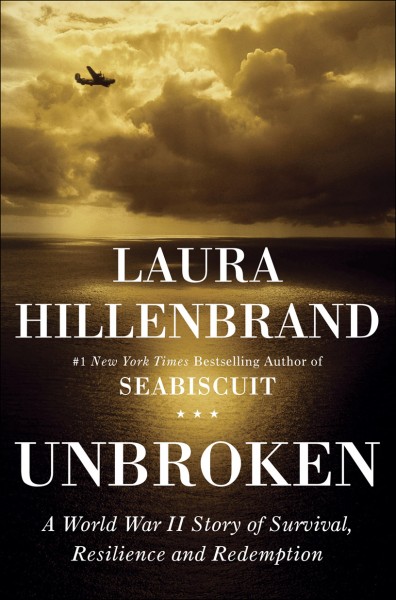
This book was mentioned to me, somewhat in passing, by my old physical therapist. My wife has a knee injury and is now seeing him, and I wanted to go to listen in on the diagnosis and prescribed exercises. While I am a layman compared to a PT or a Doctor, I became a bit of a knee expert in my own when I went through so many problems in the past. His description sounded intriguing, so I immediately picked it up, which in today’s terms means I downloaded it to my kindle app on my iPad. 🙂 I was instantly hooked.
The story is of Louie Zamperini, who was a kid struggling to stay out of trouble, when he discovered running. Within a short time, he had broken the national high school record in the mile at 4:21 in a 1934 preliminary meet. He did not qualify for the Olympics in the mile so decided to try the 5k, and on his 3rd race at that distance, finished in a dead heat with world-record holder Don Lash. While he only placed 8th in the 5k at the Olympics, his last lap was so fast (56 seconds!!) that Hitler asked to meet him personally. In 1938, he won the NCAA Championship in a time of 4:08.3 — while his opponents tried to slow him. He finished with a cracked rib, punctured shins, and an impaled toe! Many thought he would be the 1st to break the 4:00 barrier in the mile, but along came World War II.
In World War II, Louie became a bomber in a B-24. On one of his flight missions, the plane goes down and Louie and two others drifted on the pacific for 47 days, catching birds and fish as best they could, and rain water in small tins. (One of the three died before they were rescued.) Unfortunately, the rescuers were Japanese, so Louie then spends a lot of time in various Japanese POW camps, under abhorrent conditions.
I guess if I tell much more of the story, you may not read the book. It is so worth reading… Fantastic book if you like running, US history, World War II, or biographies that read like novels.
As always, a few quotes:
Given the dismal record of raft-bound men, Mac’s despair was reasonable. What is remarkable is that the two men who shared Mac’s plight didn’t share his hopelessness. Though Phil was constantly wondering how long this would go on, it had not yet occurred to him that he might die. The same was true for Louie. Though they both knew that they were in an extremely serious situation, both had the ability to warn fear away from their thoughts, focusing instead on how to survive and reassuring themselves that things would work out
I’m not going to write a typical race report… I ran this same race last year so the course details are in the 2010 post. Instead, I’ll just give a brief summary and then some random musings.
Summary: My goals were to #1 have fun, #2 finish, #3 break 9 hours. I’ll cut to the chase and say up front that I met all of my goals. Woohoo! However, it was a very strange race for me in that, even though I ran a little faster than I expected (8:50), I never felt good. I really suffered. But I survived. As early as mile 2 or 3, I had heavy legs, labored breathing, and was struggling to find a rhythm. I’m typically a slow starter, at least in terms of getting into a comfortable groove, so I kept thinking, hoping, praying, that that would happen again. But it never did. Sometime around mile 20 I gave up on that hope and knew it was going to be a sufferfest.
(I should add that I had a secret stretch goal of 8:30, and know that is entirely possible. Especially if I ever start running more than 15-20 miles per week. 🙂 I hit the turn in 4:05 having felt dead and tired all the way there. And while I slowed considerably on the way back, I was only passed twice, while I passed three other runners. So everyone slows. Maybe even a sub 8:00 would be possible.)
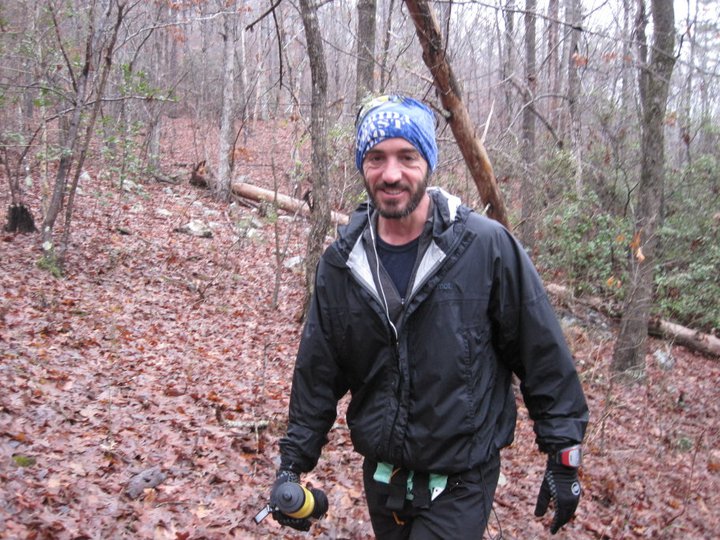
Here is a photo that Shannon took of me about mile 19… She was already coming out of the turn around, looking strong and fresh, about 3-4 minutes behind the lead female. Shannon went on to win, so congrats to her! What is amazing is that she did it all while taking nearly 200 photos on the day! As a side note, I met her last year on this course, running together from mile 4 – 9 or so, when she had a hard fall on a stream crossing — about 10 seconds after taking this photo of me. She told me to go on a few times, and I did reluctantly. She came into the turn around and left before I did looking strong, but I did pass her around mile 34 or 35, as the hurt from the fall caught up with her. When I saw her the morning of the 2011 race I told her I thought she was running much stronger and faster this year, after seeing her at Run at the Rock and Little River. Guess I was right!
Ok, back to this year’s race. How about some random musings:
1. I saw Anton Krupika write the following about his run at the Rocky Racoon 100, the same day as Uhwarrie. And while I didn’t run 100 miles, I know exactly what he is talking about. I dealt with the hand I was given on Saturday, and can’t complain about how I performed. I sure would have loved to have felt better, normal even, but there’s nothing to do about that except go with it and do what you can on that particular day.
Ultra racing is mostly about doing the best one can with whatever hand one is dealt, even if that hand doesn’t necessarily hew to pre-formed, arbitrary expectations. Some days–Western States and White River last year come to mind–the act of running on trails is beautifully and absurdly easy. Other days–like Miwok last year and Rocky Raccoon this past weekend–it is mundanely, decidedly average. Ever since some time during the middle of the first lap on Saturday–well before Ian had disappeared into the distance–I knew I wasn’t 100% on top of my game, but the reason I can still recover with a sufficient measure of peace is because I am 100% sure that I ran as fast as I could on that day. Most race days I am able to find a groove where things are generally effortless (at least for a time) and the performance just comes to me; that never happened for me on Saturday.
2. Here is a link to my Garmin data.
3. Another quote, this time from the irunfar.com blog about Uhwarrie:
It rained heavily the night before the race. While the storm broke before the 20 milers toed the line, it was still a raw run on a relentless course. Mountain Cup regular Rachel Cieslewicz commented after the race, “it was the wettest, coldest, crazy technical 20 mile trail run I’ve raced.” Others reported “the trail conditions were pretty gnarly” and “a couple people ate it.” Having run the 40 miler, I can assure you that the course is quite technical and unforgiving.
4. The banjo player out on the trail at mile 19 (and 21), was a great touch. It made me run faster (because I heard banjo music).
5. The four stream crossings in less than 5 minutes at mile 16 and 24 was really tough. The water was mid thigh high on me, but worse than that, it was icy cold. On the return, it took at least 20 – 25 minutes for the numbness in my toes and forefoot to go away. In fact, I took my shoes off a couple of times in that stretch, thinking my socks had bunched up. I actually think this was colder than my recent polar plunge!
6. That climb at mile 16 is brutally steep. It was about half way up that the two front runners in the 20 miler came flying by me. Yes, they were running. Running hard. Granted, if I didn’t have 24 more miles to go, but just 4, maybe I would have been running too. (But probably not!)
7. Army rangers in full combat gear carrying assault rifles can be amazingly quiet and still. We had been told they were out there and we may see them. But it wasn’t until I was passing them on the trail, with a large group of them within 3′ of us, that I noticed them!
8. I became a heel striker, at least for part of the run. The super steep downhills on technical terrain almost necessitate it. You need the braking power of the heel. Additionally, having a numb ball of foot due to icy water also necessitates using the heel — at least if there is still feeling there! Having some ground feel over none is well worth a little heel striking, in my opinion. 🙂
9. The 1st mile or so has quite a steep climb on very technical terrain. I was right behind Shannon and mentioned in passing that I ran all of this down last year, because I was really close to breaking 8:00 (shortened course), which I did. When I came to it this year, I was actually surprised I was able to run it last year. It’s pretty tough!
10. I was in a group behind Alicia Parr up until about mile 5. I really had no business being with a group that was going to be in the neighborhood of 8:00, but I had already tried a few paces to see if anything was comfortable; but alas, no pace felt good. However, it was about that time that I figured I better just slow down anyway.
11. Around mile 10 I saw my lowest pace of the event: 11:53. But over the next 30 miles, that dropped to something like a 13:18.  (The garmin data shoes two laps — I had no satellite sync for the 1st few minutes so I waited for that to hit the lap button.
12. A scary thing happened on Monday morning. I found myself googling “North Face Endurance 50 mile run.” Normally it takes a few weeks to start thinking about another long run…. At least that one is 8 months out.
13. Kudos to the race directors! They run an amazingly well organized event considering there are 8, 20, and 40 mile races, you have to shuttle runners in from remote parking areas to the start, shuttle back runners from the 8 and 20 mile finishes, drop bags to the 20 mile turn around and return those drop bags to the finish… And probably 100 other things. They do an excellent job and are always friendly and polite.
14. While I may not be back next year — I really hope to get in to the Mount Mitchell Challenge someday, another 40 mile run in NC the same month as Uhwarrie — I do hope to go back and run it again.
15. As always, the friendly conversations you have in an ultra are cherished. I ran with Matt from mile 5 to 8 or so. As we were talking, we discovered we both graduated from NC State. He in 2009, me in 1993! He ended up dropping before the turn around due to ITB issues. He’s the one that was telling me how gorgeous the NF50 in GA is. (Not sure if that is good or bad!) I also ran with Allan for a bit through those 4 icy streams and at the start of the killer climb at 16. Allan wears a Sport Kilt and was fun to chat with. I saw Will Jorgensen as I was running into the turn around. I’d never met him face to face, and have only seen one or two photos of him online. He provided SCAR reconnaissance for me last year, as he ran the full 72 the week before I did “Half SCAR Plus.” I yelled out “Are you Will” as we passed and he yelled “yes,” so I yelled “I’m Sean Butler” and that was it. I thought there was a slight chance I might catch him on the return, but that was not to be.
16. At the same time, an ultra like Uhwarrie can be a lonely run. Once I hit the turn at 20, and passed all the 40 milers heading that way and the 20 milers heading to the finish, there were literally hours of time spent alone. If not for the aid stations of 3 miles, I may have not seen more than 3 or 4 people for big chunk of time. Even before the turn around, I spent long stretches all by myself. I don’t have a problem with that, I’m just letting others know what you might expect.
Ok, I suppose that’s enough for now. I’ll update this with results when they are posted. I’m secretly hoping I was top 20, but I really lost count of the return runners as I was heading to the turn around, so it’s tough to say.
Update:
Official results posted: 30/88 in the 40 miler in 8:50:22
My first goal is to have fun. My second goal is to finish. My third goal is to run under 9 hours.
You would think a goal time of 9 hours, which equates to a 13:30 pace, would be easy, right? In fact, 10 or 11 minute miles on trails, which is a 6 hr 40 min – 7 hour 20 min run, shouldn’t be out of reach, right? I just run sub 9 minute miles on a 10 mile trail run at Little River.

Well, Uhwarrie is Uhwarrie:

And while those “hills” don’t amount to much, compared to certain other races, they certainly begin to take their toll. Maybe it’s not the elevation overall, but the steepness. That plus the ruggedness of the trail — the rocks, the stream crossing with no bridges, the mud, when it is wet, which it will be tomorrow, certainly add to the pace degrading qualities of the run!
Last year I ran 7 hours 57 minutes, on a course that was shortened to about 38 miles. At mile 14, they sent us down 5 miles of gravel road instead of the 6 remaining miles of trail. I distinctly recall my pace as shown on the Garmin going from something like a 12:30 to 11:40 over the 5 miles to the turn around. So change the 5 miles of easy road running to 6 miles of hard trail running, and 9 hours may not have been out of reach last year, though it would have been close!
And now, on to the weather. Here’s the forecast:

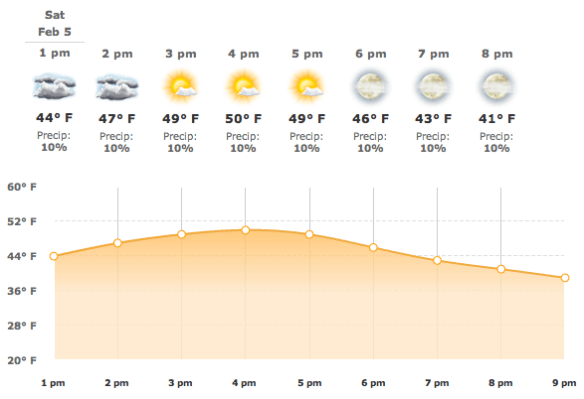
Certainly looks a little wet! And chilly at the start. (Though not this chilly!) That much rain will make for a very muddy course, I’m sure.
Looking forward to it. 🙂
Uhwarrie is just a couple days away… 40 miles on a rugged, hilly trail. Current weather conditions show rain and freezing rain on Friday, and rain on Saturday, with a low of 28F and a high of 52F. So, time to make some gear decisions!
The 1st choice is in shoes. I have been very happy with how my inov-8 195’s and 190’s have been performing all fall — right up until the point where my AT/soleus flared up unexpectedly. That was a week before a 10 mile race, and after a week of treatment and running in my old Sun Dragons, the race went fine! I chose the sun dragon’s then because they have a higher heel lift than anything else I’m wearing right now, and that helped to alleviate the AT strain. However, the Sun Dragon’s have large rips in the uppers on both shoes, so I’m a bit worried about them. But I used some gorilla tape to hopefully hold them together, and that is what I plan on going with Saturday:
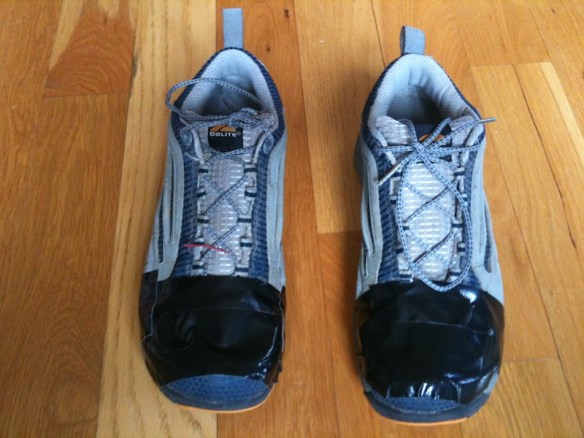
I took these out for an easy ~3 mile run, and it is obvious the tape won’t last 40 miles through Uhwarrie in the rain. There are multiple stream crossings without bridges, rocks, mud, etc. But if the tape holds the upper together just long enough, I’ll be happy. Besides, I’ll have a spare pair of shoes at the 20 mile turn around in my drop bag. Most likely that shoe will be a Solamon XA Comp.
Other gear will be a Nathan handheld bottle holder, though not with the Nathan bottle that came with it. That bottle leaks like crazy! I’ll also have a waist pack on that holds a bottle and a little fuel.
In addition to spare shoes in the drop bag, I’ll have additional fuel (see below), an extra pair of socks in case I need to change, and a head light. Lights are required past a certain time, and I doubt I’ll need it.. But just in case. I’d hate to get pulled from the course because I thought I’d be faster than I really am! And even if I’m having a bad day, I’ll want to finish if at all possible. I’ll have to decide at the turn around whether to grab the light or not.
As far as fuel, I’m going to follow the same strategy as last year and get 90% + calories from Perpetuem. I’ll have four 20-24 oz sports bottles with 4 scoops each, or about 600 calories in each bottle of Perp ready to go. Two will be in the drop bag to be picked up at 20 miles, and I’ll start with two. One in the waist pack will be without water — I’ll fill it at one of the aid stations when I need it. The one in the hand held will start full, and I’ll add water to it at each check point, slowly diluting it as I go. I’ll carry a gel and a few cliff shots for each 20 miles. I’ll have a bar or cookie in the drop bag, but I’m not sure I’ll eat it yet. There’s also plenty of food along the route at the aid stations, but I typically stay away from all of it.
The last thing is clothing. With conditions of 28-52F and rain, I still haven’t decided. Anything above 40 and I’d rather go with under armor 7″ compression shorts underneath running shorts instead of my 3/4 merino wool tights, which I reserve for colder temps. But with the rain, I’m not so sure. This may be a game time decision. If I go without the tights I’ll use the 2XU calf compression sleeves. For a shirt, I’ll use a 200 weight icebreaker merino wool shirt. Probably a long sleeve zip shirt, but maybe a short sleeve. Or maybe the short sleeve under the long. Again, a game time decision. It really depends on the rain. I’ll bring a Marmot Precip Rain shell, but again, may or may not use it. I’m going to keep this part flexible. 🙂 I’ll wear my traditional blue and yellow (Florida Coast to Coast) buff as a hat and some fleece gloves, at least at the start.
Oh, and body glide in all the right places.
And that’s it. What else is needed for 40 miles? If I’m missing anything, let me know.
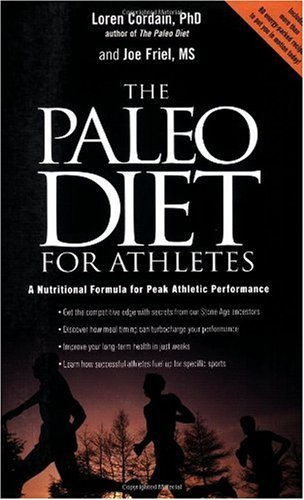
Rather than do the kind of review I normally do (which aren’t typical reviews anyway), I’m going to highlight the points in this book that I find different from current paleo/primal views of folks like Robb Wolf and his Paleo Solution (PS) and Mark Sisson and his Primal Blueprint (PB). Both of those books have been published in the past year or less, while The Paleo Diet for Athletes (PDA) was published back in 2005. I do understand that Cordain is working on a new book, so I think it will be quite interesting to see what his take is on a few items that are much different in Wolf and Sisson.
The 1st differences I want to talk about are those between endurance athletes and the typical people PS and PB are addressed to. While Sisson comes from a background as an endurance athlete (competitive Ironman triathlete and marathoner) he now thinks that kind of cardio is bad for you. In fact, he dubs it Chronic Cardio and outlines the problems associated with it, at least as he sees them(*). Wolf has more of a background with strength and crossfit type of exercise. So in both cases, they are pretty high on low carb., which is much different than PDA. I should note that on Wolf’s podcast he often talks about using carbs such as sweet potatoes and yams immediately following a workout, so that part is not different. But PDA is much higher on fruits in general. PDA specifically outlines periods of carb consumption as high as 50 percent, and at some limited periods 60%, of total caloric intake. I don’t know if I’ve ever seen Wolf give a specific percentage — he’s pretty much against calorie counting for the most part (though there are times he sees the benefits), and Sisson talks of 100 – 150 carbs max as ideal (and sometimes suggests much less). Even at 2500 calories, 150g of carbs would be 25 percent of intake, so you can see the large difference.
The other recommendations that I am really surprised by are listed below, because these seem quite different from current recommendations:
Finally, I would just say I was really surprised by PDA’s talk of following the American Heart Associations recommendations of limiting saturated fat to less than 10% of overall calories and limiting dietary cholesterol. Maybe I’m too deep into Gary Taube’s “Good Calories Bad Calories” right now, which seems to blow apart this hypothesis, but it also seems to go agains PB and PS and all the other paleo blogs out there!
(*) Suffice it to say that I don’t fully agree with Sisson on his views of Chronic Cardio. I do think that for people that work out 5-6 days per week at 90%+ maximum heart rate, there is a problem. You definitely need to mix it up with lower effort level aerobics as well as short sprints and “lifting heavy things.” I wonder if he would be cool if I explained to him my view that my ultra running is part of my “play time.” 🙂

 2sparrows