The 4-Hour Body. Timothy Ferriss.

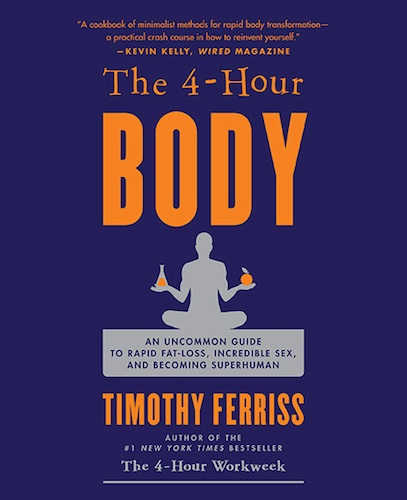
When I first started to hear the buzz about this book, I really was not interested.  I had a feeling I wouldn’t like Tim Ferriss — the title of his first book, which was a best seller, was “The Four Hour Work Week.”  That kind of put me off, for some odd reason.  And while I still have not read that book, I understand now that it s more about time management than actually working just four hours a week, so that changes my initial uninformed thoughts.

Anyway, back  to the buzz.  I really wasn’t interested, even though the original, working title was “Becoming Superhuman.” (Who’s not interested in *that* kind of book?)  But the publishers wanted to play off the success of his first book.  What really got me was the interview Tim did with Robb Wolf and Andy Deas on the Paleo Solution, when Tim started talking about “pre-hab” and the exercises he used to find and correct imbalances in his body.  That has long been a fascination of mine, due to what I already know are weaknesses (imbalances in strength) but weaknesses that I’ve found hard to correct.  It is my assumption that those imbalances are what causes a body to be injury prone — thus the notion of “pre hab.”

So I broke down and bought the book.  It is best to view this book as a reference book.  Read the 1st two chapters or so, and then pick out what you want.  For example, there are chapters on losing all kinds of weight.  I don’t need to do that.  There are chapters about putting all kinds of muscle on, and I also don’t need to do that.  There are chapters on going from a 5k to a 50k in twelve weeks, which were quite interesting to me, though not that useful (since I have already run that distance).  There were chapters on holding your breath for really long periods of time, which were interesting.  (Way back when — when I was a swimmer — I held my breath for 2 minutes 20 seconds.  On my 2nd try with Tim’s method, I hit 2:30!  I’m sure I could go over 3 with a few more practice attempts.)

Tim basically was a self experimenting machine for the past 10 years, and this book recounts his successes (mostly, with a few failures), with all kinds of crazy things that are much outside of conventional wisdom.  I myself find “CW” is often not right, so it was definitely an interesting read, though I’m not sure it is for everyone.  Definitely on the geeky side of things with the science behind the experiments.  (He talks about why new technology is often out of reach of the masses, much of it due to economics.  The cutting edge scientists, with new methodologies and treatments, are maybe 20 years ahead of the mainstream.  They are a limited resource, so it is those with money that get the treatments.  Typically professional athletes and hollywood stars. It takes time for these technologies to trickle down.)

I’m still playing with the pre-hab movements, of which he only gives 4 — the 4 that will have the best effect on the wides audience — and the chop and lift and single arm standing dead lift definitely show what I already know (my right side, especially the hip stabilizers, is week), but I am quite intrigued by having a real “Functional Movement Screening,” done which looks for imbalances and gives specific exercises (beyond the main 4 that Tim discusses) for each such imbalance/weakness.

Some quotes:

  • Does history record any case in which the majority was right? —Robert Heinlein
  • “The future is already here—it is just unevenly distributed.”
  • “Fifty percent of what we know is wrong. The problem is that we do not know which 50% it is.”
  • Somewhere along the line, we seem to have confused comfort with happiness. —Dean Karnazes
  • Ugly, and ultimately painful, postural compensation is unavoidable when wearing shoes that elevate the heels. This simple observation somehow escaped me for 30 years, until CrossFit Chicago instructor Rudy Tapalla introduced me to Vibram Five Finger shoes, which look like gloves for your feet.
  • absorb what is useful, discard what is useless, and add what is uniquely your own. — Bruce Lee
  • Motion is created by the destruction of balance. —Leonardo da Vinci
  • The Cartesian separation of mind and body is false. They’re reciprocal. Start with the precision of changing physical
  • All life is an experiment. The more experiments you make the better. —Ralph Waldo Emerson

I didn’t know there was such a thing as a trailer for a book, but there is, and here’s 4hB’s trailer:

A much longer (and better!) review is located here.
Little River 10 Mile Trail Race

Update 2: 18/69 in the 40-49 male category.  What’s up with nearly 25% of the race being in my division??  55/300 overall.

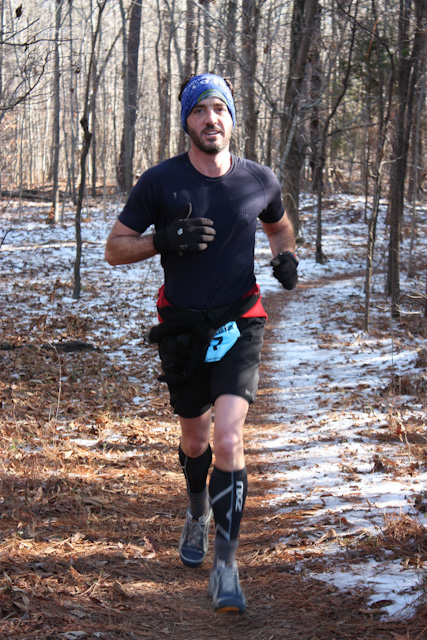
Update: Here is a photo taken of me by the race photographer:

I don’t have a lot of time to write a real race report, so let me just throw in the garmin data and what I sent to the google minimalist list for now…

And what I wrote to the email list:

Just a quick update that I ran the 10 miler and had NO achilles/soleus problems whatsoever. Well, for about two minutes around mile three I felt a little bit on the OTHER leg than the one that got so bad last Saturday and bothered me all week.

So what helped? I did a bunch of things so here goes:

1) Chiro on Monday (she did some ankle adjustments and deep tissue massage on knots and adhesions)
2) Deep tissue/structural integration massage on Wednesday
3) electro stim a couple of times (massage like setting)
4) lots of lower calf rolling with a foam roller like device
5) used topical ointments like mymed or biofreeze a couple of times a day
6) wore the go-lite sun dragon which is a 10-12mm heel lift shoe (this shoe has the added benefits of having cleat like lugs on the bottom, and it was snowy and icy. The inov8 195’s would have been a terrible choice. The 190’s would have been fine.)
7) 2xu calf compression socks… don’t know if these helped the AT but I really liked them. 🙂
8) 600mg ibuprofen two hours before the start

Another thought is that in a race situation, I really don’t have a lot of time to think about foot placement, so there is no real chance to force a particular foot strike. Thinking back to last week, besides the hard stair workout and hard pavement run, the long run on Saturday had a lot of flatter, gravel and old paved roads, and the inov8 195 does not perform well on that, in my opinion. So blame shoe choice a bit, though really it was a culmination of things that brought on the soreness.

Before I had the AT/soleus issue I had a stretch goal of 1:25:00, about 5 minutes faster than last year. I ended up with a 1:26:30, which I am extremely happy with considering how worried I was earlier in the week. For comparison, the course record was broken by 2+ minutes today, in 1:02:54.

I’ll add here that I went out fast — really fast.  My plan was about a 7:00 minute first mile to get some separation, and then back off.   I was in the low sixes at 1/2 mile and just under 7 at one, but then I didn’t back off soon enough..  Part of that is the adrenaline of the race, and part of it is that there is a lot of down the 1st couple miles…  You’ll see in the elevation chart a little climb, but not that much.  So miles 2.5 -5 or 6 were a bit of struggle to find the right zone.  My stretch goal of 1:25:00 would have been 8:30 pace, and I tried hard to hold that.  But I saw it steadily drop from 7:25, to 7:45, to 8:15, etc.  I knew the last half, and especially the last mile, were crazy tough to hold pace on because they are single track mtn bike trail with a lot of short ups and downs and tight turns.

Anyway, I’m quite happy with my time considering the AT/soleus issue earlier in the week.  Still 4 minutes better than last year!

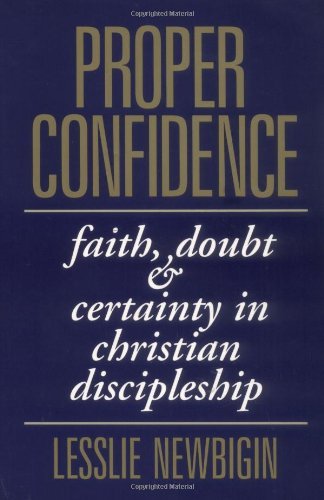
Proper Confidence. Lesslie Newbigin.

This was a fantastic read, though I have to say the 1st half was much better than the 2nd.  The 2nd half, in the conclusions, was a bit of a let down for me personally.  Perhaps after such a well-reasoned and well said introduction, where everything just clicks and makes sense, the second half didn’t lead to any new and startling revelations (for me).   However, I would say it is still worth it for any Christian that wants a better understanding of the world views that existed pre-Christianity in the Western World (namely Greek and Jewish thought), how Christianity challenged and changed them, and how the Enlightenment really changed the game and led us to where we are today.

Newbigin starts with the differences between Jewish and Greek thought, especially with respect to knowledge (epistemology), what changed with Christianity, and then goes through the early centuries following Christ, tracing the changes with respect to knowledge over time.  For example, for Plato, “the ultimate realities were ideas, which are more or less fully realized in the various entities which are the objects of our experience.”  By grasping these ideas and participating in them, the soul attains its true being and salvation.  (The idea of “Good” is the apex of this hierarchy of  ideas.)  Yet, Augustine said “credo ut intelligam,” or “I believe in order to know.”  There is an element of (biblical) faith in knowledge that is lacking in Plato and is a radical departure from Greek thought.

Along came Descarte (many centuries later, of course, but we don’t need to dig too deeply into the Dark Ages, do we?), who had a goal to build indubitable knowledge on the foundation of skepticism.  He says “I think, therefore I am,” and now all knowledge starts with the individual.  (I’m skipping huge chunks of the book and moving fast, but you should be able to see that such a believe leads to post modernism, the lack of objective truth, and relativism.)

Newbigin then follows Western thought through Kant, and Kant’s arguments for God and ultimate reality based on moral and aesthetic experience.  And through the Enlightenment (The Age of Reason), where our view (humanity’s) became that Reason is the only path to reliable knowledge.  (In Deep Church, Belcher talks about Foundationalism, and that was the 1st time when I started to be able to put into words what I had felt for some time — that we sometimes need something beyond Reason — to describe things such as certainly in Faith. (But then again, there is a problem with “Faith without Doubt…”)

He goes on to argue that we are in the midst of a great collapse of confidence due to the ramifications and limitations of the models of the Enlightenment, including the collapse in European culture as well as the collapse of the confidence in the validity of the church’s worldwide missionary enterprise.  (At least he goes after his own…)

Ok, this could get really deep and long if I’m not careful.  That’s not the purpose here.   Maybe the above, along with a few more tidbits below, will be enough to entice you if you like to read this kind of book.

Random thoughts and quotes:

I liked both of these — let’s look for the good on both sides!

From the point of view of the fundamentalist, doubt is sin; from the point of view of the liberal, the capacity for doubt is a measure of intellectual integrity and honesty.

In addition to ascribing these accusations, labels, and genuine differences over doubt to both sides in this quarrel, it is also right to ascribe moral virtues to them: Liberalism at its best is marked by an open mind which is humble and ready to learn. Fundamentalism at its best is marked by a moral courage which holds fast to the truth even when it is assailed by counterclaims from without.

I don’t know why, but the subject object duality that first entered my life in Zen and the Art of Motorcycle Maintenance keeps popping up in strange and unexpected places:

The second dualism, closely related to the first, is that dualism expressed by the words “objective” and “subjective.”

I feel like I am strong on gratitude, but after reading the following quote I wonder if I fall short on Trust:

But it the biblical story is true, the kind of certainty proper to a human being will be one which rests on the fidelity of God, not upon the competence of the human knower. It will be a kind of certainty which is inseparable from gratitude and trust.

I still haven’t figure out why this is the case (:-/):

Kurt Godel’s demonstration that the fundamental axioms of mathematics are not self-justifying does not seem to have weakened the influence of the idea of mathematical certainty.

And a few more:

But we are left in a world which the Chinese writer Carver Yu has summarized in the phrase “technological optimism and literary despair.” Looking at contemporary Western society from his standpoint as a Chinese philosopher and theologian, he sees not only the unstoppable dynamism of our science-based technology but also the bleak nihilism and hopelessness that is reflected in the literature, art, and drama of our society.

With hindsight, it is now easy to see how many of the self-evident truths of the Enlightenment were self-evident only to those who were the heirs of a thousand years of Christian teaching. They were not self-evident to the peoples of India or Africa.

The modern antithesis of observation and reason on the one hand versus revelation and faith on the other is only tenable on the basis of a prior decision that the whole cosmic and human story has no purpose and therefore no meaning. It is possible to make this assumption, but it is not necessary.  The question whether the cosmos and human life within it have any purpose other than the individual purposes we seek to impose on things is one that cannot be decided by observation.


2010 Book Shelf

Here’s a picture of my book shelf — books read in 2010…  Several of these are missing on my individual book review posts.  I am behind and really don’t know that I can catch up, so I may just have a clean up post or two.

A lot more running books and food/diet books than I ever would have guessed at the beginning of the year!  And where’s the classics?  Well I guess I did get in a couple from Chesterton.  And I might have to put the biographies/histories into a similar category.

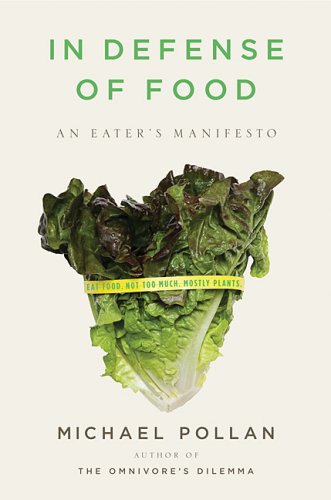
In Defense of Food. Michael Pollan.

After reading Pollan’s The Omnivore’s Dilemma, and enjoying it so much, I thought I should read his follow up book.  In the introduction, he explains the purpose of writing In Defense of Food:

But many readers wanted to know, after they’d spent a few hundred pages following me following the food chains that feed us, “Okay, but what should I eat? And now that you’ve been to the feedlots, the food-processing plants, the organic factory farms, and the local farms and ranches, what do you eat?

He goes on to give the answer early:

Eat food.  Mostly plants.  Not too much.

Of course, that answer needs a lot of explanation, which the rest of the book does.

Again in this book, Pollan shows he is a good writer, though I enjoyed the “adventure” aspect of The Ominvore’s Dilemma a bit more.  But this is still worth a read, and a fascinating account of the many problems with conventional wisdom, especially with respect to USDA guidelines for eating and, more specifically, with the food pyramid.  There is some repetition, of course, but that is expected.

I won’t say much more here, but will leave you with a few quotes:

Scientific reductionism is an undeniably powerful tool, but it can mislead us too, especially when applied to something as complex, on the one side, as a food and on the other a human eater. It encourages us to take a simple mechanistic view of that transaction: Put in this nutrient, get out that physiological result. Yet people differ in important ways. We all know that lucky soul who can eat prodigious quantities of fattening food without ever gaining weight. Some populations can metabolize sugars better than others. Depending on your evolutionary heritage, you may or may not be able to digest the lactose in milk. Depending on your genetic makeup, reducing the saturated fat in your diet may or may not move your cholesterol numbers. The specific ecology of your intestines helps determine how efficiently you digest what you eat, so that the same 100 calories of food may yield more or less food energy depending on the proportion of Firmicutes and Bacteroides resident in your gut. In turn, that balance of bacterial species could owe to your genes or to something in your environment. So there is nothing very machinelike about the human eater, and to think of food as simply fuel is to completely misconstrue it. It’s worth keeping in mind too that, curiously, the human digestive tract has roughly as many neurons as the spinal column. We don’t yet know exactly what they’re up to, but their existence suggests that much more is going on in digestion than simply the breakdown of foods into chemicals

Foods that lie to our senses are one of the most challenging features of the Western diet.

Nine percent of the calories in the American diet today come from a single omega-6 fatty acid: linoleic acid, most of it from soybean oil.

People eating a Western diet are prone to a complex of chronic diseases that seldom strike people eating more traditional diets. Scientists can argue all they want about the biological mechanisms behind this phenomenon, but whichever it is, the solution to the problem would appear to remain very much the same: Stop eating a Western diet.

Finally, he has this to say about Gary Taube’s Good Calories, Bad Calories, which I just happen to be reading now:

*Gary Taubes describes the developing carbohydrate hypothesis at great length in Good Calories, Bad Calories. According to the hypothesis, most of the damage to our health that has been wrongly attributed to fats for the past half century—heart disease, obesity, cancer, diabetes, and so on—can rightly be blamed on refined carbohydrates. But the healthy skepticism Taubes brought to the lipid hypothesis is nowhere in evidence when he writes about the (also unproven) carbohydrate hypothesis. Even if refined carbohydrates do represent a more serious threat to health than dietary fat, to dwell on any one nutrient to the exclusion of all others is to commit the same reductionist error that the lipophobes did. Indeed, Taubes is so single-minded in his demonization of the carbohydrate that he overlooks several other possible explanations for the deleterious effects of the Western diet, including deficiencies of omega-3s and micronutrients from plants. He also downplays the risks (to health as well as eating pleasure) of the high-protein Atkins diet that the carbohydrate hypothesis implies is a sound way to eat. As its title suggests, Good Calories, Bad Calories, valuable as it is, does not escape the confines of nutritionism.

Run at the Rock.

Last year, Run at the Rock was a total mud-fest.  This year, it was a bit chilly, with the starting temp around 35F, though that isn’t nearly as cold as last year’s Little River Run which was 16F.  I opted for my CW-X 3/4 tights, and an icebreaker 200 body-fit top (non-zip — I like the zipper kind better).   I’ve only run short distances in the CW-X’s, and then only when leaving directly  from home.  This time, I put them on, and then drove into town to meet Bridget and Kent, before driving the 45 minutes to the park.  When we got there and I got out of the car, my feet felt a little tingly.   I was really cold so I decided to go back to the car for a few minutes and crank the heat.  I even took my shoes off to rub my feet to try to get them to come to life.  I could not figure out why they were tingling!

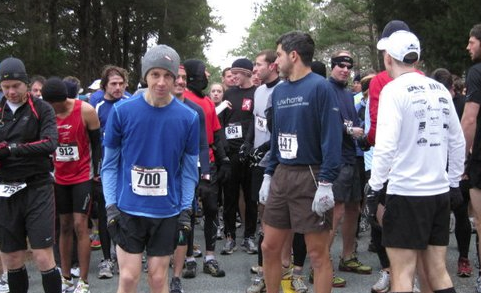
Eventually I had to go back to the start, where I hung out with a few people chatting away.  Somehow I ended up on the 2nd row, and with both a 7 mile loop and 14 mile loop, with nearly 100 in the 14 and nearly 300 in the 7, I was in front of a lot of people.  Too many people!

Shannon, as always, carried her camera and got a ton of shots.  Here is one of me at the start.  Not a very flattering photo, but at least I look happy.  🙂

And an even funnier one…  #700 in blue right at the front — he ends up winning the race.  That face right behind him – -that’s me.  What am I doing up there?


My plan was to run hard for the 1st 1/2 mile or so, which is on paved road and then an open field, before you hit the single track.  By hard I mean sub 7 pace, so I could get some distance and separation and not be held up on the single track.  I wanted the 1st mile to be in the 7:30 pace range.  I managed both of those goals, though I may have been closer to 6:30 pace in the beginning, but I reached the 1 mile mark in 7:27.

My feet had gone from tingly to numb, and between miles 3 and 4 I was seriously considering dropping out after the 1st 7 mile loop.  I don’t think it is a good idea to run when you can’t feel your feet!  Talk about lack of ground feel, feed back, and proprioception!!   I backed off the pace a little more and just took it easy.  Over the next  10 minutes, my feet came back to me, and I settled into a comfortable groove, and even picked it up a bit.

Looking back, I am not sure why my feet got so numb, but my current theory is that the CW-X tights are the culprit.  Wearing them for a couple hours, including about an hour of drive time, where my legs were bent, may have done it.  The CW-X’s have “targeted support” bands that line the quads.  I think those bands may have cut circulation a little.  But I’m really not sure.  I do know my shoes were not too tight, as I loosened them a couple times, and when I took them off and rubbed my feet, nothing changed.

Anyway, back to the race…  As you near the end of the 1st loop, you can typically tell the 7 milers vs. the 14ers, as the 7 milers really speed up.  I was in a group of about 5 or 6 ladies spread out over 20 meters, but the only one that sped up kept going on the 14 mile course!  Odd.  I passed the 7 mile finish in 57:0x or so, or 6 minutes faster than last year.  However, the Garmin showed 6.5 miles not 7, so it appears the course was short, and later most runners agreed.  I also later found that Bridget was about 20 seconds behind me, coming in 2nd place in the female masters.

Not much to report on the 2nd loop.   One lady flew by in the 1st mile.  I later spoke to her and she is training for Uhwarrie 40 and wanted to negative split, which she did by over 5 minutes!   I found a good groove and settled in.  Between miles 10-12, my legs really started to wobble on the climbs.  And the climbs are really pretty small compared to what’s coming (Uhwarrie).   You can see the elevation profile below, and there’s never more than a 100 foot climb!

When I saw the mile 6 marker and knew I was almost done, then I got some energy back and began to cruise again.  The lady who had taken off at the end of the 1st loop — we had been passing each other every mile or so since then.  I had a good 20 second lead on her when my shoe came untied.  I was tempted to run the last mile with it untied, but felt that was a little too far.  So I stopped, took off the gloves, tied the shoes, put the gloves back on….  She of course passed me, and I never could catch her coming in to the finish.

I crossed the line in about 1:55:xx, though the clock said 1:56:39.  Everyone agreed the race clock was about a minute off, and that the distance was off by about 1/2 mile per loop.  So 13 miles in 1:55 — not too bad all things considered.  That put me in 29th out of 96 overall, but 5th in the 40 age group.  :-/

I hung out at the end with Bridget, Shannon, and Anthony, as well as a few others, waiting for Kent to come in.  When he did, we headed over to the tent, which was warm, and had hot soup.  The soup smelled terrible, but tasted good.  Strange.

I used the inov8 f-lite 195’s with a metatarsal pad in place on the left foot and was happy with them for the most part.  Last year was a mud fest and I used the go-lite sun dragons, which are very luggy, and they were awesome.  It has been dry here, so I decided against the x-talon 190’s which are almost a cleat, and other than one or two muddy spots, that was a good choice.


There was an official race photographer, but the photos have yet to be posted.  I may update this post when they come in….

Raven Rock Rumble 10 miler

Raven Rock is one of my favorite parks within an hour driving or so of home.  Along with Uhwarrie Sate Park, it has some of the best trails and scenery around!  I always try to go to the once-a-year orienteering event that Backwoods Orienteering Club puts on there, and last year at the Bushwhack 24 hour adventure race, there was a long orienteering section as well.  So when I heard about the Raven Rock Rumble 5 and 10 mile race, I had to sign up!

I had checked with the PBO running group to see if anyone else was racing, in order to car pool, but no one else was.  Then the day before the race I got an email from my friend Randy saying he was going, and would I like to car pool.  I didn’t even know Randy was a runner, but this is his 3rd year running the 5 miler!  We had a good drive down, getting there at 8:30 right when the posted packet pick up cut-off was.  :-/  We had about a 3/4 mile jog to the registration tent, where there was still a line of 15-20 people in front of us, so we were good.

The 5 miler started 5 minutes before the 10 miler, and about 100 meters ahead, so I wished Randy well, and walked to my start line.

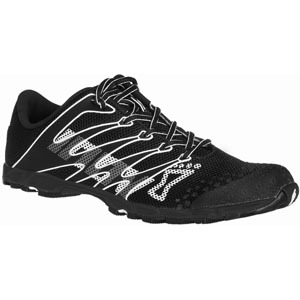
Shoe choice was really a tough decision.  I am using a metatarsal pad right now, which sits just behind the ball of the foot, which in theory spreads the load better.  This is an attempt to alleviate that weird popping thing I’ve had in my left ball of foot since Half-scar back in June.  I’ve only had the pads about 10 days, so I’m still figuring out which shoes they work in and which they don’t.    The meta-pad feels great in my new Kinvara’s, but I definitely didn’t want to wear that shoe on the trails.  It is definitely a shoe more suited to roads.  So on Friday afternoon, the day before the run, I tried the metatarsal pad in my Inov8 F-lite 195’s, Saloman XA Comps and the Go-lite Sun Dragons I had so much success with last year (but which are, unfortunately falling apart).  Both of those are a lot more shoe than I’ve been wearing recently.  At first, I did not like the feel in the 195’s, but after going back and forth between all the shoes, finally felt like that would be the best choice.  I opted to not use a pad in the right shoe.  The 195’s really have almost zero cushioning, so you can feel the pad, and on the right foot, it was uncomfortable, but on the left, it felt pretty good.  I opted not to use the luggy inov-8 x-talon 190, as it has been relatively dry and I didn’t think I would need that kind of grip.

The race started at 9:05 a.m., and my plan, as in most trail runs, was to go out pretty hard in order to not get stuck in a log-jam of runners once the course hits the single track.  So, I started up front and was with the top 15 runners about 250 meters in, just before we hit the trails.  I heard two ladies talking about 5:45 being a little too fast.  🙂  I am pretty sure it was more like 6:15 – 6:30, but I wasn’t about to look at my watch at that point!   The course was a fairly gradual down hill for the 1st couple miles, and while there was a little jockeying for position, the strategy of going hard was good because I was certainly in the top 15 – 20 at that point.

Around mile two I looked at my watch to see I was still going a bit fast — 7:35 pace.  But then again, it had been mostly down hill. That pace would slowly creep up over the next 8 miles, but there was also a lot of climbing to come!  Around mile 2.5 I settled into a more comfortable pace and a few people passed me, but I had my eyes on them and thought I’d bring many of them back in.  Especially the 14 year old!  (I didn’t know how hold he was at  the time, but looked on the results later!  🙂  )  He still did awesome, finishing just 3 minutes behind me.  Wow!

Around mile 3.5 we went down an out-and-back section that was all down hill, including a long section of stairs where it was pretty steep.  The front runners were coming back up, and almost all of them were walking.   As soon as you turn around at the bottom, you start the long climb… I switched to power hiking and passed a couple walkers and a couple of folks that were attempting to run.

Around mile 4.5, we passed the finish line, and headed out onto the 5 mile course.  It was a long half mile down, where many of the 5 milers were struggling up.  I decided this would be good information to remember – I wanted to save a little in the tank going into the last mile!  It was on this section were I started picking off a couple of the folks who had passed me earlier, but  by now there was a big spread between most runners.  I ended up running mile 7-9 with a grey haired gentleman, and I reminded him about the hill at the finish.  He passed me on one steep little climb, and I let him go, thinking I would catch him on the BIG climb.  We finally got to there, and I ran some sections and power hiked others.  He just kept plodding along, and I could never close the gap, though at least we passed two more racers who were walking.  At the top, I thought my power hiking strategy would give me a bit more energy and I could over take the guy, but he sped up and actually gained a little.  The results show he was 50 years old — so kudos to him! I hope I am running that well in 10 years.  🙂

Update:  Someone caught a picture of me at the finish so I’ll add it here:

Randy and I both had to get home very quickly, so as soon as I was done we walked over, grabbed some water and a banana, and headed back to the cars.  I felt remarkably good the rest of the day, and on Sunday only had a little soreness in the calves.  The foot popping was barely noticeable and not really any better or worse than it has been — but I have not run 10 hard miles in a while so that is a good sign.  I actually saw my PT on Monday and he poked and prodded my left foot, and the area where the popping occurs was not sore at all, but the head, or just below the head, really, was a bit more sore than it has been.  In the past when he poked and prodded, that area was not that sore.  So the theory right now is that soreness is inflaming the tendon, and the tendon is what I feel popping when I walk over hard surfaces — it comes out of the grove and gets between the bone and the ground.  :-/  It still isn’t slowing me down, and doesn’t really hurt per se, but I am monitoring it closely, and hopefully the meta-pad will help it out.

As far as the 195, they performed really well.  The course covers various types of trail, much of it single track, with rocks and roots covered by leaves.  The few times I hit a rock or root head on, the 195 provided ample protection.  I will say that by the end of the 10 miles, my feet were getting tired, though, so this may be close to my limit in this shoe right now.  In two weeks I have a 14 mile trail race, so I’ll have to make a decision.  I am pretty sure I will go with the 195 again, unless it is as muddy as last year, in which case I’ll go with the 190.

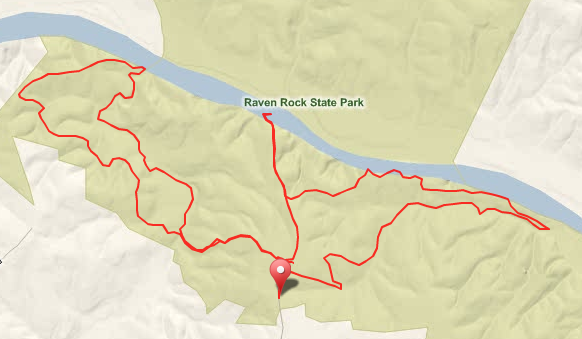
Here’s a GPS map from my Garmin showing the course…  The out and back to the river was from mile 3.5 to 5 or so, which includes a long decent down “stairs” and then, as soon as you turn around, the long ascent back up.

Here’s an elevation vs. speed graph, which really shows the two brutal hills — the 1st from mile 4 – 5 and the 2nd the last 1/2 mile of the race.  In reality, the last tenth or two tenths was flat to the finish, so I’m not sure why the Garmin doesn’t show it that way.   The course actually went down the same hill nea

I did not wear the heart rate monitor, so no stats there…

The results were posted late Saturday and showed me 23rd out of 110 with an average pace of 8:34.  On those trails, and those hills, I’m pretty happy with that pace!

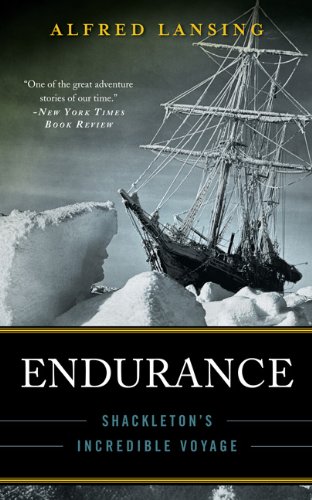
Endurance: Shackleton’s Incredible Voyage. Alfred Lansing.

Fortitudine vincimus – “By endurance we conquer.”

Endurance is the incredible true story of Ernest Shackleton and his crew’s amazing escape from disaster in Antartica — so incredible in some places it seems improbable that it all really occurred.  However, the journals of all the men and testimonies afterward seem to corroborate one another fully.  Every adventure racer, every endurance paddler, every navigator, etc. should read this story immediately.  🙂  It really is that good and that fascinating.  That men could survive in such conditions over such a long period of time, that they could travel the distances they traveled in the most unlikely of methods, and live to tell about it, is beyond comprehension.  And the book is so well written, it really grips you from the start and never lets you go.

For the navigators, imagine this…  When 6 of the men had to leave the rest of the crew, sailing from Elephant Island through perhaps the most treacherous ocean in the world, in a small boat not meant for that kind of thing:

They would travel perhaps a thousand miles across the stormiest ocean on the globe. The ultimate goal was an island no more than 25 miles wide at its widest point. To guide an open boat that distance, under conditions that were frightening even to contemplate, and then to strike a pinpoint on the chart was a task that would sorely tax even Worsley’s skill as a navigator.

For the orienteering population out there, imagine this… When they had to climb up and over South Georgia Island, an island with 10,000 foot peaks, glaciers, crevices, freezing cold weather, fog, etc….

“I do not know how they did it, except that they had to-three men of the heroic age of Antarctic exploration with 50 feet of rope between them-and a carpenter’s adze.”

Other quotes:

But it was inescapable. He was the Boss. There was always a barrier, an aloofness, which kept him apart. It was not a calculated thing; he was simply emotionally incapable of forgetting-even for an instant-his position and the responsibility it entailed. The others might rest, or find escape by the device of living for the moment. But for Shackleton there was little rest and no escape. The responsibility was entirely his, and a man could not be in his presence without feeling this.

In some ways they had come to know themselves better. In this lonely world of ice and emptiness, they had achieved at least a limited kind of contentment. They had been tested and found not wanting.

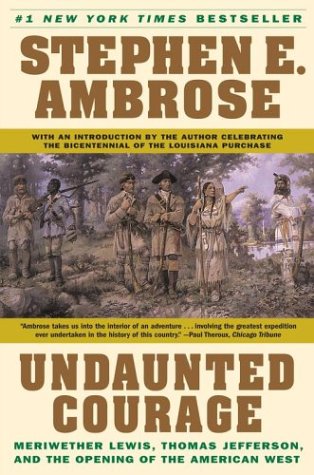
Undaunted Courage. Stephen E. Ambrose.

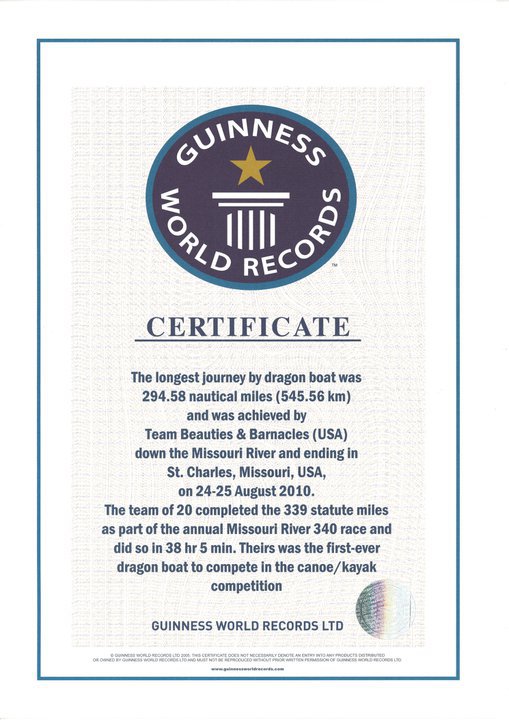
I had to read the story of Lewis and Clark, after paddling across most of the state of Missouri in the MR340, and finishing at the Lewis and Clark Museum in St. Charles.  I bought this book right at the museum, paying full list price which is probably twice as much as it would cost at Amazon, but I did want to support the museum.  It was a lot of fun to walk through the exhibits and read everything there was to read.

This was a very well written biography of Lewis, not just the expedition years, though that is where the focus is, but really is whole life.  I had not recalled from when I learned of the trip back in grade school the relationship had with Jefferson, which was refreshing.  As far as biographies, many of which can be quite dull, this book read more like a novel.  I wouldn’t put it in quite the class of John Adams, but it was close, and my 2nd favorite biography.

If you have any interest in the history of America, in expeditions and exploring, you should read this book.  As an endurance athlete who has races up to 3 days in the woods, I’m amazed at what these guys were able to accomplish.  Granted, they had a lot of help from the Indians a long the way — mores o than their journals may portray, but what they accomplished is still quite impressive.  There were times they were averaging over 30 miles on foot in the mountains.  I know from my recent 1/2 SCAR attempt what 42 miles feels like, so I know the Corp of Discovery men were in excellent shape!

Only a few quotes…

“This day I complete my thirty first year, he [Lewis] began.  He figured he was halfway through life’s journey.  “I reflected that I had as yet done but little, very little indeed, to further the hapiness [sic] of the human race, or to advance information of succeeding generation.  I viewed with great regret the many hours I have spent in indolence, and now soarly [sic] feel the want of that information which those hours would have given me had they been judiciously expended.”

“To victory over the wilderness, which is more interesting than that over man!”  – Barlow

And finally, what Jefferson himself route in 1813:

Of courage undaunted, possessing a firmness & perseverance of purpose which nothing but impossibilities could divert from it’s direction, careful as a father of those committed to his charge, yet steady in the maintenance of order & discipline, intimate with the Indian character, customs & principles, habituated to the hunting life, guarded by exact observation of the vegetables & animals of his own country, against losing time in the description of objects already possessed, honest, disinterested, liberal, of sound understanding and a fidelity to truth so scrupulous that whatever he should report would be as certain as if seen by ourselves, with all these qualifications as if selected and implanted by nature in one body, for this express purpose, I could have no hesitation in confiding the enterprize to him.