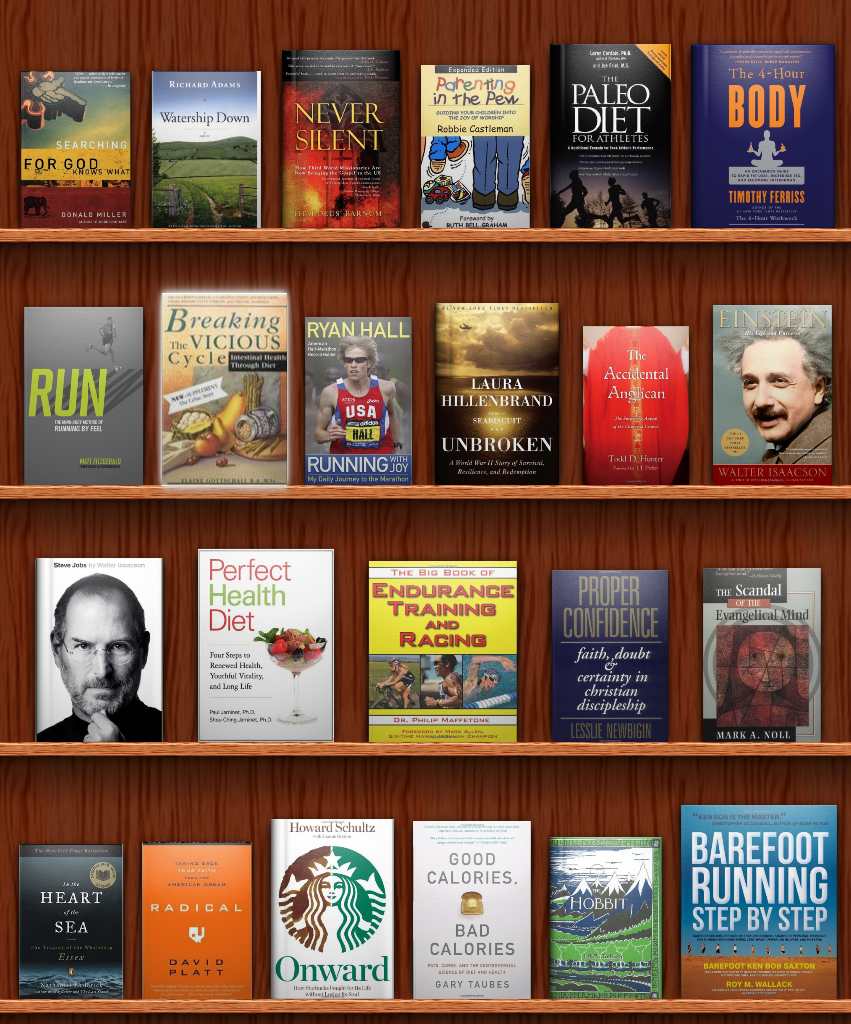
I was pretty bad about my normal reading notebook posts this year, probably only posting about half of the books I’ve read. For that, I apologize, but above you can see a book shelf of the year. Life got pretty busy and it was difficult to find time to write about each book — even to get my own personal notes from each of these books in order. A few of these I didn’t quite finish, and probably never will, such as “Good Calories Bad Calories” and “The Scandal of the Evangelical Mind.” Not that they are bad books, just that I reached a point where I had gotten all I wanted to out of them.
“Watership Down” and “The Hobbit” were re-reads, both classics, the latter read to my 6 year old son Reece. He now wants to move on to the Lord of the Rings trilogy! Of course there were several food/diet related books, as I continue to investigate my own digestion (which has been doing much much better, but is still not quite where I want it to be!)
If I were to make recommendations, “Unbroken,” Watership Down,” and “The Hobbit” are must reads in the fiction category. “Steve Jobs” is an amazing biography of a pretty amazing man that influenced our technologies tremendously during his life. “The Perfect Health Diet” is probably the closest to where I am in my diet right now, though I’d guesstimate I’m only 75-80% PHD compliant. And finally, “Never Silent” is truly an amazing and eye-opening account of where and how the Anglican Church in America has come to be…
While the total number of books read is a bit lower, most of that is due to reading more articles on-line, but it was still a good year in reading for me.
I could write my own review, or I could point you at Tuck’s to save a lot of time. 🙂 There’s not a whole lot I don’t agree with there. Plus, I personally know the sock-doc and agree with most of what he writes, and he has a recommendation/commentary in the Big Book… (Though the sock doc does not agree fully with Dr. Phil…. He’s a bit more attuned to Joe Friel for the better trained athlete in terms of HR zones…)
I would add that I found Dr. Phil a bit all over the place, a bit more “new age-ish” than scientific in spots, which makes it hard to follow, especially if you are more of a logically oriented reader. So it is a good read with a lot of good information, but a bit spaghetti-like; however, if you are looking for a reference book on training and diet, this is not it. I.e. it is not quick to pick up and find something specific that you are looking for. You’d probably have to read a chapter or two; though since the chapters are mostly short, that’s perhaps not too bad of a drawback.
Rather than a typical race report, I think I’ll just go with some random observations..
Organization: When I arrived to the hotel that the participant guide said was the registration/packet pick up hotel, and was told it was a different hotel, I was a little worried about the organization. And then at packet pick up, when there was conflicting information about drop bags, I was even more worried. For instance, I was given the tags I needed to prep my bags there, but two people right next to me were not. However, overall, the race was run quite well. On Saturday there were 4 races: 50 miler, 50k, marathon, and marathon relay. The courses were marked as well as they could be and there were marshalls at any intersection that could be confusing. I did hear of a couple racers going off course, but if you really stopped to look at any intersections, there were always flags showing you, based on which race you were running, which way to go. The only downside to so many races occurring at the same time is that there were one or two sections of single track trail with runners going both ways, but overall that was a very limited duration. The other confusing part is when they sent the 50 milers on a ~5 mile loop twice, marking your bibs appropriately each time. That loop got crowded with a couple of us in the 44-45 mile range and many more in the 37-38 mile range. I was explaining how I had just recently run this and some people thought I was crazy.
Time: Going in to the race, I didn’t really have a goal time in mind. Finishing was the goal, though I was pretty confident, that unless something went drastically wrong, that would not be a problem. So when people asked how long it would take, I said “ten to twelve hours.” I finished in 11 hours 9 minutes, so I was close. As the run started, in the early morning at 5 a.m., I looked down at my watch and saw a 9 hour pace, so for about 10 seconds I dreamed of that. Then reality set in, and I thought about a 10 hour finish. I hit the 25 mile mark in 5 hours 2 minutes and thought briefly about a negative split to break 10 hours, but then I slogged through miles 25 and 26, and my pace dropped from 12:05 per mile to 12:20 per mile. In just two miles!! Those were a bear to run, down by the creek, over and around boulders, under trees, a couple of big climbs…
Results: I’m quite happy with my results — 38th out of 200+ starters and 7th out of 47 in the 40-49 age group. There were a lot of DNF’s due to what I thought were pretty aggressive cut-off times (basically a 14 hour pace)…
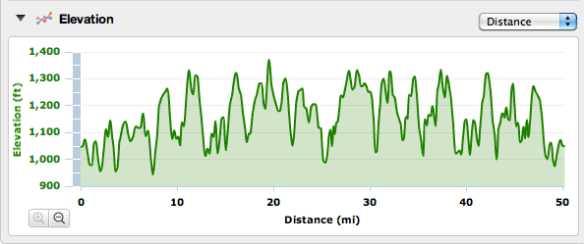
It was war out there…. The course was pretty brutal on the feet..I stubbed my right toes at least 8 times in the 1st 15 miles, before the left foot started to catch up. The rocks and roots were relentless — there was no time to just zone out. You really had to be mentally engaged with the course 100% of the time, so that was tough. I have 3 blue toenails to prove it… And I’ve never lost a toenail due to running, but I may this time. Additionally, the Oak trees apparently did not like us out there. They were launching (nearly) golf ball size acorn’s at us the whole time. There were huge crashing sounds as these things came flying down at us.
Shoe selection: I chose the Saucony Peregrine, which is by far the most non-minimal shoe I have left in my rotation, but I am sure glad I did. See the above bullet on how tough the course was on the feet! While I had my Inov8 195’s in the drop bag at mile 28, there was NO WAY I was going to change… I saw one Vibram wearer, and while he said his feet were ok, he didn’t run like they were ok. But granted this was in the 35 mile range, and none of us looked that good at that point of the run!
Sunrise: I was so ready for the sun to rise. We started at 5 a.m., and it was probably 7:30 before I could finally turn my head light off. I was tired of the shadows, especially in the early stages were at least once someone with a super high powered light got behind me and threw more shadows that made my little light almost worthless. So I just let them pass. Plus, sunrise is when I decided I would put on some music… (Just one ear!)
Cramping? I can remember cramping once in 20 years of endurance sports — an extremely hot Hi-Tec adventure race in Miami years ago. Well, a root decided to grab my foot and pull me down — the one and only fall I had, which is not too bad considering how many near falls I had and how many times the roots caught my toes. As I went down, the right calf locked, and I was really worried… It was in the 28-30 mile range, I think. The thought of 20 miles full of cramps was not a pleasant thought at all! I had forgotten my endurolytes and was using the nuun drinks at the aid stations to get me through. But I don’t think those were concentrated enough. I did begin to supplement with potatoes and salt at the aid stations. I had also found a pack of pills on the ground that looked like endurolytes. I cracked one open to taste it, and I think it may have been salt tabs, not endurolytes, but I used a few of those on the last 20 miles.
Nutrition: I followed my normal plan on really long runs of a base of perpetuem with a few gels and cliff shots mixed in. I’ve really come to like honey stingers as my gel of choice, and even though I had some hammer gel, I never used them. I did migrate away from my own supplies and use more of the aid station supplies as the race went on. Perpetuem lost its flavor after the 2nd bottle. Besides the aforementioned nuun and potatoes, I also ate bananas and oranges. All that plus one lara bar and 7/8ths of a cliff shot block pack was it. While the stomach wasn’t great in the 45-50 mile range, which was part of the reason for a “down time,” it did pretty well. The 20 oz. of water I was carrying was border line not enough later in the when it got hot (80F or so), but the aid stations were so well spaced at mostly 5 miles, with one 7 miler, it was ok.
GPS: I have never had a GPS be so accurate — there is normally drift on single track, and more drift the longer you go. But my Garmin was spot on the whole way. I finished at 50.25 miles on the 50.4 mile course. What’s up with that?
Mollyhugger: I wish I had some images to show the tornado damage around mollyhugger… Truly amazing. While the trail has been re-established, it was difficult running. And it just so happened to be the 7 mile between aid stations section!
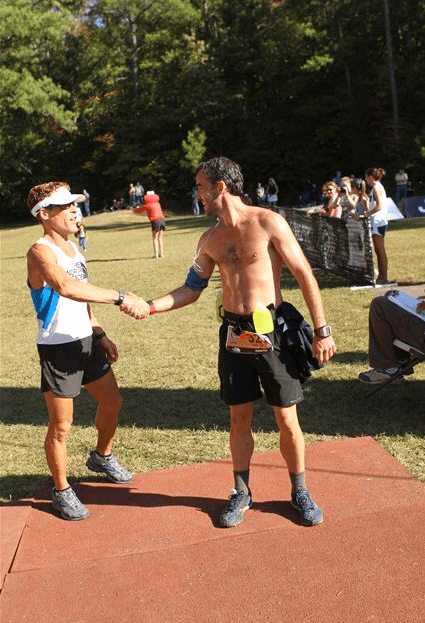
The Finish: I happened to finish at the exact time Dean Karnazes finished the kids run, and the photographer captured these images:
What’s next? Some time off! At least 1 week off completely from running, if not 2 or 3… The 4 weeks off from running after Boston sure felt good, but I’m not sure if I’ll go quite that long. When I do come back I see as much barefoot running as possible, probably on the treadmill as it will be getting cold outside, and probably some very low HR running. I’ll of course start to do something in the next 5 to 7 days — bike, paddle, crossfit, movnat, etc. But for now, I’m just going to rest. I feel remarkably good — 95% just muscle soreness, which is expected. The knees are great, but the right hip is a bit sore. That’s the only thing left that really bothers me after really long runs, so I would like to figure that out and do some “pre-hab” type work…
Run 100? Well, it is my long term goal…. During mile 47-49, when I was having a pretty low moment, I was thinking that 100 was just a foolish idea…. Now, a couple days later, it seems less foolish. Normally it takes longer for my mindset to change! I do think I’d have to change my training — 15-20 miles a week would not be enough for 100! But then again, my body seems to rebel when I get to that 30 mile per week threshold. Listening to some of the best 100 milers in the world, most of them never go past 50 on a training run. So the NF50 could be considered just that — a training run to get me to 100. But I wouldn’t consider anything until next fall, and only then if I have a strong spring season with at least one 40-50 mile race thrown in. I sure hope I get in to Uhwarrie again!
I was able to take part in a running research project, in which 20 runners from each of the following four groups are being analyzed: barefoot/minimalist, traditional shod, Pose, and Chi. Can you guess which group I’m in? 🙂 (I’ve actually read both the Pose and Chi books, and went to one Pose session with a local NC Pose coach, as well as practiced Pose drills a bit, but I would not say that I am a Pose runner in any way…)
I actually got to do the study twice. A month ago I went, and felt extremely uncomfortable on the treadmill. And it was not just because the treadmill has two belts, a left and right, with a 1/2″ gap between them. Nor was it all the ace bandages wrapped around my legs and waist. Something was just off… I had chosen to run in my Vivo Barefoot Ultras (with sock liner), which have tremendous ground feel. And I could feel a slight indention on the left belt and a slight protrusion on the right. These disturbances were enough to make my body react as if I were stepping on something dangerous… After the 1st run and set of samples, I asked to run again because it just felt so off. On the 2nd run, we quickly stopped the treadmill as it was obvious something was drastically wrong. Turns out the right belt had completely come off track!
So I went back a month later when the treadmill had been fixed, and it felt much better and I was much more comfortable. I could still feel a slight indention, now on both tracks, but I tried to not let that bother me much. We stopped at “2.8” on speed which turns out to be about a 9.40 mile though it actually felt much more like an 8:30. I hope that doesn’t skew my results too much and I’d love to see some of the data at a faster rate. I can say that I stopped at 2.8 as it felt the most comfortable in this awkward running situation. For comparison, I ran Boston this year in a 7:52 pace and my current 5k pace is about 6:50…
At some point during my 2-3 minutes of running on each belt, the researcher took video as well as sampled spatial and force data — I think five 3-second samples were taken. The spatial data is something like 240 frames per second using reflector nodes that had been attached to me… The force plates were even higher sample rates at 1200 per second.
The researcher was kind enough to send me a few snippets which I’ll include below.
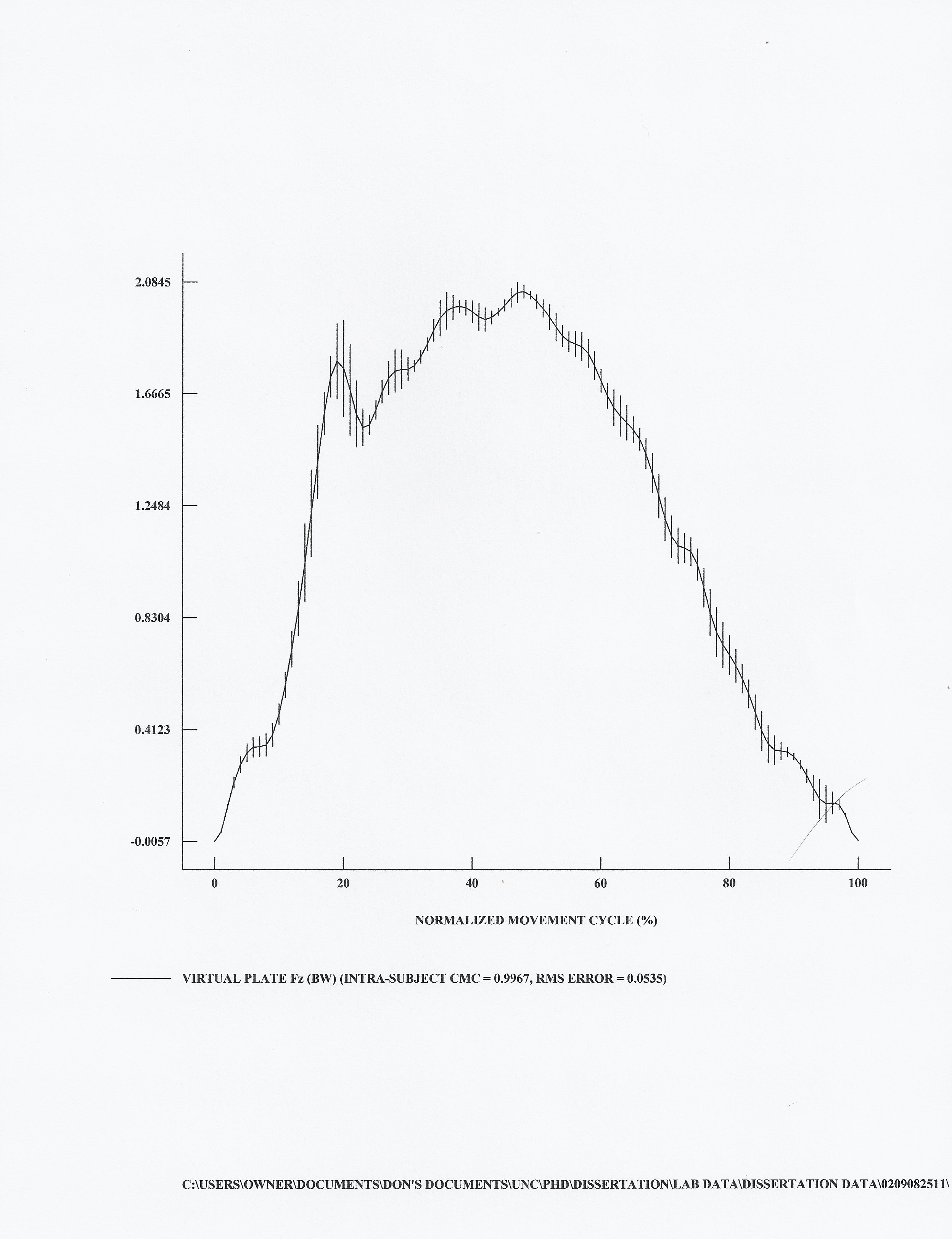
First is a composite of my ground reaction force across all the samples of data. What is interesting to me and the researcher is that most barefoot/minimalist runners do not have an impact transient — but I do, albeit slight. (For a quick summary of my barefoot history, see this post.) Overall my peak ground reaction force is on the very low end at 2X body weight, whereas the normal range for most runners it 2-3X. (This is one area where it would be nice to look at a faster run as I’m sure the GRF would go up at speed…) The researcher did say I have the lowest “bounce” in any runner he’s seen yet…
Next I’ll show the actual video of me running from the side… Unfortunately the lighting is not great and the feet are a bit blurred — this is not a high speed camera! But I think it shows a pretty decent fore to mid-foot strike. I think the VivoBarefoot Ultra’s almost force that…
And finally, I’ll show the “composite stick figure” video. This is the five 3-second samples averaged out… This appears to show more of a mid-foot strike than the video above, though that just may be due to the presentation… The vertical bar is Fz that is the breaking or propulsive (depending on where you are in the stance phase) force you are seeing in the anterior/posterior direction. (I thought it showed the impact transient but that is NOT the case…) It’s really hard to tell without the upper body being shown, but to me it looks like I might landing a bit far in front of my center of gravity and perhaps that could be part of the impact transient… I wonder if this would be different at faster paces? When I did do the Pose session, the one thing the teacher wanted me to work on was the slight forward lean from the ankles, and maybe I’m still running to straight up…
What would be most interesting is to have this kind of data available very quickly and easily, so I could try a few different things and see what would happen. But it is an expensive treadmill that is in high demand, for both research studies like this as well as rehabilitation of stroke victims and the like. And it takes about 30 minutes to get all the measurement reflection nodes attached.
All in all a worthwhile experience and the data you can get back may be useful to you if you are in to analyzing your form.
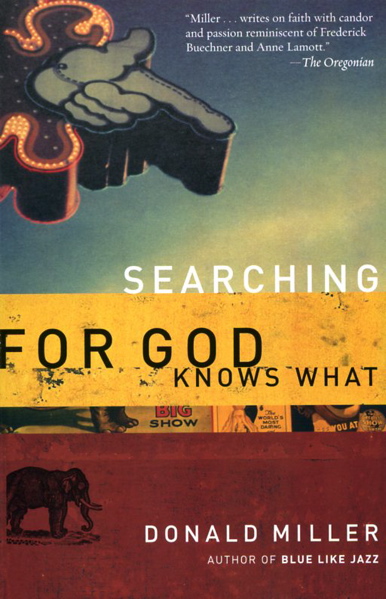
I’ve read a few Don Miller books and liked them all, and this one was no different… While he rambles around a lot, he does provide good insight into issues of the Christian faith in a way not many other authors do (at least, that I’m aware of). In this book he talks a lot about heirarchy’s in humanity, and how we are always striving to “get ahead,” or as the example in the book states, to be the last one left in the life boat…. And how that is so different from what Jesus portrays our lives should be like.
But rather than get into all that (since I’m so far behind), I just want to include one quote that he had of CS Lewis that really stood out to me:
Most of us are not really approaching the subject in order to find out what Christianity syas: We are approaching it in the hope of finding support from Christianity for the views of our own party. We are looking for an ally where we are offered either a Master — or a Judge.
Wow! How true is that. And how convicting. So many of the “arguments” in front of the church today are voiced by people guilty of this. And I’m certainly not saying I’m not guilty of it! But that is one of the reasons that standing on 2000 years of church history for your theology may not be such a bad thing.
[ I’ll preface this Reading Notebook post by once again saying how far behind I am on writing about books I’ve read and that I’ll try to catch up. The one thing I’ve got going for me right now is that I’ve not been reading books as much, so that just might happen!]
I’ve always had a bit of a love-hate relationship with Starbucks, but one thing I do love is the business success story. Imagine starting with a single store just 30 years ago to now seeing one on just about every corner in a big city in the US. But that is also one thing I don’t love — seeing SBUX everywhere. Except when I want/need coffee. 🙂
See? Love/hate. (there’s more to it that just the ubiquity.. there’s the brew… there’s the sugar and all the things they add to coffee, which is just not necessary for good coffee, etc. etc…)
Anyway, this book documents Howard’s return to CEO after having resigned that role a few years prior, returning at a time when the company was really beginning to falter. Some problems were due to the global economic crisis, but many problems had started earlier and were deeply interwoven into the company’s fabric. The success SBUX has had since then has been remarkable, so the book is a good read just for that.
I’ll only comment on a couple of things:
1) Pikes Place: Howard raves about this coffee, how they were trying to reach a larger, mostly American population, and how everybody loves it.
Strategically, Pike Place Roast had the potential to be a powerful catalyst for and symbol of our transformation.
Sadly, I have to disagree… I tried it at least 4 different times just to be certain — but I can’t stand it. These days, if I’m getting a drip/brewed coffee, I’ll always go for the dark roast — anything but Pike’s! And if there is not another option, I’ll order an Americano instead.
2) Clover: I love the clover. The brew this machine makes is excellent. Granted, Starbucks only uses their “reserve” beans in it, and that may be part of the reason Clover coffee is so good, but I also think the process has much to do with it. I was a French press man for years, but then switched to slow drip (since I don’t brew a pot at home as I’m the only drinker…). These days I love slow press — unless I’m near an SBUX with a clover.
First and most important, Clover makes a terrific cup of brewed coffee. A cross between a French press and a vacuum pot, Clover sucks water through the bottom of finely ground coffee instead of pressing water through the top, using a very fine filter that lets the coffee retain its best-tasting oils.
The transcendent little coffee machine born in Seattle’s Ballard neighborhood produces one of the top five best-selling beverages at the more than 100 stores that serve it in cities in the United States and Canada. Clover is finding its way into more locations, giving customers an opportunity to enjoy the nuances of our traditional blends and the flavors of our exotic, smaller-batch Starbucks Reserve coffees.
I have to include a few quotes:
The Starbucks mission: To inspire and nurture the human spirit one person, one cup, and one neighborhood at a time.
Historically, though, it is times like these, times of disruption, where America seems to discover its greatness.
I do think effective leaders share two intertwined attributes: an unbridled level of confidence about where their organizations are headed, and the ability to bring people along.
But in business as in life, people have to stay true to their guiding principles. To their cores. Whatever they may be. Pursuing short-term rewards is always shortsighted
I had to go to Denver for business, just a couple of days before the Tough Mudder in Beaver Creek, so my friend Ben talked me into racing. Well, it didn’t take much convincing. 🙂 It looked like a fun event to run, and one that I would love to do closer to home in NC. There’s one in VA in October, but I hope to run the NF 50miler at that time.
Once I got the go ahead from Kelly, I was all set.
My meetings were Wednesday, and when they were done, Ben picked me up. That evening he and I met Harry at Highline Canal for an “easy” 5 mile run. That “easy” run, while at an 8:30 pace, felt more like a sub 7:00 pace to me — where are my mountain lungs!!! After that, Ben and I headed out to Deer Creek for another 5 mile run, this one with about 1500 feet of elevation change. I was certainly trying to force myself to adapt!
On Thursday afternoon, Ben and I took off for Elk Meadow for a 10 mile run that got us close to 10,000 feet. I would have loved to bag another 14-er, to add to my six, but it was not to be. Most of them are still covered in snow, and while possible, it probably would have been a bit too much two days out from the Tough Mudder.
Friday was a rest day. 🙂
Saturday we left Highland’s Ranch around 7:45 a.m. and made the two+ hour drive to Beaver Creek. We had to stand in a few lines to take the shuttle bus from the parking area to the base of the resort, check in, etc. It was packed! 5000 runners over two days was pretty impressive to pull off as well as they did.
Our wave was set for 12:40 so we got to watch a couple other waves take off, hang out, get ready, etc. About 12:00 we headed up the steep hill 100 meters or so to get ready for our wave. I wish I had brought some water — it was hot and dry up there!
Here is a course map TM provided. I’ll try to walk through each obstacle as best I can, but I’m not so sure this map matches up exactly. For an interactive map, click here.
Here is an excellent video that shows a bunch of the obstacles live. (It is not me — just some random posting to youtube!)
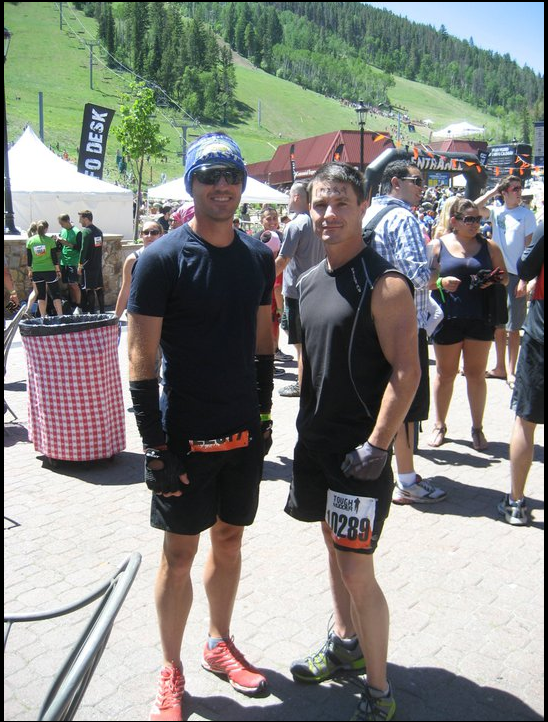
Here we are right before we headed to the start. As you can see, I chose the inov8 x-talon 190’s as my shoe – they have nice lugs that I thought would do well in the mud and snow, and I was right. I saw a few Vibram Five Finger wearers, as well as several people in road shoes or shoes with no real traction — and they all struggled on the slippery stuff.
After about a 15 minute speech, telling us what to do, what not to do, what to expect, safety rules, etc., a recording of LeAnne Rimes singing the slowest version of the National Anthem I have ever heard, we were off! We started on a very steep descent, maybe 30-40% grade, for 100 meters or so. Ben and I had positioned ourselves in row two, and took off. Well, he took off — he is much faster on the steep downs than me! (Well, much faster than me everywhere these days — especially at 8000 feet! 🙂 )
After that short steep descent, we had an easy little run on a paved walking area, before we started a gradual climb. The gradual climb took a hard left straight up the slopes, and then it got steep. And steeper. I was already red lining! Not good. But I switched to power hike mode and just made my way up as best I could. Looking ahead, there were only 8-10 people in front of us, so I didn’t feel too bad. (We quickly mingled with the waves in front of us, so we have no idea how we did relative to the rest of our wave, though I think top 10 is probably about right.)
The map above shows the 1st obstacle as “cliff hanger.” I don’t really remember anything like that. There was a muddy area from the snow sprayers misting us, which felt awesome, but that was it. The 2nd obstacle were a couple sets of the “Berlin Walls,” which weren’t too hard. If you use the leg stands on the side it’s very easy, but even without that, a quick step into someone’s hand up, grab the top and pull over.
After that we had some more slope climbing and a little single track running. I ran whenever the grade allowed and power hiked the rest. The 3rd obstacle was the Boa Constrictor, which was just two ~20 foot black pipes, perhaps two feet in diameter. In between the two at the bottom was water, so you crawled down into a bit of water, then out. Again these were not tough, but I was glad we were pretty close to the front of our wave so that we didn’t get backed up in a bottle neck. After that we had some more single track running along a pretty level grade. Here we started to pass people from the 12:20 wave.
The next obstacle on the map was the High Stepper, just walking across a net over something like water. I don’t recall it right here on the course, but I do recall a couple similar obstacles.
Next up was the Kiss of Mud, a crawl through mud with barbed wire on top… The bobbed wire was probably just 18″ above the mud, so you really had to belly crawl. This cut my knees a bit, but other than that was not too bad. We had started to stack up a bit with the next wave or two, so it was getting a bit crowded, but not terribly so. We finally hit a water station, which was much needed!
Next was the Swamp Stomp, a walk through mud at about waist level. There were a couple of hidden rocks in there, that many of us ran into, tripped over, or fell down on. (Or perhaps that was one of the river crossings later?? They kind of blur together…..)
After a bit more running, we hit one of my most dreaded obstacles — the Underwater Uunnels. Here’s a photo from the TM site — I just want you to see it. This perspective makes the tunnels look a bit closer together than they really were!
We walked into freezing water — 36F — to about waist level, and then had to dive under each tunnel. 36F on your head is COLD!!! I took a couple of deep breaths, went under, and came up. Ouch! Brrr! A couple of steps and it was tunnel #2. A few more deep breaths — now starting to shiver — and I went under. I opened my eyes and it was pitch black. I came out the other side, and now the water was shoulder level — a couple more steps to the next tunnel, a few big breaths, and under again. This time I came up and I could NOT TOUCH the bottom! That was unexpected. I had to swim the 20 feet or so to shore and I was not happy at this point. It was very cold. I got out and grabbed a couple of the emergency blankets to wrap myself. I was ready to go but Ben was back at the water looking for me. I kept yelling but he could not hear, so I had to go back to get him.
We started running up a gradual slope, me still wrapped in the emergency blankets, towards the next obstacle, the log carry. I dropped the blanket after a few minutes and then grabbed a log. Ben and I ran up the hill carrying our logs, and now it was starting to get really crowded. The log carry had us going through the woods on single track, and there were a couple of bottlenecks on bridges. We snuck around the crowds as best we could, wrapped through the woods, back to where we dropped the logs.
From here it was a pretty long run down…. And down… Sometimes gradual, sometimes a bit steep, but nothing too bad. Ben did take a roll at one point, but he was always in front of me. We reached the Chernobyl Jacuzzi, which you climb up and jump into some bright colored FREEZING water… (They start the day with 200 bags of ice, and keep adding ice all day!) We ended up in the bright green, but there was also blue and pink. I should have cannon balled. Once you jump in, you progress forward and reach a bar that you have to go under, so your head gets totally wet, freezing, and colored. Climb up and out, and start running again, mostly down.
We next reached the Turd’s Nest, which was just netting across the river. Some folks chose to roll down, while I just walked it. We ran down from there to water station number two, where I forced down a gel and drank some water.
After that, we headed up. Steep steep up. 40-50% grade maybe? At some point, we reached the Devil’s Beard, just a net on the climb. I tucked in behind someone tall and just followed. After that, there was still more climbing. This was a quite steep hill, and it took a while to get up.
The map shows the next obstacle as the mystery obstacle, though I don’t recall it at this point on the course. I’m pretty sure it was later, but I’ll write about it here. Anyway, it was a long windy tunnel made of plywood, with black plastic on the ground. They had said it would be filled with smoke, but it was not, thankfully. I was able to slide on the plastic using my arms for the most part, saving the knees, which were already cut up a bit.
The climb continued until we reached The Gauntlet, which I don’t see on the map. The Gauntlet was a 50 or 100 meter run up the hill, with some hay bales on the ground to slow you down a bit. There were 4 high powered hoses on each side– think fire hoses — with folks manning them. They would shoot you as you ran up. They waited for me until I hit the 1st bales, and one went high and one went low — they were trying to take me down!! I made it up as best I could, and I have to admit, this one took a bit out of me! At the top, I was hurting. And we had a long ways to climb still….
Just a minute or two later, we hit the Sweaty Yeti’s, which were large snow mounds with orange netting over one of them, that you had to go under. Again, it was a bit crowded here, but we made it through… Just to have more climbing. And more climbing.
Next was the Mud Mile, which was a series of 5 or 6 deep mud pits, about waist level, that we had to trudge through. Then we hit aid station 3, which was totally packed! I got a little water and had a honey stinger. I wanted more water but it was too crowded to wait.
After that there was a bit of running to the log jam, just a series of logs that you had to go under or over. It was pretty easy. Now it was a long dirt/gravel road to run down, so we let gravity do its thing. There were only a couple other runners — everyone else was walking.
The map shows the hay bales next, but I am pretty sure it was a series of 3 Berlin Walls. Again it was getting very crowded so we had to wait in line a bit, but we helped a few teams over, and other teams helped us.
More down hill running on the the dirt road… The Hay Bales came, but they were pretty torn up from the thousands of runners that had already gone before, so it was an easy jump up and through. The hay on the other side was thick, and I did fall in a hole in a couple of places.
(The map shows a super G slalom, but I don’t think we ever did anything quite like that.)
After the hay within just 50 meters or so, was the Spider Web, just a high net wall that you had to climb over. There were a bunch of people holding it down for us, so we held it for another round of other runners, and then it was back to running down, down, down.
We finally saw Allison and Isabella and she snapped this photo — still smiling after about 9 miles!
The map shows Mud Slide and Greased Lightening, but I only recall the big slip and slide… Greased Lightening. There was a bit of a line to the left, but the right was wide open. The volunteers were telling us to go left, as people were getting hurt on the right. I choose to go right so I wouldn’t have to wait, but didn’t dive quite as fast as I would have due to the warnings, and ended up not having quite enough speed to make it to the bottom without a little bit of help from my arms pushing and pulling…
A bit more running down, and we made it to the Monkey Bars, where we had to wait a bit… We took our gloves off, and used the dirt to dry our hands. We both made it over pretty easily, though Ben had a bit of a longer time than I did. The lady in front of him took a while. 🙂
Next up was Everest, a large, greased, half pipe you had to run up and over. Most people take a few steps and dive for the top, pull them selves up, and keep going. I watched Ben do that just fine, but I missed! So I had to come down and try it again, and then someone grabbed my arm, though I had made it anyway.
A bit more running and we were at the final obstacle, the Electric Shock Therapy. I had dreaded this all day — I don’t like to get shocked! There was a long line, but we again made our way up front. I pulled my arm warmers up to protect my arms, crossed them in front of my face, and made a mad dash behind a group of other people. I never got shocked! Woohoo!
There was a short sprint to the finish, where we saw 14:50 on the clock — we had finished in about 2 hours 10 minutes. No official times are kept at Tough Mudders, though you can submit them later – if you are in the top 5% of any event you can get invited to the World’s Toughest Mudder, a 24 hour event in December. I think we’ll be close, but I doubt either of us will run it. Just not a good time of year for that kind of thing! (Plus, it’s in New Jersey!)
It was super crowded in the finish chute as everyone was getting their head bands, their shirts, and their free beer. Ben and I got separated, but we of course eventually found each other. A bit of a clean up with the hoses, picked up our bags, changed, took the shuttle bus(s) to get back to the car, and we were off… Heading towards Idaho Springs for Pizza, though we got stuck in some pretty good traffic on the way.
All in all a great run. I question the “Probably the Toughest Event…” on the shirt — if you are going to call it the toughest, don’t say “Probably.” 🙂 Ben and I both agreed we’ve done tougher races in our years of adventure racing and ultra runs, though I certainly see that an event like Tough Mudder is much more accessible to many people than those kinds of races. So it is “probably” the toughest for many of the participants.
I found out later that a few people actually run the course two (or more?) times on their day, so I may consider that in the future. Once to go fast and hard, and a 2nd time to run at a more leisurely pace where I can help out others more.
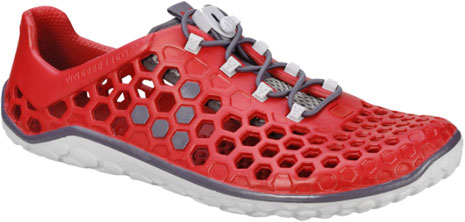
The text below is from an interview with the lead designer at Terra Plana… I have to admit, I am loving this shoe and running in it a lot more than I thought I would. I figured it would be a summer casual shoe, for walking around, maybe hiking, boating, paddling, etc.
But in the few weeks I have had it, I have been running on roads, trails, and the track. I just completed a backpack weekend of 20 miles, that included an additional 8 miles of trail running. The backpacking miles included something like 9 river crossings, and the shoe performed amazingly.
I would not run fast (race or tempo speeds) on the trails in them — just too much chance of a bruise from a stray root or rock. But they were never meant for that. This is perhaps the most versatile shoe I have ever worn. I use them with the sock liner and without, and when without I have used it with and without the tongue insert.
Great shoe.
MRS: Let me start with the newly released Ultra. Tell me a little more about the dual density EVA.
AC: The product uses a modern EVA injection molding technique which enables you to inject a soft density EVA in the uppers and a higher density EVA on the outsole. This product (Ultra) is only possible using this method which is the reason the Ultra was born and exists today. The upper part of the ultra is durable but very soft allowing the foot to flex and move naturally. The outsole section is injected second and is 6mm thick, a lot more firm than the upper which is vital for the ground feedback. It is also special high abrasion EVA which has increased durability for heavier running specific use.
MRS: How is it different than the Evo, Evo II, and Neo?
AC: Evo and Neo are high abrasion rubber outsole running shoes. Although of course they are everything VIVOBAREFOOT: thin sole, zero cushioning, puncture resistant, zero heel-to-toe differential, anatomic wide toe box. They are made like a traditional running shoe – strobel stitched with cemented outsole. And of course, they are not amphibious and quite as light weight.
MRS: Who is this shoe designed for?
AC: We saw an opportunity in this process that we can create a product that would span across a lot of activities but fundamentally, it is an impossibly lightweight running shoe and the feedback is that key buyers are using it as a pretty serious running shoe. You can run in and out of water without water lock and the very nature of it is like a functional Crocs-like product that can be used on the beach or kick around summer shoe or as a travel shoe. We hope that this product will transcend the current barefoot niche and perhaps help take barefoot to consumers that were just looking for an active functional water shoe.
Before I start this post, I just want to note that I am a bit hesitant to use the word diet. The typical connotation these days is a diet is used to lose weight, or perhaps to gain muscle. But most of the books I have read and post about, diet is more a long term lifestyle change than a short term change.
With that being said, let me also say that I read this book 6-8 weeks ago — I’m still way behind on writing all my “reading notebook” blog posts! But I did take about 30-45 minutes to review all my highlights in the book, to try to freshen it up in my memory a bit. That is always beneficial! 🙂
Of all the Food/Diet/Paleo/Primal books I’ve read in the past year or so, this would be the one I most recommend to anyone asking. Nina Plank’s Real Food would be up there too, though she is more preindustrial than pre-neolithic. There’s nothing wrong with that of course, and with the recent move towards “Paleo 2.0,” where you only use evolutionary biology as a framework, while regarding current science and research and results quite high. I won’t get into all those details here — go read Kurt Harris’s post above!
Of course, there are a couple of things I don’t fully agree with in PHD, which I’ll get to below, but I think this is the best plan overall and perhaps most accesible to both the scientific minded as well as those not quite so technical.
Rather than review the actual content and give a summary of the diet, let me just point you to the web page, which covers the everything in the book and more. In fact, this link gives a high level overview of the recommendations:
Of course, the book goes into much more detail and the science behind the reasoning, and is well worth the read.
There were a couple of things I did not agree with. One such example is that they tend to discard egg whites and just eat the yolks, as “egg whites are almost entirely made of protein; we discard them to keep protein levels down.” But overall, I would certainly recommend this book.


 The rocks and roots were relentless — there was no time to just zone out. You really had to be mentally engaged with the course 100% of the time, so that was tough. I have 3 blue toenails to prove it… And I’ve never lost a toenail due to running, but I may this time. Additionally, the Oak trees apparently did not like us out there. They were launching (nearly) golf ball size acorn’s at us the whole time. There were huge crashing sounds as these things came flying down at us.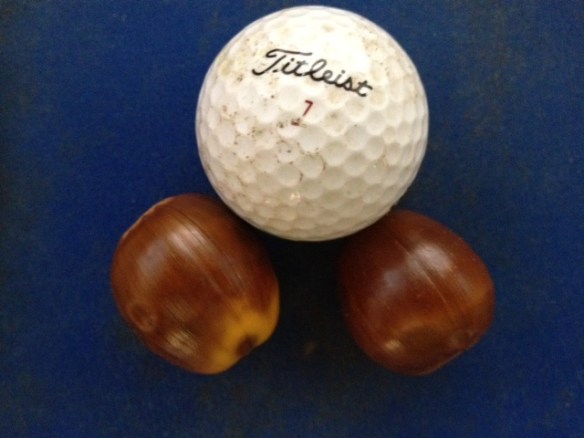








 2sparrows