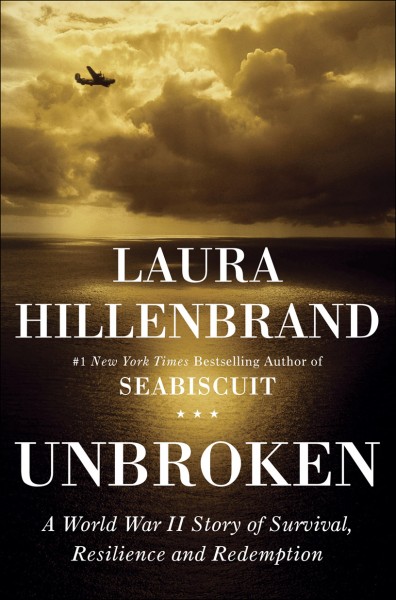
Unbroken. A World War II Story of Survival, Resilience and Redemption. Laura Hillenbrand.

This book was mentioned to me, somewhat in passing, by my old physical therapist.  My wife has a knee injury and is now seeing him, and I wanted to go to listen in on the diagnosis and prescribed exercises.  While I am a layman compared to a PT or a Doctor, I became a bit of a knee expert in my own when I went through so many problems in the past.  His description sounded intriguing, so I immediately picked it up, which in today’s terms means I downloaded it to my kindle app on my iPad.  🙂   I was instantly hooked.

The story is of Louie Zamperini, who was a kid struggling to stay out of trouble, when he discovered running. Within a short time, he had broken the national high school record in the mile at 4:21 in a 1934 preliminary meet.  He did not qualify for the Olympics in the mile so decided to try the 5k, and on his 3rd race at that distance, finished in a dead heat with world-record holder Don Lash.  While he only placed 8th in the 5k at the Olympics, his last lap was so fast (56 seconds!!) that Hitler asked to meet him personally.    In 1938, he won the NCAA Championship in a time of 4:08.3 — while his opponents tried to slow him.  He finished with a cracked rib, punctured shins, and an impaled toe!  Many thought he would be the 1st to break the 4:00 barrier in the mile, but along came World War II.

In World War II, Louie became a bomber in a B-24.  On one of his flight missions, the plane goes down and Louie and two others drifted on the pacific for 47 days, catching birds and fish as best they could, and rain water in small tins.  (One of the three died before they were rescued.)  Unfortunately, the rescuers were Japanese, so Louie then spends a lot of time in various Japanese POW camps, under abhorrent conditions.

I guess if I tell much more of the story, you may not read the book.  It is so worth reading… Fantastic book if you like running, US history, World War II, or biographies that read like novels.

As always, a few quotes:

Given the dismal record of raft-bound men, Mac’s despair was reasonable. What is remarkable is that the two men who shared Mac’s plight didn’t share his hopelessness. Though Phil was constantly wondering how long this would go on, it had not yet occurred to him that he might die. The same was true for Louie. Though they both knew that they were in an extremely serious situation, both had the ability to warn fear away from their thoughts, focusing instead on how to survive and reassuring themselves that things would work out

  • Without dignity, identity is erased. In its absence, men are defined not by themselves, but by their captors and the circumstances in which they are forced to live.
  • Dignity is as essential to human life as water, food, and oxygen. The stubborn retention of it, even in the face of extreme physical hardship, can hold a man’s soul in his body long past the point at which the body should have surrendered it.
  • The paradox of vengefulness is that it makes men dependent upon those who have harmed them, believing that their release from pain will come only when they make their tormentors suffer.
  • All he had left was his alcohol and his resentment, the emotion that, Jean Améry would write, “nails every one of us onto the cross of his ruined past.”
  • His conviction that everything happened for a reason, and would come to good, gave him a laughing equanimity even in hard times


Uhwarrie 40 mile mountain run

I’m not going to write a typical race report… I ran this same race last year so the course details are in the 2010 post.  Instead, I’ll just give a brief summary and then some random musings.

Summary: My goals were to #1 have fun, #2 finish, #3 break 9 hours.  I’ll cut to the chase and say up front that I met all of my goals.  Woohoo! However, it was a very strange race for me in that, even though I ran a little faster than I expected (8:50), I never felt good.  I really suffered.  But I survived.  As early as mile 2 or 3, I had heavy legs, labored breathing, and was struggling to find a rhythm.  I’m typically a slow starter, at least in terms of getting into a comfortable groove, so I kept thinking, hoping, praying, that that would happen again.  But it never did.  Sometime around mile 20 I gave up on that hope and knew it was going to be a sufferfest.

(I should add that I had a secret stretch goal of 8:30, and know that is entirely possible.  Especially if I ever start running more than 15-20 miles per week.  🙂  I hit the turn in 4:05 having felt dead and tired all the way there.  And while I slowed considerably on the way back, I was only passed twice, while I passed three other runners.  So everyone slows.  Maybe even a sub 8:00 would be possible.)

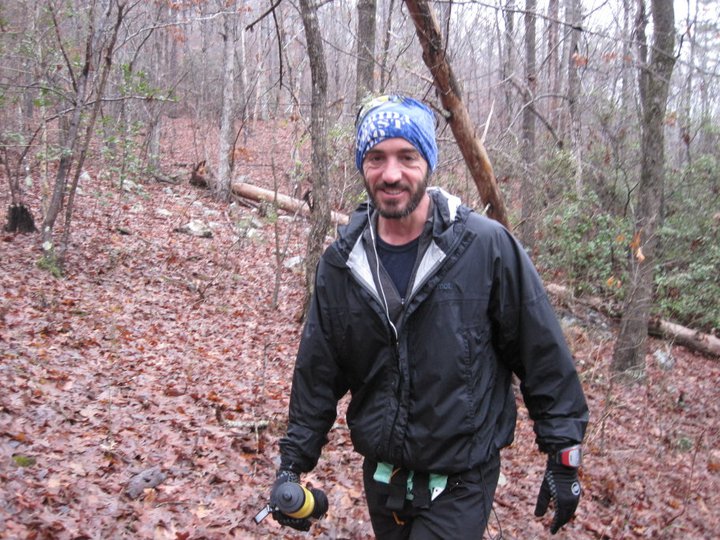
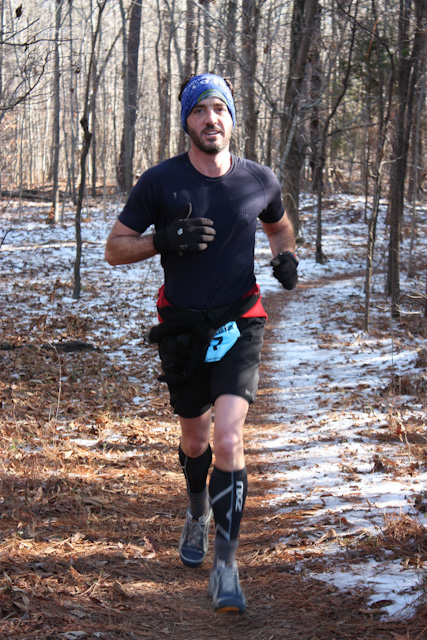
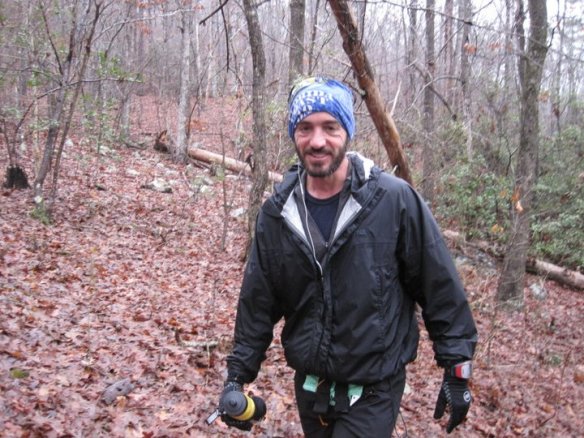
Here is a photo that Shannon took of me about mile 19… She was already coming out of the turn around, looking strong and fresh, about 3-4 minutes behind the lead female.  Shannon went on to win, so congrats to her!  What is amazing is that she did it all while taking nearly 200 photos on the day!  As a side note, I met her last year on this course, running together from mile 4 – 9 or so, when she had a hard fall on a stream crossing — about 10 seconds after taking this photo of me.  She told me to go on a few times, and I did reluctantly.  She came into the turn around and left before I did looking strong, but I did pass her around mile 34 or 35, as the hurt from the fall caught up with her.  When I saw her the morning of the 2011 race I told her I thought she was running much stronger and faster this year, after seeing her at Run at the Rock and Little River.  Guess I was right!
Ok, back to this year’s race.  How about some random musings:

1.  I saw Anton Krupika write the following about his run at the Rocky Racoon 100, the same day as Uhwarrie.  And while I didn’t run 100 miles, I know exactly what he is talking about.  I dealt with the hand I was given on Saturday, and can’t complain about how I performed.  I sure would have loved to have felt better, normal even, but there’s nothing to do about that except go with it and do what you can on that particular day.

Ultra racing is mostly about doing the best one can with whatever hand one is dealt, even if that hand doesn’t necessarily hew to pre-formed, arbitrary expectations.  Some days–Western States and White River last year come to mind–the act of running on trails is beautifully and absurdly easy.  Other days–like Miwok last year and Rocky Raccoon this past weekend–it is mundanely, decidedly average.  Ever since some time during the middle of the first lap on Saturday–well before Ian had disappeared into the distance–I knew I wasn’t 100% on top of my game, but the reason I can still recover with a sufficient measure of peace is because I am 100% sure that I ran as fast as I could on that day.  Most race days I am able to find a groove where things are generally effortless (at least for a time) and the performance just comes to me; that never happened for me on Saturday.

2.  Here is a link to my Garmin data.

3. Another quote, this time from the irunfar.com blog about Uhwarrie:

It rained heavily the night before the race. While the storm broke before the 20 milers toed the line, it was still a raw run on a relentless course. Mountain Cup regular Rachel Cieslewicz commented after the race, “it was the wettest, coldest, crazy technical 20 mile trail run I’ve raced.” Others reported “the trail conditions were pretty gnarly” and “a couple people ate it.” Having run the 40 miler, I can assure you that the course is quite technical and unforgiving.

4. The banjo player out on the trail at mile 19 (and 21), was a great touch.  It made me run faster (because I heard banjo music).

5.  The four stream crossings in less than 5 minutes at mile 16 and 24 was really tough.  The water was mid thigh high on me, but worse than that, it was icy cold.  On the return, it took at least 20 – 25 minutes for the numbness in my toes and forefoot to go away.  In fact, I took my shoes off a couple of times in that stretch, thinking my socks had bunched up.  I actually think this was colder than my recent polar plunge!

6.  That climb at mile 16 is brutally steep.  It was about half way up that the two front runners in the 20 miler came flying by me.  Yes, they were running.  Running hard.  Granted, if I didn’t have 24 more miles to go, but just 4, maybe I would have been running too.  (But probably not!)

7.  Army rangers in full combat gear carrying assault rifles can be amazingly quiet and still.  We had been told they were out there and we may see them.  But it wasn’t until I was passing them on the trail, with a large group of them within 3′ of us, that I noticed them!

8.  I became a heel striker, at least for part of the run.  The super steep downhills on technical terrain almost necessitate it.  You need the braking power of the heel.  Additionally, having a numb ball of foot due to icy water also necessitates using the heel — at least if there is still feeling there!  Having some ground feel over none is well worth a little heel striking, in my opinion.  🙂

9.  The 1st mile or so has quite a steep climb on very technical terrain.  I was right behind Shannon and mentioned in passing that I ran all of this down last year, because I was really close to breaking 8:00 (shortened course), which I did.  When I came to it this year,  I was actually surprised I was able to run it last year.  It’s pretty tough!

10.  I was in a group behind Alicia Parr up until about mile 5.  I really had no business being with a group that was going to be in the neighborhood of 8:00, but I had already tried a few paces to see if anything was comfortable; but alas, no pace felt good.  However, it was about that time that I figured I better just slow down anyway.

11.  Around mile 10 I saw my lowest pace of the event:  11:53.  But over the next 30 miles, that dropped to something like a 13:18.  :-/  (The garmin data shoes two laps — I had no satellite sync for the 1st few minutes so I waited for that to hit the lap button.

12.  A scary thing happened on Monday morning.  I found myself googling “North Face Endurance 50 mile run.”  Normally it takes a few weeks to  start thinking about another long run….  At least that one is 8 months out.

13.  Kudos to the race directors!  They run an amazingly well organized event considering there are 8, 20, and 40 mile races, you have to shuttle runners in from remote parking areas to the start, shuttle back runners from the 8 and 20 mile finishes, drop bags to the 20 mile turn around and return those drop bags to the finish…  And probably 100 other things.  They do an excellent job and are always friendly and polite.

14.  While I may not be back next year — I really hope to get in to the Mount Mitchell Challenge someday, another 40 mile run in NC the same month as Uhwarrie — I do hope to go back and run it again.

15.  As always, the friendly conversations you have in an ultra are cherished.  I ran with Matt from mile 5 to 8 or so.  As we were talking, we discovered we both graduated from NC State.  He in 2009, me in 1993!  :-/  He ended up dropping before the turn around due to ITB issues.  He’s the one that was telling me how gorgeous the NF50 in GA is.  (Not sure if that is good or bad!)  I also ran with Allan for a bit through those 4 icy streams and at the start of the killer climb at 16.  Allan wears a Sport Kilt and was fun to chat with.  I saw Will Jorgensen as I was running into the turn around.  I’d never met him face to face, and have only seen one or two photos of him online.  He provided SCAR reconnaissance for me last year, as he ran the full 72 the week before I did “Half SCAR Plus.”  I yelled out “Are you Will” as we passed and he yelled “yes,” so I yelled “I’m Sean Butler” and that was it.  I thought there was a slight chance I might catch him on the return, but that was not to be.

16.  At the same time, an ultra like Uhwarrie can be a lonely run.  Once I hit the turn at 20, and passed all the 40 milers heading that way and the 20 milers heading to the finish, there were literally hours of time spent alone.  If not for the aid stations of 3 miles, I may have not seen more than 3 or 4 people for big chunk of time.  Even before the turn around, I spent long stretches all by myself.  I don’t have a problem with that, I’m just letting others know what you might expect.

Ok, I suppose that’s enough for now.  I’ll update this with results when they are posted.  I’m secretly hoping I was top 20, but I really lost count of the return runners as I was heading to the turn around, so it’s tough to say.

Update:

Official results posted:  30/88 in the 40 miler in 8:50:22

Another Uhwarrie Post: Pacing and Weather

My first goal is to have fun.  My second goal is to finish.  My third goal is to run under 9 hours.

You would think a goal time of 9 hours, which equates to a 13:30 pace, would be easy, right?  In fact, 10 or 11 minute miles on trails, which is a 6 hr 40 min – 7 hour 20 min run, shouldn’t be out of reach, right?  I just run sub 9 minute miles on a 10 mile trail run at Little River.

Well, Uhwarrie is Uhwarrie:

And while those “hills” don’t amount to much, compared to certain other races, they certainly begin to take their toll.  Maybe it’s not the elevation overall, but the steepness.  That plus the ruggedness of the trail — the rocks, the stream crossing with no bridges, the mud, when it is wet, which it will be tomorrow, certainly add to the pace degrading qualities of the run!

Last year I ran 7 hours 57 minutes, on a course that was shortened to about 38 miles.  At mile 14, they sent us down 5 miles of gravel road instead of the 6 remaining miles of trail.  I distinctly recall my pace as shown on the Garmin going from something like a 12:30 to 11:40 over the 5 miles to the turn around.  So change the 5 miles of easy road running to 6 miles of hard trail running, and 9 hours may not have been out of reach last year, though it would have been close!

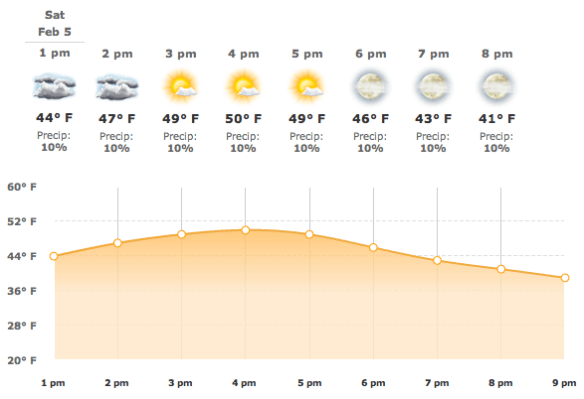
And now, on to the weather.  Here’s the forecast:

Certainly looks a little wet!  And chilly at the start.  (Though not this chilly!)  That much rain will make for a very muddy course, I’m sure.

Looking forward to it.  🙂


Uhwarrie Gear Decisions…

Uhwarrie is just a couple days away…  40 miles on a rugged, hilly trail.  Current weather conditions show rain and freezing rain on Friday, and rain on Saturday, with a low of 28F and a high of 52F.  So, time to make some gear decisions!

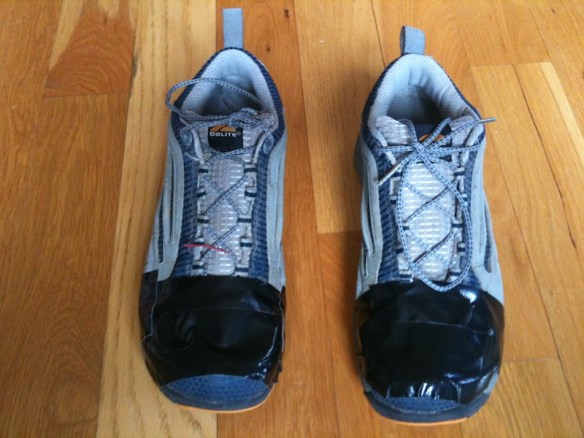
The 1st choice is in shoes.  I have been very happy with how my inov-8 195’s and 190’s have been performing all fall — right up until the point where my AT/soleus flared up unexpectedly.   That was a week before a 10 mile race, and after a week of treatment and running in my old Sun Dragons, the race went fine! I chose the sun dragon’s then because they have a higher heel lift than anything else I’m wearing right now, and that helped to alleviate the AT strain.  However, the Sun Dragon’s have large rips in the uppers on both shoes, so I’m a bit worried about them.  But I used some gorilla tape to hopefully hold them together, and that is what I plan on going with Saturday:

I took these out for an easy ~3 mile run, and it is obvious the tape won’t last 40 miles through Uhwarrie in the rain.  There are multiple stream crossings without bridges, rocks, mud, etc.  But if the tape holds the upper together just long enough, I’ll be happy.  Besides, I’ll have a spare pair of shoes at the 20 mile turn around in my drop bag.  Most likely that shoe will be a Solamon XA Comp.

Other gear will be a Nathan handheld bottle holder, though not with the Nathan bottle that came with it.  That bottle leaks like crazy!  I’ll also have a waist pack on that holds a bottle and a little fuel.

In addition to spare shoes in the drop bag, I’ll have additional fuel (see below), an extra pair of socks in case I need to change, and a head light.  Lights are required past a certain time, and I doubt I’ll need it.. But just in case.  I’d hate to get pulled from the course because I thought I’d be faster than I really am!  And even if I’m having a bad day, I’ll want to finish if at all possible.  I’ll have to decide at the turn around whether to grab the light or not.

As far as fuel, I’m going to follow the same strategy as last year and get 90% + calories from Perpetuem.  I’ll have four 20-24 oz sports bottles with 4 scoops each, or about 600 calories in each bottle of Perp ready to go.  Two will be in the drop bag to be picked up at 20 miles, and I’ll start with two.  One in the waist pack will be without water — I’ll fill it at one of the aid stations when I need it.  The one in the hand held will start full, and I’ll add water to it at each check point, slowly diluting it as I go.  I’ll carry a gel and a few cliff shots for each 20 miles.  I’ll have a bar or cookie in the drop bag, but I’m not sure I’ll eat it yet.  There’s also plenty of food along the route at the aid stations, but I typically stay away from all of it.

The last thing is clothing.  With conditions of 28-52F and rain, I still haven’t decided.  Anything above 40 and I’d rather go with under armor 7″ compression shorts underneath running shorts instead of my 3/4 merino wool tights, which I reserve for colder temps.  But with the rain, I’m not so sure.  This may be a game time decision.  If I go without the tights I’ll use the 2XU calf compression sleeves.  For a shirt, I’ll use a 200 weight icebreaker merino wool shirt.  Probably a long sleeve zip shirt, but maybe a short sleeve.  Or maybe the short sleeve under the long. Again, a game time decision.   It really depends on the rain.  I’ll bring a Marmot Precip Rain shell, but again, may or may not use it.  I’m going to keep this part flexible.  🙂  I’ll wear my traditional blue and yellow (Florida Coast to Coast) buff as a hat and some fleece gloves, at least at the start.

Oh, and body glide in all the right places.

And that’s it.  What else is needed for 40 miles?  If I’m missing anything, let me know.


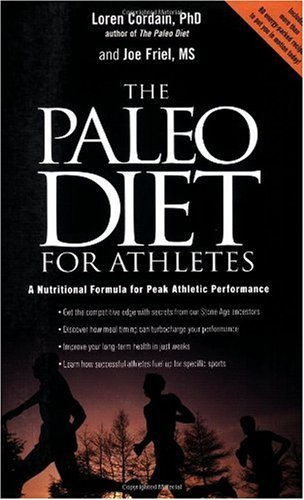
The Paleo Diet for Athletes. Loren Cordain and Joel Friel.

Rather than do the kind of review I normally do (which aren’t typical reviews anyway), I’m going to highlight the points in this book that I find different from current paleo/primal views of folks like Robb Wolf and his Paleo Solution (PS) and Mark Sisson and his Primal Blueprint (PB).  Both of those books have been published in the past year or less, while The Paleo Diet for Athletes (PDA) was published back in 2005.  I do understand that Cordain is working on a new book, so I think it will be quite interesting to see what his take is on a few items that are much different in Wolf and Sisson.

The 1st differences I want to talk about are those between endurance athletes and the typical people PS and PB are addressed to.  While Sisson comes from a background as an endurance athlete (competitive Ironman triathlete and marathoner) he now thinks that kind of cardio is bad for you.  In fact, he dubs it Chronic Cardio and outlines the problems associated with it, at least as he sees them(*).  Wolf has more of a background with strength and crossfit type of exercise.  So in both cases, they are pretty high on low carb., which is much different than PDA.  I should note that on Wolf’s podcast he often talks about using carbs such as sweet potatoes and yams immediately following a workout, so that part is not different.  But PDA is much higher on fruits in general.  PDA specifically outlines periods of carb consumption as high as 50 percent, and at some limited periods 60%, of total caloric intake.   I don’t know if I’ve ever seen Wolf give a specific percentage — he’s pretty much against calorie counting for the most part (though there are times he sees the benefits), and Sisson talks of 100 – 150 carbs max as ideal (and sometimes suggests much less).  Even at 2500 calories, 150g of carbs would be 25 percent of intake, so you can see the large difference.

The other recommendations that I am really surprised by are listed below, because these seem quite different from current recommendations:

  • the recommendation of canola oil by PDA.  while PS doesn’t mention it specifically from what I recall, PB is adamantly against it
  • PDA recommends to steer clear of saturated fat, while it seems like the current paleo folks are ok with it, particularly if it is grass fed organic meat.  PDA recommends trimming all visible fats before cooking.
  • PDA recommends lean meats over fatty meats… This is one I’d like to dig more into to see what PB/PS/paleo folks are saying… All I recall are that any meat is ok, and in fact at least one blog (hunter gather love ??) talked about why lean meat won’t cut it on a truly paleo diet.  Seems like most current paleo thought is that fatty meat is actually good and necessary (to get enough caloric load)
  • PDA recommended agains canned fish like sardines and herring, while PS and PB both seem to be for it.
  • PDA says 15 minutes of sunlight per day is enough for adequate vitamin D, even in the winter, while both PB and PS are big into supplementation — as much as several thousand mg per day of D3.  (but both recommend regular blood testing as vit D can be toxic)
  • As mentioned above, PDA is high on any fruit any time, while PS and PB want to limit fruits due to their insulin load.  I do take it from Wolf that this is more individualized, and that if you are lean and healthy, more fruit is ok.  I sure hope so!  🙂
  • PDA has ZERO mention of coconut oil from what I can find, while PB and PS are high on it.  I’ve really enjoyed learning to use it the past couple of months.
  • PDA says to limit eggs to no more than 6 per week.  I explicitly recall on the PS podcast recently that they don’t agree with this unless you have some kind of allergy; otherwise, they are all for lots of eggs.  I make 5 egg omelets for breakfast sometimes!  I definitely eat more than 6 per week most weeks.

Finally, I would just say I was really surprised by PDA’s talk of following the American Heart Associations recommendations of limiting saturated fat to less than 10% of overall calories and limiting dietary cholesterol.  Maybe I’m too deep into Gary Taube’s “Good Calories Bad Calories” right now, which seems to blow apart this hypothesis, but it also seems to go agains PB and PS and all the other paleo blogs out there!

(*) Suffice it to say that I don’t fully agree with Sisson on his views of Chronic Cardio.  I do think that for people that work out 5-6 days per week at 90%+ maximum heart rate, there is a problem.  You definitely need to mix it up with lower effort level aerobics as well as short sprints and “lifting heavy things.”  I wonder if he would be cool if I explained to him my view that my ultra running is part of my “play time.”  🙂

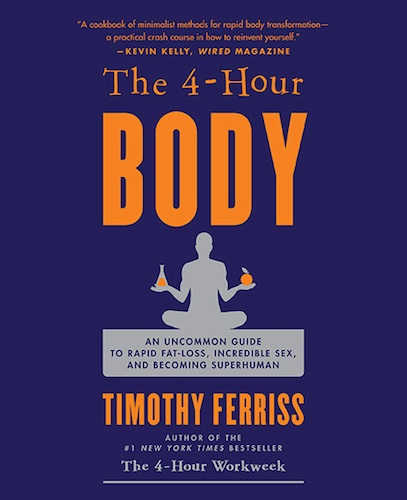
The 4-Hour Body. Timothy Ferriss.

When I first started to hear the buzz about this book, I really was not interested.  I had a feeling I wouldn’t like Tim Ferriss — the title of his first book, which was a best seller, was “The Four Hour Work Week.”  That kind of put me off, for some odd reason.  And while I still have not read that book, I understand now that it s more about time management than actually working just four hours a week, so that changes my initial uninformed thoughts.

Anyway, back  to the buzz.  I really wasn’t interested, even though the original, working title was “Becoming Superhuman.” (Who’s not interested in *that* kind of book?)  But the publishers wanted to play off the success of his first book.  What really got me was the interview Tim did with Robb Wolf and Andy Deas on the Paleo Solution, when Tim started talking about “pre-hab” and the exercises he used to find and correct imbalances in his body.  That has long been a fascination of mine, due to what I already know are weaknesses (imbalances in strength) but weaknesses that I’ve found hard to correct.  It is my assumption that those imbalances are what causes a body to be injury prone — thus the notion of “pre hab.”

So I broke down and bought the book.  It is best to view this book as a reference book.  Read the 1st two chapters or so, and then pick out what you want.  For example, there are chapters on losing all kinds of weight.  I don’t need to do that.  There are chapters about putting all kinds of muscle on, and I also don’t need to do that.  There are chapters on going from a 5k to a 50k in twelve weeks, which were quite interesting to me, though not that useful (since I have already run that distance).  There were chapters on holding your breath for really long periods of time, which were interesting.  (Way back when — when I was a swimmer — I held my breath for 2 minutes 20 seconds.  On my 2nd try with Tim’s method, I hit 2:30!  I’m sure I could go over 3 with a few more practice attempts.)

Tim basically was a self experimenting machine for the past 10 years, and this book recounts his successes (mostly, with a few failures), with all kinds of crazy things that are much outside of conventional wisdom.  I myself find “CW” is often not right, so it was definitely an interesting read, though I’m not sure it is for everyone.  Definitely on the geeky side of things with the science behind the experiments.  (He talks about why new technology is often out of reach of the masses, much of it due to economics.  The cutting edge scientists, with new methodologies and treatments, are maybe 20 years ahead of the mainstream.  They are a limited resource, so it is those with money that get the treatments.  Typically professional athletes and hollywood stars. It takes time for these technologies to trickle down.)

I’m still playing with the pre-hab movements, of which he only gives 4 — the 4 that will have the best effect on the wides audience — and the chop and lift and single arm standing dead lift definitely show what I already know (my right side, especially the hip stabilizers, is week), but I am quite intrigued by having a real “Functional Movement Screening,” done which looks for imbalances and gives specific exercises (beyond the main 4 that Tim discusses) for each such imbalance/weakness.

Some quotes:

  • Does history record any case in which the majority was right? —Robert Heinlein
  • “The future is already here—it is just unevenly distributed.”
  • “Fifty percent of what we know is wrong. The problem is that we do not know which 50% it is.”
  • Somewhere along the line, we seem to have confused comfort with happiness. —Dean Karnazes
  • Ugly, and ultimately painful, postural compensation is unavoidable when wearing shoes that elevate the heels. This simple observation somehow escaped me for 30 years, until CrossFit Chicago instructor Rudy Tapalla introduced me to Vibram Five Finger shoes, which look like gloves for your feet.
  • absorb what is useful, discard what is useless, and add what is uniquely your own. — Bruce Lee
  • Motion is created by the destruction of balance. —Leonardo da Vinci
  • The Cartesian separation of mind and body is false. They’re reciprocal. Start with the precision of changing physical
  • All life is an experiment. The more experiments you make the better. —Ralph Waldo Emerson

I didn’t know there was such a thing as a trailer for a book, but there is, and here’s 4hB’s trailer:

A much longer (and better!) review is located here.

Little River 10 Mile Trail Race

Update 2: 18/69 in the 40-49 male category.  What’s up with nearly 25% of the race being in my division??  55/300 overall.

Update: Here is a photo taken of me by the race photographer:

I don’t have a lot of time to write a real race report, so let me just throw in the garmin data and what I sent to the google minimalist list for now…

And what I wrote to the email list:

Just a quick update that I ran the 10 miler and had NO achilles/soleus problems whatsoever. Well, for about two minutes around mile three I felt a little bit on the OTHER leg than the one that got so bad last Saturday and bothered me all week.

So what helped? I did a bunch of things so here goes:

1) Chiro on Monday (she did some ankle adjustments and deep tissue massage on knots and adhesions)
2) Deep tissue/structural integration massage on Wednesday
3) electro stim a couple of times (massage like setting)
4) lots of lower calf rolling with a foam roller like device
5) used topical ointments like mymed or biofreeze a couple of times a day
6) wore the go-lite sun dragon which is a 10-12mm heel lift shoe (this shoe has the added benefits of having cleat like lugs on the bottom, and it was snowy and icy. The inov8 195’s would have been a terrible choice. The 190’s would have been fine.)
7) 2xu calf compression socks… don’t know if these helped the AT but I really liked them. 🙂
8) 600mg ibuprofen two hours before the start

Another thought is that in a race situation, I really don’t have a lot of time to think about foot placement, so there is no real chance to force a particular foot strike. Thinking back to last week, besides the hard stair workout and hard pavement run, the long run on Saturday had a lot of flatter, gravel and old paved roads, and the inov8 195 does not perform well on that, in my opinion. So blame shoe choice a bit, though really it was a culmination of things that brought on the soreness.

Before I had the AT/soleus issue I had a stretch goal of 1:25:00, about 5 minutes faster than last year. I ended up with a 1:26:30, which I am extremely happy with considering how worried I was earlier in the week. For comparison, the course record was broken by 2+ minutes today, in 1:02:54.

I’ll add here that I went out fast — really fast.  My plan was about a 7:00 minute first mile to get some separation, and then back off.   I was in the low sixes at 1/2 mile and just under 7 at one, but then I didn’t back off soon enough..  Part of that is the adrenaline of the race, and part of it is that there is a lot of down the 1st couple miles…  You’ll see in the elevation chart a little climb, but not that much.  So miles 2.5 -5 or 6 were a bit of struggle to find the right zone.  My stretch goal of 1:25:00 would have been 8:30 pace, and I tried hard to hold that.  But I saw it steadily drop from 7:25, to 7:45, to 8:15, etc.  I knew the last half, and especially the last mile, were crazy tough to hold pace on because they are single track mtn bike trail with a lot of short ups and downs and tight turns.

Anyway, I’m quite happy with my time considering the AT/soleus issue earlier in the week.  Still 4 minutes better than last year!

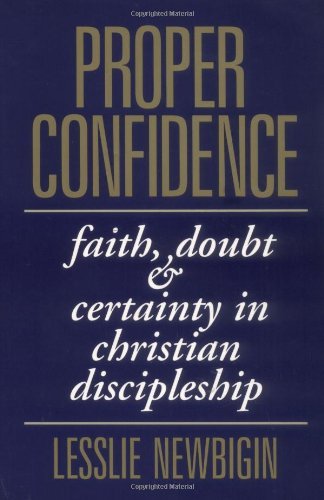
Proper Confidence. Lesslie Newbigin.

This was a fantastic read, though I have to say the 1st half was much better than the 2nd.  The 2nd half, in the conclusions, was a bit of a let down for me personally.  Perhaps after such a well-reasoned and well said introduction, where everything just clicks and makes sense, the second half didn’t lead to any new and startling revelations (for me).   However, I would say it is still worth it for any Christian that wants a better understanding of the world views that existed pre-Christianity in the Western World (namely Greek and Jewish thought), how Christianity challenged and changed them, and how the Enlightenment really changed the game and led us to where we are today.

Newbigin starts with the differences between Jewish and Greek thought, especially with respect to knowledge (epistemology), what changed with Christianity, and then goes through the early centuries following Christ, tracing the changes with respect to knowledge over time.  For example, for Plato, “the ultimate realities were ideas, which are more or less fully realized in the various entities which are the objects of our experience.”  By grasping these ideas and participating in them, the soul attains its true being and salvation.  (The idea of “Good” is the apex of this hierarchy of  ideas.)  Yet, Augustine said “credo ut intelligam,” or “I believe in order to know.”  There is an element of (biblical) faith in knowledge that is lacking in Plato and is a radical departure from Greek thought.

Along came Descarte (many centuries later, of course, but we don’t need to dig too deeply into the Dark Ages, do we?), who had a goal to build indubitable knowledge on the foundation of skepticism.  He says “I think, therefore I am,” and now all knowledge starts with the individual.  (I’m skipping huge chunks of the book and moving fast, but you should be able to see that such a believe leads to post modernism, the lack of objective truth, and relativism.)

Newbigin then follows Western thought through Kant, and Kant’s arguments for God and ultimate reality based on moral and aesthetic experience.  And through the Enlightenment (The Age of Reason), where our view (humanity’s) became that Reason is the only path to reliable knowledge.  (In Deep Church, Belcher talks about Foundationalism, and that was the 1st time when I started to be able to put into words what I had felt for some time — that we sometimes need something beyond Reason — to describe things such as certainly in Faith. (But then again, there is a problem with “Faith without Doubt…”)

He goes on to argue that we are in the midst of a great collapse of confidence due to the ramifications and limitations of the models of the Enlightenment, including the collapse in European culture as well as the collapse of the confidence in the validity of the church’s worldwide missionary enterprise.  (At least he goes after his own…)

Ok, this could get really deep and long if I’m not careful.  That’s not the purpose here.   Maybe the above, along with a few more tidbits below, will be enough to entice you if you like to read this kind of book.

Random thoughts and quotes:

I liked both of these — let’s look for the good on both sides!

From the point of view of the fundamentalist, doubt is sin; from the point of view of the liberal, the capacity for doubt is a measure of intellectual integrity and honesty.

In addition to ascribing these accusations, labels, and genuine differences over doubt to both sides in this quarrel, it is also right to ascribe moral virtues to them: Liberalism at its best is marked by an open mind which is humble and ready to learn. Fundamentalism at its best is marked by a moral courage which holds fast to the truth even when it is assailed by counterclaims from without.

I don’t know why, but the subject object duality that first entered my life in Zen and the Art of Motorcycle Maintenance keeps popping up in strange and unexpected places:

The second dualism, closely related to the first, is that dualism expressed by the words “objective” and “subjective.”

I feel like I am strong on gratitude, but after reading the following quote I wonder if I fall short on Trust:

But it the biblical story is true, the kind of certainty proper to a human being will be one which rests on the fidelity of God, not upon the competence of the human knower. It will be a kind of certainty which is inseparable from gratitude and trust.

I still haven’t figure out why this is the case (:-/):

Kurt Godel’s demonstration that the fundamental axioms of mathematics are not self-justifying does not seem to have weakened the influence of the idea of mathematical certainty.

And a few more:

But we are left in a world which the Chinese writer Carver Yu has summarized in the phrase “technological optimism and literary despair.” Looking at contemporary Western society from his standpoint as a Chinese philosopher and theologian, he sees not only the unstoppable dynamism of our science-based technology but also the bleak nihilism and hopelessness that is reflected in the literature, art, and drama of our society.

With hindsight, it is now easy to see how many of the self-evident truths of the Enlightenment were self-evident only to those who were the heirs of a thousand years of Christian teaching. They were not self-evident to the peoples of India or Africa.

The modern antithesis of observation and reason on the one hand versus revelation and faith on the other is only tenable on the basis of a prior decision that the whole cosmic and human story has no purpose and therefore no meaning. It is possible to make this assumption, but it is not necessary.  The question whether the cosmos and human life within it have any purpose other than the individual purposes we seek to impose on things is one that cannot be decided by observation.


2010 Book Shelf

Here’s a picture of my book shelf — books read in 2010…  Several of these are missing on my individual book review posts.  I am behind and really don’t know that I can catch up, so I may just have a clean up post or two.

A lot more running books and food/diet books than I ever would have guessed at the beginning of the year!  And where’s the classics?  Well I guess I did get in a couple from Chesterton.  And I might have to put the biographies/histories into a similar category.