2010 in review

The stats helper monkeys at WordPress.com mulled over how this blog did in 2010, and here’s a high level summary of its overall blog health:

Healthy blog!

The Blog-Health-o-Meter™ reads Wow.

Crunchy numbers

Featured image

The average container ship can carry about 4,500 containers. This blog was viewed about 15,000 times in 2010. If each view were a shipping container, your blog would have filled about 3 fully loaded ships.


In 2010, there were 39 new posts, growing the total archive of this blog to 401 posts. There were 91 pictures uploaded, taking up a total of 16mb. That’s about 2 pictures per week.

The busiest day of the year was April 19th with 164 views. The most popular post that day was Boston Marathon Liveblog.

Where did they come from?

The top referring sites in 2010 were hundredpushups.com, dailymile.com, facebook.com, 2sparrows.org, and birthdayshoes.com.

Some visitors came searching, mostly for poi si torno all eterna fontana, love song lyrics, springer mountain, into the wild book quotes, and poi si tornò all’eterna fontana.

Attractions in 2010

These are the posts and pages that got the most views in 2010.

1

Boston Marathon Liveblog April 2010

2

Into the Wild. Jon Krakauer. May 2008
6 comments

3

Family Happiness and Other Stories. Leo Tolstoy. June 2008

4

A Grief Observed. C.S. Lewis. October 2006

5

Grandfather Mountain Hike August 2008
8 comments

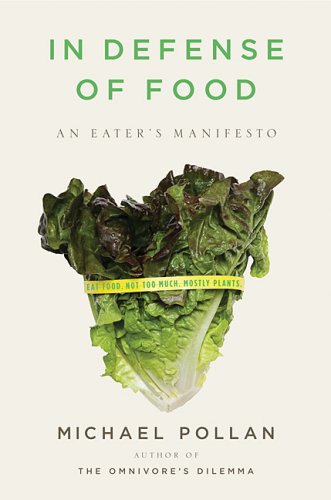
In Defense of Food. Michael Pollan.

After reading Pollan’s The Omnivore’s Dilemma, and enjoying it so much, I thought I should read his follow up book.  In the introduction, he explains the purpose of writing In Defense of Food:

But many readers wanted to know, after they’d spent a few hundred pages following me following the food chains that feed us, “Okay, but what should I eat? And now that you’ve been to the feedlots, the food-processing plants, the organic factory farms, and the local farms and ranches, what do you eat?

He goes on to give the answer early:

Eat food.  Mostly plants.  Not too much.

Of course, that answer needs a lot of explanation, which the rest of the book does.

Again in this book, Pollan shows he is a good writer, though I enjoyed the “adventure” aspect of The Ominvore’s Dilemma a bit more.  But this is still worth a read, and a fascinating account of the many problems with conventional wisdom, especially with respect to USDA guidelines for eating and, more specifically, with the food pyramid.  There is some repetition, of course, but that is expected.

I won’t say much more here, but will leave you with a few quotes:

Scientific reductionism is an undeniably powerful tool, but it can mislead us too, especially when applied to something as complex, on the one side, as a food and on the other a human eater. It encourages us to take a simple mechanistic view of that transaction: Put in this nutrient, get out that physiological result. Yet people differ in important ways. We all know that lucky soul who can eat prodigious quantities of fattening food without ever gaining weight. Some populations can metabolize sugars better than others. Depending on your evolutionary heritage, you may or may not be able to digest the lactose in milk. Depending on your genetic makeup, reducing the saturated fat in your diet may or may not move your cholesterol numbers. The specific ecology of your intestines helps determine how efficiently you digest what you eat, so that the same 100 calories of food may yield more or less food energy depending on the proportion of Firmicutes and Bacteroides resident in your gut. In turn, that balance of bacterial species could owe to your genes or to something in your environment. So there is nothing very machinelike about the human eater, and to think of food as simply fuel is to completely misconstrue it. It’s worth keeping in mind too that, curiously, the human digestive tract has roughly as many neurons as the spinal column. We don’t yet know exactly what they’re up to, but their existence suggests that much more is going on in digestion than simply the breakdown of foods into chemicals

Foods that lie to our senses are one of the most challenging features of the Western diet.

Nine percent of the calories in the American diet today come from a single omega-6 fatty acid: linoleic acid, most of it from soybean oil.

People eating a Western diet are prone to a complex of chronic diseases that seldom strike people eating more traditional diets. Scientists can argue all they want about the biological mechanisms behind this phenomenon, but whichever it is, the solution to the problem would appear to remain very much the same: Stop eating a Western diet.

Finally, he has this to say about Gary Taube’s Good Calories, Bad Calories, which I just happen to be reading now:

*Gary Taubes describes the developing carbohydrate hypothesis at great length in Good Calories, Bad Calories. According to the hypothesis, most of the damage to our health that has been wrongly attributed to fats for the past half century—heart disease, obesity, cancer, diabetes, and so on—can rightly be blamed on refined carbohydrates. But the healthy skepticism Taubes brought to the lipid hypothesis is nowhere in evidence when he writes about the (also unproven) carbohydrate hypothesis. Even if refined carbohydrates do represent a more serious threat to health than dietary fat, to dwell on any one nutrient to the exclusion of all others is to commit the same reductionist error that the lipophobes did. Indeed, Taubes is so single-minded in his demonization of the carbohydrate that he overlooks several other possible explanations for the deleterious effects of the Western diet, including deficiencies of omega-3s and micronutrients from plants. He also downplays the risks (to health as well as eating pleasure) of the high-protein Atkins diet that the carbohydrate hypothesis implies is a sound way to eat. As its title suggests, Good Calories, Bad Calories, valuable as it is, does not escape the confines of nutritionism.

Run at the Rock.

Last year, Run at the Rock was a total mud-fest.  This year, it was a bit chilly, with the starting temp around 35F, though that isn’t nearly as cold as last year’s Little River Run which was 16F.  I opted for my CW-X 3/4 tights, and an icebreaker 200 body-fit top (non-zip — I like the zipper kind better).   I’ve only run short distances in the CW-X’s, and then only when leaving directly  from home.  This time, I put them on, and then drove into town to meet Bridget and Kent, before driving the 45 minutes to the park.  When we got there and I got out of the car, my feet felt a little tingly.   I was really cold so I decided to go back to the car for a few minutes and crank the heat.  I even took my shoes off to rub my feet to try to get them to come to life.  I could not figure out why they were tingling!

Eventually I had to go back to the start, where I hung out with a few people chatting away.  Somehow I ended up on the 2nd row, and with both a 7 mile loop and 14 mile loop, with nearly 100 in the 14 and nearly 300 in the 7, I was in front of a lot of people.  Too many people!

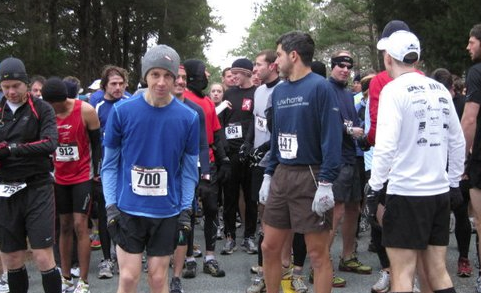
Shannon, as always, carried her camera and got a ton of shots.  Here is one of me at the start.  Not a very flattering photo, but at least I look happy.  🙂

And an even funnier one…  #700 in blue right at the front — he ends up winning the race.  That face right behind him – -that’s me.  What am I doing up there?


My plan was to run hard for the 1st 1/2 mile or so, which is on paved road and then an open field, before you hit the single track.  By hard I mean sub 7 pace, so I could get some distance and separation and not be held up on the single track.  I wanted the 1st mile to be in the 7:30 pace range.  I managed both of those goals, though I may have been closer to 6:30 pace in the beginning, but I reached the 1 mile mark in 7:27.

My feet had gone from tingly to numb, and between miles 3 and 4 I was seriously considering dropping out after the 1st 7 mile loop.  I don’t think it is a good idea to run when you can’t feel your feet!  Talk about lack of ground feel, feed back, and proprioception!!   I backed off the pace a little more and just took it easy.  Over the next  10 minutes, my feet came back to me, and I settled into a comfortable groove, and even picked it up a bit.

Looking back, I am not sure why my feet got so numb, but my current theory is that the CW-X tights are the culprit.  Wearing them for a couple hours, including about an hour of drive time, where my legs were bent, may have done it.  The CW-X’s have “targeted support” bands that line the quads.  I think those bands may have cut circulation a little.  But I’m really not sure.  I do know my shoes were not too tight, as I loosened them a couple times, and when I took them off and rubbed my feet, nothing changed.

Anyway, back to the race…  As you near the end of the 1st loop, you can typically tell the 7 milers vs. the 14ers, as the 7 milers really speed up.  I was in a group of about 5 or 6 ladies spread out over 20 meters, but the only one that sped up kept going on the 14 mile course!  Odd.  I passed the 7 mile finish in 57:0x or so, or 6 minutes faster than last year.  However, the Garmin showed 6.5 miles not 7, so it appears the course was short, and later most runners agreed.  I also later found that Bridget was about 20 seconds behind me, coming in 2nd place in the female masters.

Not much to report on the 2nd loop.   One lady flew by in the 1st mile.  I later spoke to her and she is training for Uhwarrie 40 and wanted to negative split, which she did by over 5 minutes!   I found a good groove and settled in.  Between miles 10-12, my legs really started to wobble on the climbs.  And the climbs are really pretty small compared to what’s coming (Uhwarrie).   You can see the elevation profile below, and there’s never more than a 100 foot climb!

When I saw the mile 6 marker and knew I was almost done, then I got some energy back and began to cruise again.  The lady who had taken off at the end of the 1st loop — we had been passing each other every mile or so since then.  I had a good 20 second lead on her when my shoe came untied.  I was tempted to run the last mile with it untied, but felt that was a little too far.  So I stopped, took off the gloves, tied the shoes, put the gloves back on….  She of course passed me, and I never could catch her coming in to the finish.

I crossed the line in about 1:55:xx, though the clock said 1:56:39.  Everyone agreed the race clock was about a minute off, and that the distance was off by about 1/2 mile per loop.  So 13 miles in 1:55 — not too bad all things considered.  That put me in 29th out of 96 overall, but 5th in the 40 age group.  :-/

I hung out at the end with Bridget, Shannon, and Anthony, as well as a few others, waiting for Kent to come in.  When he did, we headed over to the tent, which was warm, and had hot soup.  The soup smelled terrible, but tasted good.  Strange.

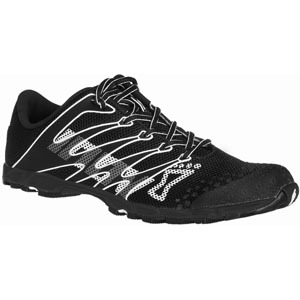
I used the inov8 f-lite 195’s with a metatarsal pad in place on the left foot and was happy with them for the most part.  Last year was a mud fest and I used the go-lite sun dragons, which are very luggy, and they were awesome.  It has been dry here, so I decided against the x-talon 190’s which are almost a cleat, and other than one or two muddy spots, that was a good choice.


There was an official race photographer, but the photos have yet to be posted.  I may update this post when they come in….

Raven Rock Rumble 10 miler

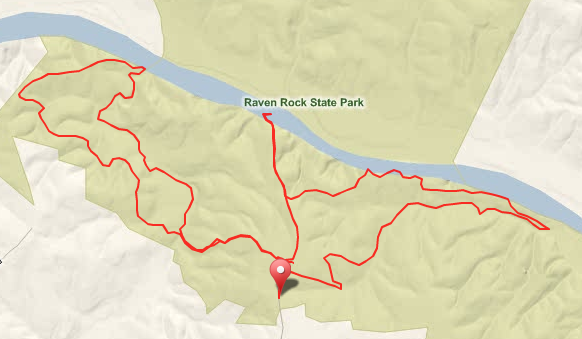
Raven Rock is one of my favorite parks within an hour driving or so of home.  Along with Uhwarrie Sate Park, it has some of the best trails and scenery around!  I always try to go to the once-a-year orienteering event that Backwoods Orienteering Club puts on there, and last year at the Bushwhack 24 hour adventure race, there was a long orienteering section as well.  So when I heard about the Raven Rock Rumble 5 and 10 mile race, I had to sign up!

I had checked with the PBO running group to see if anyone else was racing, in order to car pool, but no one else was.  Then the day before the race I got an email from my friend Randy saying he was going, and would I like to car pool.  I didn’t even know Randy was a runner, but this is his 3rd year running the 5 miler!  We had a good drive down, getting there at 8:30 right when the posted packet pick up cut-off was.  :-/  We had about a 3/4 mile jog to the registration tent, where there was still a line of 15-20 people in front of us, so we were good.

The 5 miler started 5 minutes before the 10 miler, and about 100 meters ahead, so I wished Randy well, and walked to my start line.

Shoe choice was really a tough decision.  I am using a metatarsal pad right now, which sits just behind the ball of the foot, which in theory spreads the load better.  This is an attempt to alleviate that weird popping thing I’ve had in my left ball of foot since Half-scar back in June.  I’ve only had the pads about 10 days, so I’m still figuring out which shoes they work in and which they don’t.    The meta-pad feels great in my new Kinvara’s, but I definitely didn’t want to wear that shoe on the trails.  It is definitely a shoe more suited to roads.  So on Friday afternoon, the day before the run, I tried the metatarsal pad in my Inov8 F-lite 195’s, Saloman XA Comps and the Go-lite Sun Dragons I had so much success with last year (but which are, unfortunately falling apart).  Both of those are a lot more shoe than I’ve been wearing recently.  At first, I did not like the feel in the 195’s, but after going back and forth between all the shoes, finally felt like that would be the best choice.  I opted to not use a pad in the right shoe.  The 195’s really have almost zero cushioning, so you can feel the pad, and on the right foot, it was uncomfortable, but on the left, it felt pretty good.  I opted not to use the luggy inov-8 x-talon 190, as it has been relatively dry and I didn’t think I would need that kind of grip.

The race started at 9:05 a.m., and my plan, as in most trail runs, was to go out pretty hard in order to not get stuck in a log-jam of runners once the course hits the single track.  So, I started up front and was with the top 15 runners about 250 meters in, just before we hit the trails.  I heard two ladies talking about 5:45 being a little too fast.  🙂  I am pretty sure it was more like 6:15 – 6:30, but I wasn’t about to look at my watch at that point!   The course was a fairly gradual down hill for the 1st couple miles, and while there was a little jockeying for position, the strategy of going hard was good because I was certainly in the top 15 – 20 at that point.

Around mile two I looked at my watch to see I was still going a bit fast — 7:35 pace.  But then again, it had been mostly down hill. That pace would slowly creep up over the next 8 miles, but there was also a lot of climbing to come!  Around mile 2.5 I settled into a more comfortable pace and a few people passed me, but I had my eyes on them and thought I’d bring many of them back in.  Especially the 14 year old!  (I didn’t know how hold he was at  the time, but looked on the results later!  🙂  )  He still did awesome, finishing just 3 minutes behind me.  Wow!

Around mile 3.5 we went down an out-and-back section that was all down hill, including a long section of stairs where it was pretty steep.  The front runners were coming back up, and almost all of them were walking.   As soon as you turn around at the bottom, you start the long climb… I switched to power hiking and passed a couple walkers and a couple of folks that were attempting to run.

Around mile 4.5, we passed the finish line, and headed out onto the 5 mile course.  It was a long half mile down, where many of the 5 milers were struggling up.  I decided this would be good information to remember – I wanted to save a little in the tank going into the last mile!  It was on this section were I started picking off a couple of the folks who had passed me earlier, but  by now there was a big spread between most runners.  I ended up running mile 7-9 with a grey haired gentleman, and I reminded him about the hill at the finish.  He passed me on one steep little climb, and I let him go, thinking I would catch him on the BIG climb.  We finally got to there, and I ran some sections and power hiked others.  He just kept plodding along, and I could never close the gap, though at least we passed two more racers who were walking.  At the top, I thought my power hiking strategy would give me a bit more energy and I could over take the guy, but he sped up and actually gained a little.  The results show he was 50 years old — so kudos to him! I hope I am running that well in 10 years.  🙂

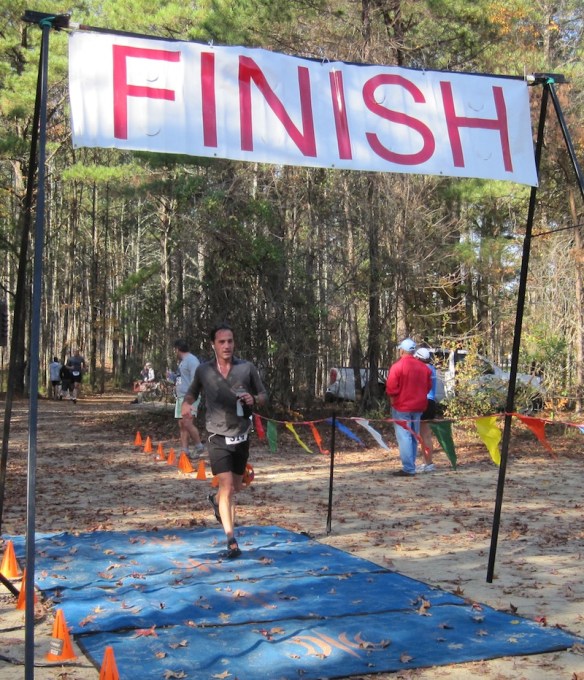
Update:  Someone caught a picture of me at the finish so I’ll add it here:
Randy and I both had to get home very quickly, so as soon as I was done we walked over, grabbed some water and a banana, and headed back to the cars.  I felt remarkably good the rest of the day, and on Sunday only had a little soreness in the calves.  The foot popping was barely noticeable and not really any better or worse than it has been — but I have not run 10 hard miles in a while so that is a good sign.  I actually saw my PT on Monday and he poked and prodded my left foot, and the area where the popping occurs was not sore at all, but the head, or just below the head, really, was a bit more sore than it has been.  In the past when he poked and prodded, that area was not that sore.  So the theory right now is that soreness is inflaming the tendon, and the tendon is what I feel popping when I walk over hard surfaces — it comes out of the grove and gets between the bone and the ground.  :-/  It still isn’t slowing me down, and doesn’t really hurt per se, but I am monitoring it closely, and hopefully the meta-pad will help it out.

As far as the 195, they performed really well.  The course covers various types of trail, much of it single track, with rocks and roots covered by leaves.  The few times I hit a rock or root head on, the 195 provided ample protection.  I will say that by the end of the 10 miles, my feet were getting tired, though, so this may be close to my limit in this shoe right now.  In two weeks I have a 14 mile trail race, so I’ll have to make a decision.  I am pretty sure I will go with the 195 again, unless it is as muddy as last year, in which case I’ll go with the 190.

Here’s a GPS map from my Garmin showing the course…  The out and back to the river was from mile 3.5 to 5 or so, which includes a long decent down “stairs” and then, as soon as you turn around, the long ascent back up.

Here’s an elevation vs. speed graph, which really shows the two brutal hills — the 1st from mile 4 – 5 and the 2nd the last 1/2 mile of the race.  In reality, the last tenth or two tenths was flat to the finish, so I’m not sure why the Garmin doesn’t show it that way.   The course actually went down the same hill nea

I did not wear the heart rate monitor, so no stats there…

The results were posted late Saturday and showed me 23rd out of 110 with an average pace of 8:34.  On those trails, and those hills, I’m pretty happy with that pace!

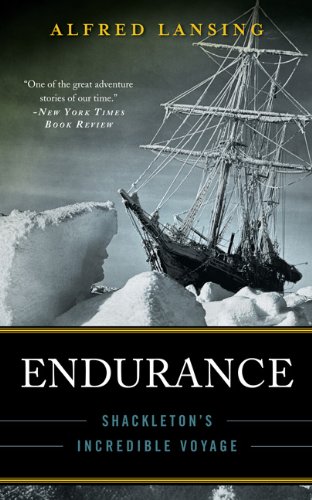
Endurance: Shackleton’s Incredible Voyage. Alfred Lansing.

Fortitudine vincimus – “By endurance we conquer.”

Endurance is the incredible true story of Ernest Shackleton and his crew’s amazing escape from disaster in Antartica — so incredible in some places it seems improbable that it all really occurred.  However, the journals of all the men and testimonies afterward seem to corroborate one another fully.  Every adventure racer, every endurance paddler, every navigator, etc. should read this story immediately.  🙂  It really is that good and that fascinating.  That men could survive in such conditions over such a long period of time, that they could travel the distances they traveled in the most unlikely of methods, and live to tell about it, is beyond comprehension.  And the book is so well written, it really grips you from the start and never lets you go.

For the navigators, imagine this…  When 6 of the men had to leave the rest of the crew, sailing from Elephant Island through perhaps the most treacherous ocean in the world, in a small boat not meant for that kind of thing:

They would travel perhaps a thousand miles across the stormiest ocean on the globe. The ultimate goal was an island no more than 25 miles wide at its widest point. To guide an open boat that distance, under conditions that were frightening even to contemplate, and then to strike a pinpoint on the chart was a task that would sorely tax even Worsley’s skill as a navigator.

For the orienteering population out there, imagine this… When they had to climb up and over South Georgia Island, an island with 10,000 foot peaks, glaciers, crevices, freezing cold weather, fog, etc….

“I do not know how they did it, except that they had to-three men of the heroic age of Antarctic exploration with 50 feet of rope between them-and a carpenter’s adze.”

Other quotes:

But it was inescapable. He was the Boss. There was always a barrier, an aloofness, which kept him apart. It was not a calculated thing; he was simply emotionally incapable of forgetting-even for an instant-his position and the responsibility it entailed. The others might rest, or find escape by the device of living for the moment. But for Shackleton there was little rest and no escape. The responsibility was entirely his, and a man could not be in his presence without feeling this.

In some ways they had come to know themselves better. In this lonely world of ice and emptiness, they had achieved at least a limited kind of contentment. They had been tested and found not wanting.

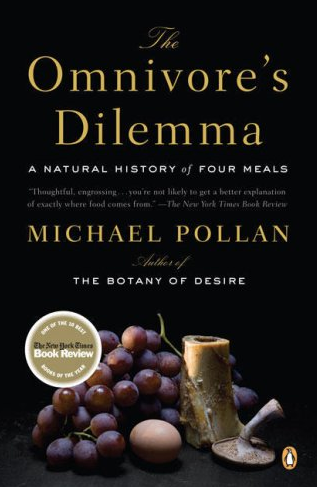
The Omnivore’s Dilemma. Michael Pollan.

  • “The whole of nature,” wrote the English author William Ralph Inge, “is a conjugation of the verb to eat, in the active and passive.”

Another food/diet book read this year, but this one is different.  It doesn’t really espouse a typically type of diet as Plank’s “Real Food” (go back 100 years and eat that way) or Sisson’s “The Primal Blueprint” and Wolf’s “The Paleo Solution” (go back 10,000 years and eat that way).

What it does is look at the 3 ways we can get food to our table:

  1. Industrial (the typical way most food is grown today — from the corn fields and cattle fields to the table)
  2. Organic (and he shows the difference between industrial organic vs. small farm organic)
  3. Hunter-gatherer (just what it says!)

In each scenario, he follows the food chain from the beginning all the way to his table, where he prepares and eats a meal.  Well, in the first (Industrial), he buys McDonald’s at the end!

This is really a fascinating book on many levels, and it shows how dependent we have become on corn (which is in something absurd like over 50% of all processed foods you buy at the grocery store) and is used in feeding the animals we eat, etc.  He goes into the economics of why this is the case – namely government subsidization of the corn farmers.  The organic section was also fantastic, especially the part that explores how Polyface Farm in VA is doing things — and how they are successful at it.

The problem with hunter-gatherer is that we can’t support the 6.5+ billion people in the world doing that.  A hunter-gathering tribe could only support themselves, only in the right locations, and only if they were not up against other people-groups.  Small scale organic like Polyface seems to work — so going organic and local is a good thing.  There is a question of scale — could it grow to support the world’s population?  That is tough to say.  And what about costs?  It is more expensive than the industrial chain in initial costs.  But what about the long terms costs in terms of the environment, the dependency on petroleum the industrial food chain has, and health care?  Is small scale organic healthier than industrial?  (I would say “of course!,” though some people don’t agree… Namely the large corporations behind industrial and the scientists on their payroll, and the government groups on the receiving end of their lobbying!)

I would highly recommend this book to everyone!  It is long, but well worth it.  If you want the movie version, Food Inc., is reasonably close, though not nearly as thorough.   And it is not an exact copy, or even a facsimile, of the book.  It does tell some of the same story, and Pollan was one of the main consultants.

The Paleo Solution. Robb Wolf.

Another food/diet book.  I had no idea when this year started I would read so many books on running and food/diet!  Oh well, it has been interesting and fun following the trail where it leads me.

Anyway, after reading The Primal Blueprint, I thought I’d read this book which just came out a month or two ago.   Based on some of the reviews, it sounded like it would have more science behind the recommendations, and I can affirm that is the case, albeit just a little more.  Overall it is very similar to Sisson’s Primal Blueprint, but there are a few differences.  PS does not get into fitness as much, though PB gets into it in much more detail in the supplemental and free PDF Primal Blueprint Fitness.

I am still not sure I agree with everything in either book with respect to diet, though I do agree with the majority of it.  Namely cut sugar, cut processed foods, and the like.  Both also promote grain/legume/dairy free as well, though PB seems to have a little more latitude towards dairy — especially fermented dairy and/or dairy from grass fed cattle.  PS says ok to butter from grass fed, but seems to not like cheeses and yogurt like PB allows.  I am still not sold on legumes being all that bad for you, and I like my cheese and yogurt, as well as milk occasionally.  None of that seems to bother me.   I am beginning to agree with grains to some extent, though I don’t know that everyone needs to cut out all grains.  I do agree that the current recommendations on building your food intake around grains is bad advice — the level of grains that are recommended seem far to high and many recent studies are pointing to the increased in grains (not just processed) ad the culprit behind the obesity and cardiovascular disease epidemic.  (I don’t want to be too reductionist and say that is our only problem… Things are much more complex than that!)   But some grains, some times, may not be too bad, unless you have a known disease/intolerance/or allergy, especially for athletes that can use more carbs…  Of all the grains, I would say wheat is probably the worst for the majority of people, due to how the body views gluten, and what that does internally.

I suppose I’ll have to read the Paleo Diet for Athletes next to see what they say!

I still don’t understand why PS states that combining fat/protein/carbs does not affect the body’s insulin response.  I.e. they state that carbs, no matter if they are eaten alone or in combinations with other (low glycemic load) foods, does not change your body’s insulin response.  I actually have a question submitted to Robb so maybe he’ll answer it on the pod cast, but if anyone understands this and has reference to the literature on it, I’d appreciate it.

Unless you are super interested in this stuff, I’d say you could just pick either PS or PB and be fine — no need to read both.  PS does have more science background, while PB lays out just what the title says — a blueprint for living, not just for diet, but for exercise, work, sleep, and play.  (PS definitely touches on sleep as well as stress as it relates to work and play.)

If you want to turn back the clock 100 years instead of 10,000, I’d highly recommend Nina Plank’s Real Food.  And the Ominvore’s Dilemma is just fascinating all around!   (I just realized I haven’t written anything on the latter yet, even though I finished it before PS, so I’ll have to do that soon!)

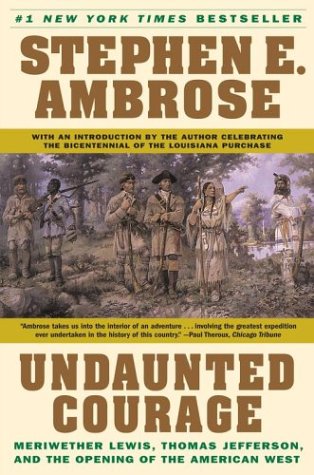
Undaunted Courage. Stephen E. Ambrose.

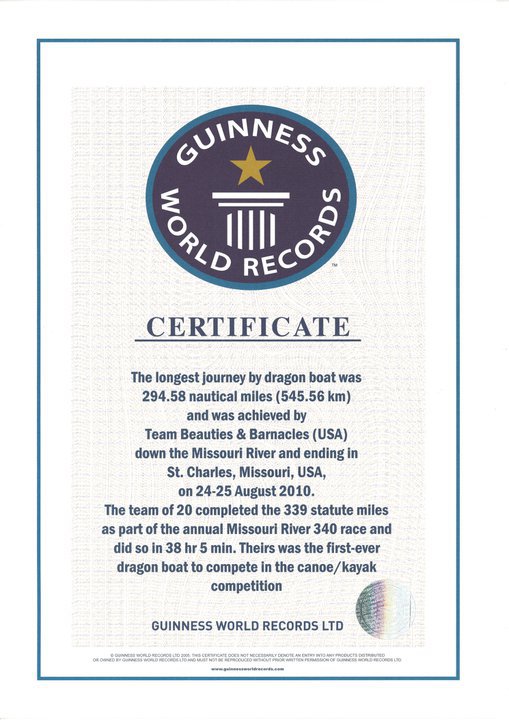
I had to read the story of Lewis and Clark, after paddling across most of the state of Missouri in the MR340, and finishing at the Lewis and Clark Museum in St. Charles.  I bought this book right at the museum, paying full list price which is probably twice as much as it would cost at Amazon, but I did want to support the museum.  It was a lot of fun to walk through the exhibits and read everything there was to read.

This was a very well written biography of Lewis, not just the expedition years, though that is where the focus is, but really is whole life.  I had not recalled from when I learned of the trip back in grade school the relationship had with Jefferson, which was refreshing.  As far as biographies, many of which can be quite dull, this book read more like a novel.  I wouldn’t put it in quite the class of John Adams, but it was close, and my 2nd favorite biography.

If you have any interest in the history of America, in expeditions and exploring, you should read this book.  As an endurance athlete who has races up to 3 days in the woods, I’m amazed at what these guys were able to accomplish.  Granted, they had a lot of help from the Indians a long the way — mores o than their journals may portray, but what they accomplished is still quite impressive.  There were times they were averaging over 30 miles on foot in the mountains.  I know from my recent 1/2 SCAR attempt what 42 miles feels like, so I know the Corp of Discovery men were in excellent shape!

Only a few quotes…

“This day I complete my thirty first year, he [Lewis] began.  He figured he was halfway through life’s journey.  “I reflected that I had as yet done but little, very little indeed, to further the hapiness [sic] of the human race, or to advance information of succeeding generation.  I viewed with great regret the many hours I have spent in indolence, and now soarly [sic] feel the want of that information which those hours would have given me had they been judiciously expended.”

“To victory over the wilderness, which is more interesting than that over man!”  – Barlow

And finally, what Jefferson himself route in 1813:

Of courage undaunted, possessing a firmness & perseverance of purpose which nothing but impossibilities could divert from it’s direction, careful as a father of those committed to his charge, yet steady in the maintenance of order & discipline, intimate with the Indian character, customs & principles, habituated to the hunting life, guarded by exact observation of the vegetables & animals of his own country, against losing time in the description of objects already possessed, honest, disinterested, liberal, of sound understanding and a fidelity to truth so scrupulous that whatever he should report would be as certain as if seen by ourselves, with all these qualifications as if selected and implanted by nature in one body, for this express purpose, I could have no hesitation in confiding the enterprize to him.

Gilead. Marilynne Robinson.

Reading Gilead was like eating a sweet fruit — but in the form of an onion.  Imagine a fruit as sweet as a kiwi, but with each bite, another layer is revealed.  As you read Gilead, layers of the characters and plot are subtlety pulled away.  The story is of a 76 year old man, writing to his young son, about his life, and it is fascinating.  The father is a preacher, and is insightful into his own character as well as life in general.  I’ll leave it at that.

I must admit, I had much higher expectations for the last quarter of the story than what was actually written.  The possibilities for the main conflict, for the characters to grow and overcome, were so strong.  But what happened was a bit of a let down after my expectations had built during the first three quarters of the book.  Still, the story was good, and the writing exceptional and beautiful.

Quotes

  • You can know a thing to death and be for all purposes completely ignorant of it. A man can know his father, or his son, and there might still be nothing between them but loyalty and love and mutual incomprehension.
  • But I’ve developed a great reputation for wisdom by ordering more books than I ever had time to read, and reading more books, by far, than I learned anything useful from, except, of course, that some very tedious gentlemen have written books
  • When people come to speak to me, whatever they say, I am struck by a kind of incandescence in them, the “I” whose predicate can be “love” or “fear” or “want,” and whose object can be “someone” or “nothing” and it won’t really matter, because the loveliness is just in that presence, shaped around “I” like a flame on a wick, emanating itself in grief and guilt and joy and whatever else.
  • A good sermon is one side of a passionate conversation. It has to be heard in that way. There are three parties to it, of course, but so are there even to the most private thought—the self that yields the thought, the self that acknowledges and in some way responds to the thought, and the Lord. That is a remarkable thing to consider
  • People talk about how wonderful the world seems to children, and that’s true enough. But children think they will grow into it and understand it, and I know very well that I will not, and would not if I had a dozen lives.
  • Each morning I’m like Adam waking up in Eden, amazed at the cleverness of my hands and at the brilliance pouring into my mind through my eyes—old hands, old eyes, old mind, a very diminished Adam altogether, and still it is just remarkable.
  • Sometimes the visionary aspect of any particular day comes to you in the memory of it, or it opens to you over time
  • I’m trying to make the best of our situation. That is, I’m trying to tell you things I might never have thought to tell you if I had brought you up myself, father and son, in the usual companionable way. When things are taking their ordinary course, it is hard to remember what matters. There are so many things you would never think to tell anyone. And I believe they may be the things that mean most to you, and that even your own child would have to know in order to know you well at all.
  • Our dream of life will end as dreams do end, abruptly and completely, when the sun rises, when the light comes. And we will think, All that fear and all that grief were about nothing. But that cannot be true. I can’t believe we will forget our sorrows altogether. That would mean forgetting that we had lived, humanly speaking. Sorrow seems to me to be a great part of the substance of human life.
  • This is an important thing, which I have told many people, and which my father told me, and which his father told him. When you encounter another person, when you have dealings with anyone at all, it is as if a question is being put to you. So you must think, What is the Lord asking of me in this moment, in this situation? If you confront insult or antagonism, your first impulse will be to respond in kind. But if you think, as it were, This is an emissary sent from the Lord, and some benefit is intended for me, first of all the occasion to demonstrate my faithfulness, the chance to show that I do in some small degree participate in the grace that saved me, you are free to act otherwise than as circumstances would seem to dictate. You are free to act by your own lights. You are freed at the same time of the impulse to hate or resent that person. He would probably laugh at the thought that the Lord sent him to you for your benefit (and his), but that is the perfection of the disguise, his own ignorance of it.
  • It seems almost a cruelty for one generation to beget another when parents can secure so little for their children, so little safety, even in the best circumstances. Great faith is required to give the child up, trusting God to honor the parents’ love for him by assuring that there will indeed be angels in that wilderness.
  • The Tenth Commandment is unenforceable, even by oneself, even with the best will in the world, and it is violated constantly.

This is long but well worth high-lighting.  I am still processing it:

  • But to return to the matter of honoring your mother. I think it is significant that the Fifth Commandment falls between those that have to do with proper worship of God and those that have to do with right conduct toward other people. I have always wondered if the Commandments should be read as occurring in order of importance. If that is correct, honoring your mother is more important than not committing murder. That seems remarkable, though I am open to the idea.  Or they may be thought of as different kinds of law, not comparable in terms of their importance, and honoring your mother might be the last in the sequence relating to right worship rather than the first in the series relating to right conduct. I believe this is a very defensible view.  I believe the Fifth Commandment belongs in the first tablet, among the laws that describe right worship, because right worship is right perception (see especially Romans 1), and here the Scripture commands right perception of people you have a real and deep knowledge of. How you would honor someone differs with circumstances, so you can only truly fulfill a general obligation to show honor in specific cases of mutual intimacy and understanding. If all this seems lopsided in favor of parents, I would point out again that it is the consistent example of parents in the Bible that they honor their children. …
  • But I wished to say certain things about the Fifth Commandment, and why it should be thought of as belonging to the first tablet. Briefly, the right worship of God is essential because it forms the mind to a right understanding of God. God is set apart—He is One, He is not to be imagined as a thing among things (idolatry—this is what Feuerbach failed to grasp). His name is set apart. It is sacred (which I take to be a reflection of the sacredness of the Word, the creative utterance which is not of a kind with other language). Then the Sabbath is set apart from other days, for the enjoyment of time and duration, perhaps, over and above the creatures who inhabit time. Because “the beginning,” which might be called the seed of time, is the condition for all the creation that follows. Then mother and father are set apart, you see. It seems to me almost a retelling of Creation—First there is the Lord, then the Word, then the Day, then the Man and Woman—and after that Cain and Abel—Thou shalt not kill—and all the sins recorded in those prohibitions, just as crimes are recorded in the laws against them. So perhaps the tablets differ as addressing the eternal and the temporal.
  • But I believe also that the rewards of obedience are great, because at the root of real honor is always the sense of the sacredness of the person who is its object. In the particular instance of your mother, I know that if you are attentive to her in this way, you will find a very great loveliness in her. When you love someone to the degree you love her, you see her as God sees her, and that is an instruction in the nature of God and humankind and of Being itself. That is why the Fifth Commandment belongs on the first tablet. I have persuaded myself of it.

And just a few more:

  • We know nothing about heaven, or very little, and I think Calvin is right to discourage curious speculations on things the Lord has not seen fit to reveal to us.
  • Adulthood is a wonderful thing, and brief. You must be sure to enjoy it while it lasts.
  • “Do you ever wonder why American Christianity always seems to wait for the real thinking to be done elsewhere?”
  • Because nothing true can be said about God from a posture of defense.
  • I fell to thinking about the passage in the Institutes where it says the image of the Lord in anyone is much more than reason enough to love him, and that the Lord stands waiting to take our enemies’ sins upon Himself. So it is a rejection of the reality of grace to hold our enemy at fault. Those things can only be true. It seems to me people tend to forget that we are to love our enemies, not to satisfy some standard of righteousness, but because God their Father loves them.
  • Love is holy because it is like grace—the worthiness of its object is never really what matters.
  • Theologians talk about a prevenient grace that precedes grace itself and allows us to accept it. I think there must also be a prevenient courage that allows us to be brave—that is, to acknowledge that there is more beauty than our eyes can bear, that precious things have been put into our hands and to do nothing to honor them is to do great harm. And therefore, this courage allows us, as the old men said, to make ourselves useful. It allows us to be generous, which is another way of saying exactly the same thing. But that is the pulpit speaking.