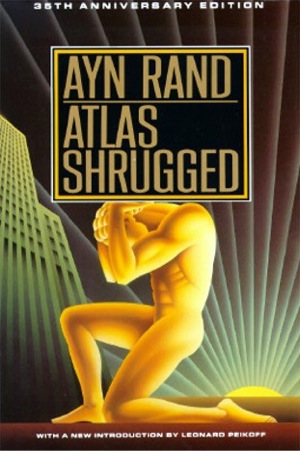
I finished this at least a month ago, but I have been busy and, to some extent, I have putting off writing about it. I have so many dog-eared pages, and there are so many interesting passages and concepts I could discuss. I am not promising that I will write all that I want to, but perhaps it will be sufficient.
First, what is so coincidental for me is to have read this during the current financial crisis and subsequent government bailout, and the economic policies of our president-elect (Obama). Atlas Shrugged portrays an America that is moving dangerously close to socialism, through more and more government regulations, subsidies from those that are successful to those that are not (“from each according to his ability, to each according to his need”), etc.; and that is frightfully close to what has recently transpired and what might transpire depending on how our policies progress.
Now, on to the book…. What an epic! My version is a little over 1150 pages, and with the exception of a 60 page “speech” by one of the books main characters — John Galt, the stories true hero — it was very readable as a novel. Of course, there is plenty of thought provoking philosophy mixed in, but it reads really well throughout the story. But that speech! Man, I had to skip ahead and come back to it over a few days… There wasn’t really much that he said that wasn’t already covered, at least at a somewhat high-level, elsewhere in the book, but this dug way way down — and seemed like it was not going to stop. So I skipped ahead to the story, and came back to the speech as I felt like it, and I don’t think it hurt my reading in anyway.
The speech finally ends with “I swear — by my life and my love of it — that I will never live for the sake of another man, nor ask another man to live for mine.”
The main premise of the book is first brought to light by this exchange a few hundred pages in, and is where the book got its final name:
… if you saw Atlas, the giant who holds the world on his shoulders, if you saw that he stood, blood running down his chest, his knees buckling, his arms trembling but still trying to hold the world aloft with the last of his strength, and the greater his effort the heavier the world bore down upon his shoulders — what would you tell him to do?”
“I … don’t know. What … could he do? What would you tell him?”
“To shrug.”
And here Atlas represents those few men who are the high achievers, the doers, the one’s that keep the world moving, progressing, living. The book’s draft name was “The Strike,” and these top performing people all go on strike from working in the world. The fall-out is incredibly quick as the state of the world degenerates terribly in just twelve years.
Rand puts this same thought another way when she says:
John Galt is Prometheus who changes his mind. After centuries of being torn by vultures in payment for having brought to men the fire of the gods, he broke his chains and he withdrew is fire — until the day when men withdraw their vultures.”
The premise is excellent and is challenging to our pre-conceived notions of society. Who are the real doers — those that have kept the world moving? And who are the leeches, the second raters, who live off the doers? And what would our world be like without them? How quickly would we fall — or would some in the middle tier step up and become the doers? (This one Rand does not discuss, but it is a thought I had…) And what happens when government steps in and tries to help the second raters at the expense of the doers? Or when many of the primary doers go on strike, and the remainder find they are no longer competing in a capitalistic society, but instead fighting by someone else’s rules that are stacked against you?
The adversary she found herself forced to fight was not worth matching or beating; it was not superior ability which she would have found honor in challenging; it was ineptitude…”
As I have been reading through all of Rand’s books the past few months, I find many aspects which I can agree on to some extent, but others which I can not. For example, I do believe that there are real doers and real second handers/leeches, that live off the doers. I do believe a society built on the premise of “from each according to his ability, to each according to his need” would (relatively) quickly become a nightmare society to live in. I believe in a love of life and of living it, and of living it to your highest potential.
Where I have my biggest issue is where she would place gratitude. For example, see the following quotes:
…man’s spirit gives meaning to insentient matter by modling it to serve one’s chosen goal.”
Try to obtain your food by my means of nothing but physical movement — and you’ll learn that man’s mind is the root of all the goods produced and all the wealth that has ever existed on earth.”
I thought by the time the sun was exhausted, men would find a substitute.”
..to place nothing above the verdict of my own mind…”
That which others claimed to feel at the sight of the stars — stars safely distant by millions of years and thus imposing no obligation to act, but serving as the tinsel of futility — she had felt at the sight of electric bulbs lighting the streets of town.”
As you can see, all gratitude is in Man, and Man’s ability to reason and to act. In both this book, and in The Fountainhead, the heroes never see beauty in the natural world outside of their ability to change it via their very humanism. For Rand, as a professed atheist, I guess that is all there is. But I see beauty in the world and am grateful to a creator. And even if our world and universe were the result of random events, I would still be grateful to something other than man. And I certainly see beauty in man’s creations when we have used material from the natural world, but I am still grateful to the gifts of that natural world that clearly have not come from man. I never see gratitude in Rand’s heroes for the materials themselves, or where they came from.
Just as in The Fountainhead, she is strongly against altruism, self-sacrafice, and humility:
If you wish to achieve full virtue, you must seek no gratitude in return for your sacrifice, no praise, no love, no admiration, no self-esteem, not even the pride of being virtuous; the faintest trace of any gain dilutes your virtue.”
Discard the protective rags of that vice which you call a virtue: humility — learn to value yourself, which means: to fight for your happiness — and when you learn that pride is the sum of all virtues, you will learn to live like a man.”
On virtue, I agree that a perfect sacrifice would seek no praise, love, etc. But I also know that as humans, that is hard (impossible!) to achieve, no matter how hard we try. But I still think that it is a desirable goal and an approachable one. On humility, I think it goes back to where we place our gratitude for our skills. If we have no one (or no One) to thank for our skills (gifts), than all we have is pride in ourselves, and that can become dangerous. But if we are grateful to someone or something other than ourselves, for our skills, but still use them as they should be used, then we can approach humility properly.
On Man’s fall as portrayed in the Judea-Christian world view, and other religious topics, she has some excellent points (this is mostly in the 60 page speech by Galt), though, in my opinion, they often lack the proper perspective. I have chosen not to go into all of those here, at least at this time, as this post is getting long enough as it is. 🙂 But the book is well worth the read just for this! I will give just a hint with the following quotes:
…a free will saddled with a tendency [towards evil] is like a game with loaded dice…”
“Faith in the supernatural begins as faith in the superiority of others”
Other miscellaneous quotes that I wanted to record, but don’t want to write more about at this time…
There is no escape from justice, nothing can be unearned and unpaid for in the universe, niether in matter or in spirit — if the guilty do not pay, then the innocent have to pay it.”
Bill Brent knew nothing about epistemology; but he knew that man must live by his own rational perception of reality, that he cannot act against it or escape it or find a substitute for it — and that there is no other way for him to live.”
This was Mulligan’s concept of wealth, she thought — the wealth of selection, not of accumulation.”
- here she is referring to a person who had a few very fine items — classics or masterpieces so-to-say — but just not many of them
What I’ve learned is that a lie is an act of self-abdication, because one surrenders one’s reality to the person to whom one lies, making that person one’s master, condemning oneself from then on to faking the sort of reality that person’s views requires to be faked. And if one gains the immediate purpose of the lie — the price one pays is the destruction of that which the gain was intended to serve. The man who lies to the world, is the world’s slave from then on.
There’s nothing of importance in life — except how well you do you work. Nothing. Only that. Whatever else you are, will come from that. It’s the only measure of human value…”
- Ok, on this one, I have to write something… While I agree that we are called to work to the best of our ability, I in no way agree that our work, at least in terms of a career, is the only measure of human value. Now if you expand work to include more than just your job, and include your family, your friends, your community, and perhaps beyond, then you may be able to measure value by that “work”
What is morality?… Judgement to distinguish right and wrong, vision to see the truth, courage to act upon it, dedication to that which is good, integrity to stand by the good at any price. But where does one find it?”
… people don’t think… And the deeper they get into trouble, the less they want to think. But by some sort of instinct, they feel that they ought to and it makes them feel guilty. So they’ll bless and follow anyone who gives them a justification for not thinking. “
..the hallmark of a second rater… It’s resentment of another man’s achievement. Those touchy mediocrities who sit trembling lest someone’s work prove greater than their own — they have no inkling of the loneliness that comes when you reach the top. The loneliness for an equal — for a mind to respect and an achievement to admire.”
The hours head, like all her nights with him, would be added, she thought, to that savings account of one’s life were moments of time are stored in the pride of having lived.”
One thing that I really want to explore is the concept of “my brother’s keeper.” “I am not my brother’s keeper” came up here and in The Fountainhead, and we just happened to be studying Genesis when Cane says this as answer to God when God asked if he knew where Abel was (just after Cane had murdered him). And it came up in the recent campaign. So, when I have time, I want to explore the context of the answer in the New Testament to see how it relates to Rand’s views, altruism, Obama, and my own views. Maybe I’ll even post on it someday.



 Oh well.

 Wow, what a fantastic movie!


 2sparrows