Taco Soup.

This is a quick, easy, and yummy recipe.

1 lb ground beef (browned)  — we omit this.  🙂
1 can diced tomato
1 can white corn
1 can pinto beans
1 can light red kidney beans
1 can Busch chili beans
1 pack HiddenValley Ranch mix
1 pack mild taco seasoning

  • Empty all cans (do not drain them) into a large pot
  • Empty the ranch mix and taco seasoning into the pot
  • stir and add the browned ground meat
  • Bring to a slight boil and turn on simmer for about 20 minutes
  • Serve ith Tosito chips or bread

21 years!

Twenty-one years ago on October 24th, 1987, Kelly and I started dating, and we’ve never looked back.  I know most happily married men think they are the happiest, luckiest, man alive, but I’d have to disagree with each one.  That man is me.  God has truly blessed me with the most amazing, beautiful, selfless woman I know.  Jack Nicholson (Melvin) said to Helen Hunt (Carol) in As Good as it Gets,  “you make me want to be a better man.”  Well, Kelly is so much a part of who I am, and I know I am a better man because of her.

Here’s to 21 years together…  as well as the rest of our lives.  🙂

The Ghosts of Christmas Eve. 1999.

I am a huge Trans-Siberian Orchestra fan.  They are 4th on my most played artist list according to ilike, which is pretty amazing since three of their four albums are Christmas albums, and I tend to not listen to them except in December!  (I do love their one non-Christmas album “Beethoven’s Last Night,” and I have been planning on a blog entry for it at some point.)

October is definitely early to watch a Christmas movie, but TSO is coming here in November, and I wanted to have Riley watch the movie to see if she would be interested in going to the concert.  Turns out she loved the movie part, but said she thought she might be bored at the concert if it was just music and not a movie!  😦

If you are a TSO fan, you will probably like this short movie (45 min.), and if you are not a TSO fan, you may like it.  I still can’t decide, after just one viewing, if it really captured TSO’s music and the emotion it can pull.  The story in the movie is much different from the three Christmas albums, and while the music was tied in pretty well, most of the music is from the stories of the albums and not the story of the movie.  I also can’t compare to a live show since I have yet to see them, but I still want to!

Anthem. Ayn Rand.

I actually finished Atlas Shrugged a few weeks ago but have not written anything yet — it was 1200 pages and I have a lot to say – If I can find the time!

Anyway, I ran out of reading material on a recent trip and grabbed this book at Borders.  (It is so hard to pay list price for a book these days, after years of discounts at on-line retailers with free shipping but sometimes in a pinch when I don’t have anything to read, I have to.  😦  )

This was a very fast read (I read it in a day) and not nearly as deep or complex as Rand’s other books that I have finished, but it was still quite good.  Almost sci-fi like.  The basic premise is that of mankind in the future, where all sense of individualism is lost.  Even when the characters are talking of themselves, they use “we,” or “us,” or “our,” but never “I” or “me” or “mine.  Any work towards all mankind is good, and any work, thought, desire for an individual is evil.  The triumph of the main character (whose name is Equality 7-2521) is when he finally, truly discovers his “ego,” his self, and uses the word I.”

Just one quote, and it goes along with past discussions of freedom:

But what is freedom?  Freedom from what?  There is nothing to take a man’s freedom away from him, save other men.  To be free, a man must be free of his brothers.  That is freedom.  This and nothing else.

Note that in The Fountainhead, Rand defines freedom as “want nothing, expect nothing, depend on nothing.”

Failure to Launch. 2006.

Kelly and I were both recovering from a rough stomach bug and needed something light hearted and relatively short, and this was just the ticket.  If I had to summarize with just one word, that would be “predictable.”  But it still made me laugh here and there.

Old newspaper cut-out found…

I found this old news paper clipping in my Bible the other day and thought I’d put it here rather than continue to carry it around there.  I don’t know how old this is but I am guessing 8+ years.

I believe there is an important distinction between two senses of the word “religion” that many decent people don’t understand, and I’m not being sarcastic about this.  Religion can be understood and practiced in two very different ways:  as a routine act and as a reflective act.

As a routine act, religion is an object of worship in its own right, an excuse not to think and a justification for violence against those who are not of the same religion.  In this routine sense prayer is a weapon to be used against “pagans,” “heathens,” and “infidels.”  Rent Schindler’s List and watch what happens when any religion becomes an object of worship by its practitioners, a routine to be enforced against unbelievers at any cost including war.

On the other hand, religion as a thoughtful, reflective practice, which is what I hope most people have in mind, is a process of standing back from all of the everyday routines of our lives (including our religious routines) and inquiring whether the results of those routines are likely to be acceptable in the eyes of a being of infinite knowledge, power, and goodness.  In this sense prayer is a means of achieving the highest level of personal responsibility.

— Jim Perry

Tracking Goals and Workouts, part II

This is part II…  Find part I here.

At the end of that article, I said I would jump into the pros and cons of my little spreadsheet, so here goes:

pros:

  • It is nice to set goals and work towards them.  Goals make it more likely that I won’t skip workouts.
  • The tracking I have set up lets me know exactly where I am in my progress towards the goal, and lets me know how far behind I am (if when I do get behind).
  • I made a “static” goal and an “adjustable” goal, in case I was too aggressive (or not aggressive enough!) in my targets.  For example, just a couple weeks in, and I can tell that the push up goal will be fairly easy to reach, while the running goal may not be.  That will depend on if my knee and hip can handle that amount of running…

cons:

  • I am combining push ups, pull ups, and dips into my bodywork/strength column.  So while I have specific strength goals for those three exercises, and an overall time goal for general strength work, I am not tracking a lot of other exercises I do such as squats, or curls, or whatever.   So I will have to be careful not to let the 3 specific exercises dominate my strength training time just to meet those goals.  If I continue this approach over time, I will try to rotate different exercises into to the spreadsheet, or perhaps just add a couple more to get a more rounded list of exercises in there.
  • I can already see that I am going to have to be careful to not let the spreadsheet dictate to me what I should be doing, but let my body dictate — especially in terms of pushing my knee/hip too hard.  The running goal is probably a bit aggressive, so I will have to be careful not to run just because I am behind in my tracking, if my knee does not feel up to it.
  • I typically have one or two big events a quarter — something like a 2 or 3 day back pack trip on the Appalachian trail.  Those are going to be a little hard to fit into this model, but I will figure something out.

No matter what, I am still having fun with this method, and that is a good thing.  As long as I am having fun, I am more likely to keep at it.

The Big Chill. 1983.

The Today show was running a series of anniversary/get-togethers on old movies, including Airplane, Footloose, and the 25th anniversary of The Big Chill.  So after seeing that, I wanted to see the movie again because it had been years and years and I really didn’t remember it all that well.  The movie is good, but there are a lot of drugs and some other things that go on that I don’t care for that much.  Maybe I’ve changed as I’ve grown older, as I don’t recall feeling that way when I watched it way back when.  The movie is still worth a watch,  as the thought of a close friend (from college) dying unexpectedly is sobering as we get older.  But most of the movie deals with that at a fairly superficial level while spending more time on less pressing issues.

Tracking Workouts and Goals

After recently finishing the push up challenge, I found that I liked having a goal as well as a way to track my progress towards the goal.  When I used to do a lot of adventure racing,  I always had a goal on the calendar, and I had teammates I was accountable to…  But with the knee problems, and now slowly recovering but not racing much, and not on teams at all, I have found that I am more likely to miss workouts.   With all that in mind, I thought I’d set up some goals and track them.

At 1st, I started to do a full year’s worth, but that was a bit intimidating so I moved to a quarter’s worth instead.  But even then, I think that things are going to come up — family, business, injury, sickness, or just changing goals, so I made two goals — one fixed from the start, and one adjustable, in case anything comes up.

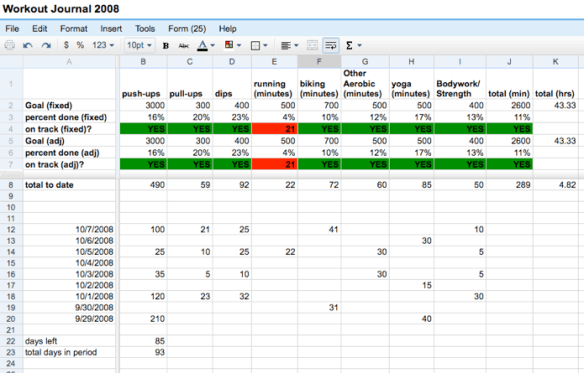
Here is what it looks like on google docs.  Most columns and rows are self explanatory, but I will go through them below…  First, let me talk about the tracking and the “on track” row.  Here you can see I was not on track for running…  All the other columns show a green YES, but that one shows a RED 21, meaning  I was 21 minutes behind my target.
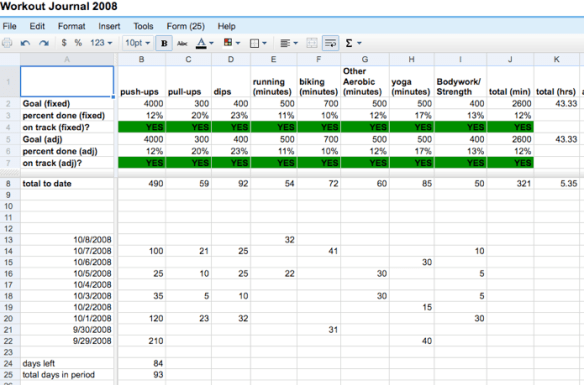
But then I ran 35 minutes and got back on goal:
So first on the columns:

  • push ups — normal push ups, any hand position or variation
  • pull-ups — both hands forward, both hand back (really a chin up) or alternate hands (supposedly works on obliques)
  • dips –obvious
  • running — obvious
  • biking — obvious
  • other aerobic — stairs, elliptical, hiking, walking, paddling, etc
  • yoga — preferably video or class though I have my own practice too, that will go here
  • bodywork/strength — time spent on pull ups, push ups, and dips goes here too, but this also includes physical therapy exercises (stretch, strength, core) and other such stuff

For the rows:

  • goals (fixed) — the goal I set at the start of the quarter — this one I will not change
  • percent done — total to date divided by the goal (fixed)
  • on track (fixed) — whether or not I am on track to meet the goal — I’ll show some formulas below
  • the next three for “adj” are the same as the prior three, just for the adjusted goal, if I make changes due to unforeseen circumstances… So far this Q I have not.  🙂
  • days left — number of days left in the quarter
  • total days in period — number of days in the quarter — I started 2 days early this time, thus the 93

WARNING:  Stop reading here if you don’t care for math and spreadsheets!

Now, there are some pretty interesting formulas here, so let me walk you through them.


percent done — this is just the “total done to date” divided by the “goal” displayed as a percentage:

=B8/B2

total days in period — using dates in formulas like this was new to me, but pretty nifty..  Basically “total days” = “end date” – ” start date”

=DATE(YEAR(TODAY()),12,31)-DATE(YEAR(TODAY()),9,29)

days left — here it is just “end date” — “today”

=DATE(YEAR(TODAY()),12,31)-TODAY()

Second warning — it gets ugly here!

on track — here is where it gets interesting… let me start with the full formula then break it down

=IF ((B2/$B$25)-(((B2-B8))/$B$24)>0,”YES”,(B2/$B$25)*($B$25-$B$24)-(B8/($B$25-$B$24))*($B$25-$B$24))

The “IF” is just:

IF (test, then value, otherwise value)

So in other words, do some kind of evaluation, and if it is true, use the “then” value, and if it is false use the “otherwise value.”  My test is (B2/$B$25)-(((B2-B8))/$B$24)>0) which basically breaks down to if the “goal divided by the number of days in the period”  (which gives you a target count per day), minus the “total to date divided by the number of days left”  (which gives you a required count per day for the remaining days), is greater than 0, then I am on track…  So, if “target per day” – “actual per day” is positive, things are good and I put a “YES” in the value.  Then I use google spreadsheets coloring to change the cell to green when ever it sees YES.

It may be best to work through an example…  Lets use running, so for B change that to E.  (For $B leave that as B!)  I have 500 minutes as my goal for running, and the total days in the period is 93.  So 500/93 = 5.37.  That is my “target count per day,” in this case 5.37 minutes.  If I ran 5.37 minutes each of the 93 days, I would reach 500.  (Of course, I normally only run 1 or 2 times a week, so it is more like 36 minutes a week is what I need…)

Next we look at “total to date divided by the number of days left” to get a  required count per day for the remaining days…  In the 1st screen shot above, I had run 22 minutes, so I had 478 minutes left to do in the remaining days.  478/85 = 5.6.

Now, 5.3 – 5.6 is negative, thus I was not on track.  Anything 0 or above is on track, and gets the big green YES.

Now rather than just put NO if I am not in track, I want to see how far off I am — or what my deficit was.  So I have:

(B2/$B$25)*($B$25-$B$24)-B8)

Let me break that down down too…

That is the (goal divided by total number of days) multiplied by (the number of days remaining) minus the total to date.  (The parenthesis are important!)  Again an example would be useful, so going back to the screen shot where I had a goal of 500 minutes but had run only 22 in the 1st 8 days, and was therefore behind schedule…

So (goal/number of days) = 500/93 = 5.37.  Multiply that by the remaining days, which in this case was (93-85) = 8, so 5.37 * 8 = 43…  That is how much I would need to run per day to reach the original goal.  But I have already run 22, so 42-22 = 21…   (I am rounding so that shows up as 22 in the example above.)

Got it?  🙂  I admit it took some experimenting and trial and error to get these formulas right!

Now there is more to this — there are pros and cons to tracking this way, but I will save that for another post.

The Fountainhead. 1949.

After reading The Fountainhead (see post here), and then finding out there was a movie, I had to see it.  I was sckeptical that a movie, especially at just 2 hours, would be any good since the book was so epic and philosophical.  I just couldn’t figure out how the screen writer(s), director, and producer could pull it off.  I was happy to see right in the beginning that Rand did the screen play herself.

The movie started out moving incredibly fast.  The book takes time to develop the plot, the characters, and the philosophy.  The movie did not.  And there were also several items that were out of order, and one very notable item that was much better placed in the book, in my opinion.  (I don’t want to say what it is here, as it is a bit of a spoiler…)

Overall, the movie was just the tip of the iceberg of the book.  While fairly well thought out, it certainly does not match the book’s depth (nor do many movies that try to capture this kind of book).  While I can recommend the movie, I would say that you must read the book if you really want to dig into Rand’s ideas.

One thing that was a pleasant surprise was to see some of the buildings of Roark.  In the book, it was extremely hard to visualize, but the movie did a good job with them.  It was quite impressive considering the movie was done in 1949 how the skyscrapers seemed so real.  Of course, I’ve had the opposite experience of seeing things in a movie that I had visualized in a book.  For the Lord of the Ring movies, it was quite a different experience for me.  I had been picturing hobbits, orks, etc. for 20-25 years, and when I saw someone else’s representations that were so drastically different than my own, I was not pleased.  I got over it.  🙂

Some quotes that I may have missed in the book, or maybe they were just different in the movie.  These may be more paraphrases than exact quotes.  🙂

  • Defining freedom as “want nothing, expect nothing, depend on nothing.”   (Compare that to the discussion in this post.)
  • “The things that we want and admire enslave us.”
  • “See through your own eyes, think with your own brain.”
  • …spectacular talent, but made subservient to the masses
  • “Does man have a right to exist if he refuses to serve society.”
  • “The world is perishing from an orgy of self sacrifice.”

That last one is huge for Rand… She is not into altruism at all.  I am just about done with Atlas Shrugged, and that book is even stronger on this point.  So I likely will say more about this when I write on that book.

Finally, in the speech to the court near the end, Roark talks of the brain as man’s only weapon, and that the mind is an attribute of the individual.  He goes on to say that there is such thing as a collective mind.  I wonder how Rand would see today what is often called a hive mind, or universal mind, or even the collective mind.  I think I first read of it in Neal Stehpenson’s “The Diamond Age,” though I often think of it today as I am searching for answers online– data, information, knowledge, how-to’s, solutions to problems I am having that others have already had.  Today, we really do rely on each other’s minds moreso than at any other time in history.