2025 training and racing year in review

Only one race, but it was my dream race, and it was magical, and it was epic:

The Barkley Marathons

There’s no need to write more about that one in this space! 🙂

I did some other big runs, such as the Virginia Triple Crown (though I guess I didn’t write a blog about it, so here’s a Strava link, and another ALTAR (not a single, not a double, but an out and back that covered 46+ miles). There was also the hike/run around Mount Blanc — I’ve posted some of that trip, but not all of it yet… You can find most of them by using this search link.

Sträva year in review screen shots are here:
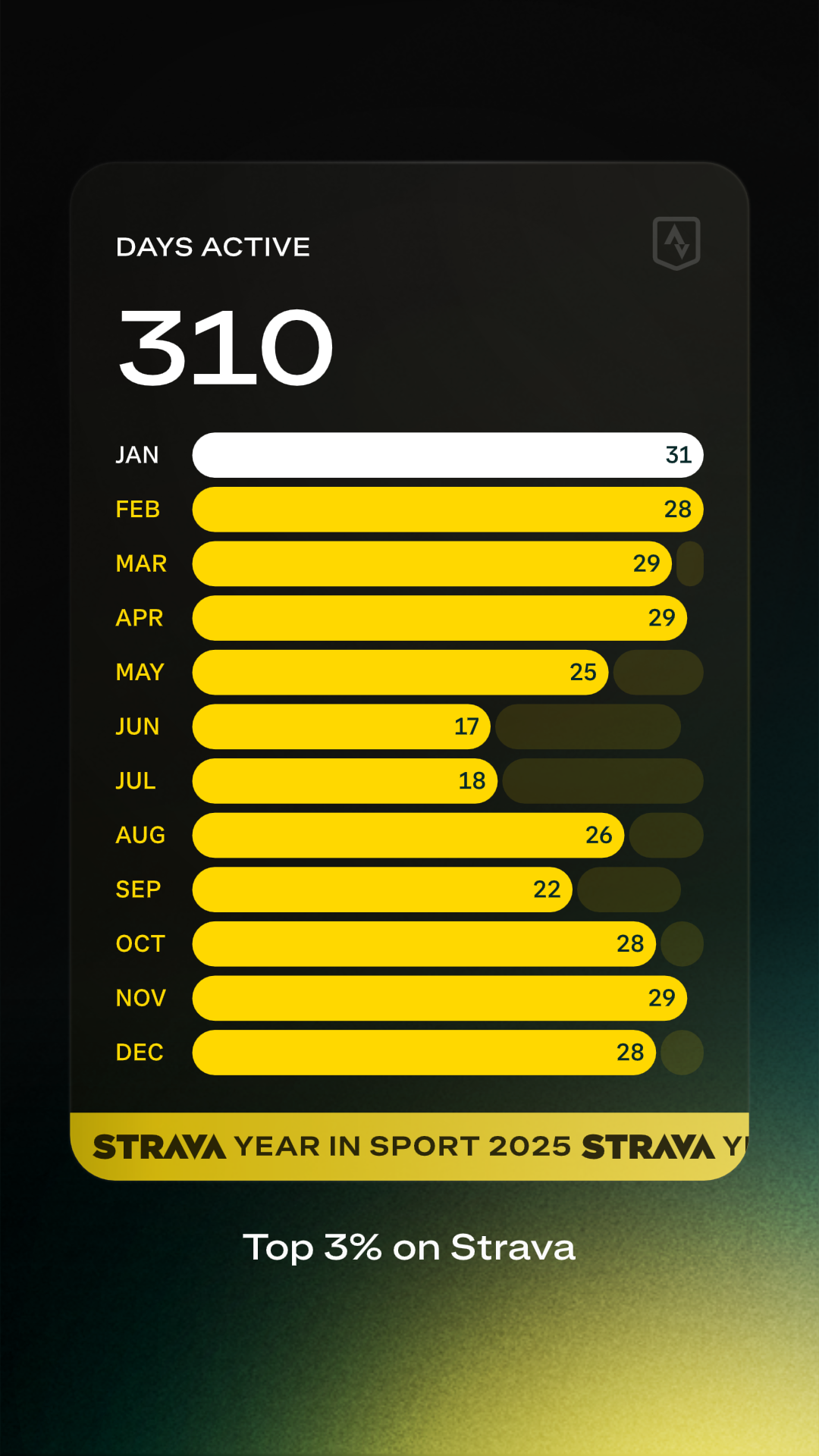
That’s 17 days less active than 2024, if anyone is counting! After Barkley in March, I did need a break, both mentally and physically, and it showed in my training. Next up is 498 hours, and that was 33 hours less than last year!

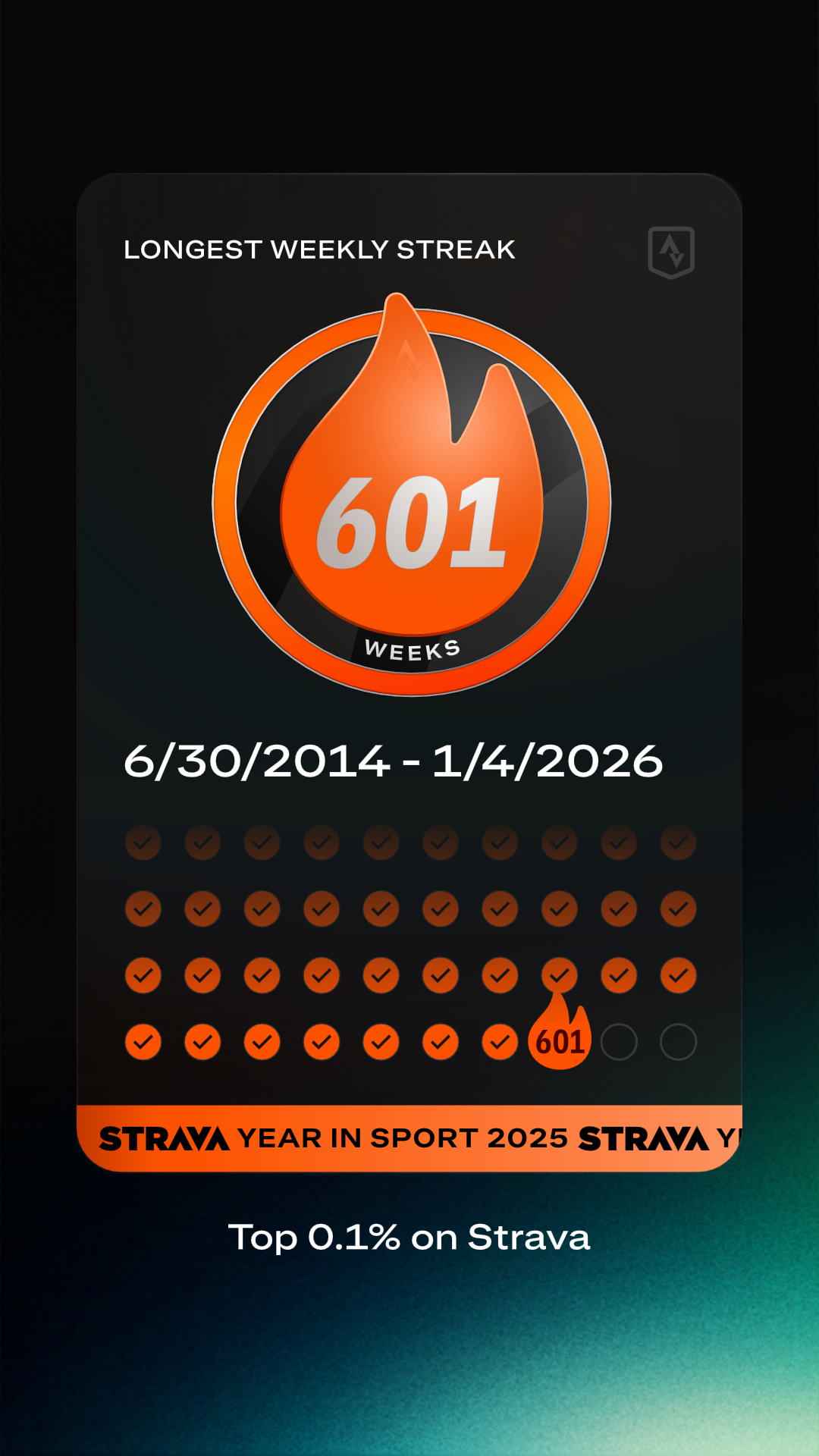
I’m not sure if the next one shows anything other than I’ve used Strava for a long time:
And finally the summary – which shows almost 700 miles less than 2024, which I find a little odd — other than I rode my bike more that year?
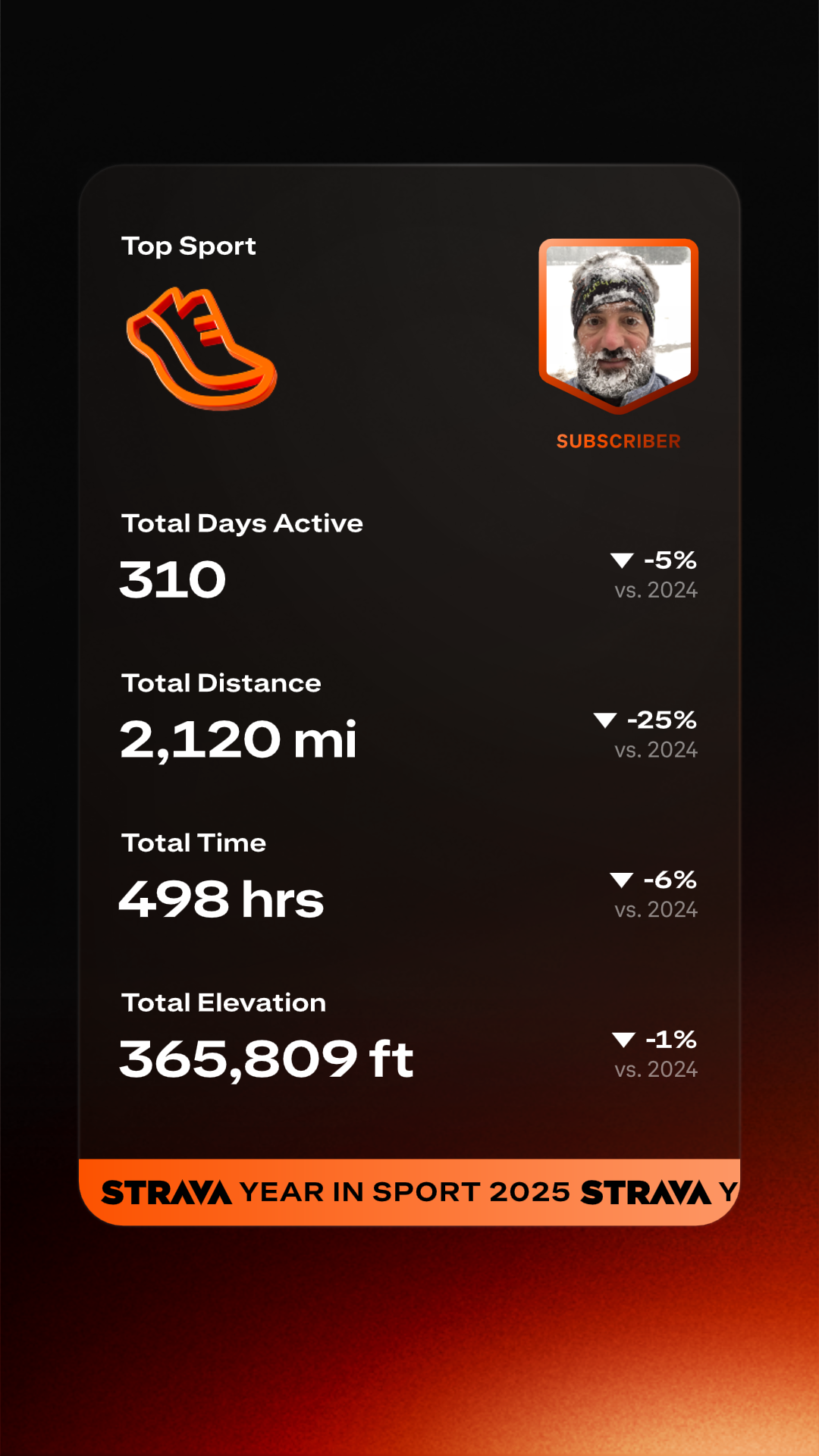
The big one is the 365,000 of elevation — that’s back to back years of reaching that milestone!

I guess in early 2025 I didn’t write much about what I was thinking training wise for the upcoming year, and I looked back at 2022 and 2023, and see a little…

I can say that 2025 was far too little strength training, and I really need to get back to that. I can say the same about mobility work – it has really fallen off and I need to up my game there. I’m feeling it more now that I’m 55. I think I’ll combine mobility and strength numbers on Strava — there’s not a good separate breakout that works well with Garmin, and I tend to do them together anyway.

Beyond that, I’ve also been thinking a lot bout Nassim Taleb’s tweet here:
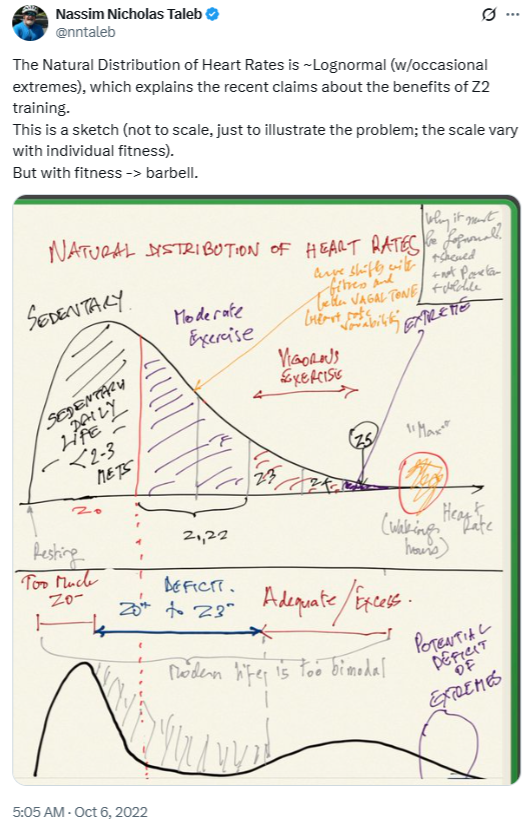
And reading a lot of Alan Couzens, who recommends 1000 or more calories burned per day during exercise. At low intensities (he’s big on zone 1 and low zone 2), that’s a couple hours per day. I’m not sure I can find more time to train, nor if I want to, but perhaps I can be more active in every day life, outside of training, while still maintaining ~500 hours per year (*). And more active throughout the day is what Taleb is getting at — most of us who train for big events tend to be pretty inactive outside of training, whereas historically, active humans were active for much longer periods each day.

(*) I’d note most weeks I’m in that 6-10 hour range, but then I’ll have 2-3 very big events per year — 12-24 hours, as well as a 4-6 hour training session once a month — that’s where the 500 comes from.

Garmin shows the following active and resting calorie burns for last year — yes I didn’t grab this on Jan 1 so it’s a bit of off for the calendar year, but it’s close enough:
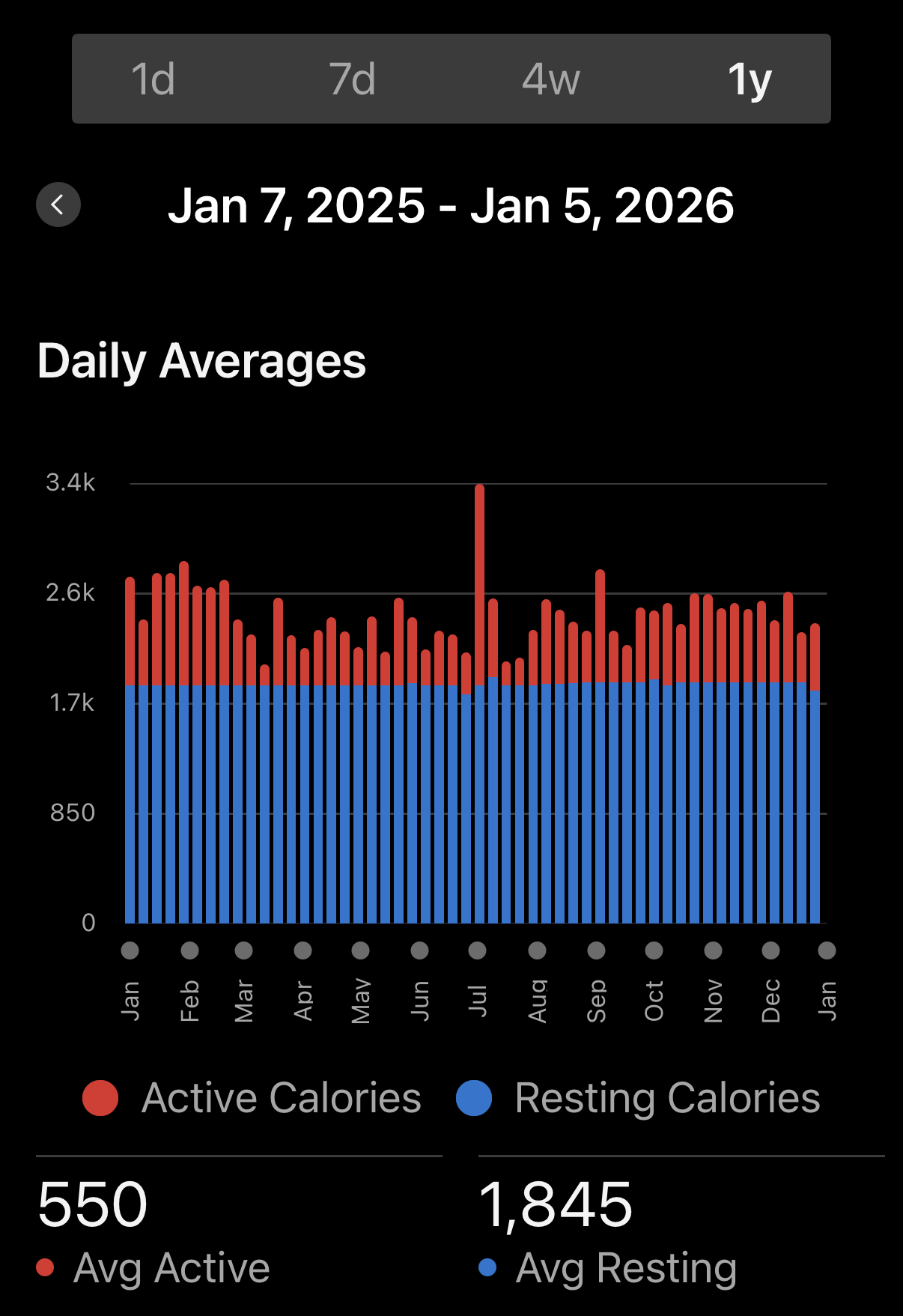
First, I’d note that when I had a Whoop, it showed I was burning 3-4k per day (active and resting), so there’s a huge discrepancy there. Calorie counting tends to be like that — a device might be as much as 10-20% off. But it’s the trends that matter. The big jump in July in the image above is the 7 day/100+ hike/run around Mount Blanc.

So this shows an average of 550 active last year, and my goal this year MAY be to get significantly higher than that. I say “MAY” as I’ve just started tracking this closer the last couple weeks, and I already see some issues… For example, tread hikes on the treadmill calorie counts seem to be dramatically lower than they should be, while runs on the treadmill are just fine. It appears trainer rides on Zwift transfer to Garmin well. So I’m still exploring how this all works, and it’s hard to set a goal until I have a better understanding.

But at a high level the goal is to be more active throughout the day, while still training like I have in the past. That may prove difficult with my desk job, but I’ll try to throw in more “exercise snacks” during the day, as well as more walking in general (on top of “training.”)

2022 year of training and racing in review

Another year has come and gone, so it’s time to write a little about it. Last year, I shared that I only had 3 races planned, Uhwarrie 40, Florida Sea to Sea, and Barkley Fall Classic. Well, a couple weeks before Uhwarrie, I got sick, and while a week out I was feeling ok, I thought it wasn’t really wise to push the body as much as a 40 mile race would take. And I knew there was no way I could go to a race and not push. So I ended up racing just two events: Florida Sea to Sea and BFC. S2S was good — 73 hours across Florida on foot, bike, and boat, with lots of navigation, but the navigation can be frustrating due to the quality of the maps. And BFC was a great day for me — started pretty slow, but worked my way up to 28th overall out of 400 starters! I was very happy about that. Very tough course this year, too!

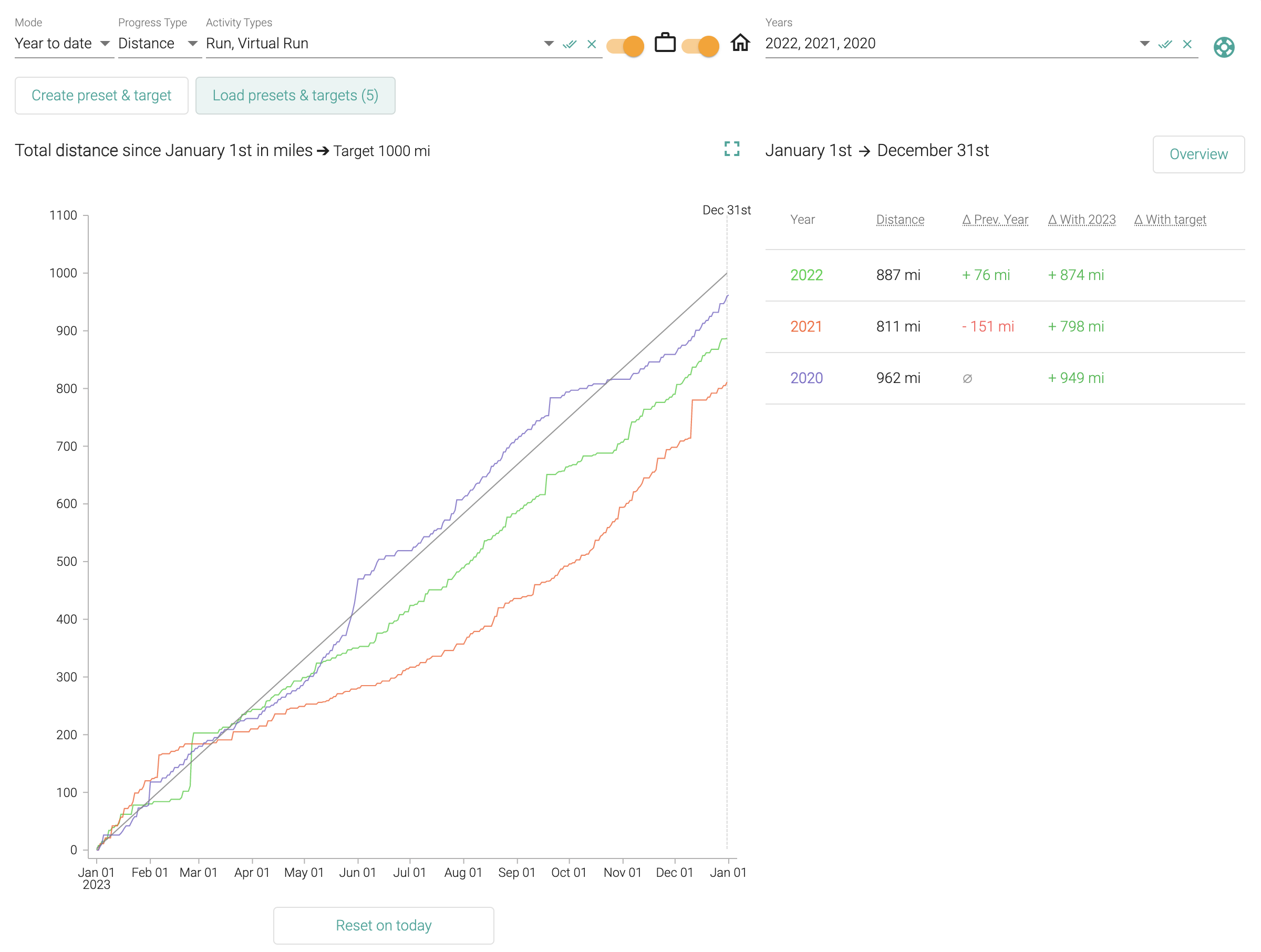
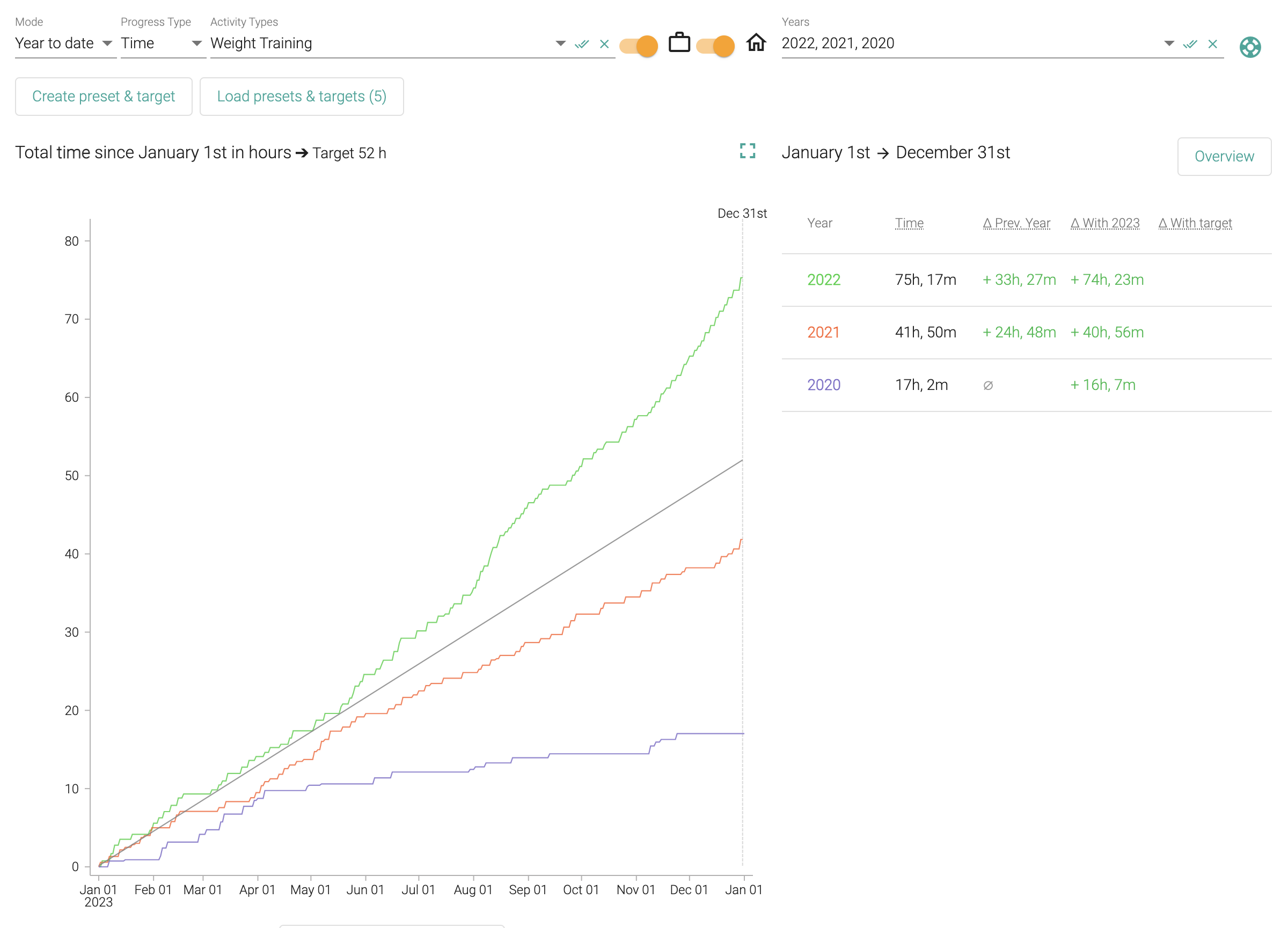
Last year I shared that I was keeping the same goals, so I’ll just share the graphs here which show again that I missed on most of them!

First up, elevation, and this was the lowest in 3 years! I still want to hit 365,000 one day, but that day likely will wait until we live in the mountains full time.

Next up, total time. Pretty close to 500 (though the goal was 550), and more than I’ve done the past couple years, but all in the same ballpark:

Running was basically in the middle of the past couple years, but still not even 1000 miles:

And next biking, my lowest in a while:

And next, strength training, which I had mentioned last year was going to be a focus going forward. And it certainly was this year, as you can see in the graph. I surpassed most of my strength goals (though not all of them) and find myself stronger now than I was back in Weightlifting 101 at NCSU in 1990!

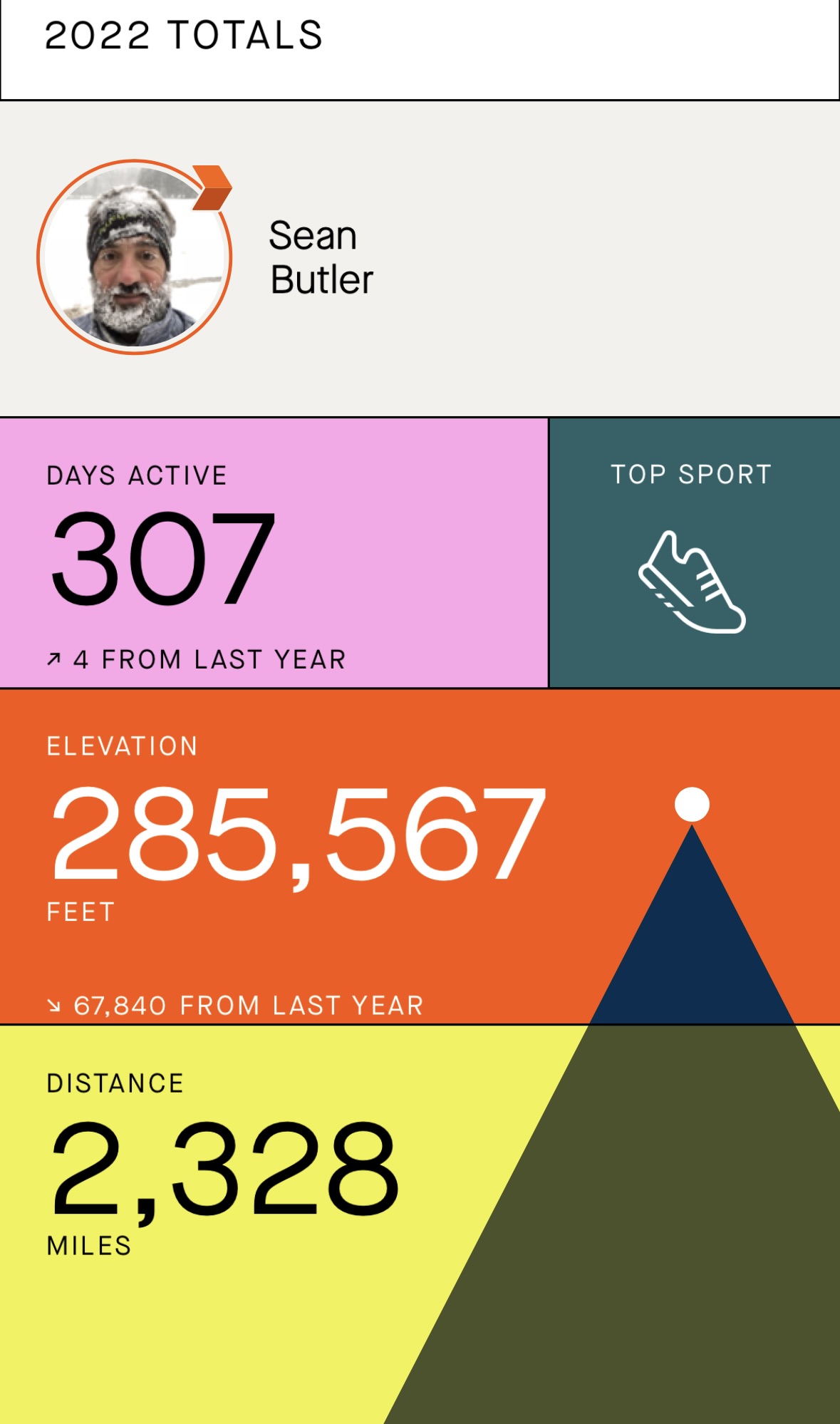
And next just a couple more summaries from Strava:

Next year will be more of the same — running, biking, strength training as the focus, but always looking for outdoor activities like hiking and paddling. As of right now, I only have two races: Uhwarrie 40 and Mt Mitchell Challenge. The latter is a race I’ve tried to get into for years with no luck. This year they’ve changed it, so everyone can run the Black Mountain Marathon (which I did in 2002 or so), but if the Mt Mitchell Summit is open, the 1st 250 runners are allowed to go up. The rangers normally don’t give an indication of whether the summit will be open or not until just a day or two before, and I have to admit, I’m not that interested in running the marathon. So if the summit isn’t open, I may skip this. I am on the waitlist for BFC and do hope to run that again. And apparently I’m joining the Knight Crawlers for the Blue Ridge Relay again this year, but the “mountain goat hard legs,” that I got to run last year, are going to the ladies.

I do have at least one adventure planned — plane tickets and hotel room booked for Rim 2 Rim 2 Rim across the Grand Canyon with a group of friends that I’m really looking forward to in April. (This is something like 48 miles and 10,000’+ of elevation change). I still want to run the Grand Loop of the Linville Gorge (34 miles). Weather permitting, I may do the little loop (23 miles) there in a few weeks, but the Grand Loop is going to have to wait until after the February races.

I still have a couple crazy ideas I’d like to attempt, like an Everesting attempt either on bike or foot (or both!), maybe even a vEveresting attempt on Zwift. On a bike I’m looking at 12-15 hours, and on foot, probably 28-30, so they are serious undertakings. I also saw someone do a marathon (42k’) on a Concept 2, so that would be a challenge.

I’m still extremely focused on strength. While the extra muscle is a pain to carry around the mountain, I think it is much healthier going forward into my mid 50’s, 60’s, and 70’s! I’m intrigued by Peter Attia’s “Centurion Olympics,” where you backcast from goals you have in your marginal decade… Let’s just call that 80-90, or even 90-100, and what you want to be able to do then. (Examples: Load your own luggage on an airplane, hike 3 mph, get down on the floor to play with your great grandkids..) And then you work backwards. Things like VO2Max look good for me (though I need to continue to train both zone 2 and VO2Max!), but some of the strength goals were pretty far off. And I definitely need some mobility work! 🙂

Two benchmarks that he has mentioned are a dead hang for 120s and being able to farmers carry your body weight for 2 minutes. I’m up to 90s on the dead hang, but farmers carry is just at 2×35 and I need to get to 2×75! (I’ve not tried the latter at the start of a weigh training session, only at the end, so it’s a little unfair. I will do one of these at the start with 40 lbs and see how it goes. I have carried 75 for 45-60s but it recked me for the rest of the workout!)

I also created a table of strength benchmarks based on both my weight and age, and looked at what intermediate lifters can do. Then I set my target at the lower of those two numbers. Upper body strength is in-line or very close for pull-ups, bench press, overhead press, and bar row. But lower body strength for squats and dead lifts has some serious work to put in this year. (Note, if I don’t have a measured 1 rep max, I use 120% of my best 5×5. This worked out well for most of the lifts for me where I have both, so I think it’s a decent approximation.)

Here’s the chart as of today, a little small but this is the best way to share it.

I don’t know if I can make all those green by the end of the year, but I’m going to work towards it!

See you on the mountain!

Tobacco Road Marathon

When I 1st started training for the ATT marathon, I had a goal of 3:15.  (ATT = American Tobacco Trail, which is what I tend to call the marathon, even though that’s not its name!)

I knew 3:15 would be a big stretch for me, but I thought with Lucho coaching me, I might have a chance.  However, throughout training, it seemed like 3:20 was going to be more realistic.  But I never fully gave up on the 1st goal.  Even when, about two weeks out, my legs felt a bit achy and tired on every run, especially when I bumped the speed to under 8:00/mile pace.  And even when, a week out, my lungs started feeling congested and wheezy.  Two days out, and one day out, I was definitely on the upswing.  So what was in store?

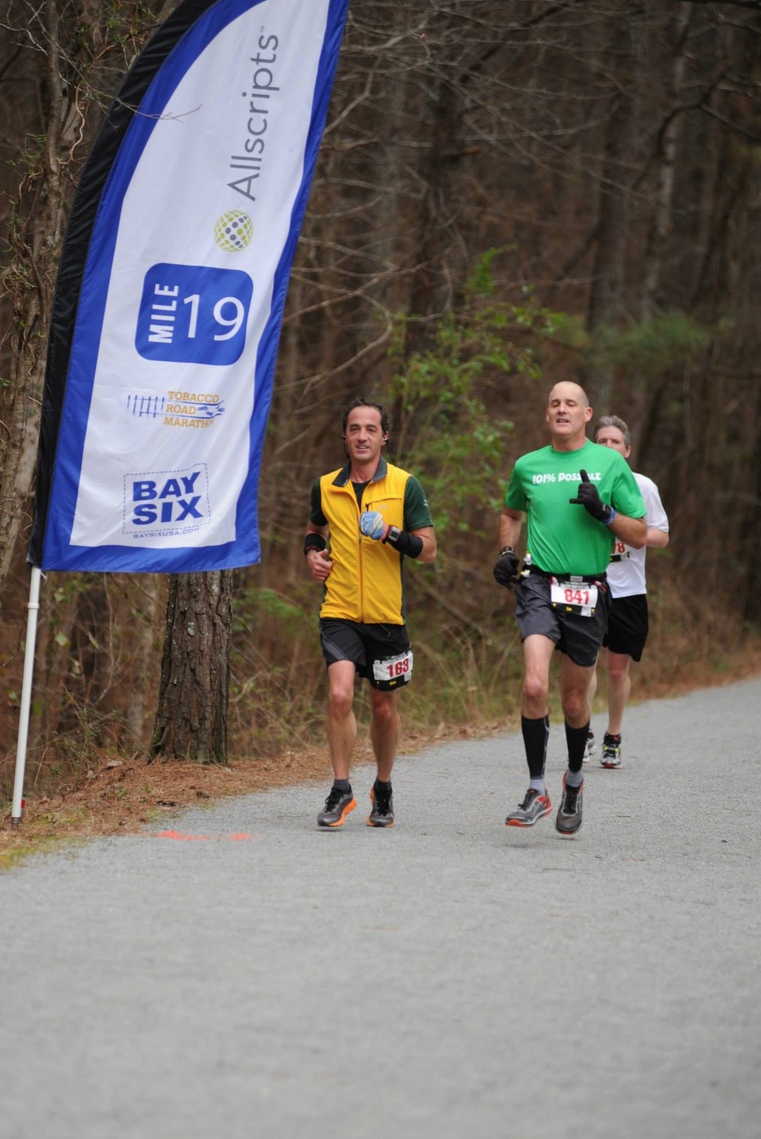
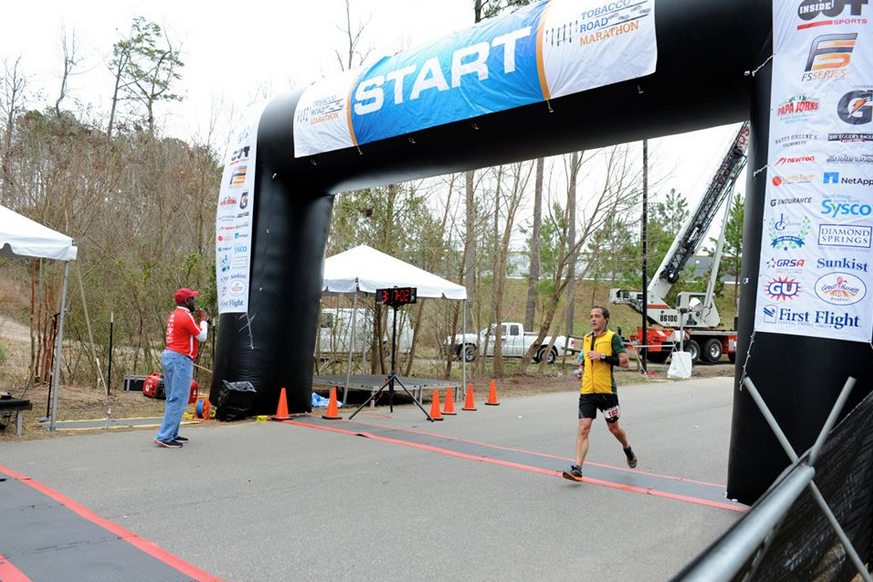
I’ve not got a lot of pictures — only the ones Kelly and the kids took of me at mile 19 or so, and at the finish.  But here I am at 19, still looking happy!

mile 19

I came up on Tom, who has an amazing story as a brain cancer survivor.  I was really surprised to see him, as I figured he’d be under 3:15, but there he was.  We didn’t run together long as he was struggling a bit with too fast of a start, but still finished in a BQ time of 3:22.

tom

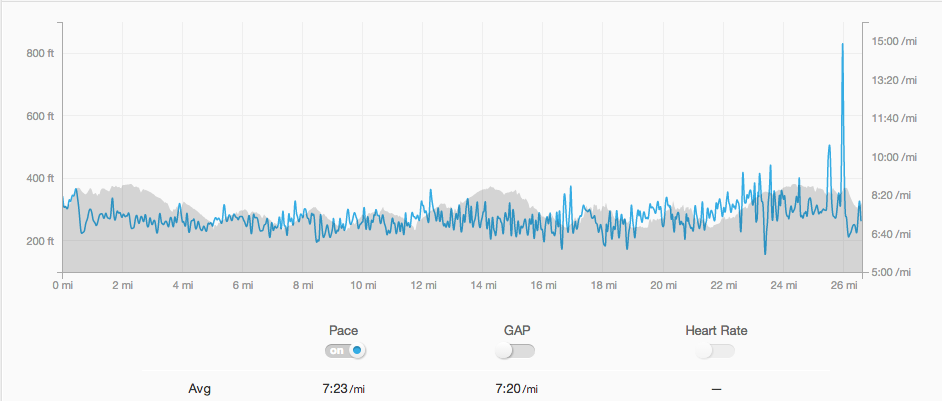
So, what happened to me?  The splits tell the story…  I put the mile splits from my GPS next to the perfectly even splits of a 3:15, and show the time difference…

Now this isn’t quite fair — the mile splits are from my GPS, which was slightly off.  It showed a total of 26.44 at the end, not 26.2.  But this shows I had a conservative start (negative difference for the 1st few miles).  In fact, I jumped in behind the 1:40 half marathon pace group for the 1st couple of miles — until they split off south on the ATT and the marathoners headed north.    And then the differences pick up, where I’m fairly far ahead of a 3:15 as much as 2.5 minutes!

At the point the half marathoners turn south and the marathoners turn north, it’s a slight downhill — if you can call any rise or fall on the ATT a hill!  As an old railroad bed, it’s never more than 1 or 2% grade max.  But I let gravity pull me along, and even tried to hold back a bit.  I wasn’t wearing a heart rate monitor, but just ran by feel.  And the pace felt solid, but good.  I know come mile 18 or 19 or 20, that pace would no longer feel so good, but it’s at that point when you have to rise and hold it..

I did have the GPS on so I could use that as a pacer, and I steadily saw my average pace go down, down, down.  All the way until about mile 21, when it was 7:18/mile.  And I thought “I’ve got 3:15!  Unless I have an epic collapse!”

I even thought briefly at that time that 3:10 was within reach, but I wisely decided not to push it at all.  In fact, I thought I’d back off a touch, to preserve the 3:15.  But little did I know that the “climb” at mile 22 – 25 would do me in…  It got really hard to hold the pace, but I was doing it!

And then we left the ATT and hit the roads.  And there was this little hill, but this killer head wind. And I had to walk.  Twice!  You can see it in the elevation profile and pace graph below the splits.  And you can see in my splits… I began to really suffer, and the buffer I had built faded oh so quickly…

Mile Split Cumulative 3:15 Marathon Splits Difference
1 0:07:45 0:07:45 0:07:26 -0:00:19
2 0:07:27 0:15:12 0:14:52 -0:00:20
3 0:07:17 0:22:29 0:22:18 -0:00:11
4 0:07:15 0:29:44 0:29:44 0:00:00
5 0:07:04 0:36:48 0:37:11 0:00:23
6 0:07:23 0:44:11 0:44:37 0:00:26
7 0:07:05 0:51:16 0:52:03 0:00:47
8 0:07:16 0:58:32 0:59:29 0:00:57
9 0:07:01 1:05:33 1:06:56 0:01:23
10 0:07:09 1:12:42 1:14:22 0:01:40
11 0:07:12 1:19:54 1:21:48 0:01:54
12 0:07:16 1:27:10 1:29:14 0:02:04
13 0:07:29 1:34:39 1:36:41 0:02:02
14 0:07:28 1:42:07 1:44:07 0:02:00
15 0:07:18 1:49:25 1:51:33 0:02:08
16 0:07:03 1:56:28 1:58:59 0:02:31
17 0:07:20 2:03:48 2:06:26 0:02:38
18 0:07:31 2:11:19 2:13:52 0:02:33
19 0:07:06 2:18:25 2:21:18 0:02:53
20 0:07:42 2:26:07 2:28:44 0:02:37
21 0:07:19 2:33:26 2:36:11 0:02:45
22 0:07:37 2:41:03 2:43:37 0:02:34
23 0:08:04 2:49:07 2:51:03 0:01:56
24 0:08:08 2:57:15 2:58:29 0:01:14
25 0:07:52 3:05:07 3:05:56 0:00:49
26 0:08:31 3:13:38 3:13:22 -0:00:16
27 0:03:07 3:16:45 3:15:03 -0:01:42 26.44 vs 26.2

That last line shows the unfairness of using the Garmin mile splits, which were steadily increasing past exact mileage.  Otherwise it would imply I lost 90s on the last 0.2 miles!

See those two jumps on the blue line?  Just a few seconds of walking…  You can see after I stopped kicking myself for walking I did pick up the pace back to sub 7:30, at least on the downhill, but it was too late…

profile-pace

Ah, it was so good to be done.  The last 2-3 miles, I was hurting.  Not a bonk — nutrition was solid, but I was so tired.

finish

So, was I mentally weak?  Or was the body really done?  I feel I’m strong mentally — when it’s just about keeping going.  Paddle for 38 hours straight?  Sure.  Run 24 hours around a 5k loop? Sure.  But hitting that last 800 on an 10×800 interval session?  That is hard!   Or fighting through the pain and fatigue on mile 25 of a marathon at sub 7:30?  Ugh.  So I will be working on that aspect of my running!

Here are the official numbers.  I’m quite happy with all the placings!official results 2

And official splits:official splits 2

Now I am in no way disappointed with a 3:17.  3:15 was always a big stretch for me.  And yeah, to almost get it, only to fade so quickly — bummer.  But I am happy with 3:17!  An 11 minute PR!  And such a great run for the 1st 2:50 or so.  🙂

(I really did want the cool BQ shirt, though!)

kelly kids

Chi Running. Danny Dreyer.

chirunning

As most of you know, I have a history of knee problems, though I do seem to be getting better and better.  I am runing faster than anytime in the past 4 years (but still about a minute per mile slower in a 5k than before my knee got really bad).  And I’ve heard good things about the style of running described in Chi Running, so I wanted to read the book.  There is a lot of common sense information here, and I really need to take the time to put it into practice, work on the exercises and the form, before I can say whether this form is going to “fix me.”  Overall my form is not that bad per se, but I have biomechanical deficiencies… Now which came first, I can not say — i.e. did my bio mechanics change to prevent the pain, or did the bio mechanics cause the pain?

Anyway, reading this makes me want to also get the DVD, but even more so sign up for one of the Chi Running workshops.  There are some as close as Raleigh, but since Danny lives in western NC, I may try to get into one he teaches himself in Asheville.

The book is full of philosphy from T’ai Chi that are applied to both running and life.  (Many of the philosphies are similar to Yoga…)  Anyway, here are some such tidbits of information:

It was weird to find a quote fomr Cecil DeMill regarding his film “The 10 Commandments,” but there it was:

It is impossible to break the law ourselves.  We can only break ourselves against the law.

(Here Dreyer was referring to “moving with nature,” not against it.  Or using gravity to propel your running (via a forward lean) rather than the power of your own muscles.)

Relaxation is the absence of unnecessary effort.

A tansition is a conscious pause.  It is a time to take stock of yourself and thing about the run before you are about to begin.  The space before a run is like the pause between breaths.  It’s the thoughtful momemnt that precedes movement, when you set up your intentions of what you’d like to do during your run.  It’s your opportunity to ponder what you’d like to focus on, whether it is pacing, focuses, weak areas of form,….

Our culture offers us little in terms of training us how to live and appreciate life from the inside out.  So much of our focus is on the external that little attention is put on considering what goes on internally…

Q1 Workuout update

Below is my fitness spreadsheet update for Q1…  I still enjoy tracking workouts this way — it keeps me motivated!  🙂

As you can see, it was close, but no cigar.  I always make these “stretch” goals so they will be difficult, but I would like to actually complete every goal one day.   I ended up a lot higher on “other aerobics” and “strength” as I started doing some P90x workouts such as plyometrics, core synergistic, etc…  For hiking I set the goal at 300 before we had planned on an AT trip in March.  When that trip fell through, I still got out for an over nighter where I was able to hike for 30+ miles, thus the large number for hiking.

q1results

For my specific goals, the ones in green I completed, the others I did not:

q1goals

I ran 23:36 on a 5k in mid January (on a treadmill), so I was close and thought that would be an easy one, but I tried a couple of times after that, and never quite made it.  Still a far cry from when I was consistently running 20:00 – 20:30 in 5ks a few years ago (pre knee issues)!  😦

And I only got out to vista point once, when I ran for an hour.

I’m still trying to figure out exactly what I want to do in Q2.  I know I am going to remove the specific targets on push-ups, pull-ups, and squats — a ton of those are part of P90x and I do plan to incorporate more P90X workouts, both cardio and strength/toning.   I am also singed up for The Bear, a 5 mile run up grandfather mountain, in July, so I need to do some running hill work.  And finally we moved the AT hike from March to May, so I should get plenty of hiking in.

Q4 Workout Goals Final Post.

This post is a bit late, but better late than never.  I won’t continue to bore everyone with my workout goals by quarter, but since I had originally posted the idea and spreadsheet here, I thought I should at least post the final numbers.  As you can see, I did pretty well, though fell quite short on yoga.

I hope to improve that in the current quarter!  My new goals have more push ups, no dips (though I will still do them), more running, squats/lunges, I have separated hiking from other aerobic, and things like that.  I  have also added other more concrete goals like run a 23:30 5k on the treadmill (a far cry from a few years ago when I was consistently in the low 20:00’s, but I am slowly getting better), trail run for 1 hour, etc.

q4-workouts

Quick update on workout goals

Half way through the quarter and things don’t look too bad for reaching my goals:

workout-11-16

I had outlined my goals for this quarter and this tracking spreadsheet here…  The spreadsheet and accountability of posting it helps keep me motivated!

This snapshot was tacken on 11/15, or the mid-way point of the quarter.  I was hoping to be more than 50% done on most goals, because with the Holiday season coming up, I’m not sure I will be able to keep up.  I’m really only significantly behind on the biking goal — and it has gotten really cold here the past few days so that is not likely to change!  I am not a big fan of riding in the cold (though other cold weather workouts like running and hiking are fine)!  But I am only just one decent workout away from getting back on track.

Tracking Goals and Workouts, part II

This is part II…  Find part I here.

At the end of that article, I said I would jump into the pros and cons of my little spreadsheet, so here goes:

pros:

  • It is nice to set goals and work towards them.  Goals make it more likely that I won’t skip workouts.
  • The tracking I have set up lets me know exactly where I am in my progress towards the goal, and lets me know how far behind I am (if when I do get behind).
  • I made a “static” goal and an “adjustable” goal, in case I was too aggressive (or not aggressive enough!) in my targets.  For example, just a couple weeks in, and I can tell that the push up goal will be fairly easy to reach, while the running goal may not be.  That will depend on if my knee and hip can handle that amount of running…

cons:

  • I am combining push ups, pull ups, and dips into my bodywork/strength column.  So while I have specific strength goals for those three exercises, and an overall time goal for general strength work, I am not tracking a lot of other exercises I do such as squats, or curls, or whatever.   So I will have to be careful not to let the 3 specific exercises dominate my strength training time just to meet those goals.  If I continue this approach over time, I will try to rotate different exercises into to the spreadsheet, or perhaps just add a couple more to get a more rounded list of exercises in there.
  • I can already see that I am going to have to be careful to not let the spreadsheet dictate to me what I should be doing, but let my body dictate — especially in terms of pushing my knee/hip too hard.  The running goal is probably a bit aggressive, so I will have to be careful not to run just because I am behind in my tracking, if my knee does not feel up to it.
  • I typically have one or two big events a quarter — something like a 2 or 3 day back pack trip on the Appalachian trail.  Those are going to be a little hard to fit into this model, but I will figure something out.

No matter what, I am still having fun with this method, and that is a good thing.  As long as I am having fun, I am more likely to keep at it.

Tracking Workouts and Goals

After recently finishing the push up challenge, I found that I liked having a goal as well as a way to track my progress towards the goal.  When I used to do a lot of adventure racing,  I always had a goal on the calendar, and I had teammates I was accountable to…  But with the knee problems, and now slowly recovering but not racing much, and not on teams at all, I have found that I am more likely to miss workouts.   With all that in mind, I thought I’d set up some goals and track them.

At 1st, I started to do a full year’s worth, but that was a bit intimidating so I moved to a quarter’s worth instead.  But even then, I think that things are going to come up — family, business, injury, sickness, or just changing goals, so I made two goals — one fixed from the start, and one adjustable, in case anything comes up.

Here is what it looks like on google docs.  Most columns and rows are self explanatory, but I will go through them below…  First, let me talk about the tracking and the “on track” row.  Here you can see I was not on track for running…  All the other columns show a green YES, but that one shows a RED 21, meaning  I was 21 minutes behind my target.

But then I ran 35 minutes and got back on goal:

So first on the columns:

  • push ups — normal push ups, any hand position or variation
  • pull-ups — both hands forward, both hand back (really a chin up) or alternate hands (supposedly works on obliques)
  • dips –obvious
  • running — obvious
  • biking — obvious
  • other aerobic — stairs, elliptical, hiking, walking, paddling, etc
  • yoga — preferably video or class though I have my own practice too, that will go here
  • bodywork/strength — time spent on pull ups, push ups, and dips goes here too, but this also includes physical therapy exercises (stretch, strength, core) and other such stuff

For the rows:

  • goals (fixed) — the goal I set at the start of the quarter — this one I will not change
  • percent done — total to date divided by the goal (fixed)
  • on track (fixed) — whether or not I am on track to meet the goal — I’ll show some formulas below
  • the next three for “adj” are the same as the prior three, just for the adjusted goal, if I make changes due to unforeseen circumstances… So far this Q I have not.  🙂
  • days left — number of days left in the quarter
  • total days in period — number of days in the quarter — I started 2 days early this time, thus the 93

WARNING:  Stop reading here if you don’t care for math and spreadsheets!

Now, there are some pretty interesting formulas here, so let me walk you through them.


percent done — this is just the “total done to date” divided by the “goal” displayed as a percentage:

=B8/B2

total days in period — using dates in formulas like this was new to me, but pretty nifty..  Basically “total days” = “end date” – ” start date”

=DATE(YEAR(TODAY()),12,31)-DATE(YEAR(TODAY()),9,29)

days left — here it is just “end date” — “today”

=DATE(YEAR(TODAY()),12,31)-TODAY()

Second warning — it gets ugly here!

on track — here is where it gets interesting… let me start with the full formula then break it down

=IF ((B2/$B$25)-(((B2-B8))/$B$24)>0,”YES”,(B2/$B$25)*($B$25-$B$24)-(B8/($B$25-$B$24))*($B$25-$B$24))

The “IF” is just:

IF (test, then value, otherwise value)

So in other words, do some kind of evaluation, and if it is true, use the “then” value, and if it is false use the “otherwise value.”  My test is (B2/$B$25)-(((B2-B8))/$B$24)>0) which basically breaks down to if the “goal divided by the number of days in the period”  (which gives you a target count per day), minus the “total to date divided by the number of days left”  (which gives you a required count per day for the remaining days), is greater than 0, then I am on track…  So, if “target per day” – “actual per day” is positive, things are good and I put a “YES” in the value.  Then I use google spreadsheets coloring to change the cell to green when ever it sees YES.

It may be best to work through an example…  Lets use running, so for B change that to E.  (For $B leave that as B!)  I have 500 minutes as my goal for running, and the total days in the period is 93.  So 500/93 = 5.37.  That is my “target count per day,” in this case 5.37 minutes.  If I ran 5.37 minutes each of the 93 days, I would reach 500.  (Of course, I normally only run 1 or 2 times a week, so it is more like 36 minutes a week is what I need…)

Next we look at “total to date divided by the number of days left” to get a  required count per day for the remaining days…  In the 1st screen shot above, I had run 22 minutes, so I had 478 minutes left to do in the remaining days.  478/85 = 5.6.

Now, 5.3 – 5.6 is negative, thus I was not on track.  Anything 0 or above is on track, and gets the big green YES.

Now rather than just put NO if I am not in track, I want to see how far off I am — or what my deficit was.  So I have:

(B2/$B$25)*($B$25-$B$24)-B8)

Let me break that down down too…

That is the (goal divided by total number of days) multiplied by (the number of days remaining) minus the total to date.  (The parenthesis are important!)  Again an example would be useful, so going back to the screen shot where I had a goal of 500 minutes but had run only 22 in the 1st 8 days, and was therefore behind schedule…

So (goal/number of days) = 500/93 = 5.37.  Multiply that by the remaining days, which in this case was (93-85) = 8, so 5.37 * 8 = 43…  That is how much I would need to run per day to reach the original goal.  But I have already run 22, so 42-22 = 21…   (I am rounding so that shows up as 22 in the example above.)

Got it?  🙂  I admit it took some experimenting and trial and error to get these formulas right!

Now there is more to this — there are pros and cons to tracking this way, but I will save that for another post.