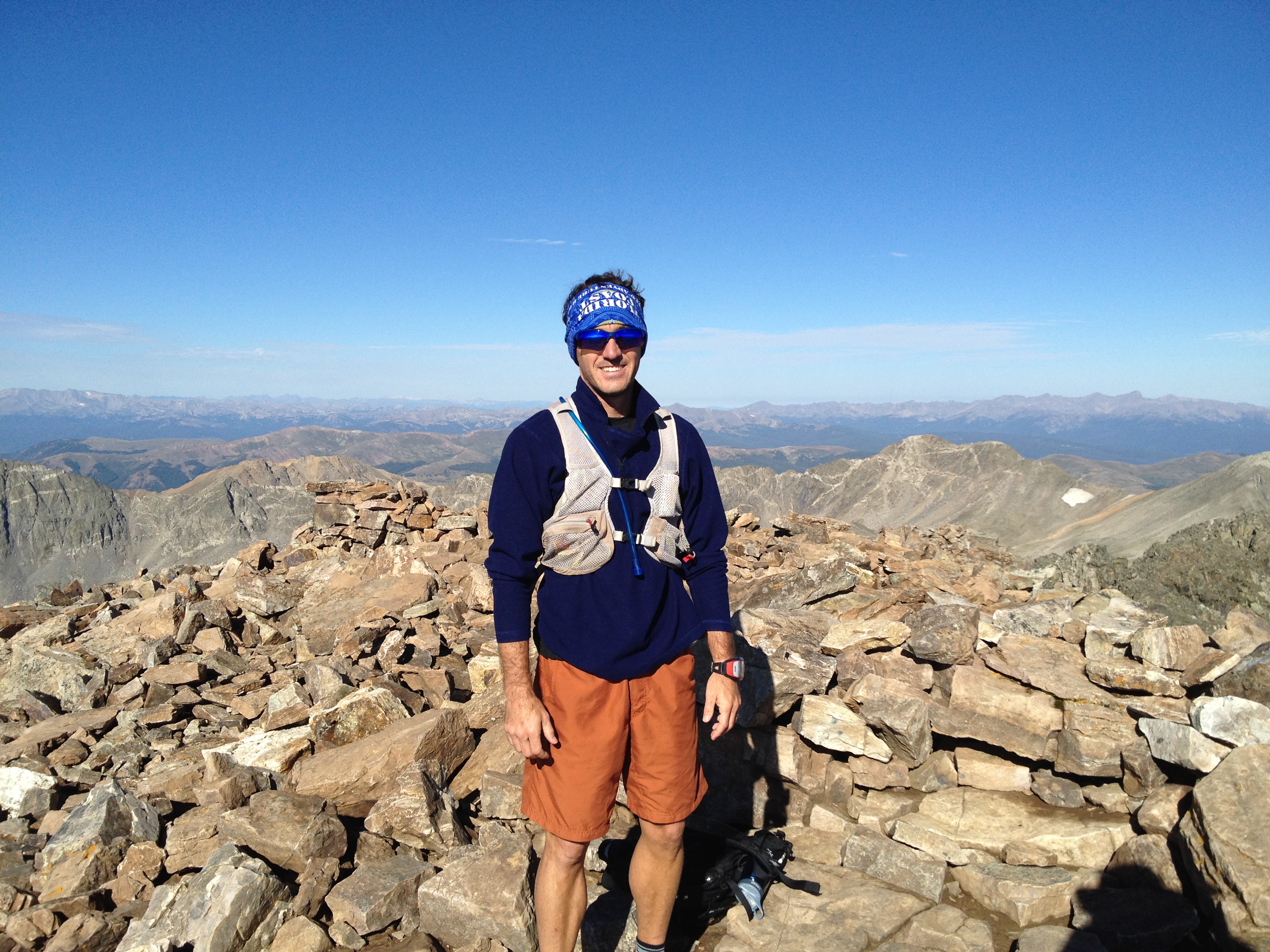
Art Loeb: Run Gone Bad

David H. and I have been talking about this run for a while, and we were finally able to find a weekend when it worked for both of us.  The Art Loeb Trail is billed as “one of the longer and more difficult trails in the state, and it’s also one of the more popular.”  Thirty one miles of tough single track sounded like a nice little run…  🙂

On Friday I drove the four hours from home to meet David in Brevard at his brother’s house.  We had to have two cars as it is a point to point run, and we had no other way to shuttle from the start to finish.  We got a quick bite to eat at a local Mexican place, went through gear and food one last time, and hit the sack.  The alarms were set for 6:00, and at 6:15 when I didn’t hear anything from David’s room, I went to wake him.  A quick coffee and we were on the road.  We dropped my car at the trail head in Pisgah near Brevard, and drove 276 up and over the mountains to the trail head at the Daniel Boone Boy Scout Camp.

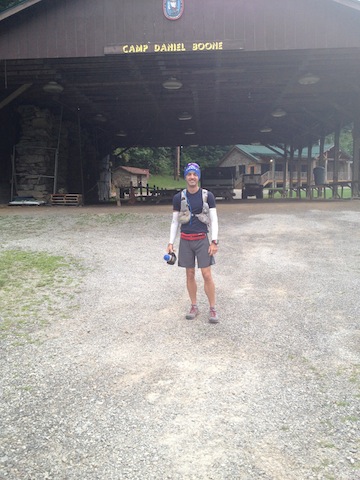
Here we are at the start:
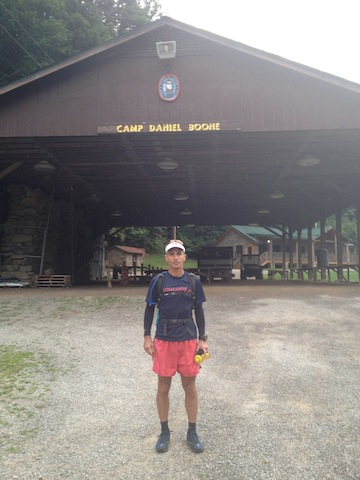
  

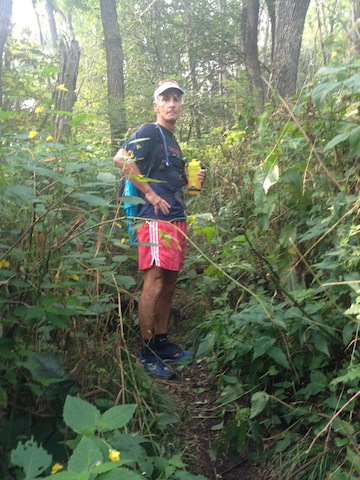
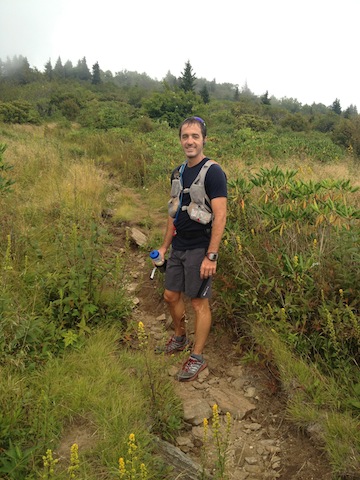
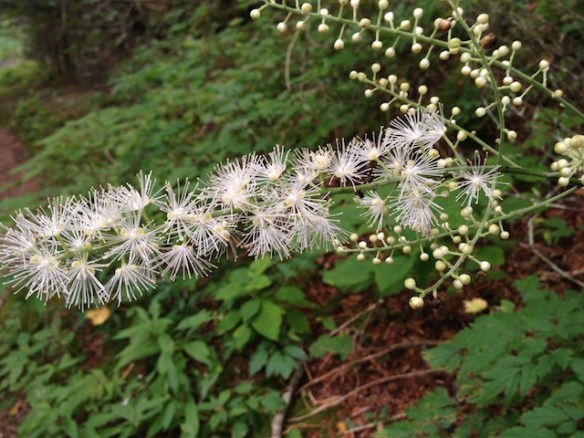
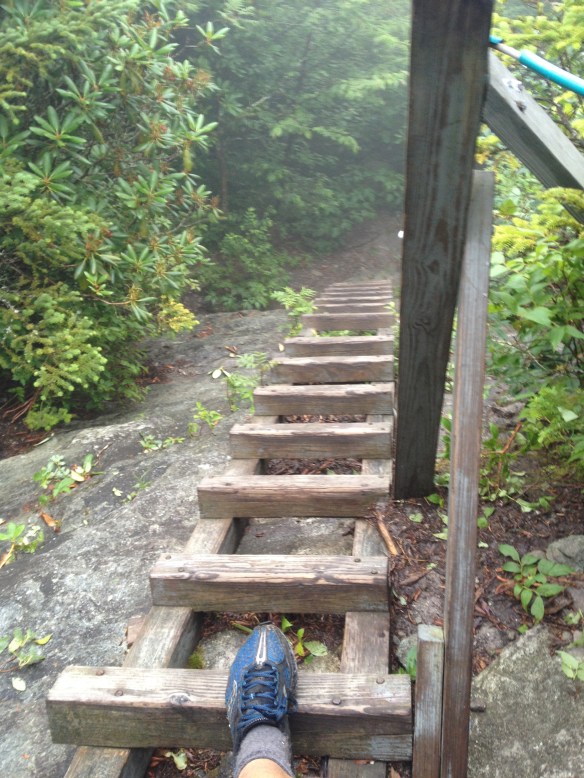
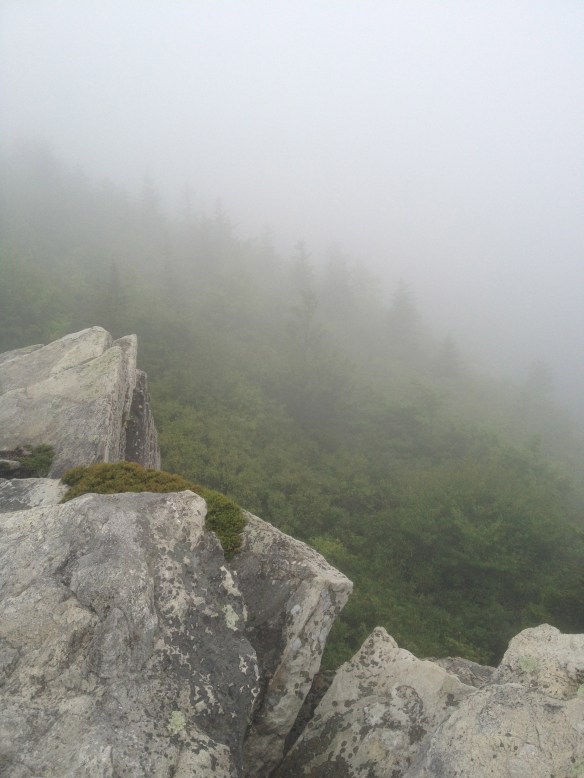
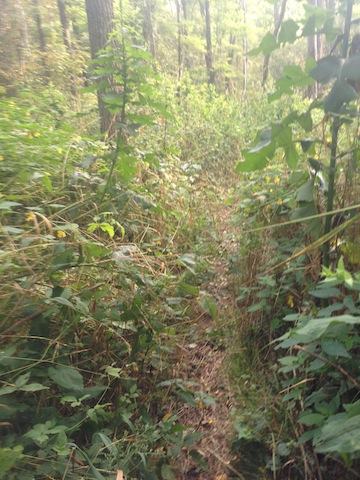
The trail head and some random shots.  As you can see, much of the trail was very overgrown!  It was also not very well marked in some places.
Somewhere around mile 5 or 6, David had a sharp pain on his foot.  Turns out he had a blister that he didn’t even know about pop suddenly:

While he stopped to tape it, I thought I’d head on at a leisurely place until he caught me.  After about 30 minutes, I got worried, and headed back.  I ran a full mile back before I finally found him.  He had gotten off the trail at some point and had to bushwhack back up to the ridge!  This was the 1st sign of the “run gone bad.”  Now I had an additional 2 miles on top of the planned 31!

This next section was through Shinning Rock Wilderness:

This area was incredibly crowded, with tons of people picking blue berries, a few day hikers, and a few backpackers.  Turns out we were close to the Blue Ridge Parkway and there was a paved road and a parking area close by.  There was also a pretty rough forrest road, and we saw a couple cars make it over a pretty sketchy area.  The trail was not well marked here and we actually got off the main trail and found ourselves on the rough road at one point:

We eventually found ourselves in the parking area and had to run the paved road to get back on the Art Loeb and Mountains to Sea Trail, which at this point ran together.

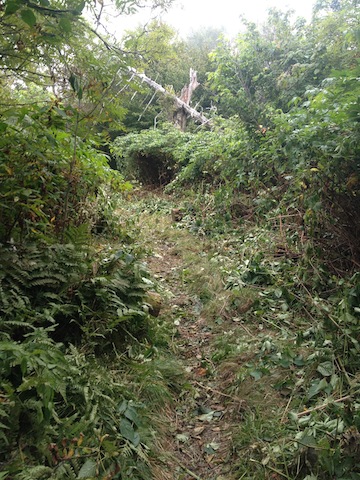
More rough trail:
It was somewhere just past this that we went wrong…  David was a little ahead of me and stopped to wait at a trail junction.  There were signs for the Art Loeb and the Mountains to the Sea trail, but they were not clear at all.  We choose poorly, but did not figure it out for quite some time.  😦   The Mountains to the Sea is relatively new, and uses white circles as the blazes, while the Art Loeb uses white rectangles.  We did not know that at the time, or we would have realized our mistake much sooner!  Or if we had only had a map… The map we expected to be at David’s brother’s house were missing, and we did not have time to pick up another.  😦

As we were running along the wrong trail, we were talking about how the elevation profile did not match what we expected.  I’d never been on the trail and David had only been on it a year or more ago on a backpacking trip.  He expected a deep descent, a cross of the Blue Ridge, and then a quick climb up Pilot Mountain.  Instead we had a long gradual climb, which neither of us remembered.   (I had only looked at an elevation profile online…) We did eventually cross a road that we assumed was the Blue Ridge, but it was not labeled.

Somewhere along here David rolled his ankle pretty good.  :-/

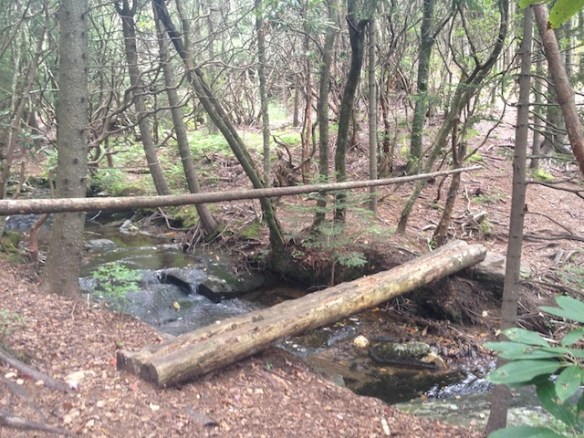
We reached a stream crossing where we decided to fill up on water:
As I was standing there with fresh water in my hydration bladder, I felt an incredibly sharp “pinching” on my right achilles…  Turns out a few bees were stinging me…  I’d feel one of the stings rub the back of my shoe just about every step for the remainder of the run.  😦  20+ more miles…

Here are a few shots from this area:

Somewhere along this point I was questioning David’s memory of the trail, and he was questioning my questions… He thought for sure we were still on the right trail, but I was beginning to have my doubts.  Then we saw a road that he did not expect to see, and he finally agreed with me!   At that point I pulled out my phone, checked the GPS, and we figured out we were pretty far from where we were supposed to be.

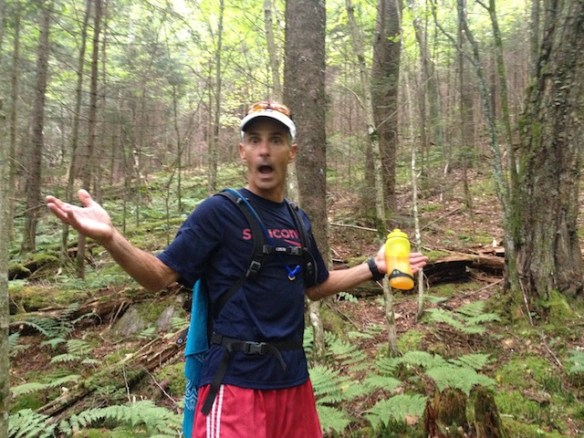
David saying “I have no idea where we are!”
At this point, we were so far off, we decided to bushwhack up to the road, knowing from the GPS it was the Blue Ridge.  Here’s the short 500 foot bushwhack.  Not too rough, all things considered.  I’ve had some considerably worse bushwhacks from back in my Adventure Racing and Orienteering days!

Once we got to the Blue Ridge we had to orient ourselves to figure out exactly where we were and where we had gone off track, and make a decision on how to proceed.  It looked like we could run the Blue Ridge about 3 miles east, and hit highway 215.   That looked to be a 10 – 12 mile downhill run back to our starting place and David’s car.  The alternative was to run the Blue Ridge 5 or 6 miles back to the Art Loeb, at which point we’d have a good 15-18 miles of single track left.  We really didn’t have the food or the lights to make it that far, so we opted to head back to the start.

At first I opened up some sub 9 minute miles on the newly paved 215, but my left knee started bugging me, and I was really worried about it being ITB, so I backed way off and walked a lot.

Oh, I forgot to mention, it started pouring on us.

This was a bit of a death march for me… Turns out it was about 16 miles of pavement.  Once I reached the flatter bottom, my L knee did not hurt so bad — but everything else did!  David ran ahead the whole way and his quads are now paying for it, while I feel pretty good.  🙂

There was a pretty nice waterfall along the way:

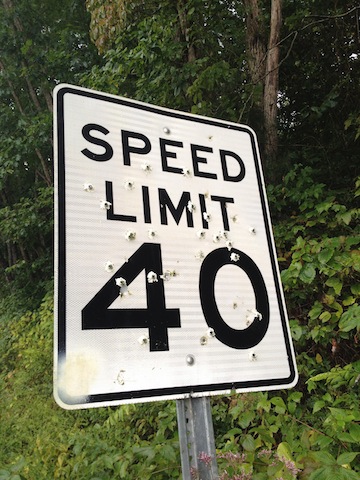
At some point on this road, I heard a gun shot.  And then another, and another, and then some semi-automatics opened up.  I was a little concerned that I might be running through a red-neck party gone bad, and they might not take to a lone runner that well.  I was picking up the pace to a sub 8:00 to get the heck out of there, when I saw this sign, and felt somewhat relieved:
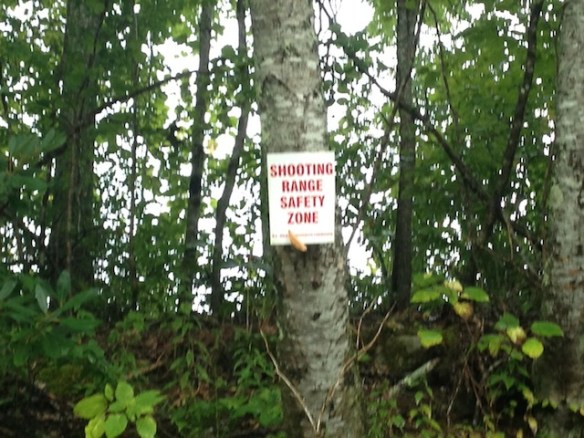
Yet a minute later I saw this and realized that a shooting range may not be so safe afterall:
I struggled on a few miles until the sign for the Daniel Boone Boyscout Camp, and made it up that road about 2.5 miles just a half mile short of the car, when David finally came around to pick me up.  I wondered what had taken him so long!

Here’s a map of the run… Right where we turn west along the Blue Ridge, we were supposed to head steeply down and cross the road to continue on the Art Loeb…  Instead we headed a few miles west on the Mountains to the Sea, picked up the Blue Ridge, and then headed down 215…

And here’s the elevation…  That first 7 miles is quite the climb!  It was pretty hard to maintain anything better than a 20:00/mile pace there…

We were pretty exhausted, of course.  42 miles is a long long ways to go on foot.  🙂   We headed back over the mountain to pick up my car, and then went straight to dinner before showering as it was getting late and places to eat shut down in Brevard pretty early!

Quick Gear Review:

  • Merrell Mix Master 2:  more ground feel, yet more protection than the Peregrine’s I’ve been doing most of my long trail runs in recently…  More flexible, so my feet have to work more.  The shoes were fine on the trails, but on the roads the left ITB started bugging me… Not sure if that was the shoes or not.
  • Ultimate Direction Wasp:  I used a camel back bladder instead of the one that came with the Wasp, and the tube somehow rubbed my lower back pretty raw.  I did eventually turn it around, but too late!  The Wasp is a tiny bit too big for me, so it does bounce around, but it is the smallest they made at the time I got it…  I also used a handheld 20 oz bottle…
  • Under Armour 7″ compression shorts prevent chaffing!  But the 200 body fit Icebreaker shirt really rubbed me raw in the arm pits.  😦 Seams are too big and I need to find a better shirt for the long stuff, I guess.  I also like the Teko socks I’ve been using…

Quick Food Review:

  • I’m still mostly following a “train low, race high” strategy, in terms of carbs, and while this was not a race, I was treating it as one in terms of nutrition.  While I don’t go out of my way to eat low carb most of the time, when you cut out refined foods, a lot of the carbs disappear.  I’ll still eat a bit of white rice, sweet potatoes, and fruits in every day life, so I’m not that low carb.  I’ve not measured it recently so I can’t give a specific number, but probably 20-30% carbs at most.
  • I’ve also done some fasted runs to work on the fat burning…
  • Just before we started running I had two hard boiled eggs and pemmican.  Then an hour in our so I had another pemmican, and finally started sipping on some perpetuem maybe two hours in…
  • After that it was a mix of:  jerky, one honey gel, one hammer gel, a few LARA bars, a few chocolate covered espresso beans…  And I think that is it.  So definitely some carbs there…
  • I had packed nearly 3000 calories, but probably ate more like 1500 – 2000 (at most).  In the past I would shoot for 200-250 calories per hour, but this was more like 100-150 over the 11 hours.  So maybe the fat burning was working.  I never had any real stomach issues so the food choice worked pretty well.  (For the honey gel, I did eat it over 10 minutes and diluted with water, instead of all at once, as that has bothered me in the recent past.)

All in all a good run, but I do hope to go back and run the trail proper in the not too distance future…
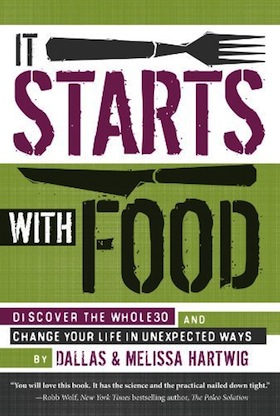
 

It Starts With Food. Dallas and Melissa Hartwig.

I’d have to say this has replaced “The Perfect Health Diet” as the first book I’d recommend to someone interested in the ancestral health movement (aka paleo diet), though PHD would be second.  🙂  I just received “Practical Paleo” in the mail but at 420+ pages of condensed info, that is going to take a while to work through!  It is getting great reviews, though, and I do like the Balanced Bites Podcast a lot…

I won’t review It Starts with Food as others have done a much better job than I could (Wolf, That Paleo Guy, Kresser, etc.)

But I will include their elevator pitch here, as just that is worth reading…

I eat real food – fresh, natural food like meat, vegetables and fruit.  I choose foods that are nutrient-dense, with lots of naturally occurring vitamins and minerals, over foods that have more calories but less nutrition.  And food quality is important – I’m careful about where my meat, seafood and eggs come from, and buy organic local produce as often as possible.

This is not a “diet” – I eat as much as I need to maintain strength, energy, activity levels and a healthy body weight.  I aim for well-balanced nutrition, so I eat both animals and a significant amount of plants.  I’m not lacking carbohydrates – I just get them from vegetables and fruits instead of bread, cereal or pasta.  And my meals are probably higher in fat than you’d imagine, but fat is a healthy source of energy when it comes from high-quality foods like avocado, coconut and grass-fed beef.

Eating like this is ideal for maintaining a healthy metabolism and reducing inflammation within the body.  It’s good for body composition, energy levels, sleep quality, mental attitude and quality of life.  It helps eliminate sugar cravings and reestablishes a healthy relationship with food.  It also works to minimize your risk for a whole host of lifestyle diseases and conditions, like diabetes, heart attack, stroke and autoimmune.

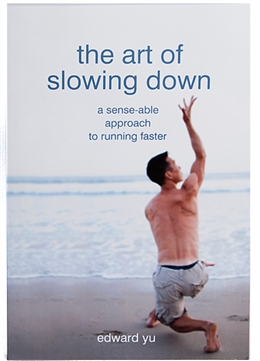
The Art of Slowing Down. EdwardYu.

The most important running book you’ve (probably) never heard of.

Granted, I’ve not done all the exercises yet, but I’m working my way through the book a second time and will start some of them.  I do think I have a bit of a head start from the years of yoga I used to do (and miss now), that gave me a pretty good body awareness… But these exercises look like a different methodology and I would like to read more about Fendelkrais…

Grays and Torreys

After two 14er’s in two days, why not try to knock out two more on my last day in CO?  Ben and I met at about 6:00 a.m. at the bottom of the approach road to the parking lot to Grays and Torreys, and I jumped in his car for the trip up the fairly unmaintained road… Well, on the way down there was a road scrapper working on it, which was a good thing as the ascent and a pretty sketchy section were many people opted not to park.  In the FJ Cruiser, it wasn’t too bad.  When we did make it to the parking lot, there were several other cars there so we weren’t the only ones that took the gamble.  🙂

Ben had recently run this route — twice in one day — and done the 1st loop in 2:38.  I was thinking anything under four and I could still have time for lunch, a shower, and time to get to the airport!  I was feeling pretty tired from the prior three days — nearly 10,000 feet of vertical, much of it above 10,000′ feet!  So I knew I’d be slow, but 2:38 would not be possible for me unless I had a lot of time to acclimate!

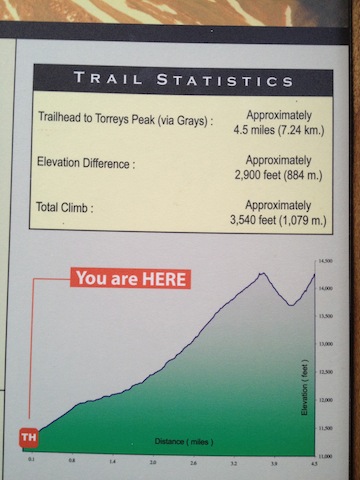
Here’s the elevation profile for what we were about to start:

The bridge at the parking lot that leads you to the trail…

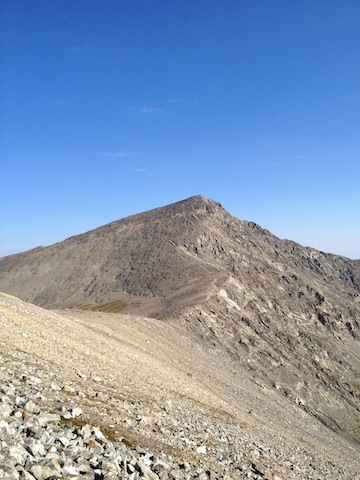
First shot of Greys with the sun just coming up…  The approach trail is relatively easy, and we ran a little of it, but as I said above I was pretty tired already so I needed to save some energy!

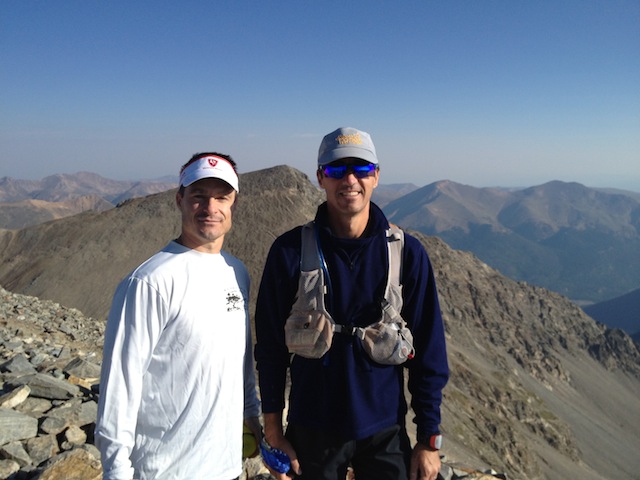
Me atop Greys:

Ben and I…

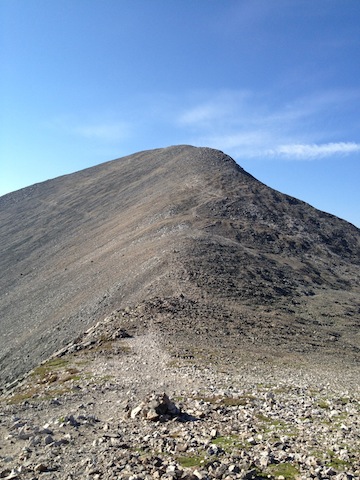
This is the trail up Torreys… It was steeper in real life!

Atop Torreys… Four 14ers in 3 days!  (Yeah the record for all 54 is 10 days, so 4 in 3 is not that great.  😉 )

We hiked down the trail to the parking lot, started driving down, and asked a couple if they wanted a ride.  They had a two mile walk as they had stopped below the washout — which had now been fixed by the road scraper!  After that we headed to Idaho Springs for pizza and beer at Beau Jo’s…  An old friend was in the area so she and her family came by to chat for a bit, before I had to rush off to shower, change, drive to the airport, etc…

Mt. Sherman – 14,036

After work was done for the day, I had a few hours to kill so thought I’d tackle another 14er — the 2nd in two days.  Mt. Sherman was less than an hours drive away, so off I went…

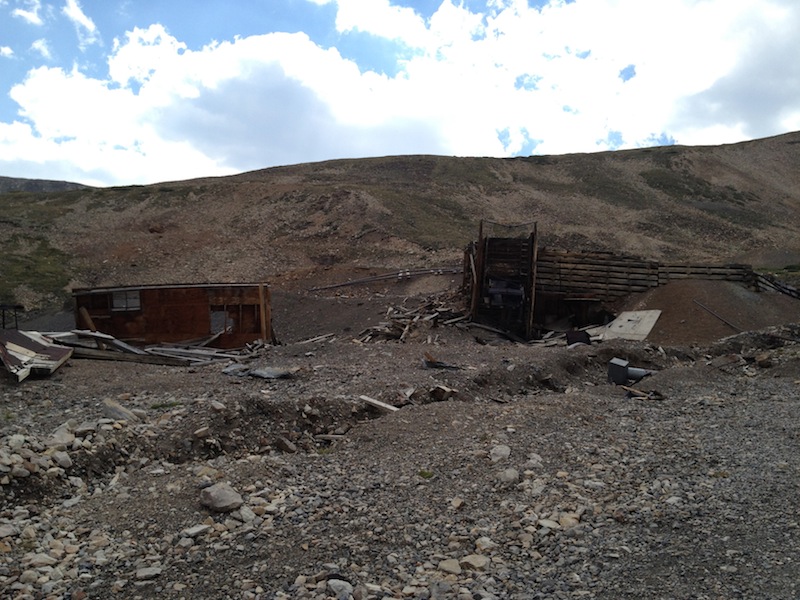
After driving about 10 miles on a long dirt road, you start to go up an old mining hill.  I parked about 11,500, well below the gate at 12,000, but it seemed like a good chance to get a nice downhill road run in for training for the Ridge To Bridge marathon in October.  I quickly started climbing the hill and the reached the gate, and then continued up eventually coming upon several abandoned mining buildings.

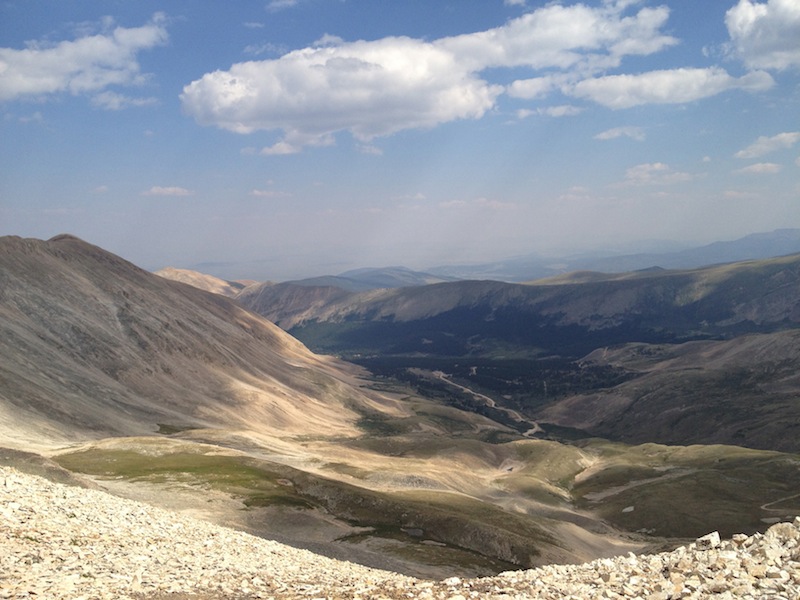
This is looking back down the valley and the road I had just climbed..

The valley from just a little higher:

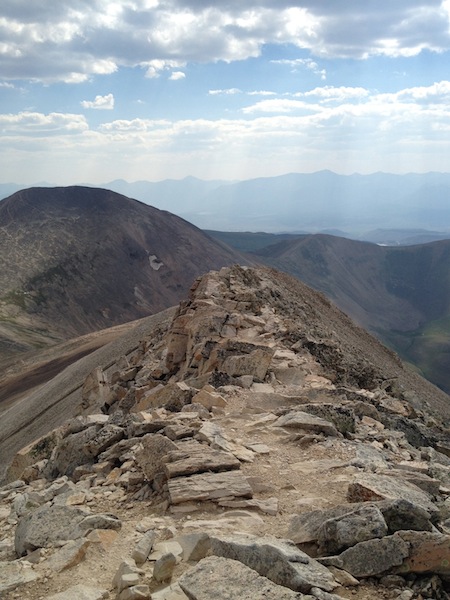
The last little ridge line is a bit sketchy…  This was at 13,800′, and I really started thinking that 13,800 was good enough…  This was about 4′ of solid ground in the middle, but both sides of that were scree — and 500′ drops (or more?) to your death.  The picture really doesn’t do it justice to how precarious it looked!  I’m not normally affected by heights, but this one was giving me a slight sense of vertigo..

Another shot a bit further up.  I basically looked down at my feet and started moving.  I was ready to turn back, but eventually made it up without any difficulty.

This is looking back down… I really need a person in there so you can get a sense of how narrow that ridge is!


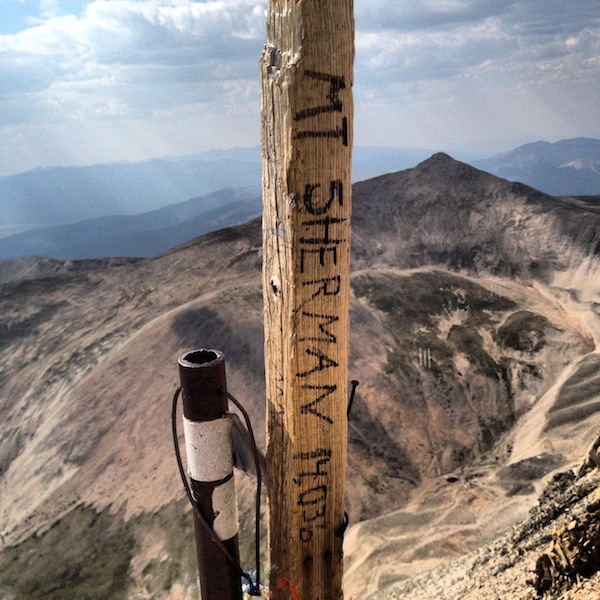
The summit!

Me… There was no one up there to take a picture, so it’s just me… This was the quietest 14’er I’ve ever done.  I only saw two groups of three all day…


Eight down, 46 more to go!


Mt. Quandary – 14,265′

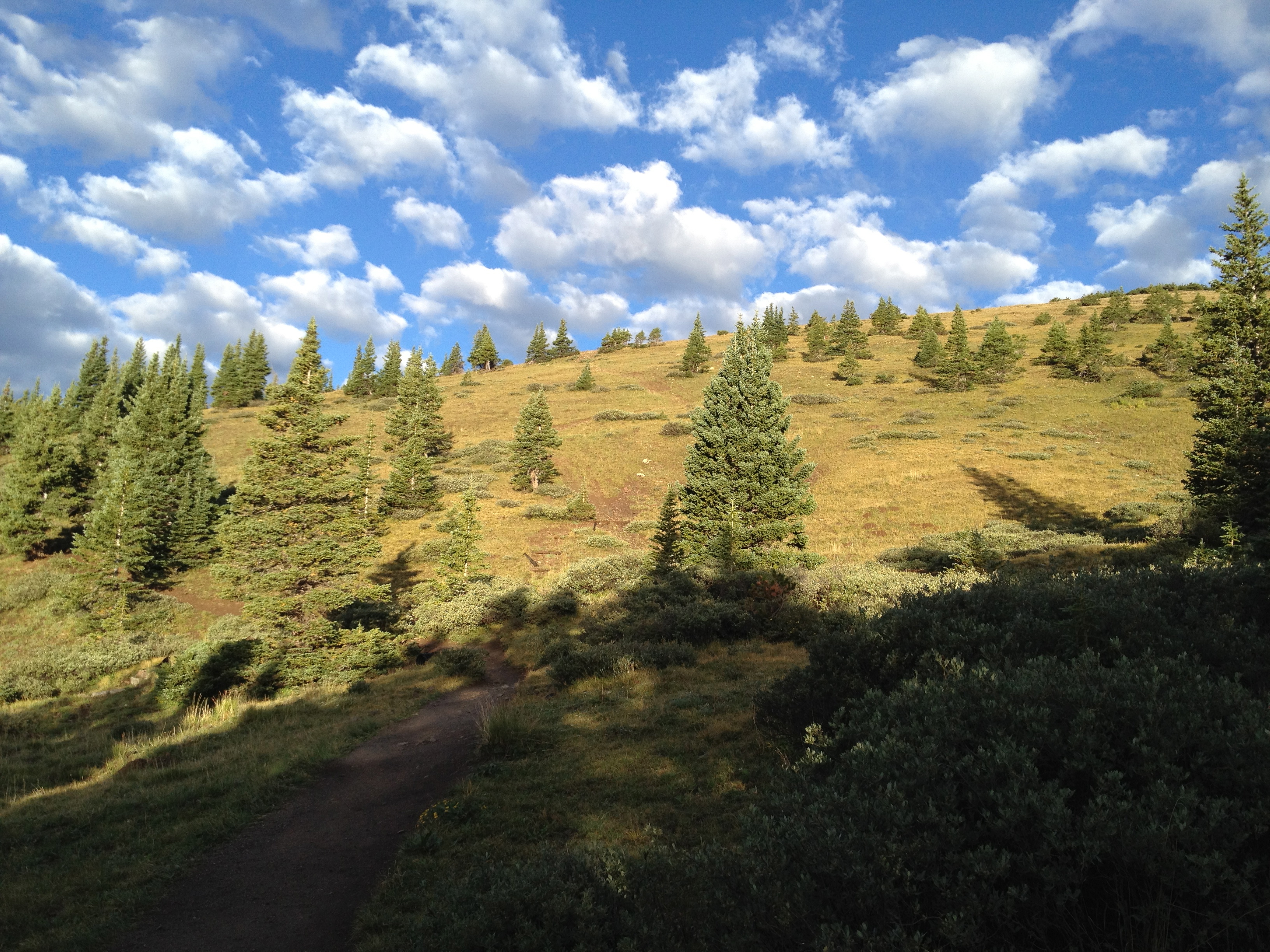
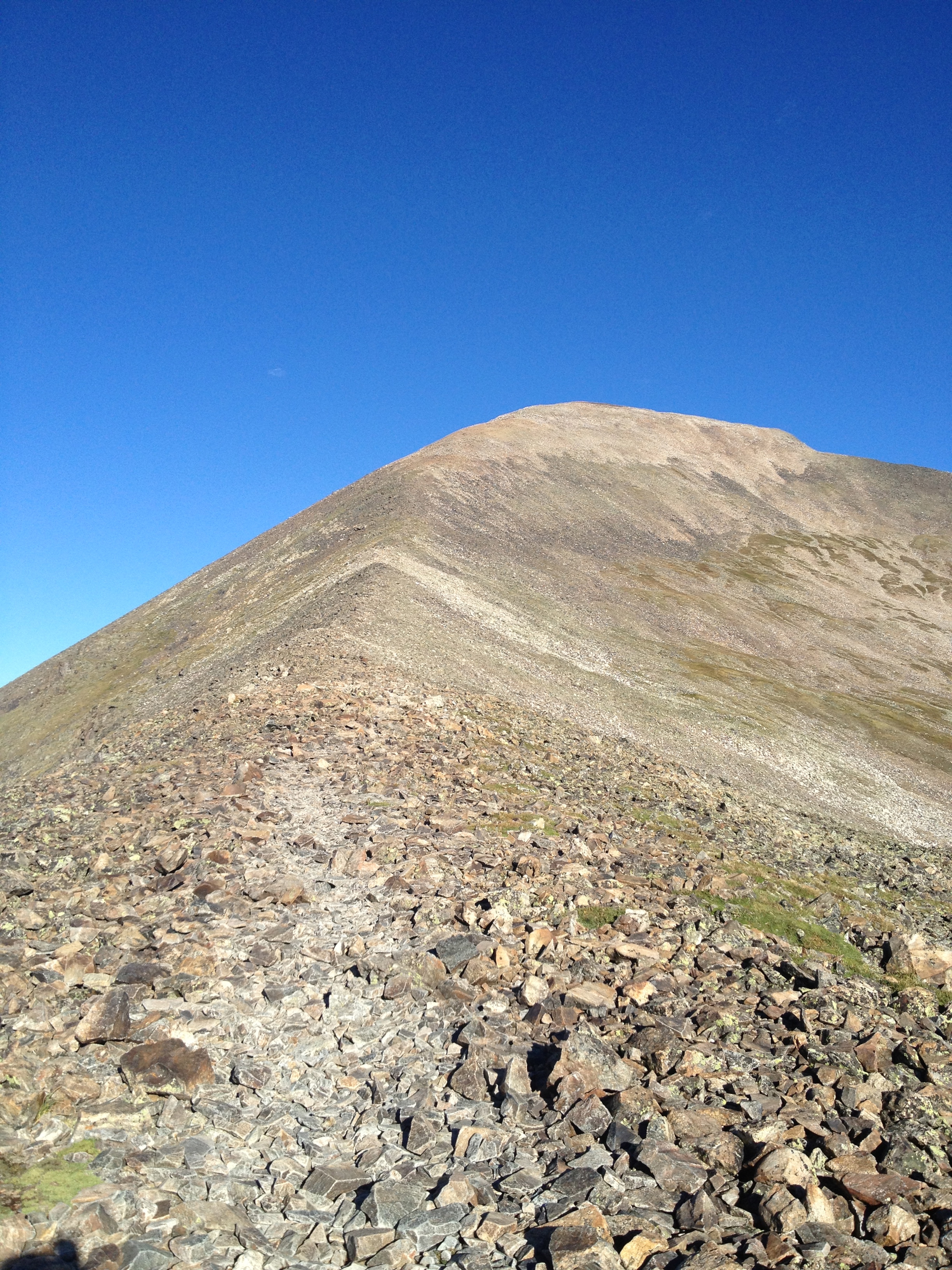
I was in Keystone CO for work and had the opportunity to hike Mt. Quandary a short drive away.  I could not sleep so I was out the door a little before 6:00 a.m. and hiking by 6:30.  While I took the photo below on the way out, this was the 1st glimpse I had of the peak a few miles from the trail head.  I’d be hiking up that ridge line in just a bit!

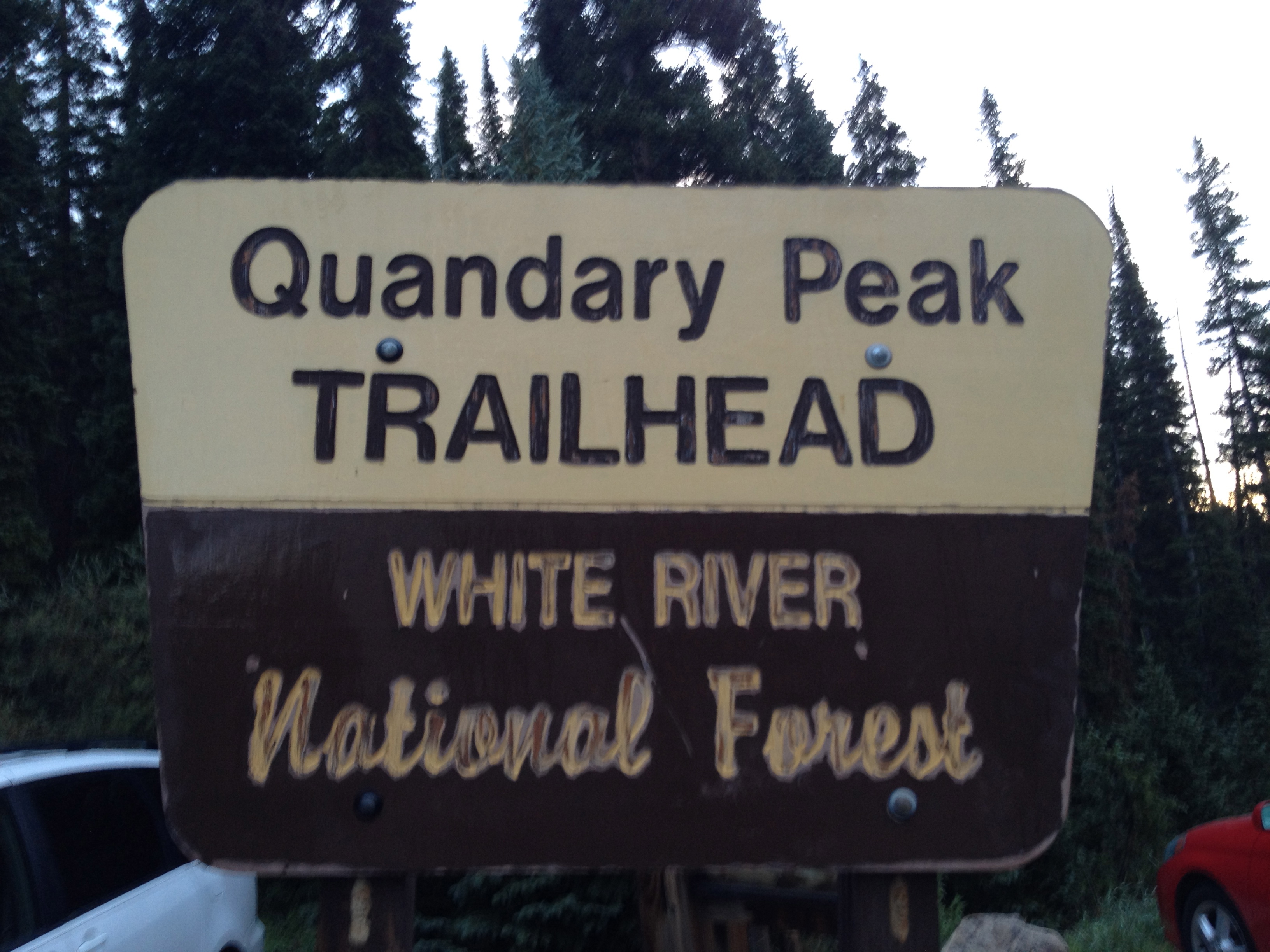
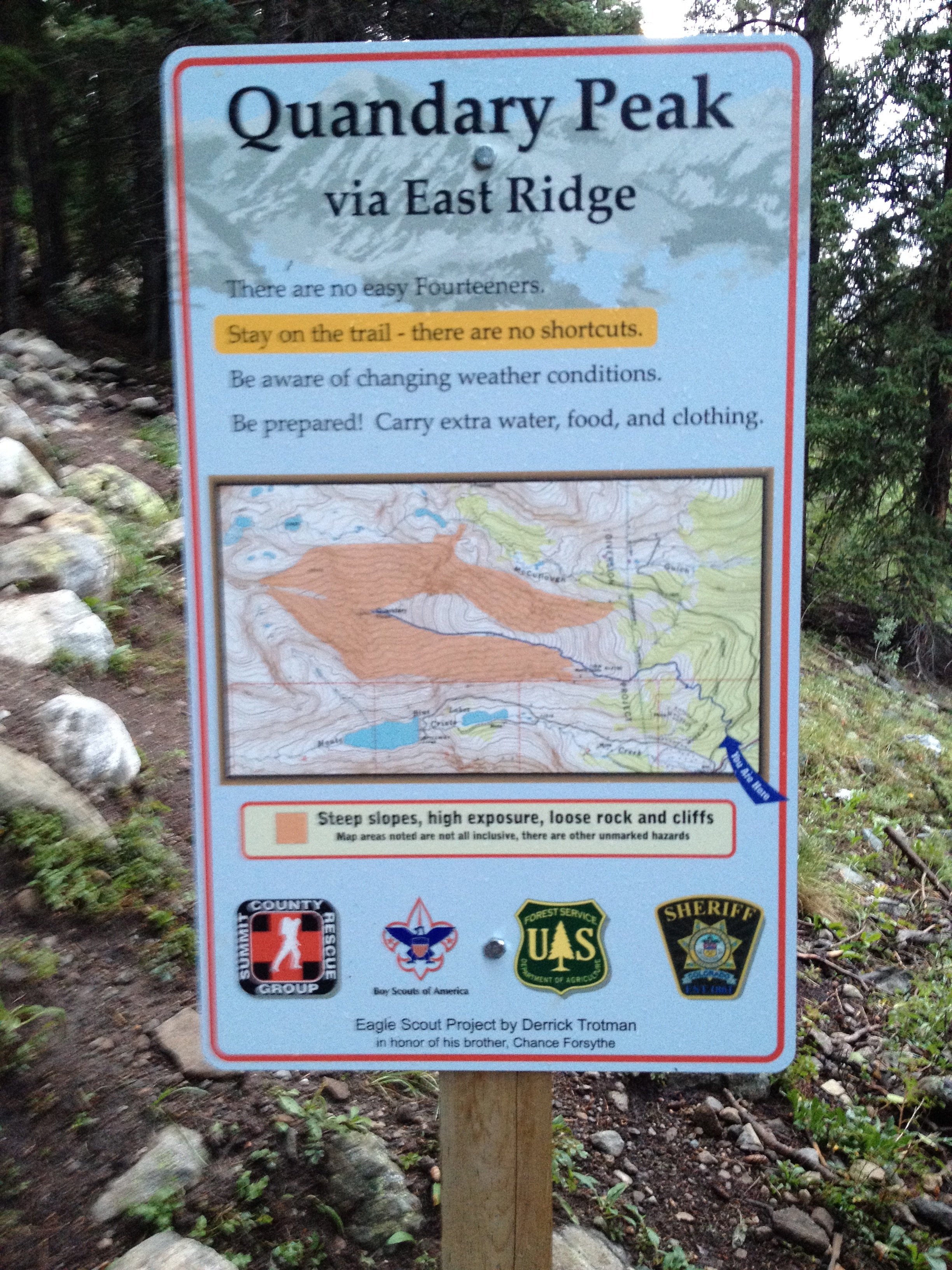
Here’s the trail head sign… There were already 8 to 10 cars there — but there would be many many more when I left a few hours later…  And a sign with the most obvious statement of all — “There are no easy 14ers!”


There’s not much to report so I’ll just put in some random images below.  It took me about 2 hours 25 minutes to hike up, including the time to take photos along the way, chat with other hikers, etc.  It was a beautiful day and, as always, big mountains don’t disappoint with the views!  I’m always humbled by how slowly I move once over 13,000′!  It’s like slow motion up there…


Garmin Data here…

Grandfather Profile Up and Over and Back Again

Here is what I wrote on DailyMile, but I wanted to include some photos here…
Route was: Grandfather Profile -> Calloway, then Daniel Boone Scout down on the back side to just about the Boone Fork parking area on the Blue Ridge. Nuwati to Cragway and up around the Boone Bowl, back to Daniel Boone, back up to Calloway, and down the profile.

I had the mountain all to myself — because it was mid 50’s and POURING for much of the the run. :-/ Really wish I had more phone protection, though the iFit neoprene did somehow keep it safe enough. Maybe a poncho or a jacket would have been nice, though I only got cold the one time I stopped under a rock ledge because the rain was so intense.

Garmin distance was more like 11-ish but the trail markers show 13+. I did leave the Garmin off accidentally on one 10 or 15 minute section — when I had stopped under a rock ledge when it was raining really hard to try to protect the phone. I’m going with a “heavy half” of 14-ish. 🙂

Garmin does show 4000+ of climbing which would be about right.

http://connect.garmin.com/activity/198207096

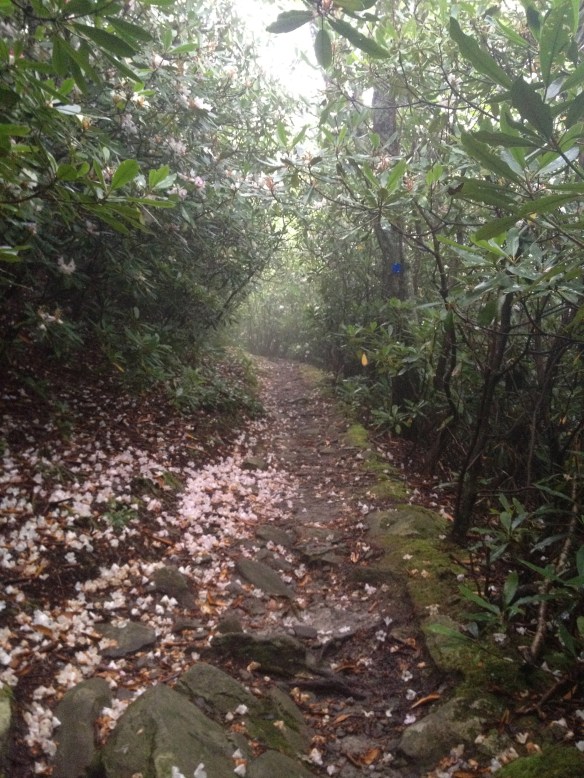
Not many views with the clouds, other than the gorgeous trail:

Calloway Peak:

The first long down ladder on the back side…  You can never tell the steepness by photos:

Looking up:

Tame part of the trail down on the backside of Grandfather… The Nuwati…

Looking into the Boone Bowl:


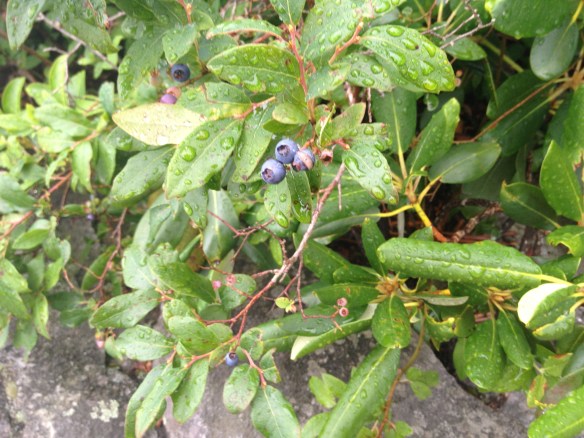
Mid run snack…  A little early in the season, I suppose — only a couple of handfuls!


Nearing the top of Cragway:

More trail shots nearing the top of Cragway approaching Daniel Boone Scout:


After that it started POURING!  Really Really Pouring…  I had to wrap the phone up as best I could, double wrapping it in a neoprene iFit.  It still works, so that is good.  But I got no other pictures the next couple of hours!


PHEAR

I realized this May 2005 race report was not on the old 2sparrows site nor the blog, but on triangle-ar-team.com, so I’m just grabbing it and putting it here…  Wish there were some photos — it was a beautiful place!


It’s going to be a bit difficult to write a race report for this race, but I’ll give it my best shot. Only two teams out of over 20 finished ranked, due to various difficulties along the way, so that gives you some sense of what I mean.

Brian, Charlie, and I met in Cary to load gear and then pick up Brian’s dad Ken, who would support us solo. It was a tight fit — getting all the gear plus 4 people into the Durango , but we made it. Bruce had left the night before and luckily Brian had given him some camping gear, or we would not have fit! That year spent working at UPS loading trucks certainly paid off.

We met Bruce at the Seneca Rocks campground and checked in. We got the maps and passport around 6 p.m. and ran over to the local restaurant for a quick bite to eat while we looked over the many maps. There was one large map which covered most of the national forest, and then some smaller maps with more detail for certain sections. All of the CP’s had been pre-marked, so there really was no plotting for us to do.

We ran back to the camp site for the pre-race meeting at 7 p.m. Folks from Nelson rocks came in and covered the Via Ferrata (cool rock climb with permanent cables and rungs) was covered, and then the owner of the boat outfitter came up to cover the white water paddle section. The guy made it sound like we better walk ½ the paddle or we’d be in a lot of trouble! Eventually Brad Hunt, the director, came back, and we went over the rest of the course.

After the meeting, we went back to our tent site and assembled the necessary gear and went over strategy for various sections. Since there were many CP’s and TA’s, where we had unlimited access to our support, we didn’t really need to carry much between each section. We finally knocked off around 11 p.m. I did not have a sleeping bag, and spent much of the night tossing and turning from being cold, even though I had two fleeces on and tried to cover myself with a towel!

We awoke at 5 a.m. , broke down camp, made final preparations, and made our way to the 6 a.m. start, a short 10 minute walk away. There were some folks who had not filled out all the release forms completely, so we had to wait for that to be done, and we eventually started about 15 minutes late.

Start – Big Bend

The first leg was a 9 – 10 mile trek that went up through Roy Gap and down the other side. The beginning of the ascent was a road, but that eventually disappeared and we were left scrambling up some steep terrain. I was a bit slower than the rest of the team, and as I struggled I was wondering what I had gotten myself into! After being sick much of the spring and not training a whole lot, I was worried. But once we got to the top I was ok and we began to run down a trail and eventually a long gravel road. At one point, we decided to bushwhack instead of taking the long switch back, but it was quite thick and in the end, it didn’t buy us any time. Teams right behind us when we went in to the woods were still right behind us when we came out, and they took the roads! At the bottom, we ran into the river, and just ran/walked that road the 4 miles to Big Bend . We arrived shortly after 9 a.m.

White Water ( Big Bend to Eagle’s Nest Outfitters)

We had a quick transition, grabbed our boats, PFD’s, and paddles, and headed out. Charlie and I were in one boat and Bruce and Brian in the other. I was nervous as I don’t have much white water experience, but I quickly began to enjoy it as I found a rhythm. We had a hand drawn detailed map of the river that was designed to alert us to all the danger points, and as hand drawn maps go, we quickly found that the scale was sometimes quite deceptive.

We came around a turn to the 1st “walk point” at a waterfall, but the fall was so small we thought it was just another rapid. Charlie and I made it through with no problems, but Bruce and Brian took on some water on the 1 st drop, more on the 2 nd , and slowly sunk. Charlie and I paddled to the shore and threw a throw line out, and pulled them in. They quickly emptied the boat and we were on our way in just a couple of minutes.

The next section that was supposed to be tough was the dam. As we neared it, the current really picked up, and it was on a blind turn, so we pulled over. I hopped out to scout the dam, which was a couple of hundred yards ahead. By the time I got back to tell the guys it looked runable, they already had the boats out, so we just carried them past the dam and put back in.

The rest of the river wasn’t really memorable, other than the fact that the section labeled “Crash and Burn” was not obvious as we went through it – it was that easy and uneventful. At the end, we pulled out and carried the canoes through a large drainage pipe and to the outfitters. We arrived around 12:30 p.m. We had a fairly quick TA as we changed from boat to bikes and again headed out.


ENO – Kline’s Gap – Bear Rocks

We had several miles of paved, rolling roads, until we reached the next CP (CP3). Here, we were given the choice of taking roads to TA4 or taking the gap. We chose the gap as it was 1.5 Km or so, compared to several miles roads. The 1 st part of this was ridable down a gravel road, but we eventually reached a point where we could not ride. We had to make a river crossing, and on the other side the stinging nettle was out in force! All of us got hit pretty good, but I did not have the same allergic reaction I’ve had in the past.

After some rough bushwhacking, we made it to an unimproved road, which led us to a paved road. A couple miles on that, including a long climb (that I struggled on), and we reached the turn for Dolly Sods. The sign said 5 miles, and we immediately began a steep ascent. I quickly dropped off the pace, and eventually Charlie towed me for a while. Then Bruce fell off the pace, so Charlie towed him and I made it the rest of the way up. What a long, tough climb! I think it would rival L’Alp Duez – one of the most famous climbs in the Tour de France! We checked in and were the 6 th team, but one in front was unofficial, so we were currently in 5 th overall.

Bear Rocks – Timberline

At the top, we transitioned from bikes to foot for an 8 – 10 mile trek. Dolly Sods is quite interesting. It has similar characteristics as parts of Canada , even though it’s just less than 4000 ft. It did feel very “Alpine” to me. Another interesting thing is that there are unexploded World War II ordinances all over, so there are lots of warnings to not leave the trail. Finally, most of the hike was a bog! It was quite beautiful, though, and we enjoyed this section (other than the wet feet!).

We eventually neared the end, and I figured we were supposed to come down one of the ski slopes at Timberline since we were given a ski brochure that showed the runs. However, the trail kind of petered out, so we just began to bushwhack down on the ridge before the slopes. We came out in a neighborhood, and took the road down (other than one bushwhack where we cut out a switchback). We checked in, still in 5 th overall, and began to get ready for a long bike section. We had some Pizza that Ken had ordered, as well as ramen, etc. We loaded up on food and water and headed out at 8:15 p.m.

Timberline (TA5) – Gladwin (CP6) – Alpena(CP7)

We were told that CP6 was now unmanned, but that we still should go there and then continue on to CP7. It was all paved roads to CP6, though there were some small climbs and some fast descents. We did go slightly past CP6, but quickly turned back and found it.

From there, we were to take the Allegheny trail to CP7. The passport said to watch out for washouts and down trees – what an understatement! And this is where the race began to fall apart – not just for us, but for everyone.

A couple of miles in, a team was coming back saying the trail ended and they could not go on. We decided to press on, and eventually came to where the trail ended in a rushing river, next to a cliff face. After some scouting around and not finding anything, Charlie scrambled down into the water. Near the cliff, the current was not that strong, but further out, it was moving at a good clip. Charlie found the trail on the other side, so we handed bikes down to him one at a time, he moved them to the other side, and then each of us shimmied down the cliff and waded through.

On the far side, the trail continued again for about a mile before dead ending in the river. We scouted for a place to cross, but there was no way with the current like it was. After going back and forth for a while, we finally did find a blazed trail going up. And up, and up, and around. It was obvious this had not been maintained in some time, but we kept pushing – over and under trees, along steep slopes, with loose rocks, etc. At times we really thought we were going way out of the way, but at this point we were committed and it would have been crazy to turn back.

After a long time, the trail crossed the river, which was now a stream, at a safe location. But then we had more of the same on the other side – an un-maintained trail that was more of bushwhack than a hike, and riding was certainly out of the question for much of the way. Towards the end, we’d be able to ride 15 or 30 seconds at a time, and then have to scramble over a tree, etc. At one point, there was a down tree I thought I could ride under. But my pack caught me and I was literally stuck upright on my bike for a minute, until I could wiggle my way out!

We finally came to the end of the trail, to an improved road, and took that up to CP7. We arrived at 1:15 a.m. They were quite surprised to see us come from the direction we had, as no one else had come that way. Apparently, the top couple teams had gone in at CP6 but turned back, and told the race director it was not passable/too dangerous. So he shut down that section. But since we were already in it, that didn’t help us! At any rate, we had dropped from 5th to 12 th , which was somewhat demoralizing, since we had done the course as designed and no one else had.

Alpena – Wildell

The staff at CP7 assured us the ride would become much easier as we set out. Boy was that wrong! The Allegheny picked back up just past the CP, and it wasn’t too bad other than the mud for the first couple of miles. But it eventually got harder and harder to ride. At one point, we came up on 3 or 4 teams where the trail dead ended in the river. Brian and Bruce fell asleep, while I started to scout further up river, literally wading up and around a cliff. Meanwhile, Charlie had found the ridge line trail just before where all the racers were congregating/sleeping, and was trying to alert us without alerting everyone else. That didn’t work too well with Bruce and Brian asleep, and me wading up river, so another team did get the jump on us (but we passed them pretty quickly).

We eventually began hiking this trail, pushing the bikes up and up and on and on. From here, for about 5 or 6 miles, the trail was not very ridable. There were only a few sections where we could pedal a bit, before we’d have to stop to climb a tree, or get through some tough mud, etc. After a long time – about 1/3 of the way, we came to a paved road.

Here was another decision point that would affect the entire race. It was clear to us that the passport said to continue on the Allegheny. However, we found later that many teams elected to take the paved roads out, rather then continue pushing bikes along this hiking trail. But we kept pushing and pushing. For many hours! At one point, we did stop to take a 15 minute nap, and Charlie and I also had to refill our water with treated river water. I was also low on food, and had to bum some Fig Newtons off Bruce and Wheat Thins from Charlie.

We eventually came to a small town, and took some paved roads to the rail to trail road. We took that for about 4 miles to CP8, where we arrived at 12:15 p.m. – 11 hours after leaving CP7.

Wildell (CP8) – Camp Pocahontas (TA9)

It was now obvious that the race was somewhat in chaos. The 1 st place team had skipped the 2 nd 2/3rds of CP7-CP8, and many other teams had as well. We were told it took the top teams 4 hours to go from CP8 to TA9, but it was rails to trails and paved road most of the way. We didn’t have many options here since our crew was still at CP9 (where he had been waiting since 2 a.m. ), though some crews had come to CP8. Luckily for some of us, there was a team there that had stopped and was giving a way food. I grabbed some balance bars, cookies, crackers and cheese, Gatorade, etc. What a life-saver since I was out of food!

We made it from CP8 to TA9 in about 3 hours and 15 minutes. At this point, it was 3:30 p.m. , and we knew there was no way we could make it to CP10 by the 5:30 p.m. cut off. I was all for going on the 10 mile trek anyway, rather than stopping, but in the end, the guys convinced me there wasn’t really any point. What really changed my mind was the staff at CP9 really couldn’t help us. He hadn’t seen the race director in 8 hours, and had no idea if there’d even be anyone at CP10 when we’d arrive, or if there was a shorter course we could start, etc.

So we bagged it. We grabbed a couple of hotel rooms, showered, ate, and crashed. In the morning, we went to the Via Ferrata at Nelson rocks, and at least got to do that, which was quite fun.

Epilogue

Since then, this is what we’ve learned. Team Odyssey was given a 12 hour penalty for skipping much of CP7 – CP8, but they still got 1st . NADS was given a 6 hour penalty for using an alternate trail for much of CP7 – CP8, which was apparently much easier than what we did since they completed it in just 6 hours. They were 2nd . No other teams were ranked!

What we can proudly say is that we are the only team that completed the entire course as the passport specified to CP9. In the end, though, that was our undoing. A couple of other teams did the entire course except the section between CP6 and CP7 that was shut down, and I agree that was justified. While not overly dangerous, I’m not so sure having slower teams attempt the river/cliff crossing after dark would have been wise. I do think it added a couple of hours to our time, and we would have been much close to making the CP10 cut-off without that. All the teams that did the complete section between CP7 and CP8 missed the cut-off at CP10.

In addition, we left CP8 just before the RD started sending teams direct to CP10, which would have allowed us to continue on a shortened course. Since our crew was at CP9, and there was literally no communications between CPs, I’m not sure this would have helped us anyway.

It’s disappointing to us that the only teams that got ranked were only able to do so by skipping some of the toughest sections, and therefore they were able to make cut-offs that we could not. No matter how you look at it, the race became a bit of a ‘disaster’ in that sense, and nothing the RD could do would make everyone happy.

However, we still had a great time, and the area the race was held in was phenomenal. There is a ton of potential and with a few tweaks here and there, better communications, and some pre-selected alternate courses, this could be one of the best races on the east coast.

Eat & Run. Scott Jurek.

This was a book I had planned on NOT reading.  I had seen it mentioned in a few places, and saw Jurek promoting it on Twitter and on various blogs, but I just didn’t have much interest.  While I consider myself an ultrarunner, I’m in a much different place with diet than Scott.  Or so I thought…  (More on that below…)  But then I saw a couple of good comments on it here and there, grabbed the kindle sample, and was immediately hooked.  There’s something about reading race reports that I’ve always been drawn to, and while this was much more than just race reports, there was enough excitement in his recaps of Badwater, Western States, etc., that I was sold.

Regarding diet, I am certainly in a much different place…  Jurek has been a vegan for a long time, while I’m much more in the Paleo/Primal world these days, though I wouldn’t quite put myself fully in that camp.  I suppose if I had to identify myself, it would be similar to the diet outlined in Mark Sisson’s The Primal Blueprint (paleo +  some dairy w/ the 80% rule (eat this way 80% of the time)) and I also really like the Paul Jaminet’s The Perfect Health Diet.  But then again I mix in some SCD/GAPS/Weston A Price concepts as well, which Chris Kresser is high on.   But certainly not vegan!   However, as far as vegan diets go, I think Jurek has it right…  While he eats many things I probably would not be interested in, some of the foods I see as problematic he treats the way our ancestors did — soaking and sprouting grains and beans is just one example.

I seek out traditional whole foods rather than highly refined meat substitutes. I look for products that have been sprouted, soaked, or fermented to help break down the indigestible cellulose in plant cell walls. Among soy sources, I favor tempeh, miso, and sprouted tofu, which are all more digestible and have less phytoestrogen (a naturally occurring substance that some—in spite of medical evidence to the contrary—suspect might mimic estrogen’s effects in humans) than isolated soy protein. I eat sprouted-grain breads and tortillas, and at home I often soak my whole grains and beans before cooking.

My biggest challenge in plant-based eating isn’t taking in enough protein but taking in enough calories to replace those I burn on my training runs. I make a big effort to include enough calorie-dense foods in my diet—nuts and nut butters, seeds, avocados, starchy root vegetables, coconut milk, and oils such as olive oil, coconut oil, flaxseed oil, and sesame oil.

If he just added a little meat, I’d be on board.  🙂    A meat eating vegetarian is probably the best way to eat, and by that I mean just eliminate all the processed carbs and refined foods… Fruit, veggies, and well sourced meat seems to be what works best.  Jurek even mentions this in a few places, though he doesn’t quite go that far.  He talks about the problems with industrial farming of animals and how it was different for his grandparents…  But he never explicitly says he would eat that way now.  Overall he’s the least “in-your-face” vegan I’ve ever read…

But it was really the racing part of the book that I loved.   Jurek is an incredible runner, and had some amazing runs and amazing comebacks, when he seemed at the brink of disaster… Only to get up, get moving, and eventually win.  And sometimes win really big!  Amazing….

One thing that scares me is that UTMB defeated him twice, though he eventually finished — in 18th place.  I’d have to put UTMB at the top of the races I dream about running some day…  Maybe even above Leadville.

Some quotes… including some that I will use as mantra’s on some future run:

We might not have been as experienced as the other teams, and we definitely weren’t as well equipped, but we were focused. Coach had only three commandments: Be in shape. Work hard. Have fun. They were the perfect fundamentals for a bunch of poor redneck Minnesotans. His motto was, “Pain only hurts.”

According to bushido, the best mind for the battlefield—or the race—is that of emptiness, or an empty mind. This doesn’t mean sleepiness or inattention; the bushido concept of emptiness is more like that rush of surprise and expansiveness you get under an ice-cold waterfall. The empty mind is a dominant mind. It can draw other minds into its rhythm, the way a vacuum sucks up dirt or the way the person on the bottom of a seesaw controls the person on the top. When I hear a runner say he “runs his own race,” what I hear is bushido. Bushido is letting go of the past and the future and focusing on the moment. As Thoreau, an American practitioner (though he probably didn’t realize it) of bushido and a pretty good distance walker himself, wrote, “Our life is frittered away by detail. An honest man has hardly need to count more than his ten fingers . . . simplicity, simplicity, simplicity.” I created my own bushido exercises. I stood in icy rivers to strengthen my mind’s control over my body. I sat cross-legged and meditated, visualizing my breath, focusing.

And yet ultrarunners—even the fiercest competitors—grow to love each other because we all love the same exercise in self-sacrifice and pursuit of transcendence. Because that’s what we’re all chasing—that “zone” where we are performing at the peak of our abilities. That instant when we think we can’t go on but do go on. We all know the way that moment feels, how rarely it occurs, and the pain we have to endure to grab it back again. The longer an ultrarunner competes, I believe, the more he grows to love not only the sport, not only his fellow ultrarunners, but people in general. We all struggle to find meaning in a sometimes painful world. Ultrarunners do it in a very distilled version.

I’ve got a bunch of other quotes in my Evernote notebook, but that is good for now.  Enjoy!

Welcome to the Book of Common Prayer. Vicki K. Black.

As some of you may know, we recently started attending an Anglican church (the reasons for which I won’t get into on this blog).  As part of that switch, I want to learn more about the Book of Common Prayer, which is used constantly in the Anglican Church.   This little book by Vicki Black is a great starting point for the history of the BCP, though it does not get into actual methods for using the BCP.

I’ll just include the following Instagram Photo I took of one passage for this “review:”

(Note the BCP is also used by the Episcopalian Church…)