Octoberfest 5k in huaraches

I haven’t run a road running race in something lke 8-10 years, but I got back from Europe Friday afternoon and said if I woke up in time and didn’t feel jet lagged, I’d head out to a small local race. I woke up early and made it out, registered, etc.

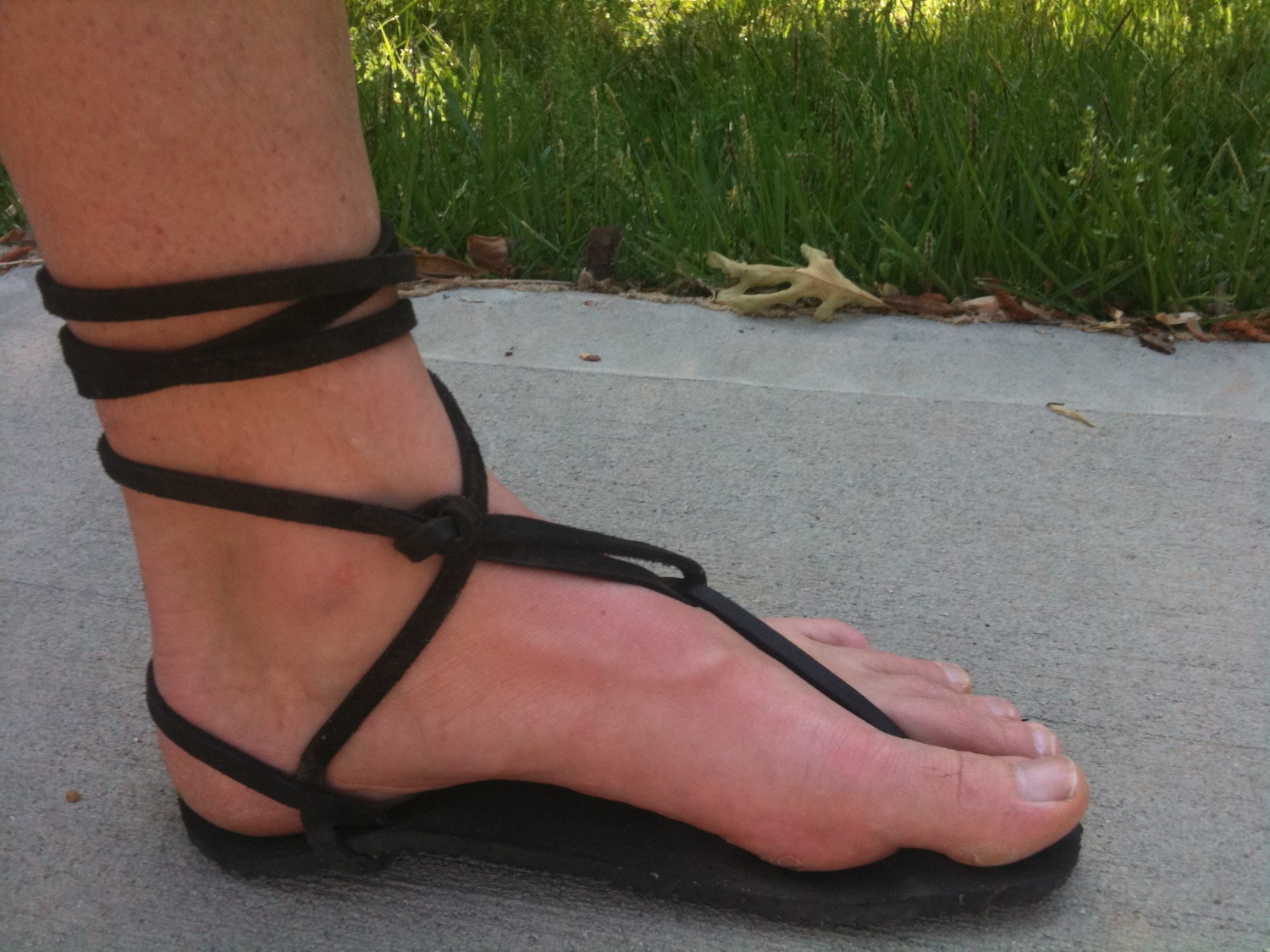
I warmed up in huaraches… I had not decided what to wear yet, and brought 4mm vibram huaraches and my new f-lite 195’s to the race. The run was to be in a neighborhood that I’ve never run before, so barefoot was out… I had no idea exactly what kind of asphalt there might be, and didn’t want to hit chip seal at “high speed” unexpectedly. I hadn’t worn the huaraches that much for running since April or May, so I wasn’t sure how they would feel, but they felt quite good and I opted for them over the f-lites.

Even during the warm up, the huaraches were getting a lot of questions and looks — even causing one lady to trip and fall (I think)! 😦 She was ok, which made me feel a lot better!

Local races here are maybe 100 competitors, so I had secretly hoped for a top 10 finish. But as we stood at the starting line, 3 “ringers” from the big city were there, looking awfully fit and fast. The 1st 1/2 mile was a very slight down hill, and I was cruising in the top 10 – 15. The 2nd half mile was a gradual up to a turn around, and then a gradual down back into the neighborhood. There were no mile markers, but the Garmin showed 1.0 miles in 6:20, about 15 seconds faster than I should have been going, but I was feeling good. 🙂

With just 100 runners, we spread out quickly, but I could hear some comments on the shoes. And with the out and backs mixed in, I could see a lot of the runners looking at my feet. 🙂

The run was pretty flat, but the slight downhills bothered me. I couldn’t really open up and let gravity take over like I wanted to — I’ve always found that downhill in huaraches is a bit tough.

The last 3/8 of a mile was on a small park asphalt path, but it was so twisty and turny…. Again, the huaraches limited me a bit as they were a bit wet from my sweat, but even in shoes, that kind of trail would be hard to get any speed up. I looked in front and realized I would not be able to catch the guy in front, and checked in back and realized I was safe in my position.

I still went as fast as I could, though. I crossed the line in 21:40, or a 6:50 pace, probably a minute faster than I thought I would run in huaraches, so I was pleased. I do think I could have taken 30-45 seconds off that pace if I’d had shoes on, so I am slowly getting back the speed I had 8-9 years ago before all the knee problems.

I couldn’t stick around for the awards and breakfast, as I had to be somewhere, but before I left I checked in and found I was 11th overall. I also had several people come up and ask about my choice of footwear, so I got to evangelize a bit.

I later found I won 1st in my age group (40 – 49 — turning 40 recently has its benefits!), so I have a mug and a $5 gift certificate to the hop shop waiting for me. Not quite enough for a growler, but pretty close. 🙂

All in all a good huarache run, and I got the locals talking about minimalism. 🙂

MR 340, Part III: Anecdotes and Miscellaneous Photos

See part I for how I got involved in the MR 340, and part II for a fairly (somewhat) brief account of the race itself. Now here in part III, I’ll include some miscellaneous photos and anecdotes from the race that I did not include in the race report.

Fish Hook
As was the case at most of the check points, I always tried to jump out of the boat and, with the pretense of “holding the boat steady” so it would not float away and that it would be easier for others to get in and out of the boat (while in reality relieving myself in the relative comfort and obscurity of the water), I did that about 24 hours into the race, which would have been Jefferson City. I really have no idea what check point it was — from the water and not being familiar with the river and the area, while they each looked a little different, I really had no clue what the names were. But based on timing, I’m pretty sure it was Jefferson City…

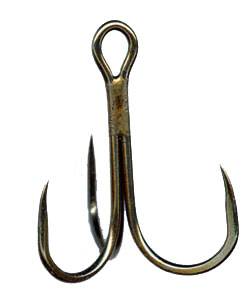
At this particular check point, while holding the boat, all of a sudden I felt like something was biting my foot — there was a piercing/stabbing shot of pain on the left ball of foot… I had my Vibram Five Finger KSO’s on, which while not the best shoe for this kind of race, is about the only shoe I have right now that was a decent choice. How could something be biting me through 4mm of vibram material??!! I pulled my foot out of the water and saw a treble fish hook sticking through the material. Luckily only one hook had penetrated, but it was in deep enough that I could not pull it out without taking the shoe off, but it was also in deep enough that I could not get the shoe off easily without hurting my foot more. With the help of one of the crew members, I finally got the shoe off and we were able to get the hook out of the shoe. But I’d feel the pain in my foot the rest of the race and for a couple of days after. Luckily it was a clean, non-rusted hook, and the wound healed up rather nicely.
“Brawny”
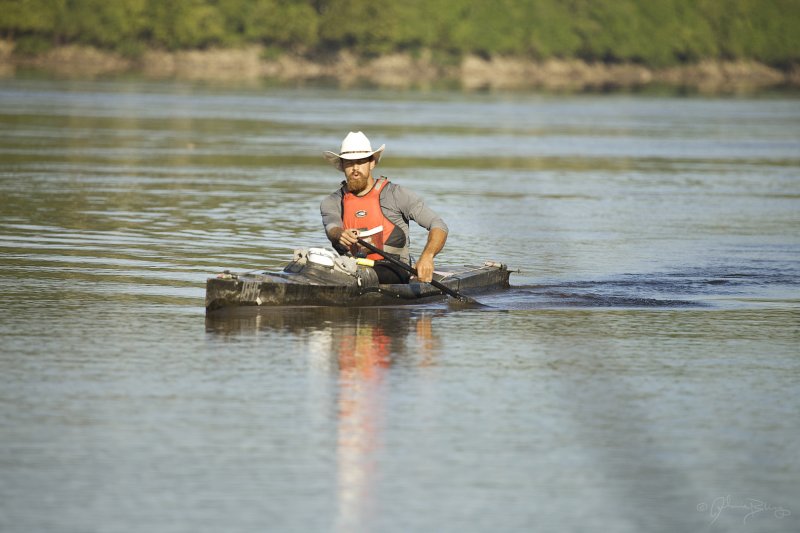
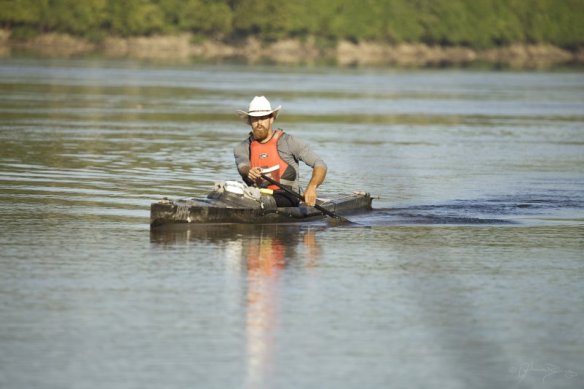
At some point the 1st afternoon, when we had worked our way up to the top 5 or 6 boats, we got to know several of the boats around us. The top two boats were pretty far head, but boats 3-8 or so we traded places with until about 28 hours into the race (when we settled firmly into 3rd), so we did get to converse with them fairly often. I started hearing our crew call one of these paddlers “Ronnie,” though it turned out they were saying “Brawny.” I’m not sure where that came from, but my guess would be Redfern. They said he looked like the man on the Brawny paper towel packaging because of his beard. At one point, when we were told who was in front of us, I heard “Andy…” and there was no Brawny or Ronnie, so I finally figured out Brawny was Andy. (BTW, Brawny liked his nickname — he took it as a compliment!)

Brawny got pretty far ahead of us at one point, running comfortably in 3rd. We finally were able to catch him, and it was then that he told us the barge that had just gone by had caused waves which made him capsize. After “swimming for 20 minutes,” and getting all his gear together, he jumped off the river bank and got in behind us in order to draft. A few of us in the back were trying to devise a strategy in how to drop him so that it would not come down to a sprint finish for 3rd at the end, but he dropped off the back after about 15 minutes of drafting and we never had to implement our strategy. Which basically would have been to paddle faster. 🙂

We were never to see him again, but after we had finished we heard he had dropped. But then about 20 hours after we had finished the race, and gone back to the finish line to get the dragon boat out of the water, we saw him come in! I was quite happy to see that, as typically the front runners of a race, if they have a bad day, will just drop. Not many persevere to the end. I walked over, shook his hand, and congratulated him on sticking it out, and he said that is why he was there. We later found that he had gotten pretty sick after he dropped off our tail, and had pulled over to rest. Eventually he made it to the next CP, where he refueled and tried to go out again, but capsized twice within a minute of going out. At that point he went back ashore, went to a hotel, showered, slept, etc., and, 19 hours later, went out to finish the race.

On Friday before the awards ceremony Brawny came to lunch with us and we got to chat for a while over a beer. (I had the Missouri Mud, which was appropriate, since the river is quite muddy.) He seemed like a good guy and I was glad to have been able to share some of the MR 340 experience with him. Plus, he’s raced the Texas Water Safari, which I hope to do some day as well. 🙂

Here’s a photo of Brawny:
Breaking the World Record
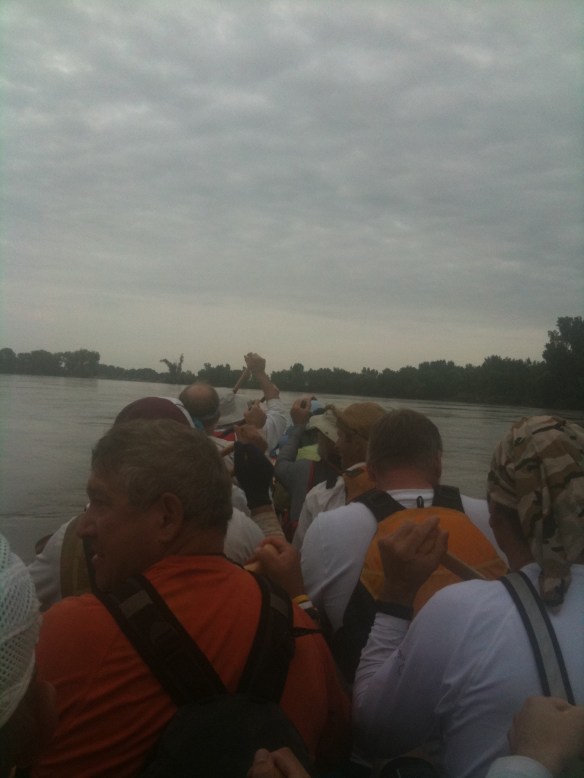
The prior dragon boat distance world record was just 82 miles, so we beat that fairly early in the race. Dragon boats are normally raced in sprints — 500 meters or 1000 meters, and not typically raced in distance races — especially a race of 340 miles! In fact, there were some that thought we wouldn’t even finish, or if we did, we would slow considerably as the race progressed and we suffered attrition. But we never lost a paddler and, while we had one slow section the second day, I blame that a bit more on slow water. 🙂

Here is a photo taken from the boat when we passed the 82 mile mark… Not a very exciting shot, but at least we got it on record!
Sunset and Crab Moon
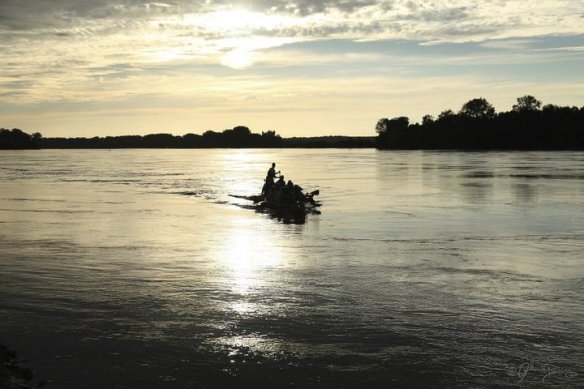
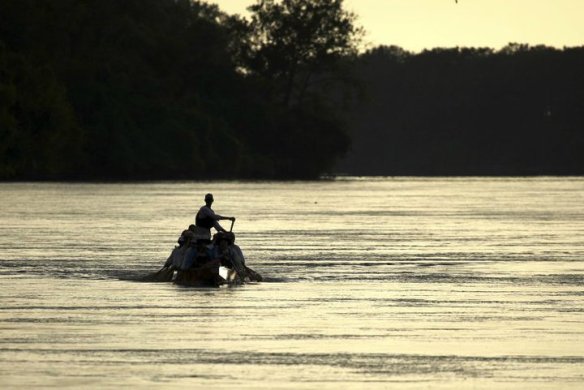
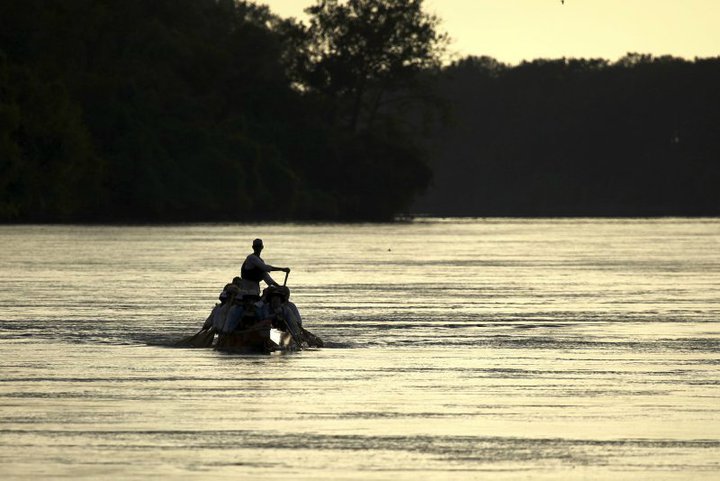
The 1st day was overcast all day, which was great, as it kept the heat down and the sun off. Right before it got dark, it started to clear, and we were treated to a fantastic sunset:
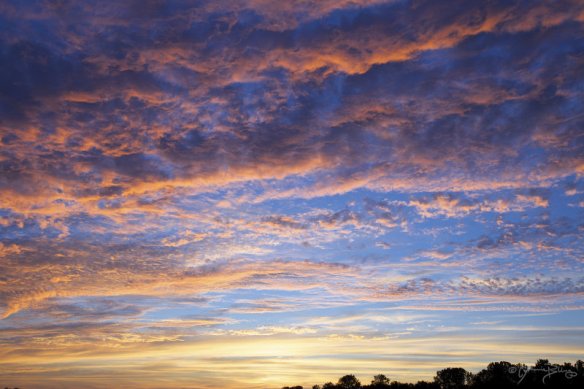
Just after this, it clouded up a bit more, and then we saw some bright white glowing clouds glowing in the shape of an erie, evil crab. Unfortunately, I don’t have a picture of that. It was just the moon shining through some of the thinner cloud layers, brightening up the sky.

Boat Position Changes
While all the paddlers got to change sides every 30 – 40 minutes, only a few of us got to change positions (rows). The 1st half of the race I was in row 9, and the 3 steer-ers would rotate through that row. It was good that we had row 10 with only one paddler — we had one person drop from the team the week before the race — but it would have been extremely tight if row 10 had two paddlers in it when we needed to switch steer-ers. The 2nd half of the race, I moved up to row two, which allowed me to meet some of the other paddlers. Even tough we were all in the same boat, at 41 feet we were spread out front to back pretty far, and there really is a sub-culture built around those you can easily talk with (the row immediately in front of you and behind you) and those you can somewhat talk with (two rows up and two rows back). Beyond that, not a lot of chatting occurs.

Nutrition
I have my long race nutrition pretty dialed in these days, and had no problems whatsoever. While one of my teammates had two 1 gallon igloo jugs for water for me for the race, they seemed excessively large and I was able to borrow someone else’s half gallon jugs. We used two, so that one was in the boat, and one could be filled by our ground crew. If it had been really hot, I could see a half gallon being a touch small on the really long legs during the day, but we did not have that problem.

Beyond water, I used my normal Perpetuem (Hammer Nutrition), and has been my recent want, mixed in a TB or two of chia seeds. I typically shoot for 500-600 calories of Perp/chia mix per sports bottle, and use that as anywhere from 60-90% of my fuel, depending on the intensity of the event. Then I mix in some gels, energy bars, and cliff shot blocks. For real food, almond/peanut butter and honey, salt and vinegar chips, famous amos cookies, etc. It all worked out fine in this race, where I was definitely closer to the 60% range on the perp/chia, and maybe even as low as 50%, since the intensity was lower than something like an ultra-run.

Boat that got sucked into a strainer
After we finished, we heard rumors of various problems people had along the course… One person supposedly lost their boat in the fog and had to sit on the rocks, nearly hypothermic, for hours until they could be rescued. Another boat had gotten crushed on a bridge pylon, etc. I’m not sure which ones are true and which stories had grown in the short time since they had first been told, but at least one boater did have a scare, and they posted about it on the RiverMiles forum, so I’ll just post a link here. It is worth a read — it shows how dangerous the river can be! (But there is a happy ending — and an MR340 finish! Woohoo on the perseverance!)

http://rivermiles.com/forum/YaBB.pl?num=1283050380

NetCam
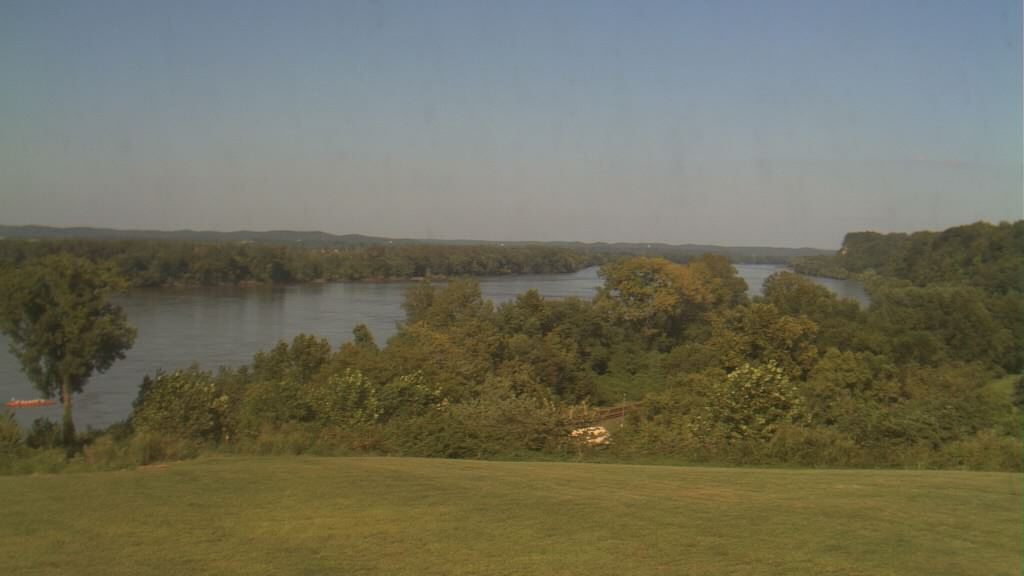
After we had finished the race, and recovered with sleep, it was fun to head over to the RiverMiles forum and read what had happened along the river while we were on the water, and to read about what had occurred since we got off the water. One funny thing was that Val, who was supposed to be on the team but could not make it once the race was postponed, was posting about us, and hoping to catch us on one of the river netcams. Well, she caught us, and the photo is below. Supposedly the netcam takes a shot every 12 seconds, but we only showed up in this one… Maybe were were going too fast! 🙂

Miscellaneous Photos
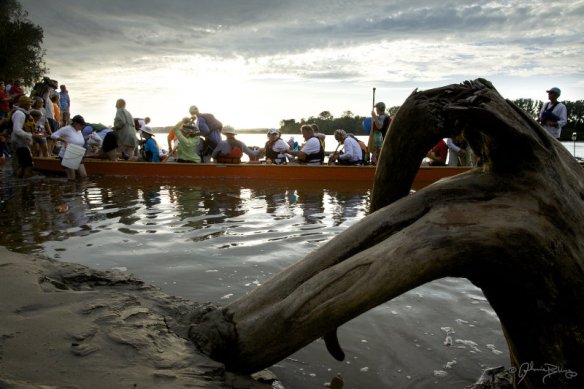
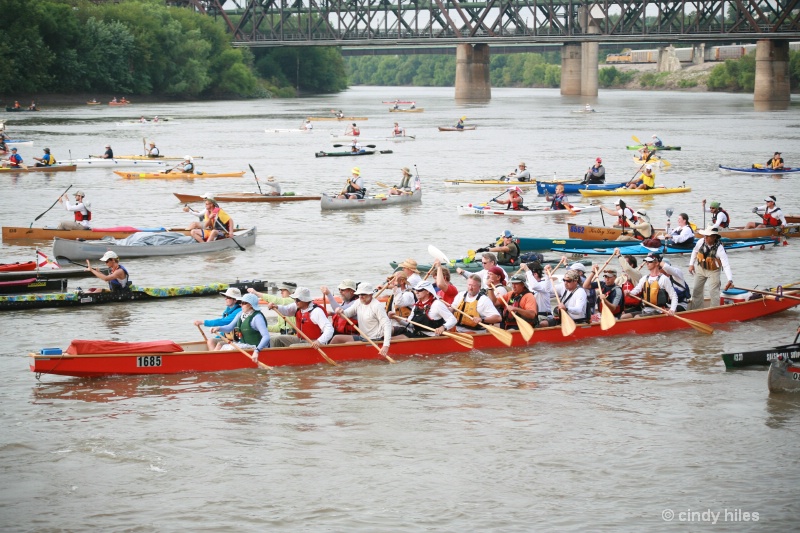
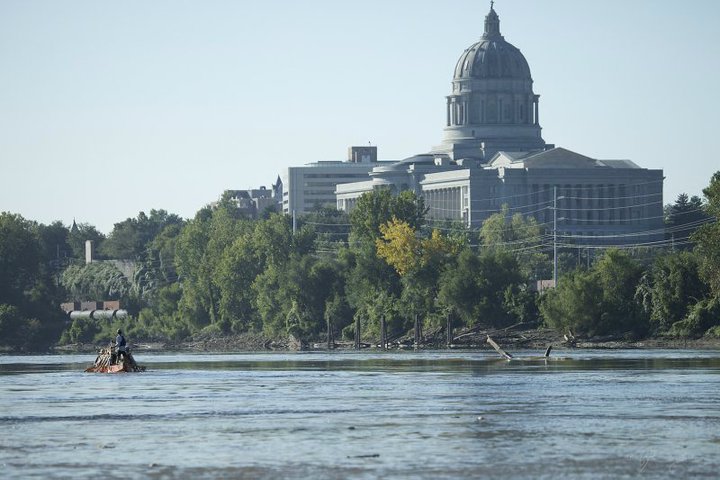
I did not carry a camera, but I have a bunch of photo’s from teammates, a bunch have been passed around on Facebook and email, etc. There are a couple pro photo sites out there, and I’m either in the process of talking to the photographers about permission to use the photos and/or purchase some. But if any of the photos that have been passed around via email and Facebook are copyrighted, I apologize! Just let me know and I’ll fix it.

The two pro photo sites are:
http://cindyhilesphotography.com/-/cindyhilesphotography/galleryindex.asp?c=20285

http://www.pbase.com/johnnie_bling/mr340_2010

John Niebling also has a site here: http://www.hipsnapcreative.com.

And here are a bunch of shots:

I bet this was a familiar sight:
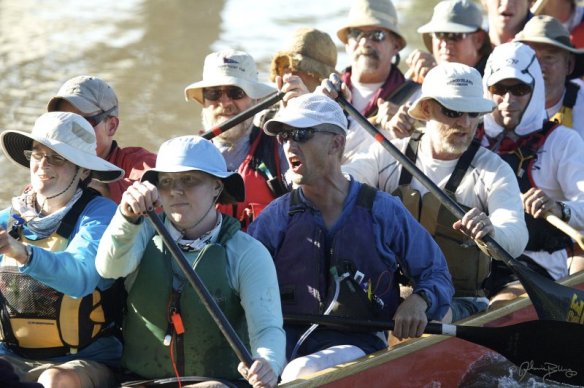
Everyone is pretty content, and there Redfern is yelling his head off. 🙂

MR 340 Part II, The Race

It is a bit difficult to write a race port on this race in my typical adventure race format.  In AR’s, I am normally able to keep all of the details and happenings straight in my head — I think due to the transitions from one event to another.  I’m also typically more involved in planning and navigation than I was in the MR 340 — in this race I was just a paddling grunt.  (Happily, I might add!  It was nice to not have to do a ton of planning as is typical.)

So, to put it another way, since I’m normally reading maps and the passport, heavily involved in the navigation during the race, and because there are clear transitions, it is much easier to keep things straight in a normal AR than in this race.  In the MR340, while we stopped 7 times, I didn’t even get out of the boat a couple of times, and the ramps all kind of blend together in my mind.   So in this post, I’ll give a breakdown of times per checkpoint as kept by our ground crew, perhaps include a quick point or two, and throw in some photos here and there.

I’ll also include the same photo from the last post (part I) here for reference.


Race Start – Kaw Point

The race started at Kaw Point.  We chose to not go to the far river bank so that we could stay close enough to shore to allow us to enter the boat fairly late (close to the start time).  While the far shore definitely gives you a jump on the other competitors in terms of cutting the corner and getting to the fast water quicker, we felt that an additional 45-60 minutes sitting in the boat and fighting the currents was not worth it — especially when we were looking at a 40 hour or more race.

We all got in the boat a few minutes before 8 a.m., pushed off a bit, and then waited.  It was a bit difficult to hold the boat in the current and not collide with other boats, but overall we did pretty well.  At 8:02 the national anthem started, and at 8:05 the canon was fired and we were off!


It was certainly crowded, and when the Kansas River joins the Missouri River within a minute or two of the start, the high/fast current of the Missouri was playing havoc with some of the boats.  While we made it through fairly clean, we later learned that five boats capsized at this point, including eventual female solo winner and star paddler, Robin Benecassa.

I’d like to say we quickly settled into a groove, but in reality, it took hours and hours for that to happen.  However, with 20 paddlers, even though we were pushing nearly 5000 pounds through the water, we had enough power to get into a good groove and start picking off some of the boats that had gotten a jump on us.


Kaw Point to Lexington

The 1st checkpoint was Lexington, 51.1 miles from Kaw Point.  See the chart below for all the times in, times out, etc.

I recall from this section a few things:

Santo:  Santo Albright, the eventual men’s solo winner, drafted us almost the whole way on this section.  Every time I looked back, he was within a foot or two of our stern.  At times, there were several other boats drafting behind him.  This was a solid strategy for him — even though we were losing a little time to the front runners, including a couple of solo men in his division, he was biding his time and taking it easy.  340 miles is a long ways, and he would be fresh on the 2nd day.

Brad:  I noticed a solo man in front of us that was having trouble staying straight.  He was fighting the water the entire way, it seemed.  I couldn’t understand how he could be in front of us — I guess whenever he could keep it straight, he was flying!  We eventually pulled up beside him, and he asked us if his rudder was working.  As best we could see, it was.  A few minutes later I looked back and saw him pulling over, I suppose to check the rudder.  We never saw him, but later learned that he had dropped from the race.  The headline that was picked up nationally, and eventually, internationally read “Asian Carp Knocks Paddler” from race.  The actual story pointed more to the rudder as the main problem, but speculation around the post race area was on boat choice.

Lexington to Wavery to Miami to Glasgow … to St. Charles

Now it all starts to get a little fuzzy.  :-/

I can say going in to the 1st check point at Lexington, I thought our time off the water (at the check points) would be pretty high, as much as 20-25 minutes per stop.  Going in to our 1st CP, I said a stretch goal would be 12 minutes, but we made it out in 8!  Overall, we had amazing checkpoint times considering our crew had to refuel 20 people every time, and in many cases we could not get the boat in broadside — so everything had to come in from the bow.  Or people just jumped.

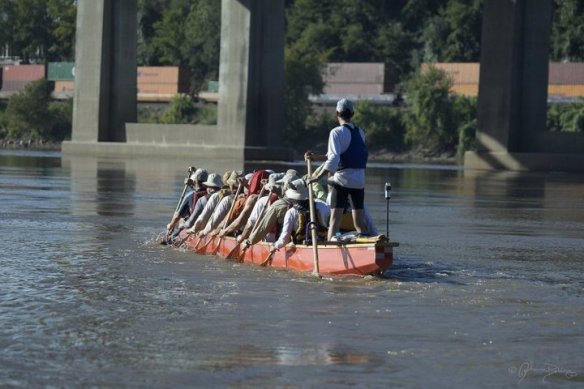
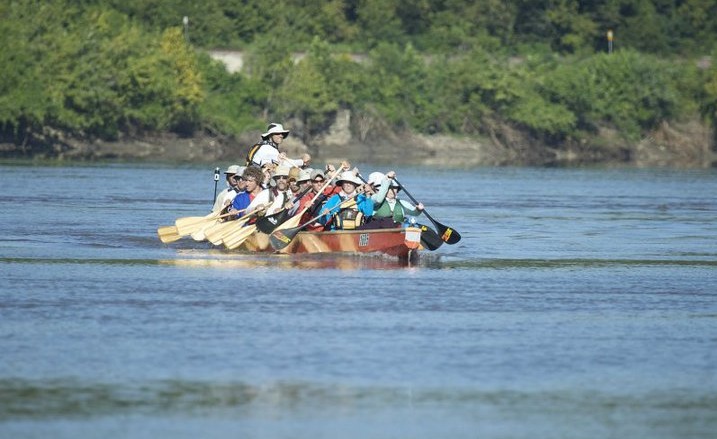
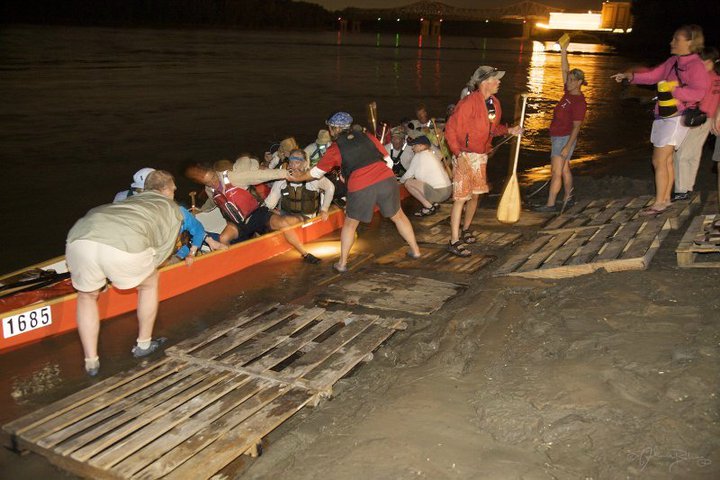
This is what we looked like coming in to a typical CP:

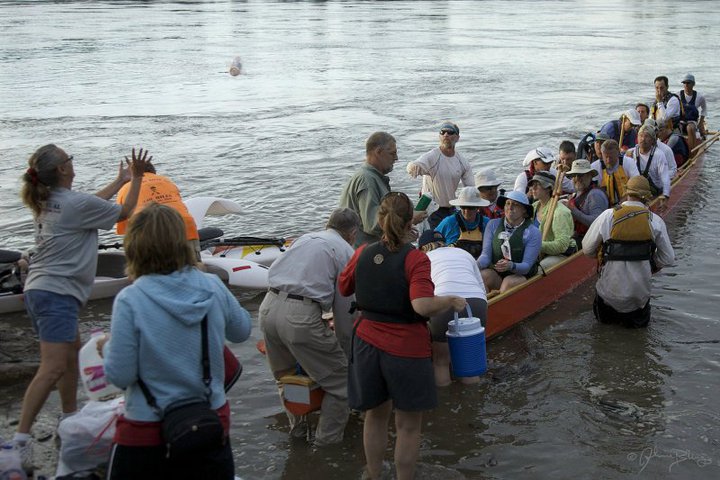
And this next photo shows a little of the controlled chaos of a CP — note the bottle being thrown in the air.  This is actually early in a CP before it got really chaotic.  At only one check point did everyone get out — typically a quarter to as much as half of us would stay in.  Others would jump out to use the restroom, or help with gear, or to just to stretch their legs.  Yet our longest CP was only 12 minutes.  Most of the credit has to go to the crew for this amazing feat.


And here we are just about to leave:

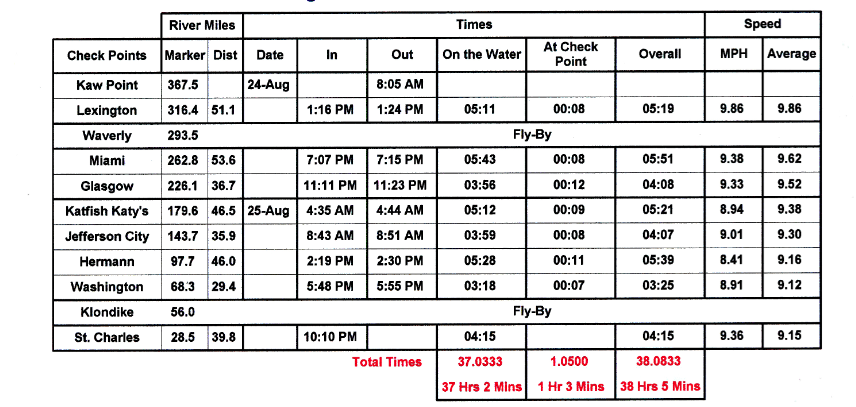
Here is a chart of all the CP’s and other relevant data, showing our average mph, time in the CP, etc.

Finish
We pushed hard the last 40 miles from Klondike in — well, really we pushed hard the last 100 miles or more.  Once we had crept into 3rd place, we did not want to give that up!  And even before then, I recall Will saying a few times “We only need to pass two more boats to secure our place on the podium,” so we pushed hard for a long long ways.

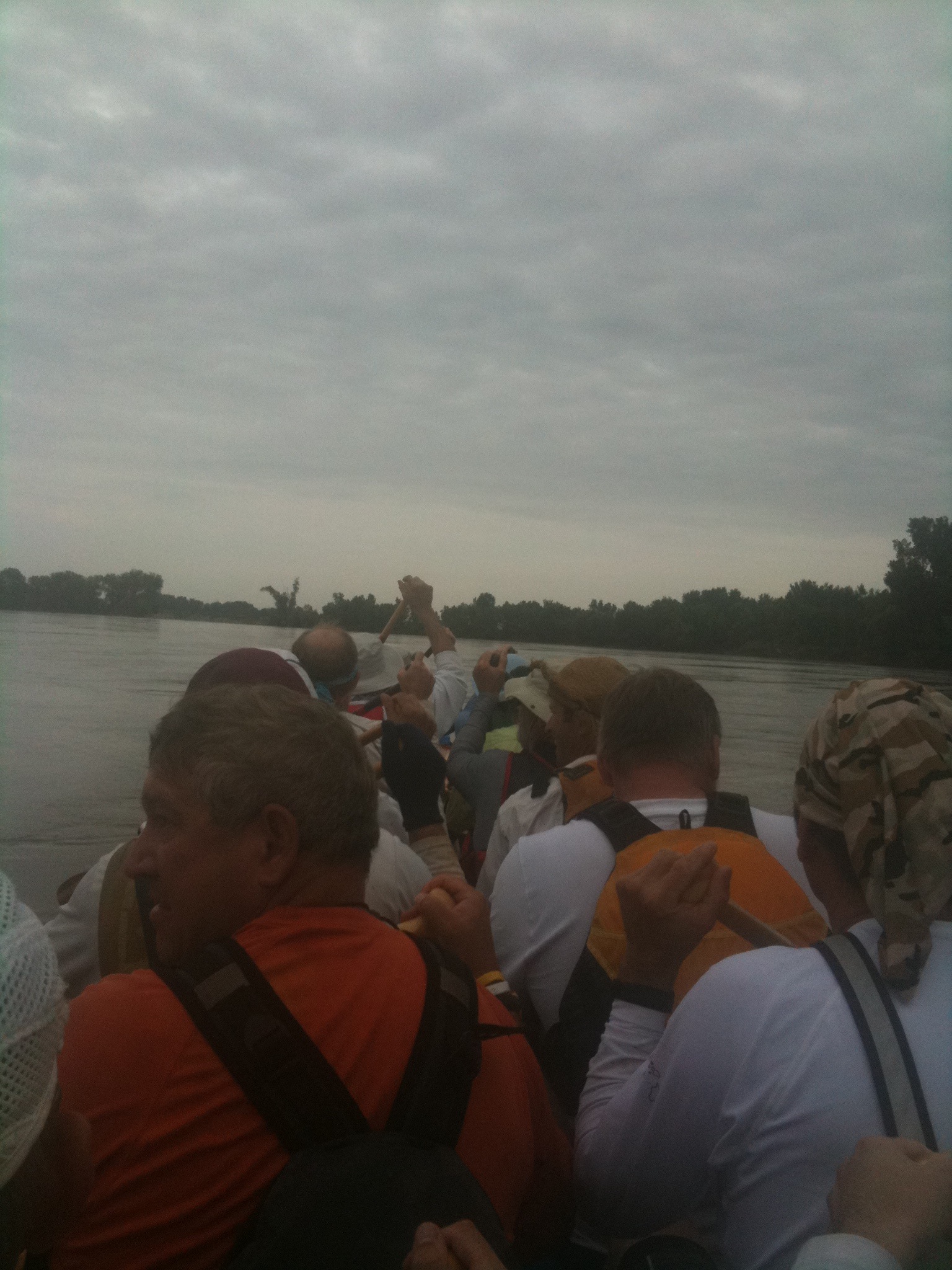
We tried really hard to break 38 hours when we realized how close we were, but we came up just short at 38:05.  I have to say the last couple miles was an amazing, exhilarating time.  We really came together, paddling hard an in sync, and the energy level was unreal.  I think the whole boat was yelling and screaming, and chanting out various words such as “hit,” “stroke,” “arrrgh” an the like, to keep us all in sync.  I certainly hope someone has a video of us coming in under the last bridge.  They said they could hear us long before they could see us.

We had a bit of an anti-climatic finish, as we misjudged the current in the eddie, so we got pushed back up river about 20 feet instead of hitting the shore right at the finish.  But it was only a few strong paddles to put us right where we needed to be.

Considering our original optimal time goal was 40:00 hours, and I thought we could be as much as 48 hours, we really rocked it!  It was good enough to win our division (well, we were the only Dragon Boat!), and get 3rd overall, behind two incredibly fast and talented tandem boats.  We were all certainly pleased, and I think we proved to the entire paddling community that not only is it possible to finish a race like this in a dragon boat, but that in future years, a dragon boat just may win it.  With a few tweaks here and there, I’m certain that is the case.  And, while we were at it, we just happened to shatter the previous world record for distance covered by a dragon boat!

Here is a photo of me getting out at the end — falling back into the boat.  I knew my legs were going to be rubber — in fact, when Joey and I had been switching seats the past few hours, I only did it while sitting and him standing.  I had tried once on the last leg to stand, and the legs just weren’t there.  It wasn’t that I was that exhausted or anything, I just didn’t have land legs.  So I had grabbed my paddle to brace myself as I came out, but it still wasn’t quite enough!

Again, much of the race is a blur, and I don’t recall everything that happened in the order it happened, so in my next post, I’ll offer a few anecdotes and post some other photos…

(to be continued)

MR 340 Part I, Pre-Race

June 15th, 2010

I was just ten days past my Half SCAR Plus run, recovering nicely, trying hard not to think about what might be next, though the thought of a Fall 50 miler (running) kept creeping into my mind, when I received an email from my old Florida teammate Will, from team “Are We There Yet,” that simply read:

“I am on a team that is paddling a dragon boat in the Missouri River 340 at the end of July. If we finish it will be the world record for longest race in a dragon boat. We lost a person. There are some folks in line to take the spot, but there is probably a chance for another opening. Are you interested?”

Do you know what my response back was? “I don’t even know what a Dragon Boat is!”

To which he responded:

“It is, for our purposes (even though not technically accurate), a big, ceremonial canoe that, in its most common form in the US, seats 20 paddlers in 10 rows of 2, with a drummer in the front who helps with timing, motivation and communication, and a steersperson in the back who steers with an oar through a lock on a steering arm. So it would be like canoeing with a lot of teammates, except that you only paddle on one side at a time. We will be switching sides periodically.”

My first response was “No!” I have enough experience in 2 – 3 day adventure races with 1 to 3 other teammates to understand how difficult team dynamics can be with that few number of people – who could imagine what it would be like with 20? I also like the aspect of adventure racing that allows you to change sports, from running to biking, or paddling to running, etc. Doing one sport for 48 hours (plus or minus), did not sound fun at all. I also thought about the utter chaos we would have at check points — trying to re-supply 21 people in a short amount of time seemed to be an impossible task.  And I hate wasting time at check points!

But, the two words “World Record” kept coming back to me. So a couple of days later, I let Will know, who in turn let the team captain, Christina (later named the Imperial Commandress), know, and a couple of days after that, a spot opened and I was on the team.

And best of all, we’d be raising money for the Shriners Hospital of St. Louis.  Please consider donating here to this cause here.

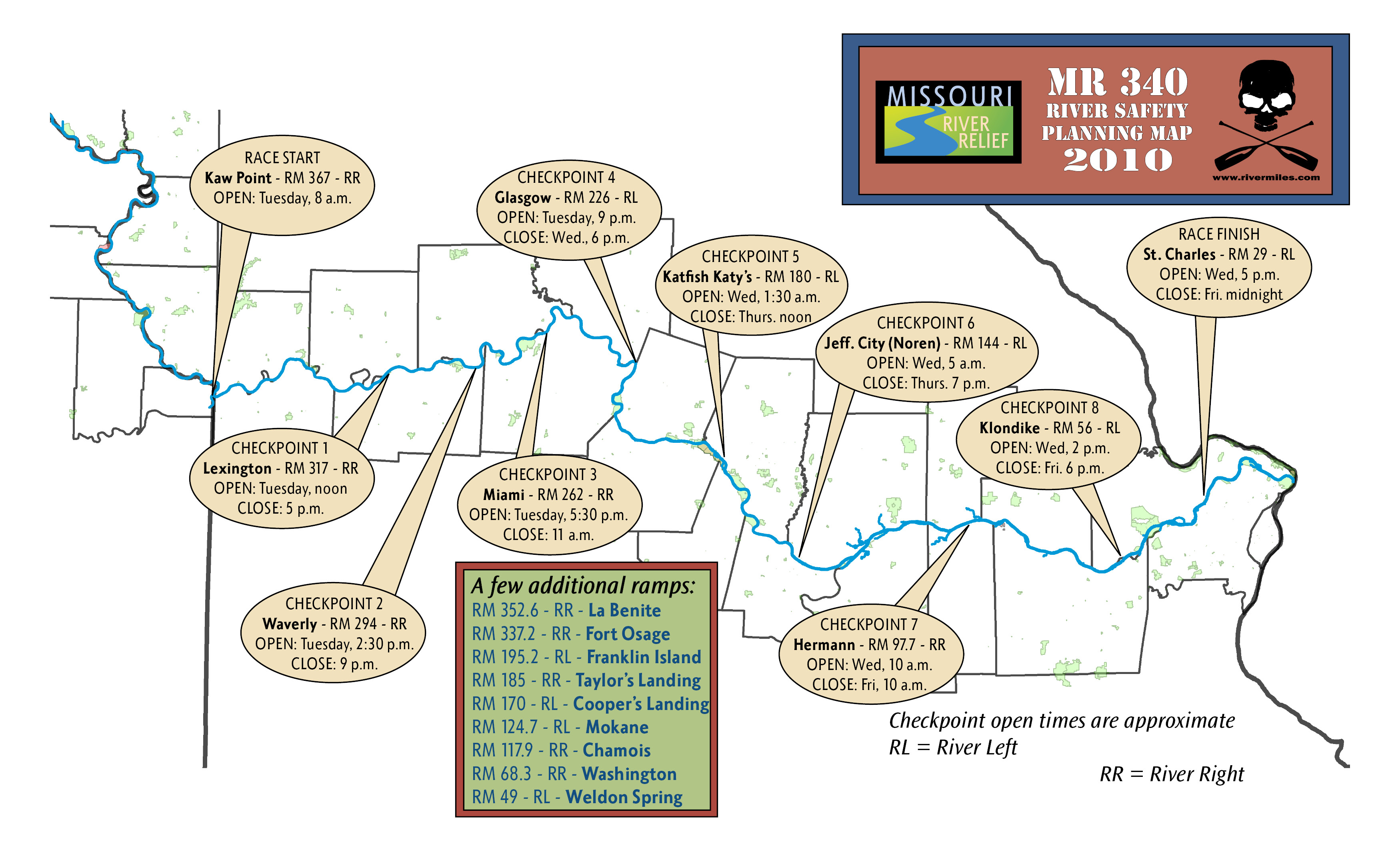
Here is the logo from this year’s shirt, which shows the map of the course.  We’d be paddling from Kaw Point in Kansas City, all the way to St. Charles.  The other points on the map would be the check points where we’d have to check in with race staff, and where we could stop and refuel.  We were also allowed to “fly by” these as long as our ground crew made visual contact with us to check in for us.

And another:

Training
Wow, here I am entering an extremely long paddling race, with what appeared to be a serious paddling crew, and I’m thinking, “I’ve only paddled once this year, and that was to take the kids out on the canoe for an hour!” Hmm, how to get in shape in less than 5 weeks! Well, I had a good aerobic base from the ultra run, and I had been keeping my strength training up so I felt like I had a decent strength base as well. What was left? Paddle, paddle, paddle! And paddle some more!

Looking back at my training log, it looks like I was able to get in 8 rowing specific workouts, with canoe paddling as long as 3 hours on Jordan Lake, though most were in the 90 – 120 minute range. I had to get up at 5 a.m. a few times to fit in these kind of time commitments around work and personal life schedules. That is not a whole lot of paddling!

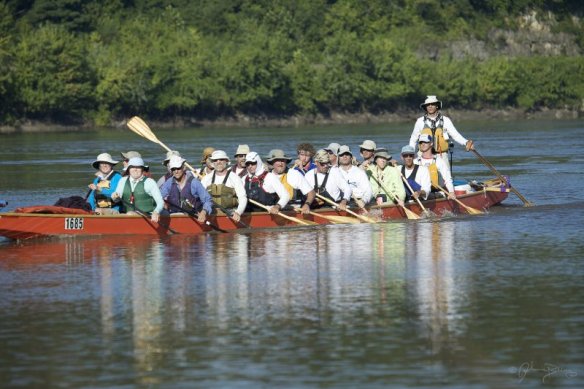
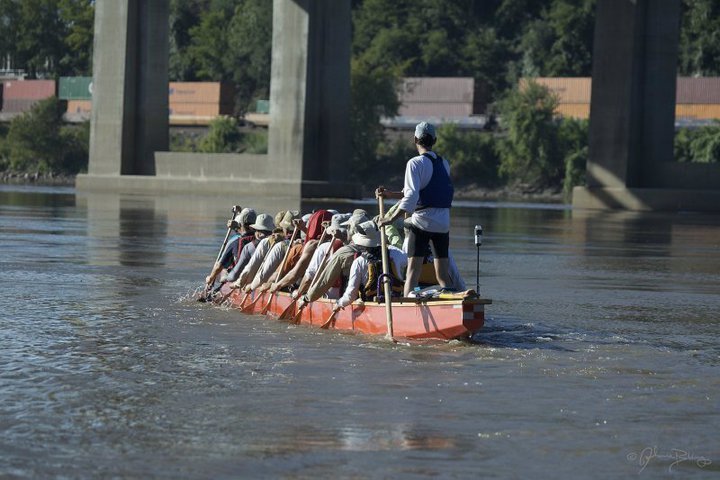
Here is a photo of the dragon boat in action… Our team was able to get in a couple of training runs on it, though getting 16 – 20 paddlers together is tough schedule wise!

Postponement
About a week before the race, we got a clue from the race director that the race would likely be postponed. The Missouri River was at or above flood levels, and many of the check points would be inaccessible. And the river could be dangerous. And then it happened. The race was put off until 8/24.

There was a mad dash scrambling to put the pieces of a team back together. Many members had commitments in August such as school, work, etc., but a core group remained, and we eventually were able to secure a team with 20 people on it — leaving one seat empty.  (We later found that one empty seat was essential to allow the 3 steers the ability to rotate on the fly in a safe fashion. If that back row and been completely full, it would have been much tougher to make changes!)

You would think that would be a good thing for someone like me, who had very little paddle specific training in place. But I had an extremely busy time right around then, with a couple of trips planned, and I was only able to get in three more paddling workouts in!

Travel
It came time to travel west to Kansas City. I took an early morning flight to DFW, where I hooked up with Will and Ryan. I had not seen Will in several years, and was introduced to Ryan. Our DFW to KC flight was delayed about 40 minutes, as a seat belt was broken. On a half empty flight, that should not have caused any problems since you can just move someone to a new seat — but the broken seat belt was the pilot’s! That delay was a bit concerning as we were supposed to meet the team at the race start and take the boat out for a quick practice, before the mandatory safety meeting, and now we were cutting in to that time. But we got picked up and went straight to the start, where we quickly changed clothes, where introduced to everyone, and jumped in the boat.

Practice
We paddled the boat as a full team for the 1st time for about 45 minutes. (Actually, I think we were missing one or two people…) At this time, I hate to admit it, but my realistic side was kicking in… Or, perhaps more accurately, it was pessimistic side! Our paddling was awful — we were not synchronized in any way, and there were several in the boat that had paddling strokes that left a lot to be desired. One of the team mates in front of me happened to be a very accomplished adventure racer, ultra-runner, and paddler, and we started talking about attrition rates. We both guessed as high as 20-25%, which would be 4-5 paddlers. A boat as big as that would be difficult to move quickly if we dropped that low. And while we never openly discussed the particular people that we individually thought would not make it, I’m sure we were both thinking about it. This turned out to be a great lesson in “Don’t Judge a Book by its Cover,” because I was dead wrong. The entire crew made it to the finish, and some that I thought would be weak, turned out to be strong.

Dinner
Doug, one of the paddlers, who lived a couple of miles from the race start, had opened up his place to several of us, which was very generous considering he didn’t know most of us at all. I rode to his place with Christina, and then the three of us, as well as Doug’s wife, went to a casino buffet dinner, where we (well, me, at least) stuffed ourselves silly. 🙂 Apparently, river boats were awarded the right to offer gambling a long time ago, and the law was written such that as long as there is a little water between the land and the casino, that’s legal. So the “boat” we were on was a building with a little bridge over a 5′ span of water.

Pre-race safety meeting
We headed to the safety meeting, checked in, and were briefed by the race director on what to expect, the rules, etc. We heard “high fast water” about 100 times during the safety video — while the water had certainly dropped since the postponement in July, it was still very high. And fast. “Drink!” (He had suggested making a drinking game out of the video… 🙂 )

Final Preparations
After the meeting, I went to the grocery store with Eric and Michael for some last minute food grabs — for me that included famous amos cookies, some mixed nuts, etc. Then we headed over to Doug’s, where the 5 racers and 1 support crew member made our final preparations. There were a lot of zip lock bags and food flying around. We finally got to bed around 10:30 or 11. I used my buff to cover my eyes since not everyone was quite ready to turn out the lights when I was — is there no end to the uses of a classic buff? 🙂 I love mine!

Wake-up call
I woke up about 5 a.m., before the alarm went off, and started to get ready. It had not been a great night of sleep, but certainly wasn’t terrible. Just like the night before most races, I’m always anxious and wake up a few times during the night, only to check the clock and realize there is plenty of time. Doug’s wife walked Michael and me to a nearby cafe, only to find it was closed. 😦 I really wanted needed my coffee. Then she drove us a bit further to a very nice grocery store that had a large breakfast buffet. And coffee. Now I was ready!

We had to make two trips to the start with all the paddlers, crew, and gear, but we were there in plenty of time to put everything together for the start…

(to be continued…)

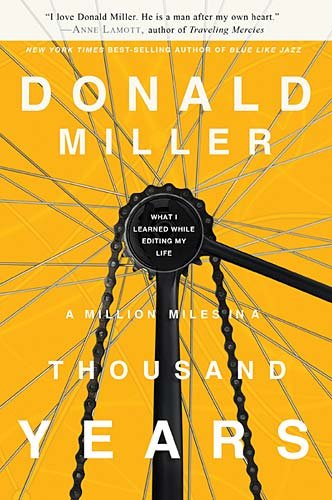
A Million Miles in a Thousand Years. Donald Miller.


I’ll tell these things to God, and he’ll laugh, I think, and he’ll remind me of the parts I forgot, the parts that were his favorites. We’ll sit and remember my story together, and then he’ll stand and put his arms around me and say, “Well done,” and that he liked my story. And my soul won’t be thirsty anymore.

What if your life was a story?  What if your life was a story and you were the author, or at least co-author (but main-author)?   How would you change your current story?  How would you make memorable scenes?  How would you invite others into your story?    In the book Miller discusses life as a story, and how the elements of story come together in each of our lives.  We can have a captivating story, or a dull story — we choose, as we are the main author.   Many of us are guilty of not changing our life story, because we have become content, or we are afraid of change.  (Or both.)  But should we be content with where we are today?  Could greater things be in store?

He didn’t discuss it much, but of course other people are part authors of our story as well.  I had this revelation a few weeks ago when Kelly threw a surprise party for me on my 40th birthday, and I got to see so many people from my life — family, of course, and friends from college, friends from nearby, and friends from far, some of whom I see often, and some of whom I see rarely (these days).  And they are all a a part of my life story.  I have many “memorable scenes” with all of the people I saw, and there will (hopefully!) be many more.  But, as the main author of our life story, we have so much to do with those scenes…  What more can we do to create more and more of those scenes that stand out from the dull monotony of every day life?   Not that every day needs to be an adventure of some type — there are opportunities for memorable scenes more often than we typically think.

Another key point, for me, was how we choose to invite others into our stories — and how we help create memorable scenes for them.  I want to be better about this.

I have to admit that this book unexpectedly made me be quite introspective, which is rare for me.  I’m not an introspective person by nature.  But when you think of your life as a story, you think about the quality of the story.  Is it a good story?  Is there character development?  (“I wanna have friends I can trust… that love me for the man I’ve become not the man that I was…” — Avett Brothers)  Is there conflict that is overcome, preferably for “the good (noble?)”.   (“I have fought the good fight….”  2 Timothy 4:7)

The quote I opened this post with struck me…  It is from the very end of the book, and is key.   Don’t we all want to hear “well done” from God on that last day, and that “He liked my story?”  I can’t wait to be reminded of those parts of my story that I’ve forgotten, but that were important not just to me, but to Him.

Food Rules. Michael Pollen.

A VERY quick read of 64 rules about food that Pollan has established after writing his other books on food and nutrition.   These rules lack most of the scientific reasoning of the rules, but the rules themselves are good if you don’t like that kind of thing.  Of course, I do like that stuff, so I’m now reading his more in-depth book “The Omnivore’s Dilemma”
Quotes – only a couple… Most of the rules are quotable!

  • Today foods are processed in ways specifically designed to get us to buy and eat more by pushing our evolutionary buttons—our inborn preferences for sweetness and fat and salt. These tastes are difficult to find in nature but cheap and easy for the food scientist to deploy, with the result that food processing induces us to consume much more of these rarities than is good for us.
  • Not surprisingly, the decline in home cooking closely parallels the rise in obesity, and research suggests that people who cook are more likely to eat a more healthful diet.

The Primal Blueprint. Mark Sisson.

This was mentioned on the Google minimalist list a few times, and the latest thoughts on wheat (outside of Conventional Wisdom) are pretty interesting to me right now.  Sisson outlines 10 rules of the primal life style, ranging from nutrition, to exercise, to sleep, and play. I won’t get into all of them here but just focus on a couple that are most important to me, nutrition and exercise (though I love to sleep and play too!)
Since I am behind, these are just some quick thoughts…  Also, as an “experiment of one,” it will take some time to digest (pun intended) all of the information in this book!
I agree with much of what he writes about food such as the avoidance of all high fructose corn syrup, highly processed and refined foods, etc.  I am starting to believe more and more his feelings on veggie oils other than olive oil. I am not so sure I agree with him on beans and legumes.  I am curious about his feelings on wheat and other grains.  I do think that the body’s insulin response should be considered in light of the whole meal, not just individual parts of the meal.
I also feel similar to how he feels about what he calls “Chronic Cardio…”  My take is world class athletes are often not that healthy, as they have to push their bodies so hard to be world class.  His argument is that what most Americans do for exercise — those that do exercise — do too much hard cardio, where he defines cardio as > 75% MHR.  He suggests long slow cardio of a few hours at 55 – 75% MHR, which is what you would get on a decent hike.  He also advocates sprinting and “lifting heavy things,” which goes along with my exercise philosophy of doing lots of different things.  For me that includes running, hiking, biking, paddling, weights, yoga, plyometrics, etc.  He also states if you are in good Primal Shape, you should be able to jump into events as long as ultras and do ok.  Sounds good to me!  🙂
Along the lines of Real Food by Nina Plank.

And now for a few select quotes:

  • The doctor of the future will give no medicine, but instead will interest his patients in the care of the human frame, in diet, and in the cause and prevention of disease. —Thomas Edison
  • My goal with the Primal Blueprint is to expose much of the lucrative health and fitness industry as ethically and scientifically bankrupt.
  • “Perfection is impossible. However, striving for perfection is not. Do the best you can under the conditions that exist. That is what counts.” —John Wooden
  • Americans will always do the right thing—after they’ve exhausted all the alternatives. —Winston Churchill
  • Experience teaches us how difficult it is, if not impossible, to be lean, fit, energetic, and healthy following Conventional Wisdom.
  • However, too many lengthy workouts at elevated heart rates (between 75 percent and 95 percent of maximum) can put you at risk of exhaustion, burnout, injury, and illness.
  • The high-carbohydrate diet required to perform these workouts day-in and day-out only adds to the problem. At the extreme—such as with the overtrained marathon runner or ironman triathlete—a commitment to fitness can actually accelerate the aging process.
  • A man’s health can be judged by which he takes two at a time—pills or stairs. —Joan Welsh
  • pursuing specialized athletic goals is inherently destructive to your health.
  • When I take responsibility for my actions, my misfortune becomes a growth experience—an appealing alternative to feeling like a victim or placing any importance on the notion of bad luck.
  • Increase your daily activity level in every possible way—walking or cycling instead of driving for nearby errands, taking the stairs, parking at the edge of the lot, strolling the neighborhood after dinner, and enjoying leisurely hikes on the weekends.

Way behind on posting about the books I’ve read…

I’m way behind writing about the books I’ve read.  At least six books behind.   😦   I’ll try to catch up, but that means I’ll probably write less than I normally do.  With Kindle Highlights, I just put them in Evernote note’s, which is great, though the process is manual and leaves a lot to be desired!   I hope someone comes up with an automated way to do it soon!  🙂   That also means I only grab a few quotes to put here, while the rest I have forever in Evernote.

The Runners Guide to the Meaning of Life. Amby Burfoot.

This book didn’t have a lot of meat, and I read it well over a month ago (meaning I have lost my 1st impressions, since it wasn’t that impressionable)  so I won’t write much now.  (I’m about 3 or 4 books behind in writing about the books I’ve read!)   So how about just some quotes?  I know that is boring and lazy, but there are some good quotes!  I’ll even highlight some of my favorite.

  • As runners, we all go through many transitions-transitions that closely mimic the larger changes we experience in a lifetime. First, we try to run faster. Then we try to run farther. Then we learn to accept ourselves and our limitations, and at last, we can appreciate the true joy and meaning of running.
  • Every workout reveals new truths and releases new dreams.
  • Running has long suffered, in my opinion, from an early attitude best described and captured by the classic novella and movie of the same name: The Loneliness of the Long-Distance Runner.
  • I wasn’t yet wise enough to see how traditions make us stronger.
  • Now I began to see these transitions differently. In a world that perpetually moves faster, never slower, we need all the anchoring points we can find.
  • I have heard a million people say that running is the most boring activity that they can possibly imagine. Since I’m sure I’m not any smarter or wittier than these people, I can only guess that they never learned to listen as they run. If they did, they would surely he entertained and informed by their own thoughts.
  • I have learned that there’s no such thing as an easy decision. But I have also learned that it’s much better to make decisions and move on than to he trapped in the agony of the process.
  • Indeed, only about 5 to io percent of the overall marathoning population is fast enough to qualify for Boston. [ Hmm, I’m still pondering going for a 3:20 which is my BQ time! ]
  • The answers lie within, not outside. The best solutions are achieved from personal resolve, not from multiple credit cards.
  • “Bid me run, and I will strive with things impossible.” -WILLIAM SHAKESPEARE
  • The simple approach is often the best. As we enter ever more technical times, with ever increasing levels of complexity and decision making, we need to remember that the simple path can harness great powers.
  • During his much-read and discussed life at Walden Pond, Henry David Thoreau preached simplicity above all else. He felt that the unencumbered life was paradoxically the fullest.
  • While running at first appears to depend on great physical strength and endurance, it is, in fact, based almost entirely on strength of mind. Those who have the will will succeed.
  • “It is distance, not speed, that holds the answers. The reward comes with crossing and confronting the boundaries of fatigue. For these runners, satisfaction is measured in miles, not minutes.”
  • many wise people have observed that you can’t accomplish something if you don’t believe you can. Or the converse: If you believe something is beyond you, it is.
  • While you always have to stay focused on your goal, you also need to stay flexible enough to adapt to different conditions. When in the mountains, enjoy the mountain scenery. Nobody achieves his goal without having some fun along the way. Without fun, we’d give up long before the finish
  • … parents can’t be cookie cutters. We can’t mold our children into ourselves or anyone else. We have to let them run free to discover themselves. It’s the greatest gift we can give them.
  • if I were handed a couple of decades, I would cherish them so. I would give every moment the honor and respect it deserves

p.s. I was quite surprised when Burfoot mentions the following book as one of his favorite all time books!   GODEL, ESCHER, BACH: AN ETERNAL GOLDEN BRAID, BY DOUGLAS R. HOFSTADTER

MR 340

After my “Half Scar Plus” 42 mile run on 6/5, my plan was to take it easy for a few weeks, and not plan any more runs or races immediately.  Of course, it was difficult not to think about what might be next, and I already had ideas about a 50 miler in the Fall, such as the Vermont 50 on 9/26.  But I was being good and not getting too serious about anything, when out of the blue I received an email from Will, a former team mate of mine from my Florida Adventure Racing days.  The email said:

I am on a team that is paddling a dragon boat in the Missouri River 340 at the end of July.  If we finish it will be the world record for longest race in a dragon boat.  We lost a person.  There are some folks in line to take the spot, but there is probably a chance for another opening.  Are you interested?

My first response was:  “I don’t even know what a dragon boat is!”  Will responded that while not exactly technically accurate, a dragon boat is a large ceremonial canoe that typically seats 20 paddlers, has a drummer in front to keep strokes in sync, and an oarsman in back to steer.  At first I really had no interested in racing with 20 other people!  While I had been trying to get Will to race the Texas Water Safari, a 260 mile paddling race, with me for years, the thought of racing with 20 other people, instead of just one, scared me.  An adventure race of 2-3 days with just 3 other teammates can be tough enough in terms of team dynamics and chemistry, yet here was a race with 17 more people to throw into the mix.  I couldn’t even imagine it!

But over a few days, my sense of adventure started to get the better me.  Then there was definitely a spot for me.  And the thought of having my name on a world record was intriguing, as well.  🙂  Finally, the race would start just a couple of days after my 40th birthday!   Looking at the calendar, it was a bit tight logistically to fit into my work and personal life, but there was just enough window to make it happen.  And when both my wife and my boss gave me the green light (Thanks K and D!), I decided to go for it!

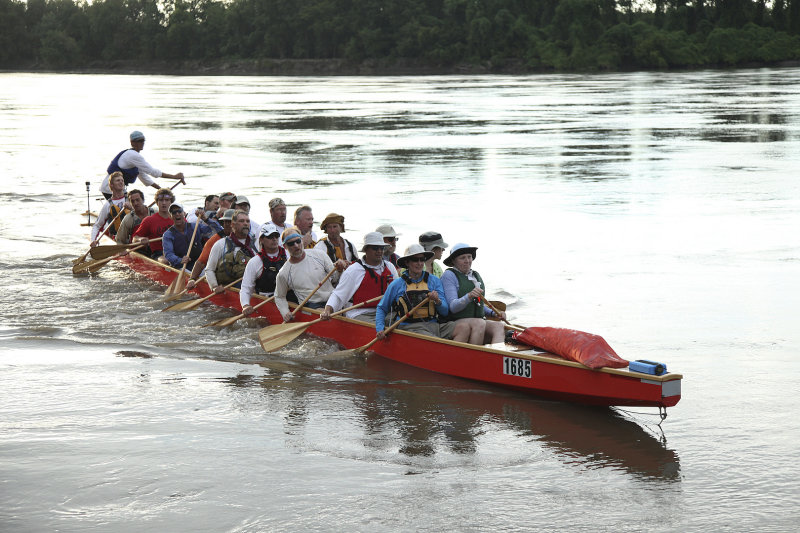
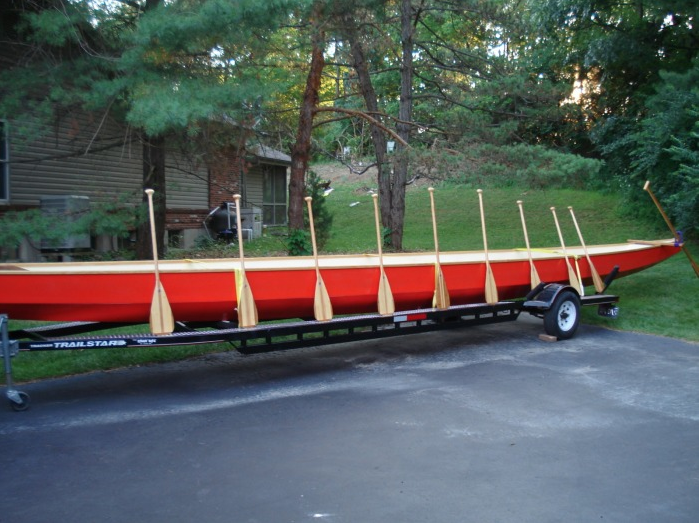
So here is a picture of the boat that has been custom built for this adventure:

On top of the chance to paddle 340 miles in a couple of days with 20 other adventurers, and the chance to go for a world record, we are also doing this for the Shriners Hospital for Children in St. Louis.  I encourage you to take a look at our team web page, Beauties and Barnacles, and consider making a donation to the Shriners Hospital for Children in St. Louis.