Orthodoxy. GK Chesterton.

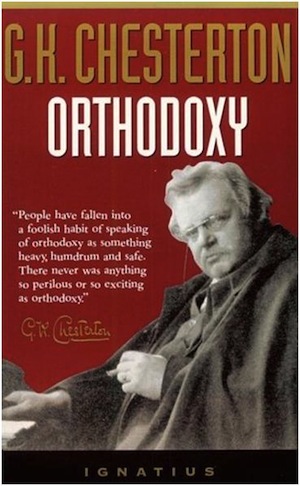
GK Chesterton quotes show up all over classical Christian education, so one of my goals this year was to read some of his works.  I have already read one fiction work (The Man Who Was Thursday), so this was my non-fiction work.  Orthodoxy is sometimes mentioned in the same sentence as CS Lewis’s Mere Christianity, so it does seem to be held in high regards.

This was a difficult book to read.  There were long stretches were it was extremely tough, and just when I thought I should give up, there were a few pages that became lucid and clear, and were well worth reading.  Like finding Nirvana when you least expect it.

So, is it worth it?  I’d have to say that I can’t recommend this book to everyone, but if you like reading difficult books, if you are a Christian looking for some interesting slants on theology that differ from the norm, and that sort of thing, than go for it!  🙂

And with that, I’ll just include a few (select) quotes…

  • This at least seems to me the main problem for philosophers, and is in a manner the main problem of this book. How can we contrive to be at once astonished at the world and yet at home in it?
  • We need so to view the world as to combine an idea of wonder and an idea of welcome. We need to be happy in this wonderland without once being merely comfortable.
  • The poet only asks to get his head into the heavens. It is the logician who seeks to get the heavens into his head. And it is his head that splits.
  • Mysticism keeps men sane. As long as you have mystery you have health; when you destroy mystery you create morbidity.
  • He admired youth because it was young and age because it was not. It is exactly this balance of apparent contradictions that has been the whole buoyancy of the healthy man. The whole secret of mysticism is this: that man can understand everything by the help of what he does not understand.
  • A man was meant to be doubtful about himself, but undoubting about the truth; this has been exactly reversed.
  • For the old humility made a man doubtful about his efforts, which might make him work harder. But the new humility makes a man doubtful about his aims, which will make him stop working altogether.
  • The test of all happiness is gratitude; and I felt grateful, though I hardly knew to whom.
  • An optimist could not mean a man who thought everything right and nothing wrong. For that is meaningless; it is like calling everything right and nothing left. Upon the whole, I came to the conclusion that the optimist thought everything good except the pessimist, and that the pessimist thought everything bad, except himself.
  • Courage is almost a contradiction in terms. It means a strong desire to live taking the form of a readiness to die. “He that will lose his life, the same shall save it,” is not a piece of mysticism for saints and heroes. It is a piece of everyday advice for sailors or mountaineers.
  • A soldier surrounded by enemies, if he is to cut his way out, needs to combine a strong desire for living with a strange carelessness about dying. He must not merely cling to life, for then he will be a coward, and will not escape. He must not merely wait for death, for then he will be a suicide, and will not escape. He must seek his life in a spirit of furious indifference to it; he must desire life like water and yet drink death like wine.
  • Now here comes in the whole collapse and huge blunder of our age. We have mixed up two different things, two opposite things. Progress should mean that we are always changing the world to suit the vision. Progress does mean (just now) that we are always changing the vision.
  • We are not altering the real to suit the ideal. We are altering the ideal: it is easier.
  • The modern young man will never change his environment; for he will always change his mind.
  • Unfortunately, if you regard Nature as a mother, you discover that she is a step-mother. The main point of Christianity was this: that Nature is not our mother: Nature is our sister. We can be proud of her beauty, since we have the same father; but she has no authority over us; we have to admire, but not to imitate.
  • If I am asked, as a purely intellectual question, why I believe in Christianity, I can only answer, “For the same reason that an intelligent agnostic disbelieves in Christianity.” I believe in it quite rationally upon the evidence. But the evidence in my case, as in that of the intelligent agnostic, is not really in this or that alleged demonstration; it is in an enormous accumulation of small but unanimous facts. The secularist is not to be blamed because his objections to Christianity are miscellaneous and even scrappy; it is precisely such scrappy evidence that does convince the mind.
  • The man who lives in contact with what he believes to be a living Church is a man always expecting to meet Plato and Shakespeare to-morrow at breakfast. He is always expecting to see some truth that he has never seen before.
  • All other philosophies say the things that plainly seem to be true; only this philosophy has again and again said the thing that does not seem to be true, but is true. Alone of all creeds it is convincing where it is not attractive;

“Half SCAR Plus”

Introduction

The SCAR run has long been on my mind, when I first heard about it from my old adventure racing teammates Charlie and Ernie.  At the time,  I thought they were pretty crazy, and their first attempt was downright frightful — caught in crazy weather of snow, rain, wind, etc.  You can read Charlie’s account of their second, successful attempt here. I didn’t really think I’d ever attempt it at the time, but then the idea began to grow on me.  And as my knee has been doing better and better the past year or so, and I’ve been running stronger and stronger, including an 8 hour finish at Uhwarrie (38 miles this year on a slightly shortened course), I figured now was as good a time as ever.  When my friends April and Mike said they were interested in helping out, I jumped at the chance.

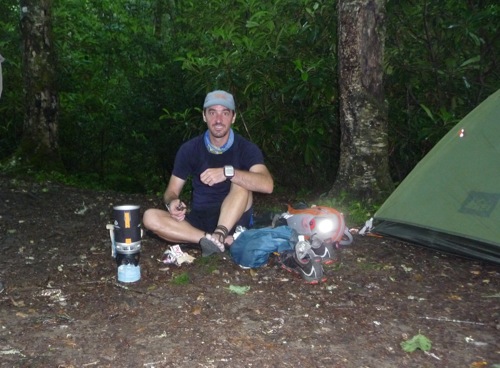
I did not carry a camera as I didn’t want the added weight or the temptation to stop.  There were many amazing sites that will only live in my head.  So hopefully this post is not too boring!  I do have some photo’s at the camp site where Mike and April were waiting for me and I did take a couple with my phone at clingman’s when I got it out to send a quick update to my wife that I was still alive and well…

The Plan

I had planned to run the full SCAR, all 72 miles, all along.  But the weeks leading up to it led me to believe that was not a wise choice.  First I got some pretty bad blisters on both feet on a barefoot run — I almost never blister!  What gives?  I had some callouses growing, which are no good for distance running, and normally a mile or two on pavement acts like a pumice stone and they are gone.  For some reason, this time I blistered under the callouses and they eventually came off.  So I lost about a week there.  Then I got pretty sick, and lost a week trying to figure out what it was.  The 1st day was really bad, but then I thought I was getting better, only to plateau and then get worse.  A second week down the drain.  When it got worse and I noticed a swollen lymph node, I went to the doctor.  Turns out I had had Rocky Mountain Spotted Fever, and subsequently a bacterial infection from the same bite!   I started antibiotics right away, but recovery was slow and I never really got back to good training.  I had lost about 6 – 8 lbs, which for me is significant since I only weigh about 145, and had trouble putting it back on. Finally, 6 days before my scheduled SCAR date, I got a two hour run in, but it was not strong.  At that point I decided for sure that 1/2 SCAR would be plenty.

Because Clingman’s Dome road and Mt Collins shelter are closed, the former due to re-paving and the latter due to bear activity, doing a 1/2 SCAR was tough logistically.  I didn’t want to meet April and Mike at US 441/Newfound Gap, as I was not sure when I would be there and did not want to  leave them waiting too long.  We settled on camp site 53, a five mile run down a side trail away from the AT.  Fork Ridge trail hits the AT at just about  the exact half way point for a full SCAR.

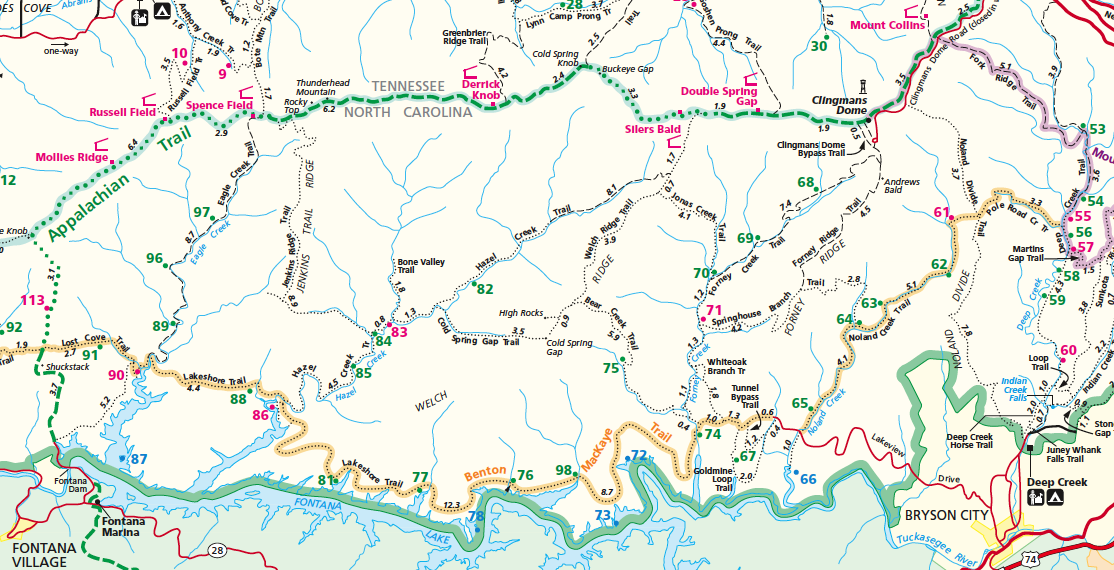
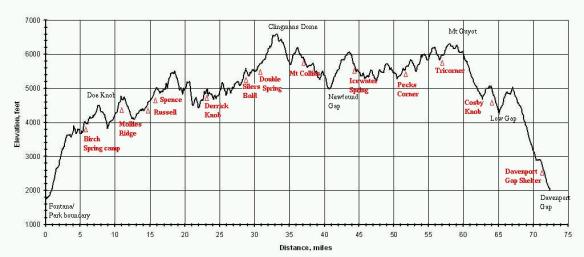
Here is an elevation profile and map… About 3 miles past Clingman’s dome, I would hit the Mt. Collins shelter trail head, and just past find the trail head for Fork Ridge down to the camp site.  I had spoken to a runner who had done the full SCAR just a few days prior and he said there was a sign on the AT for Fork Ridge, but my map did not show that, so I was not sure that would be the case.  But I was hopeful, and if not, Clingman’s Dome road was right next to the AT just past the Mt. Collins shelter split, so I knew I could find it from there.
And a part trail map…  Start at the bottom left at Fontana Dam, run the AT, the green dotted trail all the way to Mt. Collins at the top right, then head down Fork Ridge, the purple trail, to site 53:

Getting There

I picked up April and Mike around 10:30 a.m. and we headed west.  Any trip on I-40 near lunch time warrants a stop at My Father’s pizza in Black Mountain, one of the best pizza joints in the world, so we hit that where I ate a salad, an entire pizza, and had a last beer to wash it all down.   April wondered if I was having a “last meal.”  :-/  She also introduced me to an excellent little chocolate shop a well.  We grabbed 50′ of 3mm cord for a bear rope as I wasn’t sure if the camp site we had agreed to meet at would have cables or not, and we were on our way to Fontana Dam.  We arrived there around 5:30, walked down to the shelter which only had 2 hikers in it, and then walked around the dam, visitor center, across the dam and up the road that leads to the trail head.  We turned back, cooked dinner, chatted with the hikers, went over the meeting place one final time, and I went to sleep as soon as it was dark (about 9:30).

Wake-up Call

I of course tossed and turned.  I normally don’t sleep that well the 1st night out on a back packing trip, and the night before a big race or event is also always difficult.  So I tossed and turned.  And tossed.  And turned.  I looked at my watch many times and it seemed like time was moving in slow motion.  Finally at 4 a.m. I decided I might as well just get up and go rather than wait any longer.  I grabbed my pack, bag, and pad as quietly as I could and walked the 100 meters up to the Fontana Shelter bathroom.  There were some tent campers on top of the hill with a HUGE blazing fire.  At 4 a.m.!  Weird.   Anyway, there I put my sleeping bag and pad in their respective packs, filled my hydration bladder and two hand held bottles, and walked the 200 meters to the car.  There I quickly got a cup of coffee brewing, got dressed, and put my final gear in order.  I opted here to skip my oatmeal breakfast — there was no way I could eat anything right now, so I decided to stuff another bar in my pack and head out.  I hit the restroom at the visitor center, climbed the stairs back to the dam, and started running at 4:38 a.m.  Officially that means I ran an extra 1/2 mile or so since SCAR starts at the border of the GSMNP.  I was cool with that.  🙂

The Climb out of Fontana

After the nice flat run across the dam, the road up to the trail head was gradual and fairly easy.  But as soon as I hit the trail, I knew I was in for quite a climb. I already knew that, at least in theory, from having looked at the elevation profile (see above!).  But wow was this tough… Not much running here.  Every once in a while I’d see the lights of the dam below, getting farther and farther a way.  This was literally a 4 mile climb of 1500 feet before it plateaus just a little, and then continues climbing for 4 more miles before you finally get a down hill.  I tried to run as much as I could, but again, it was tough.

Bear Encounter

About 2 and a half hours in, my first handheld bottle of perpetuem and chia mix was just about empty.  (See below for my fueling strategy.)   I squeezed it into my mouth, and the bottle of course made a squishing empty bottle sound.  I heard a response off to my left — it sounded like a wild pig snorting in the woods maybe 20 meters a way.   A few minutes later I heard what sounded like a very large pig digging for truffles off to my left, and then I thought to myself that it was moving awfully quick.  The next thing I knew, the biggest pig I had ever seen ran across the trail maybe 15 – 20 meters in front of me.  It took all of 3 seconds to realize it was not a pig but a bear — albeit a somewhat skinny bear!  My 1st live/wild bear sighting!  🙂

About 30 minutes later, I saw my 1st hikers of the day.  They asked where I had come from and were surprised when I told them Fontana, which was a good 10 miles away since it was not even 8 a.m. yet!   About 20 minutes later I came up on Mollies Ridge shelter, which kind of has its back to the trail the way I was headed.  I could see a couple people on the far side doing normal morning things like gathering gear and brushing teeth.  It turned out it was a father and daughter (about 13 yrs old I would guess).  Apparently I had given her quite the fright as all she saw was me in my black shorts and shirt, and she thought it was a bear running at them!  I just stopped to say good morning and then kept on running.

First Water stop:  Russell Field Shelter

My 1st planned water stop was Russell Field Shelter, about 15 miles into  the run.  I got there and there were a lot of hikers eating breakfast and the like.  I’m not sure if they all had slept in the shelter the night before, but that would have been packed like sardines if that was the case!  I asked where the water was, and ran down about .2 miles to it.  It was not a piped spring, which was a bummer.  I poured the good water from my bladder into my hand held bottle, then filled the bladder and 2nd bottle.  I was not happy to see all the floaties, but figured I’d not really notice them later!  I put my water treatment pills in, filled the handhelds with my perpetuem chia mix, and headed back up to the shelter.  There I stopped for a minute or two to fix my socks and re-tie my shoes, and chatted with a couple of the hikers.  Then it was back to the trail for more running.  I had my pace down to about 17:15 per mile at this point, but by the time I left after getting water and all, it was up to 17:45!

Thunderhead

From Russell field I passed Eagle Creek trail to Spence Field shelter, Rocky Top, and on up to Thunderhead, which is quite a steep little climb.   Near Rocky top I passed a crew of trail volunteers maintaing the trail, and I thanked them all.  This section of trail was getting quite over grown, and where they had cleared was great, but beyond that, it became difficult to run as the grass was covering all the dangers of the trail like the rocks and roots and washouts.  After Thunderhead, I expected to see two SCAR runners that were supposed to have started at Davenport, the opposite end of where I had started, at midnight.  Based on what I thought their expected time would be, I should have seen them, but I did not… So I kept looking and kept looking….  My pace had slowed into the high 18’s by this point, as this was difficult trail!

Derrick Knob Shelter

I reached Derrick Knob probably around 7.5 hours.  I wanted to get more water here — hopefully for the last time.  This looked to be a really nice shelter, so I’m storing that away in case I ever backpack this section!  The water was just down the hill and was a nice piped spring — the kind I am tempted to not filter or treat.  But I had tablets so I used them.  Once I was back up the hill at the shelter I spent a quick minute re-organizing the gear before I was back at it.

26.2

I hit the marathon point just after 8 hours.  Wow!  I finished Uhwarrie this year, which was 38 miles, in just under 8 hours.  Here I was 12 miles behind that pace.  I had not felt that my sickness leading up to this race was slowing me down that much, and while it may have a little, it just proved to me how tough this trail really is.

It was here that I finally put on the ipod — one ear only as always on the trail so I can hear what is going on around me!  I had originally figured maybe a few hours of no ipod, but I never really needed or wanted it until this point. And then right at 26.2 I just felt like it was time for a little music.  🙂

About 15 minutes later, I finally saw someone that appeared to be a runner not a back packer — he had just a waist belt on with two bottles in it and one hand held.  Since this is such a remote location — we were probably a good 15 miles from the road at Newfound gap — it had to be a runner.   I asked him if he was a SCAR runner and at first he didn’t understand and just said he was running from Davenport to Fontana.  I said “yeah, that is SCAR,” and he said “oh yeah — it’s been a rough night.”  They had left at midnight as planned, but the 1st 12 miles were pretty tough, and his co-runner had gotten sick.  So he tended to him and got him to their support crew, and then continued solo.  His final words stayed with me for a while — “I’m just in survival mode now!”   At this point he had done about 45 miles to my 27 or 28…

Clingman’s Dome

From Derrick’s Knob to Clingman’s is about 10 miles and 2000 feet of climbing.  Would the ascent never end?  It was gradual, but there was so little flat ground to gain some speed!  One thing about the AT is that there are often long sections with very little mountain vistas and views, especially in the summer when the trees are full.

At Double Spring Gap I decided to stop and do some quick foot work.  I felt the blister from 5 weeks earlier on my left BOF start to come back — at this point my feet had been wet most of the day and they turn that white pruney cadaver look, and the old blister lines were splitting a touch.  So I took the time to duct tape that area and put on dry injinji socks for the rest of the run.

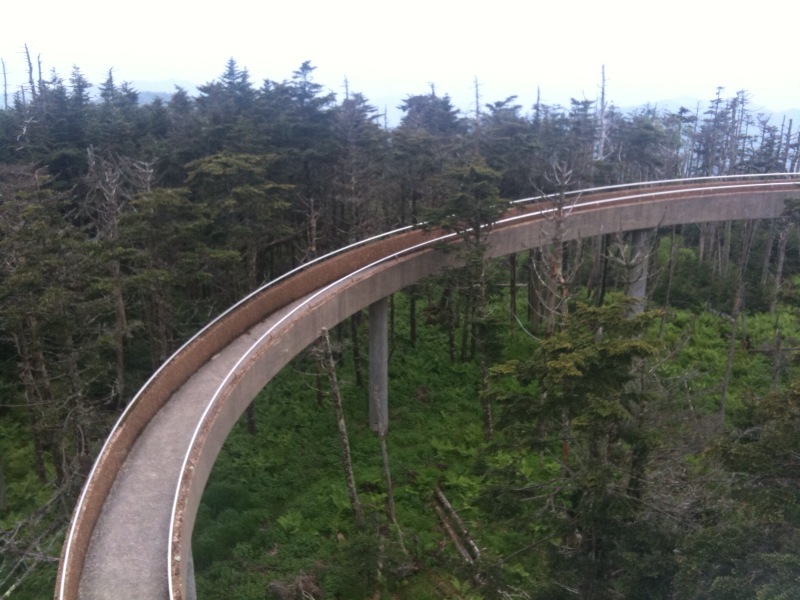
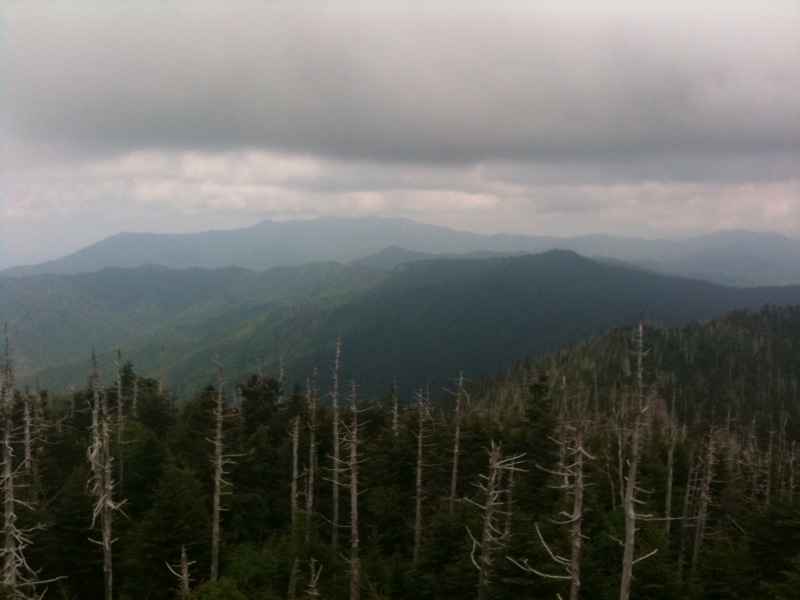
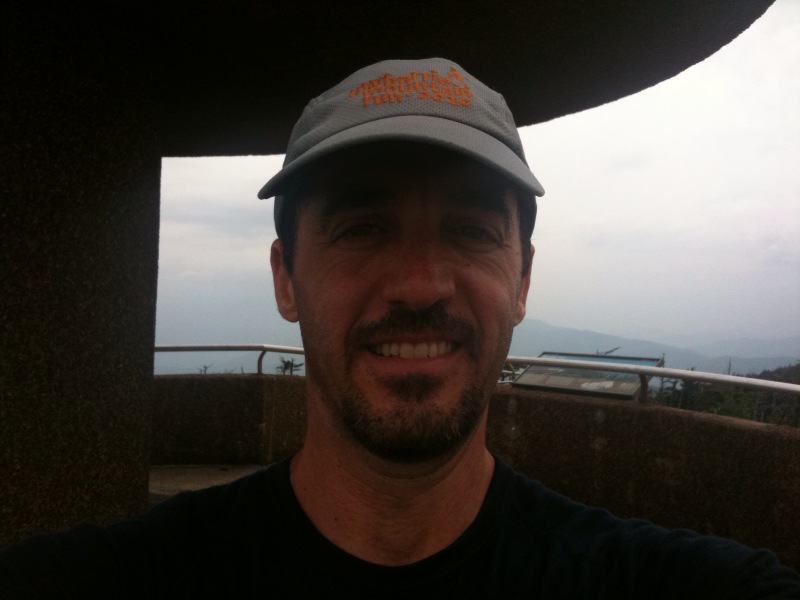
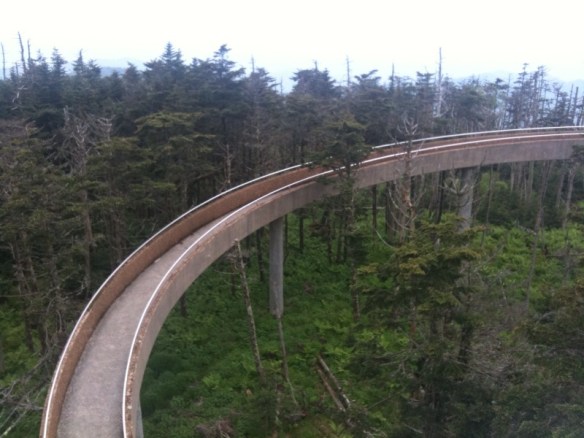
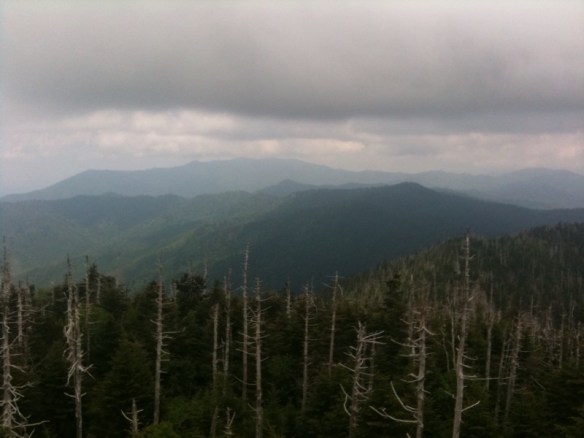
Once I passed Double Spring Gap shelter around mile 31, the trail opened up and there were mountains all around!  It was sad to see so many dying hemlocks, but it was nice to finally see something.  When I finally reached Clingman’s Dome, I had to run up the ramp to the watch tower, even though it was a little off trail.  With the road closed, it was deserted up there — much different than last time when it was crawling with tourists!  I had carried my phone on the off-chance there was service here, but had yet to take it out of my bag.  I pulled it out and there was AT&T E!  I sent a couple quick text messages to Kelly updating here on where I was and decided to snap a couple quick pictures.  For some reason, April and Mike’s phone number was missing, so I could not send them anything.  I doubt they would have received any messages from me as they would have been hiking down into the valley by now.

The ramp:
Mountain vista:
Me, not looking too bad after 34 miles!  🙂

Mt Collins

From Clingman’s I had to descend down the AT to the trail towards Mt. Collins, about 3.5 miles away.  This section of trail was very tough — it was steep and muddy and rocky, and it started to sprinkle.  And then it started to pour.  I finally had to break out the black trashbag I had brought… I brought it instead of a rain jacket to save space and weight, and the trash bags can be useful in many ways.  I quickly poked a hole in it for my head, put it on, put my buff around my neck to keep water from dripping down, and put my hat on.  Now it was raining so hard the trail was literally a stream bed…  After a while I thought for sure I should have come to the Mt Collins split, but it was nowhere to be found.  I really had hoped I had not passed it.

And then I met Gandalf.  Well, he reminded me of Gandalf.  All of a sudden, there he was.  A man in a yellow 3/4 length poncho with the hood on, and a large staff in his left hand.  At first I thought it was Mike, and I was impressed that he had hiked nearly 8 miles to find me! Then I realized it wasn’t Mike.  I asked Gandalf if he had passed the trail to Mt Collins.  “I don’t know,” was his response.  :-/  I said either I passed it or you did.  And he said “Maybe it is 20 minutes beyond for you.”  Ok, thanks for the info, and I head out.  He was thoughtful enough to yell “Stay Dry!”  Right, this was like the Biblical Flood happening and I have a black trash bag as a rain jacket.  Stay dry!  I thought of lots of responses but in the end just ran off.  I was more worried about staying warm at this point!  Cold rain at 6000+ can be chilly!

Two minutes later, I hit the trail split!  I guess he must have been out of it to have not noticed.  The beautiful thing here was a sign for Fork Ridge trail 0.2 miles further along the AT!  Here I was at the 1/2 way point of SCAR, just about at 20:00 pace which is a 24 hour run if you do all 72 miles.  I had really slowed on the climb up and down Clingman’s!  From here, though, the rest of SCAR is mostly downhill.  Should have been easy to maintain that pace or even speed up a little, right?!  Except night would hit in about 4 hours, so I’d have a good 7 or 8 hours in the dark.  Anyway, the plan today was for Half SCAR, so maybe next time!

Fork Ridge Trail

I reached the sign for Fork Ridge Trail 0.2 miles later just as the sign at Mt Collins had said.  Only here was a problem.  There was now another sign that said Fork Ridge was closed due to the road construction on Clingman’s.  Now I had a dilemma.   If it was closed where Mike and April were to park and hike down on Deer Creek Trail, would they be at the bottom?  My choice was to run 4.6 miles on the AT to US 441 and head down that road to the trailhead they should have been parked at which would have been maybe 3 or 4 miles more on the road.  If the car was there, I’d run down the trail and meet them.  That would be about 12 more miles of running.  Or I run down the closed trail 5 miles, and if they are there, I am done, and if not, I have 4 miles to run up to the road and hopefully find some clue to where they might be.

I decided to stick to the original plan and run down Fork Ridge.  If they were not there, it was less running for me.  If they were there, it was a lot less running for me.  I went from the AT another 20 meters to Clingman’s Dome Road, crossed, and went to the trail head for Fork Ridge.  Here another sign slightly caught my attention — it said the bridge at Deer Creak was out and not usable.  Hmm… It’s a creek, right?  I can cross a creek without a bridge…  That thought stuck with me much of the way down this trail.

So, the bad thing about a trail being closed is that it is not maintained.  Well, this trail turned out to be  bushwhacking adventure in some places, there were so many down trees.  And there were a couple of washouts where there was not a whole lot of trail left.  But when the trail was open, it was good.  5 miles down with nearly 3000 feet of descent.  It was here that my knees finally let me know that they  were getting a little tired of all the pounding!  Overall they had held up really well, though, so not much to complain about….

As I got closer and closer to end, I kept wondering what would happen if April and Mike were not there… Or if the bridge was out and the creek was more than I bargained for.  And the sound of water kept getting louder and louder.  And LOUDER.  So now I had some serious concerns about creek crossing with no bridge.

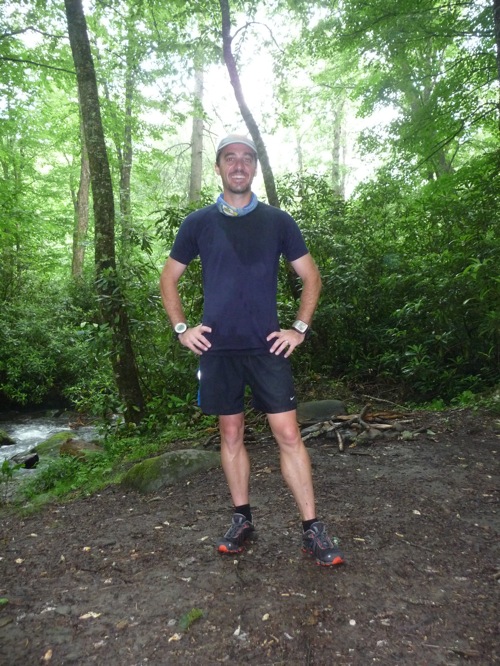
When I finally got to the bottom and came to the creek — there April and Mike were!!  Woohoo!  13.5 hours and 42 miles later, it was so good to see them, and it was awesome to see they had set up my tent!  🙂

Me at the finish, still smiling!

After taking off my shoes, I had to eat before anything else!  🙂

Here is the stream we camped beside… it was crossable!  and Very very cold.  After I ate, I used my buff to rinse off the days sweat and grime.  April even had soap which was a nice surprise and treat.  I had packed a camp towel in the backpack April had carried down, so I dried off with that and got dressed in clean clothes.  I have to give a big thanks here to April and Mike.  They carried all my back packing gear — more food, fresh clean clothes, my tent, sleeping bag, sleeping pad, etc., as well as the gear they needed, all the way down for me.  Awesome!

Garmin Data

Here is the map from Garmin…  Too bad wordpress.com won’t let me embed it here.  Oh well, a picture works too I suppose!

And the elevation profile:
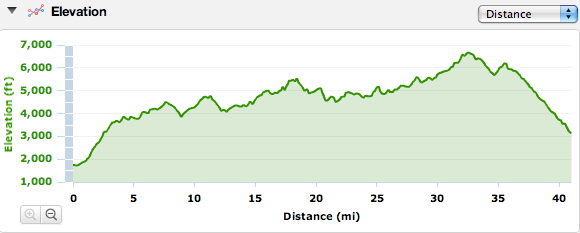
Garmin says I did nearly 14,000 feet of elevation, which I think is about right for this run.   That much climbing and descending made running tough.

Hiking out

After a decent nights sleep, we had breakfast, packed everything up, and hiked out the 4 miles to the car.  Yes, I wore the huaraches out!  🙂  I also carried my backpacking pack and all my gear, as well as my running pack and running shoes.  I just strapped them on to my pack and hiked out.  Overall, my legs felt good, other than my right hip.

Wildlife

Besides the bear encounter described above, I saw the following:

Turkeys — one sitting on a log about eye level just  10-12 feet away.  We stared at each other until I finally said something to him like “Good Morning,” when he proceeded to jump off the log and fly away.  Yes, turkey’s can fly, at least a limited distance!   Then a few hours later I came across two more… One jumped off the trail fairly quickly, the other ran the trail in front of me for a good 30 seconds before it realized it should just get out of the way.  Or maybe he was pacing me.

Fox or coyote — I caught a glimpse of a sandy small dog shaped animal running the trail in front of me, though I could not tell exactly what it was.

Whippoorwill — I didn’t see it, but it kept me company as I climbed out of Fontana in the dark… Reminded me of home, though our Whippoorwill is about 50 db louder than this one!

Toads – many toads on the trail, especially in the morning — one the size of a softball!  I swear!

Gear selection and thoughts

I always like to re-cap my gear and nutrition to help me on future events.

Nutrition

I again used a strong/thick mix of perpetuem — about 500 calories per bottle.  This time I mixed in a couple tablespoons of chia seeds.   I dilute this with water from my hydration bladder as I run, and this allows me to get in a lot of calories with relatively little weight.  This was my main fuel.  Beyond that I had two or three bars, two or three packs of cliff shots, 4 hammer gels, and combos.  If I went longer I would have liked to have something like a PB&J or almond butter and honey.

Gear

  • Ultimate Direction Wasp  — great little pack, rides nice and high, love the vest in front with 4 pockets to give quick access to food and other items…  a touch small if I wanted to do the full SCAR unsupported, but for half SCAR it was fine…  And if I do a full SCAR with support at US 441, it would work fine.  I kept one hand held bottle in reserve in the pack.  The pack did give me a small rash on my back where the bottom of the pack must have been rubbing… I was pretty much wet all day so I am sure that had something to do with it!
  • 64 oz hydration bladder — just for water
  • 2 x 22 oz sport bottles — to carry my perpetuem/chia mix… one in the pack and one in the hand held…
  • Nathan Hand Held — used this to hold one hand held bottle… it also has a small pocket to keep something like a pack of cliff shots and bar or gel.  I would clip this on to a loop on the pack’s shoulder strap now and then when I needed two hands to work with gear, or to use on my legs as I climbed the steep stuff.  Clipping the bottle like this to the pack does not work well when the bottle is full and you are running — there is too much bounce.  But when you are hiking up or down the steep inclines, it works fine.  And if the bottle is empty or close to empty, it is also not too bad.
  • Icebreaker shirt – never leave home without Icebreaker!
  • running shorts & under armor 7″ compression shorts — the compression shorts really helped eliminate chafing.  I was worried about the seams but they rarely bothered me
  • ekko tekko socks – used these for about 30 miles
  • injinji socks – after I taped my left foot, I switched to these for the remainder of the run.  I often use these as a “liner” when the feet start feeling hot spots, but this time I used them alone.
  • NB 790’s – I was worried this might not be quite enough shoe, as it is a trail racing flat, but overall I was pretty happy with them.  There were a few times I would feel the jolt of a rock or root through the bottom, and early on my left ball of foot felt slightly bruised so I switched to a mid foot strike instead of forefoot when the terrain allowed it
  • Pettzl Tikka and Fenix P3D – nice and light yet bright head lamp… the P3D is 120 lumens and helps me find my way quickly if things get tough with the tikka.
  • black plastic trash bag — these have many uses, but on this run, when it started to pour, it became my rain poncho
  • emergency blanket — just in case… I have carried this same blanket on many events and have yet to use it, but some day I know it will come in handy
  • Leatherman skeletool CX — I always carry a leatherman, even though they are heavy.   This one is only 5 oz. so not too bad.  9 times out of 10 I only use the knife, which I did this run for cutting the water treatment tablets.  But having a couple of the other tools, especially the pliers, is a nice safety in my opinion
  • Buff — another item I rarely do long events without.  I mostly used it to wipe the sweat off my face, but it can also be used as a pre-filter for water, as a head covering if you get cold, and around the neck to keep water from dripping down through the trash bag poncho I made.

Final Thoughts

I’m now about 2 days post run, and my muscular soreness is just about gone.  My right hip is still a bit sore, but much better than yesterday.  I have some kind of weird feeling in my left ball of foot — like a metatarsal is popping when I walk barefoot, but it also seems to be getting better.  Overall I am happy with how I felt post-run.  While my knees had started to get sore the last 5 miles or so from all the pounding, they were fine the next day for the hike out and have given me no troubles since then.

I had planned to take at least a week off from running, and I am definitely going to do that, and maybe run just once a week for 2 or 3 miles for a week or two after that.  I still plan to lift more for the next month or so, to try to regain some of the lost muscle from rocky mountain spotted fever.

I am finding it hard not to think of the next big event, and a 50 mile race in the fall sounds tempting.  At the same time, I had said I would take some time off before deciding what to do next, so I need to stick to it.  I could not help but ask Sultan to compare SCAR with some of the ultra’s he has done, and he responded that a full SCAR is more difficult than most 100 mile races.  So that makes me feel better, because Half SCAR was one of the toughest things I have done.

I loved every minute of it, and can’t wait to attempt the full course in the not too distant future!

Thanks for reading!

My name is Zola

This article was shared on the Google Minimalist list, and I thought I’d share it here.  It brought back memories, and my Zola story:

In 1986, when I was a sophomore, my high school started a soccer program for the 1st time in school history.  Rather than hire a soccer coach, they sent over the fitness coach of the football team to be our coach.  We were the fittest team in the county!  But we sucked at soccer.  We lost 17-0 once, though that was to one of the top team in the state.  They were probably taking it easy on us.

Anyway, we had two hour practices, with about an hour of fitness stuff to start, then a little soccer.  (The worst was the dreaded Indian run, were all 20 of us lined up 10 yards a part, jogging slowly, and the person in back had to sprint to the front…  Man those hurt!)  Anyway, we always ended up at the track after practice where we had to run two miles.  I hated running in cleats, and always forgot “sneakers,” so one day I just dropped the cleats and ran barefoot just inside the clay track on the grass.  I did that every day for the rest of that year and subsequent years — which was less often as we eventually got a coach who wasn’t quite so into fitness.

Well, the 1st day I dropped the shoes, one of my teammates started calling me Zola, and it stuck — all through high school and my 1st year of college when I still played indoor on the 18 and under team we had.  I didn’t even recognize the name until someone reminded me of the collision between Zola Budd and Mary Decker in the 1984 Olympics.

You can watch the video of the 1984 Olympic 3000 meter run here, where Decker and Budd collide.

So, other than running barefoot as all kids do, that was the start of my barefoot career.  Granted I got away from it for many years, only to come back about 7 or 8 years ago when I started having knee issues — but only for 5 or 10 minutes on a treadmill or beach every now and then.  I’m glad to be back much more “full time” these days (though I definitely still wear the right shoe for the trail!).

Run Less Run Faster

After coming back from Boston, where I watched my Dad and sister run the marathon, I realized I had caught the Boston bug…  Even though Dad can get me in without a qualifying time, I had to check the what my BQ time is to see if I would have a chance.  For me at nearly age 40, I’d have to run a 3:20, or 7:38 minutes per mile for 26.2 miles.  I can run that now for 5 miles, but adding more than 20 would be tough.  I’m also torn, as I don’t really enjoy road running that much, but instead love the trails and right now want to concentrate on trail ultras..

Either way, I had heard about this book so I thought I’d check it out.  The main premise is “3plus2” which is 3 hard runs per week, plus 2 cross training workouts.  The hard runs are all about speed — interval work, short tempos, and long tempos (or at least long runs with tempo like speeds mixed in).  The cross training is mostly about other aerobic work where you are allowed to mix in items that will save your body from some of the pounding of running, such as swimming and biking.  They also show weight workouts and 2 running drills.

The book is filled with all kinds of tables such as:  pace charts for what your times should be for various distance races based on your current 5k race time;  times for your intervals and tempo’s based on current 5k times; training plans for 5k, 10k, and marathon; and on and on.  Lots of tables.

Since I have not actually used the book to train for a particular race, I can’t say if it is effective, though looking around at reviews on-line, many people seem happy with it.

I will say the authors were extremely prompt with responding to a couple questions I had.  For example, I had hoped I could use Heart Rate as an effort indicator instead of just pace, so I could do my long runs on trails.  That would allow me to pursue both my goals of trail ultras and speed work.  Bill Pierce responded within 24 hours that “The principle of specificity dictates that training on trails is good trainng for racing on trails.”    Later, Scott Murr did respond with a much lengthier email all about using heart rate levels, which I still have not finished due to its length!

Right now I am not concentrating on speed at all, as I have SCAR coming up (70 mile run in the Smokies on the Appalachian Trail, though I am pretty sure I will cut it to 33 or 40 miles due to my recent bought with Rocky Mountain Spotted Fever).  After SCAR I will re-assess and decide, and while I will most likely not follow the training schedules in this book exactly, I will incorporate some of the speed work into my training to see how close I can get to that 7:38 over 26 miles!

Romans. RC Sproul

Romans has been thrown at me from every conceivable angle for the past few years, starting with a long conversation with a Catholic priest (in street clothes, on holiday — didn’t come out he was a priest until pretty far into our conversation!) in Gatwick airport, sunday school class, reading it on my own, and seeing various passages from it in much of my other reading.  RC Sproul has become one of my favorite writers.  So when  I saw he had a verse by verse commentary on it, I had to get it!   It is a long read, and I had a hundred or more quotes highlighted on the kindle, but I won’t include them all here.  I will just say that if you want to do a serious study of Romans and have a Reformed bent, this book is for you.

What I talk about when I talk about running. Haruki Murakami.

I saw this book while in the Harvad Co-op while in Boston for the marathon (I was spectating, not running!).  Quickly put a sample on the kindle and when I read that later, had to get the whole book.  Kindle samples are killing me!  🙂

The 1st chapter of this book sounded an awful lot like me, even though Mr. Murakami is in his later 50’s…  The 1st chapter was the best, while the rest were not as interesting to me.  Just about running marathons and/or triathlons, though he did have one ultra. But overall a lot of good insite worth reading and sharing here.  So I’ll just throw out a bunch of quotes:

  • Somerset Maugham once wrote that in each shave lies a philosophy. I couldn’t agree more. No matter how mundane some action might appear, keep at it long enough and it becomes a contemplative, even meditative act.
  • Pain is inevitable. Suffering is optional. Say you’re running and you start to think, Man this hurts, I can’t take it anymore. The hurt part is an unavoidable reality, but whether or not you can stand any more is up to the runner himself. This pretty much sums up the most important aspect of marathon running.
  • I don’t know why, but the older you get, the busier you become.  [ too true! ]
  • the fact that I’m me and no one else is one of my greatest assets.
  • By running longer it’s like I can physically exhaust that portion of my discontent.
  • (Putting off thinking about something is one of my specialties, a skill I’ve honed as I’ve grown older.)
  • I’m struck by how, except when you’re young, you really need to prioritize in life, figuring out in what order you should divide up your time and energy. If you don’t get that sort of system set by a certain age, you’ll lack focus and your life will be out of balance.
  • but the only way to understand what’s really fair is to take a long-range view of things.
  • Life is basically unfair. But even in a situation that’s unfair, I think it’s possible to seek out a kind of fairness. Of course, that might take time and effort. And maybe it won’t seem to be worth all that. It’s up to each individual to decide whether or not it is.
  • The most important thing we ever learn at school is the fact that the most important things can’t be learned at school.
  • As you age you learn even to be happy with what you have. That’s one of the few good points of growing older.
  • Still, it’s pretty wonderful to watch these pretty girls run. As I do, I’m struck by an obvious thought: One generation takes over from the next. This is how things are handed over in this world, so I don’t feel so bad if they pass me. These girls have their own pace, their own sense of time. And I have my own pace, my own sense of time. The two are completely different, but that’s the way it should be.
  • and covered sixty-two miles. It was draining physically, as you can imagine, and for a while afterward I swore I’d never run again. I doubt I’ll try it again, but who knows what the future may hold. Maybe someday, having forgotten my lesson, I’ll take up the challenge of an ultramarathon again. You have to wait until tomorrow to find out what tomorrow will bring.
  • Since I was on autopilot, if someone had told me to keep on running I might well have run beyond sixty-two miles. It’s weird, but at the end I hardly knew who I was or what I was doing. This should have been a very alarming feeling, but it didn’t feel that way. By then running had entered the realm of the metaphysical. First there came the action of running, and accompanying it there was this entity known as me. I run; therefore I am.
  • In this instance, relief outweighed happiness.
  • And one of the privileges given to those who’ve avoided dying young is the blessed right to grow old. The honor of physical decline is waiting, and you have to get used to that reality.
  • Competing against time isn’t important. What’s going to be much more meaningful to me now is how much I can enjoy myself, whether I can finish twenty-six miles with a feeling of contentment. I’ll enjoy and value things that can’t be expressed in numbers, and I’ll grope for a feeling of pride that comes from a slightly different place.
  • Reaching the finish line, never walking, and enjoying the race. These three, in this order, are my goals.
  • On the body of the bike is written “18 Til I Die,” the name of a Bryan Adams hit. It’s a joke, of course. Being eighteen until you die means you die when you’re eighteen.
  • I’ve carried this character around like an old suitcase, down a long, dusty path. I’m not carrying it because I like it. The contents are too heavy, and it looks crummy, fraying in spots. I’ve carried it with me because there was nothing else I was supposed to carry. Still, I guess I have grown attached to it. As you might expect.
  • I’d always thought I was sort of a brazen person, but this issue with hyperventilating made me realize a part of me was, unexpectedly, high strung. I had no idea how nervous I got at the start of a race. But it turns out I really was tense, just like everybody else. It doesn’t matter how old I get, but as long as I continue to live I’ll always discover something new about myself. No matter how long you stand there examining yourself naked before a mirror, you’ll never see reflected what’s inside.
  • Of course it was painful, and there were times when, emotionally, I just wanted to chuck it all. But pain seems to be a precondition for this kind of sport. If pain weren’t involved, who in the world would ever go to the trouble of taking part in sports like the triathlon or the marathon, which demand such an investment of time and energy? It’s precisely because of the pain, precisely because we want to overcome that pain, that we can get the feeling, through this process, of really being alive—or at least a partial sense of it. Your quality of experience is based not on standards such as time or ranking, but on finally awakening to an awareness of the fluidity within action itself. If things go well, that is.
  • My time, the rank I attain, my outward appearance—all of these are secondary. For a runner like me, what’s really important is reaching the goal I set myself, under my own power. I give it everything I have, endure what needs enduring, and am able, in my own way, to be satisfied.

Real Food. Nina Plank.

I saw this book mentioned on the google minimalist (running) list saying it was a bit more approachable than some other books on the paleo diet, though after reading this I don’t know how paleo it really is.  Guess I’d have to read a paleo book after all.  Or maybe it mentioned Weston Price and Price is not paleo??  I don’t know.  I have read so few food/nutrition books in the past few years that maybe it has all passed me by.  Guess I have become pretty comfortable with my diet!

This book touts moving back to the way food was before it was industrialized, including farm animals, milk, eggs, and produce.  Getting away from grain fed beef and chicken when that is not their natural diet, not eating farm raised fish, getting back to locally grown produce, etc.  And I’m all for that, though I don’t eat a lot of meat…  She was very into using butter — which I never used a whole lot of margin but only went for the real thing — butter is better!; whole milk — I normally do skim or 2% but am now considering sticking with just 2%; eggs – i love ’em — but only pastured so they can be omnivorous as they were ment to be.  She was against all industrial oils (which pretty much leaves olive oil as the only oil).  And all in all getting away from as much process and pre-packaged food as possible, which I already try to do.

Just a few quotes:

  • Is drinking milk unnatural? The critics say that cow milk was “designed” for newborn calves, not for humans. That’s true. But this observation does not prove that the human digestive system cannot, or should not, handle milk. After all, the tomato was designed to make more tomato plants, not pasta sauce.  [ i’ve been guilty of saying this in the past, but I would still say we shouldn’t drink it constantly… everything in moderation!]
  • Aren’t some fats unhealthy? Yes. It’s easy to remember the bad ones: they are the industrial fats recently added to our diet. The unhealthy fats are refined vegetable oils, including corn, safflower, sunflower, and soybean oil, and synthetic trans fats. Trans fats are formed by hydrogenation, in which unsaturated oils are pelted with hydrogen atoms to make an artificially saturated fat. That’s how they make firm margarine from liquid corn oil.
  • To reap all the flavor and health benefits of olive oil, buy the best oil you can afford, ideally extra-virgin, cold-pressed, and organic.
  • The sooner we ban trans fats— as Denmark has— the better.

Boston Marathon Liveblog

I am going to attempt a live blog of the Boston Marathon as Dad and Kim race. We’ll see how it goes.

6:50 — saw Dad and Kim off from the hotel. They are taking a taxi to the runner bus station in Boston, where they will take the bus to the start at Hopkinton.    And there they will have an hour or two to wait for their start at 10:30.

8:00 — after a bit of email, loading my pack, getting fed, I am out the door. Taking the red line to South Station where I will pick up the P509 Worcester train @ 8:50 for Framingham. That is the last rail stop where you can get close to the marahon course, and it is at mile 6.

8:30 Waiting at South Station.

if you want text updates from AT&T for when Dad and Kim cross certain points, text “runner” to 31901 and then when you get a reply enter the bib numbers…

Kim — 27665
Dad — 27617

8:51 slight delay in boarding and leaving… mad dash of people ran for the track when it was announced… out bounds in the morning are normally NOT this crowded!

8:57 – the train has left the station!

the science of sport will be doing live splits for the leaders, which should be interesting. Will Ryan Hall have his break out race and win it all?

http://www.sportsscientists.com/2010/04/2010-boston-marathon-live-splits-and.html

9:08 standing room only:

9:26 – a few more stops to Framingham… I’ll have a tough decision to make at some point as there is nearly a two hour gap on inbound trains which could put me in jeopardy of making it back into the city for seeing Dad and Kim finish. :-(. Not sure how much I can trek on foot.

9:55 just got to Framingham…

10:09. lead women just passed where I am in about 38 minutes… I must be further than the 10k which is where I thought I was… going to start heading up the course…

10:28. ran a little over a mile up, now waiting for the lead men. Dad and Kim should be starting in two minutes. I’m just short of the 8 mile mark.

10:38 lead pack of men just passed in a little under 38 minutes — again I am a little short of the 8 mile mark. they are fast! 🙂

10:45. that will be the last of my posts on the elites… think I’ll head up the course some more so I have more options on the trains!

11:02 I’m at the mile 9 marker. I’ve gotten no text updates for 3 wave 1 runners shooting for 3 hr runs so it looks like ther may be too much of a delay to be useful to know when to expect dad and Kim

11:04  random picture of runners

11:06 I have yet to see a barefooted or vibram wearer. but I have not been looking that close!

11:23 wave 1 is finally starting to thin out a bit here at the mile 9 marker… it would be just about impossible to spot someone in particular as thick as it was!

11:37 the beginning of wave 2 is now coming through mile 9…

12:09. Kim just passed mile 9. I’m going to have to make a run for the train station or I am going to be stuck.

12:30 ran 1.5 miles for the station and made it, but now the train is late. I had to make the tough decision to not wait for Dad at mile 9 as the next inbound train is at 2:20 pm and I would not have made it back to Boston until too late! Now I need to figure out when to get off next!

12:39 I think I’ll get off in Newton, just past mile 19. I can make it in from there on foot if needed! Bummed I’m missing “kiss me corner” at Wesley College! 🙂

12:53 ATT texts do not seem to be working for most spectators around me, but Nadia in GA is getting them! she just sent me this:

They’ve both passed the 15k mark–your dad just a little while ago, and
Kim about 10 minutes before him. By my calculations, Kim will be at 20k
before 1:00. Your dad should be there before 1:15.

I think I’ll jump off the train a little sooner than I said in my last update.

13:27. just arrived at the 30k mark — hope I didn’t miss Kim!

13:37. finally saw some bare footers! the lady was in a full body cheetah leotard.

13:43 definitely missed kim according to the splits on the web… by maybe 10 minutes at most, probably a lot less — she sped up! now need to figure out what to do and how to get back!

13:49. looks like a 2 mile run to the 1st subway station… will hang here at 30k a bit to see if I can catch Dad…

14:05. still no Dad here at 30k and the web shows no 25k time… not sure what is going on… Kim past 35k and should be done soon but I am miles form the finish… time to run to the T I guess…

14:34 just past mile 20 waiting o see if dad shows up. based on updates from Nadia he should be here any minute…

14:49 word from Nadia is Kim finished in 3:49. I’m with dad on heart break hill.

15:21 still close to Dad near mile 23. I was going to take the T in but I’m able to keep up with the train because t is moving so slow due to all the people…

15:27 dad is making phone calls from the course.

15:51 passing mile 25, 1.2 to go! I’m still tailing dad from off course.

16:23 at the end waiting to find everyone… the last mile was impossible as a spectator to keep moving and I had to go a few blocks around

16:40 in taxi heading towards hotel

17:22 cleaned up a few typos from a real computer.  the end.  thanks for watching.

The Barefoot Running Book. Jason Robillard.

Jason is one of the contributors to the Google Minimalist list (http://groups.google.com/group/huaraches/) and when I saw he had a book coming out, even though it is a bit more for beginners, I thought I’d grab a copy.  Over all it is a good read, though it is definitely geared towards the newer barefoot runners out there.  I would definitely recommend it to you if you are in that camp — not withstanding his sense of humor!  😉

Quotes that are worth sharing:

  • Leonardo Da Vinci called the human foot “… a work of art, a marvel of engineering…”
  • wearing shoes decreases the runners ability to judge impact… As such, shod runners produce far greater impact forces [… than barefoot/minimalist]  (I can certainly attest to that, as I currently run barefoot, minimalist, and with traditional shoes…  I can definitely feel the difference.)
  • it will become increasingly difficult to run in traditional shoes.  Your feet will feel incredibly heavy and the rest of your body will rebel against the pounding…  (Another thing that I am finding very true…  Traditional shoes no longer feel comfortable to run in, and my shoes are trending more and more minimalist.  Luckily we are on the precipice of a large variety of minimalist options, something that has not been the case until very recently.)
  • “Each of us is an experiment of one – observer and subject making choices, living with them, recording the effects.” — George Sheehan

Thoughts worth sharing:

  • He brings up the analogy of baby formula vs. mother’s milk, and how an entire generation was lead to believe that formula is better.  But then over time that fallacy was proven, and now it is well known mother’s milk is better (as long as that is possible).  Are we witnessing the same thing with running shoes?  I’m a firm believer in the right tool (shoe) for the job (run/terrain), but also that the more minimalist the better!
  • He suggests running on hard surfaces such as pavement before grass and trails.  I am not so sure I agree.  While trails I would definitely say are “advanced,” I found my short 2-3 minute runs on grass a great way to start the foot strengthening process.   Yet at the same time, I do believe that forgiving surfaces will allow you to miss problems with your form and perhaps delay the transition to proper form…  Its also the case that wearing a minimalist shoe before you have good form can be a recipe for disaster.  So I would recommend 100% barefoot, hard surface running early.  But I also think foot strengthening via exercise, walking barefoot and various surfaces, and yes, running on grass, is good in the early stages.  Just be sure to mix in hard surfaces as well!

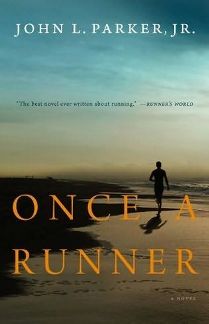
Once A Runner. John L Parker, Jr.

Wow, another running book.  Go figure.  🙂

This one is the first fiction running book I have read, and it is a great story about a college miler.  Beyond the fictitious story, you get a great view into the world of an elite level runner and some view into some of the more intense workouts.  It certainly captured my attention and kept me interested throughout.  And of course I as glad to see Cassidy, the main character, a fan of barefoot running.

Quotes:

  • A runner is a miser, spending the pennies of his energy with great stinginess, constantly wanting to know how much he has spent and how much longer he will be expected to pay. He wants to be broke at precisely the moment he no longer needs his coin.
  • He sought to conquer the physical limitations placed upon him by a three-dimensional world (and if Time is the fourth dimension, that too was his province).
  • If he could conquer the weakness, the cowardice in himself, he would not worry about the rest; it would come. Training was a rite of purification; from it came speed, strength. Racing was a rite of death; from it came knowledge.
  • She found it impossible to tell him that this simply wasn’t the way she had imagined it would be. She was not experienced enough to know that it rarely is.
  • There was no refuge in injury, his body could not be injured in this way. There was no refuge in mercy, there was nothing to forgive and no one to issue dispensation. And at last he saw: there was no refuge in cowardice, because he was not afraid. There was no alternative, it just had to be done.

Worth a read when you need to mix in something fast ,easy, and entertaining into a non-fiction reading list.