Haw River West “Scramble”

I’ve wanted to attempt this run for a while…  Turns out it is much more of a scramble than a run, as there is not a whole lot of trail.  Lots of bushwhacking, bouldering, and even a couple cliff climbs.

Here is what I wrote on Daily Mile:

Ouch! Brutal! Loved it! 🙂

That was much harder than I thought, even though I have done much of the southern sections of this route before, though not all at once. I had not been on the last 2.5 miles or so of the north part before the turn around at Bynum…

Lots of bushwhacking, a few cliff climbs, bouldering. In fact I’d guess that less than 35% of this is on a real trail. And once you pass the power line north of 64, there is NO trail.

I made it to about a quarter mile south of the old Bynum bridge, and I could see the dam at 15/501. But I turned there because I reached someone’s personal property. There were yellow signs showing the “state park” land but with the water as high as it was, I didn’t feel like trespassing. Never know who might pull a shot gun on you! (Next time I’ll just jump on Bynum Beech Road, which I ran next to for a bit.)

I experimented with Chia “fresca” as my only fuel. Two 20 oz bottles of 3-4 TB of chia seeds, a little lime juice, and a little honey, and the rest water.. I will need to try this again. I felt pretty dead by the end, but I can’t tell if that was the course beating it out of me or if it was Chia not fueling me as much as my normal fuel, pPerpetuem.

About 9 minutes slower on the way back, but some of that was route selection. Instead of going “up and over” I went down by the water and with the water level it more bouldering and climbing than I expected!

Looking forward to trying this on the “east” side soon!

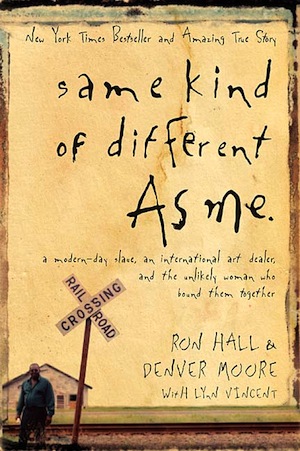
Same Kind of Different As Me. Ron Hall, Denver Moore.

This is another example of how dangerous the Kindle is!  Being able to sample a book, a book I probably would not have glanced at a 2nd time anywhere else, can get you hooked!  I saw this mentioned in blog post by John Piper, where all he said was:

If you want to crawl inside the possible world that opens when a dirt-poor, illiterate, former-share-cropin’, homeless 50-something enters the life of a swank, upscale, southern, Christian art dealer, read Same Kind of Different As Me. These two men tell their increasingly interwoven stories in alternating short chapters that kept me coming back night after night.

So I downloaded the sample, and was hooked a few minutes later.   It was really a great story, well told by the two men who are completely different and write in completely different ways.  Ron, the “rich art dealer,” really strikes a chord with me personally, in how he shows how easy it is to give charitably, but in a distanced manner where you don’t have to risk getting too close, to personally involved.   How true that is!

And Denver is full of wisdom, yet is a person you would never expect it from:

  • There was found in the city a certain poor man who was wise and by his wisdom he saved the city.
  • But you go on down to Louisiana right now, and take a drive on down the back roads in Red River Parish, and you might be able to see how a colored man that couldn’t read and didn’t have no radio, no car, no telephone, and not even ‘lectricity might fall through a crack in time and get stuck, like a clock that done wound down and quit.
  • the more I became convinced we’d enjoy life a whole lot more if we owned a whole lot less
  • on saying yes to being a friend: “Don’t catch and release no matter how difficult it gets.”
  • A successful person is one who is living a joyful life with the hand he or she was dealt.
  • A successful person is one who can thank God for nothin’, and then He’ll give him everything!

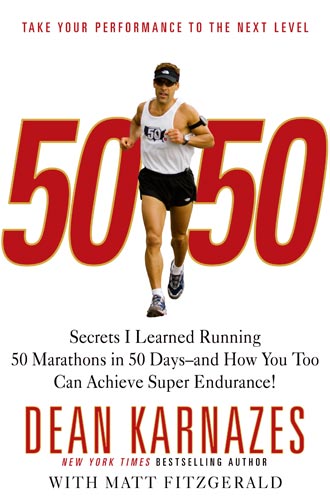
50/50: Secrets I learned running 50 marathons in 50 days…. Dean Karnazes.

After reading Ultramarathon Man, I thought I would read Dean’s second book, which details his journey of running 50 marathons in 50 days in 50 states.  I have to admit, this one did not grab my attention like the other.  I think it is due to the nature of most of the marathon’s — road runs which just don’t excite me.  And the few trail marathons that were thrown in were not of the same level of adventure as the runs in his other book which are more like the long adventure races I prefer.  Still, there were good moments and lots of good quotes, of which I’ll of course include a few.

On “The Awakening” statue:   Most statues, you look at. The Awakening forces you to look in.

(Pretty cool!)

More:

  • “Most people run a race to see who’s the fastest,” he said. “I run a race to see who has the most guts.” — Prefontaine
  • Treat yourself as an experiment of one. Don’t blindly copy the way others train. Try new workouts and methods often; keep those that work for you and discard the rest.
  • I love the motto:  “No Child Left Inside!”
  • Every runner is familiar with the sin of knowing better—of stubbornly pushing ahead despite warnings from the more sensible parts of our minds. The desire to keep running until the task is completed or the goal achieved is so great that it overrides our better knowledge and our self-protective faculties.
  • If everything you knew about life came from TV, your goal would be to live the easiest, most comfortable and unchallenging life you possibly could. You would believe that the only good feelings are sensual pleasures such as the taste of a good soft drink and the fun of driving an expensive car and lying on the beach.
  • … I found myself wondering why so many people like Kris are drawn to marathons and other such challenges these days. I can’t help thinking that the phenomenon is in part a largely unconscious backlash against comfort culture and the easy life. Heated seats and online shopping and robot vacuum cleaners have created a void that we’re all sensing. Our modern comforts and conveniences have accumulated to the point that they have stopped making us feel better and started making us feel worse. Some primal instinct lurking deep inside is trying to tell us that what is needed is a good, hard sweat—some struggle in our lives; some physical challenge.
  • The best way I know to overcome low motivation for running is to get back in touch with the source of my passion to run. Motivation and passion are somewhat different. Passion is an overwhelming love for the experience of a favorite activity. Motivation is a drive to engage in an activity based on some reward the activity offers beyond the simple enjoyment of the experience itself. When you have great passion for running, or anything else, you don’t need any extra motivation. But motivation without passion can only take you so far.
  • As Plato said, “Of all the animals, the boy is the most unmanageable.”
  • Rest was not an option. Endurance never sleeps.
  • He who suffers remembers.

Uhwarrie Mountain Run.

I had tried to get into this race the past few years — the 8 miler or the 20, but never registered in time.  The race typically fills up in 20- 30 minutes.  Due to a registration snafu, I got into the 20 miler twice this year.  I wasn’t sure I’d be ready to run 40, and thought 20 would be plenty.  For a while I thought I might give one of the entries to my sister.  But I also was looking for a reason to run the 40, and when she had plans come up, things fell into place.  All of the old Triangle AR guys were in the 40, and I’ve been running pretty well, so I thought why not go for it.  I could just use the ultra-shuffle to go that distance, right?

The trail and race is notoriously rugged.  Here is an elevation profile:

I’ve run some on the northern section (mile 0-5 or so), though not a whole lot on the trail as we were practicing for a Rogaine, and I had backpacked from the southern end solo last year (miles 20 to 5 or so), so I knew what I was getting into.  Lots of steep climbs, stream crossings (many with no bridges), some without stepping stones, etc.

The week prior Kelly and Reece had not been feeling well.  I used Airbornne all week to try and stay healthy, but the night before the race I got a tickle in my throat, my nose started running, and I just didn’t have much energy.  I went to bed at 8:30 but couldn’t really fall asleep until closer to 10:00.  Luckily on race day I awoke not feeling very sick after all.

I woke up at 3:52 a.m., 3 minutes before my alarm was due to go off.  I got up, made coffee, got dressed, forced down some oatmeal (I hate to eat that soon after waking), and I was out the door by 4:20 or so.

The 90 minute drive to Uhwarrie went by quickly as I jammed to some genius play-list, though I can’t for the life of me recall what song I seeded it with.  None-the-less it was good music and kept me awake.

I arrived at the Church shuttle parking lot a few minutes after 6 a.m.  This year, with the amount of rain there has been, the forrest service did not want racers parking at the start, which is really a trail head with very minimal parking anyway.  I went in to the church to use the facilities, gathered up the gear I wanted, threw on some body glide in the appropriate placeds, got in the shuttle bus, and was at the start by 6:30.

After I quick check-in, I attached my race number to my shorts, made some final gear selections, and hung out.  I ran into Charlie and met Sultan, whose blog I have followed for a while… Here is a link to his race report.

A couple minutes after 7:00 we headed to the road to listen to last minute instructions.   Due to the amount of rain and high streams, some of the crossings on the southern section were deemed too dangerous and we were told that at mile 14 we would have to leave the trail and run a gravel road to the turn-around.  This cut 6 miles of difficult trail out and put in 5 miles of relatively easy) road running in, thus shortening the 40 mile run to 38 and making it a bit easier.  We were also told that depending on conditions they may elect to call the run at 20, which would have been a major disappointment!

Just before the start I decided I should ditch my top layer, a mid weight wool shirt, and just keep my even lighter weight wool base shirt on.  As I ran the 30 meters back to my bag I heard “Get Set! Go!”  Uh-oh, here I am starting the race in last place!   No worries though in a 40 miler, in which my goal is to 1st finish, and then finish in under 10 hours.  (The 10 hour goal was before the course modifications had been put in place.)

The first 50 meters or so is on the paved road up to a short double track trail that then climbs a few hundred feet, before you hit the single track.  I passed some folks on the climb up before we hit the single track, and then settled into an easy pace, passing a few people here and there as the trail permitted.  About 3 miles in I dashed past a pack of 6 or so to get some separation so I could do my own thing.

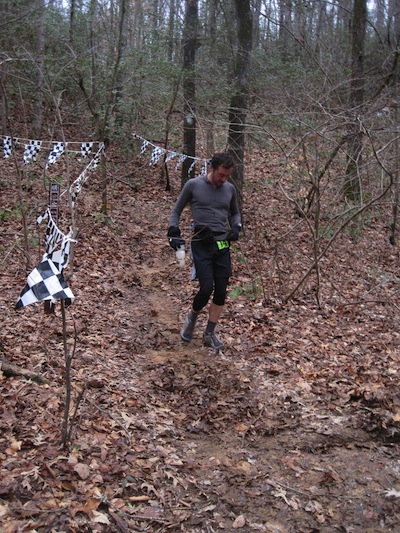
From mile 4 – 9 or so, I ran with Shannon and we talked about a bunch of things, which passed the time.  She had a camera and took a few photos of me, which I’ve included in this post.

Crossing a stream.

Between 4 and 6 miles, snow started to fall and I began to worry about my choice of not wearing any kind of rain/snow shell.  At the last minute I had stuffed it in my turn-around bag, so I had 15 miles or so to go until I could get it, and if the snow turned to rain, I probably would have chilled pretty quickly.   But luckily, the snow stopped and it never rained.  It was beautiful running in the woods with big flakes of snow falling all around.

Shannon had a pretty good fall right after the stream crossing shown here, at about mile 9, and told me to go on.

Just before the aid station at mile 14, the two leaders of the 20 mile run came flyng up behind me – they had started an hour later.  I watched them run off and subsequently tripped and fell pretty hard on my right knee.  Now two days later I don’t know if it is my old patella-femoral syndrome that I feel or the fall!  I lean towards the fall since most of the pain is on the outside of the patella, not underneath, though the PFS is probably contributing a little.

Mile 14 is where we turned on to the 5 mile gravel road instead of continuing on the 6 miles of trail.  Who knows how bad the trail was, but at the end of the day I trust the RD’s.  They put on a great race in not so great conditions, had 8 aid stations well stocked with supplies and volunteers, etc.  And while I would have loved to do the full trail, I still had a great time on the modified course.  Here is the elevation data from the Garmin, which you can compare to the normal course elevation shown above.  Miles 14 – 23 or so are the gravel road…  As you can see pretty level compared to the rest of the course!

The thing with the road, for me, at least, was that I had planned on walking all the steep hills on the trail.  The road, however, only had gradual inclines and declines.  So I ran just about the whole 10 miles, which again, was not really in my race plan and not how I trained.  Watching my average pace on the Garmin showed me go from about a 12:30 minute per mile average down to 11:40 by the turn around, so it was clearly a lot faster.

Only 2 or 3 more twenty milers passed me on the road up to their finish and my turn around.  I was starting to get concerned that maybe the 40 milers were being pulled from the course at the turn, but finally I saw another 40 miler coming back.  And then another, and another, and another… Good, the full race was on!

At the turn around I just put on new socks and grabbed my two extra fuel bottles.  My fueling strategy for this run was to use two 20 oz bottles filled with perpetuem mixed very thickly with water for each half …  One in my hand with water, the other in the pack with just powder, and then drink water at each aid station to dilute it.  I ended up diluting the mix in the bottles by filling them with water at each station.  This strategy worked well and I only had a tiny bit of solid food… About 3/4’s of a bananna at the turn-around; less than one pack of cliff shots, and one hammer gel single serving.  The rest of the run was fueld by my liquid diet of Perpetuem and two or three swallows of Heed the aid stations had.  (About 600 calories per bottle, 4 bottles total, and I never even drank from the 4th bottle!)

Shannon came in to the turn-around and said her leg was fine, and was back out on the road pretty quickly.  After the turn, it was 5 miles back on the gravel road.  I saw many more 20 and 40 milers heading towards the finish/turn, but I could not wait to be back on the trail.  I was really getting sick of the roads!

Sometime around mile 25 or so, a lady in purple came up behind me and we ran together for a while.  She said “that was impressive” when I crossed a stream on high, slipperly log.  I looked back to see her in water up to her thighs, and thought my way was the  better choice.  🙂  After the stream I told her to pass me and she was gone.  She was running some really technical trail like she was a mountain goat — she made it look so easy!  I on the other hand had to walk through some of this section.

From that point on there’s not much to report.  I passed a couple runners, and at least one passed me.  I was just marking time to the aid stations and the finish.

Coming down to the finish is a really rocky section… I was trying to push it to finish in under 8 hours, but it was tough to run here!  I finally came down the last steep descent to finish in something like 7:58.  Here I am coming to the line.  I was trying to make sure my race number was showing so I could find the photo later!  :-/

My goal for the original course was to #1 — finish, and if I finished, to break 10 hours.  I think a 9 hour finish on the original course might have been possible, but pretty tight.  We did a little under 38 miles, and about 9 – 10 of that was on roads.  The roads were definitely easier and faster, though by how much is hard to say.  So add 25-30 minutes for the extra distance, and another 25-30 minutes for the added difficulty, and 9 may have been in reach.

There’s always next year to see!  However, I would really like to do the Mt Mitchell challenge which is another 40 mile run from the town of Black Mountain to the top of Mt. Mitchell and back.  But it is a couple of weeks after Uhwarrie, and I can only handle one of these that close together!

Click here to see the Garmin GPS data…

Ultramarathon Man. Dean Karnazes.

I finished the last ultra running book too far before my own attempt at an Ultra (Uhwarrie 40 miler — tomorrow!), so I searched around to find another and found this book by Dean Karnazes.  Dean ran as a freshman in high school but pretty much gave it up after that until he was 30.  While feeling unfulfilled, though successful in terms of career and salary, he decided to go for a run after getting home from his 30th birthday celebration (which included Tequila!).  And he didn’t stop running all night — in fact he has been running ever since.

At first it was fairly “normal” running of 5 or 6 miles after work, but then he came across two guys training for the Western States 100.  He felt called to attempt that challenge, and eventually moved on to race Badwater (135 miles starting in Death Valley ascending to the top of Mt Whitney), to completing the 1st marathon run to the South Pole, and finally, the book culminates in running a 199 mile relay race solo!

In some ways the stories are like race reports, but they are woven around his metamorphosis into one of the greatest endurance runners ever.  Fascinating read, good writing, and just what I needed with my race tomorrow!

Here are a few quotes… I highlighted much more than this, but many are about training or things I wanted to look into further…

  • He who suffers remembers. —Fortune cookie
  • The cross-country guys hung out in late-night coffee shops and read books by Kafka and Kerouac.  [ as compared to the track guys…]
  • “Don’t run with your legs. Run with your heart.” On some level, even as a high school freshman, I got his meaning: the human body has limitations; the human spirit is boundless.
  • At that moment I realized that my life was being wasted. Disillusioned with the trappings of the corporate scene, the things that really mattered—friendship and exploration, personal expansion and a sense of meaning—had gotten all twisted around making a lot of money and buying stuff. I hungered for a place where I could explore nature and my capabilities, away from a corporate office in a corporate building in a big city with crowded supermalls and people judging me by the car I drove (which, of course, was a new Lexus).
  • As I limped around my office, trying to appear natural, I reminded myself that pain and suffering are often the catalysts for life’s most profound lessons. A passion I’d ignored for half my existence had been serendipitously reignited in one all-night thirty-mile hullabaloo.
  • You’ve got to bundle up self-doubt and fear and stuff them in your shoe, cutting loose your rational mind as your body is pushed to inconceivable levels of endurance.
  • As Lily Tomlin said, “Exercise is for people who can’t handle drugs and alcohol.”
  • Long-distance running requires a certain discretion and reserve. It’s easy to let your ego get the better of you early on and run beyond your means.
  • Most dreams die a slow death. They’re conceived in a moment of passion, with the prospect of endless possibility, but often languish and are not pursued with the same heartfelt intensity as when first born. Slowly, subtly, a dream becomes elusive and ephemeral. People who’ve let their own dreams die become pessimists and cynics.
  • Only those who will risk going too far can possibly find out how far they can go. —T. S. Eliot
  • Start slow, then taper off. —Walt Stack, Bay Area running legend
  • People think I’m crazy to put myself through such torture, though I would argue otherwise. Somewhere along the line we seem to have confused comfort with happiness. I’ve now come to believe that quite the opposite is the case. Dostoyevsky had it right: “Suffering is the sole origin of consciousness.” Never are my senses more engaged than when the pain sets in. There is magic in misery.
  • But life didn’t seem as vibrant without coffee, so I went back to my morning ritual (okay, maybe I am totally addicted after all). [ sounds like me, though I haven’t even tried to give it up!  🙂 ]

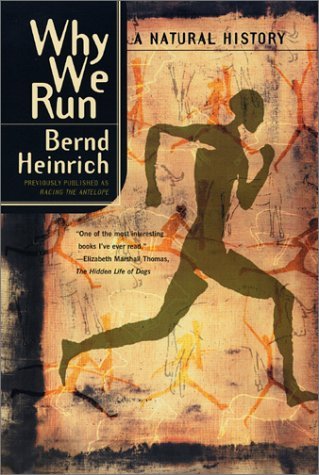
Why We Run. Bernd Heinrich.

It’s funny how a book may come at a time in your life when most appropriate.  I saw “Why We Run” mentioned on a mailing list of minimalist runners (barefoot, vibram five fingers, hauraches,  or minimal shoes), had a “sample” delivered via Amazon’s Kindle, and then had to read the whole thing.  You see, in a few weeks I am about to try my 1st “ultra,” my first running race that goes beyond the marathon distance of 26.2 miles.   Now, I have done longer distances on foot as part of Adventure Races or Rogaine’s (24 hour orienteering events), but I have never gone past 26.2 in a running race.  And the last trail marathon I completed, nearly 7 years ago really bothered my knee, and it has been a loooonnnnnggggg road back.

But here I am, just having finished a 7 mile trail race a month and half ago, and then a 10 mile trail race in the past two weeks, and then a 20 mile training “adventure run” in the past few days.  And in less than three weeks I will be attempting to finish 40 miles in Uhwarrie, a very rugged trail in the middle of North Carolina.  Here is the elevation profile to show you what I mean:

If you can get past the first few chapters of the book, which focuses on cooling, respiratory, fueling, and cardio-vascular systems in bugs and animals, with a little human running mixed in, it becomes a great read about Bernd Heinrich who is attempting his first ultra (at the 100k distance) at age 41, and not only that, but attempting to break the US record at the distance.  (I actually loved the sections on animals, but it may not be for everyone.)  Heinrich has studied different animals and how their bodies are suited for endurance, from moths, to bees, to antelope, to camels, and on and on, and goes through each animal and the pros and cons of the systems they have developed.  He then uses these aspects in his own training, which he calls an experiment of one.   Some of the experiments are crazy, when he tried to drink one beer each mile for 18 miles, or when he downed a quart of honey before heading out for a 20+ mile run.  Many of them were not successful, as you can imagine!

The book culminates with his race in the 100k.  I won’t give you the outcome here.  🙂

I had highlighted many quotes on the Kindle, and imported those into my Evernote note book, but I’ll just include some of the better ones here.  I’ve left out the ones I highlighted related to the science of training, for the most part.

  • I love running cross-country. You come up a hill and see two deer going, “What the hell is he doing?” On a track I feel like a hamster. —ROBIN WILLIAMS, film star
  • An anonymous runner captured the notion in this now-famous aphorism: “Every morning in Africa, an antelope wakes up. It knows it must outrun the fastest lion, or it will be killed. Every morning in Africa, a lion wakes up. It knows it must run faster than the fastest antelope, or it will starve. It doesn’t matter whether you’re a lion or an antelope—when the sun comes up, you’d better be running.”
  • We are, deep down, still runners, whether or not we declare it by our actions. And our minds, as much as our lungs and muscles, are a vital force that empowers our running. Whenever one of us jogs down a road or when we line up to race in a marathon, we are not only celebrating life in general and our individual aliveness but we are also exercising our fantasies while acknowledging reality. We are secure in the knowledge that there is no magic. Which is not to say the world is only of simple logic, because although it may be simple in its design, it is awesomely complex in its details.
  • There is nothing quite so gentle, deep, and irrational as our running—and nothing quite so savage, and so wild.
  • I wanted to do something different. However, that is a difficult thing if you see no opportunity. On the other hand, it is hard not to try when you think you can do something when you have a chance at success, even though it is often hazardous to strike out on one’s own. That seldom goes unpunished. Any mark of difference may become a target. Even my own father, to whom I owe so much, had taught me this harsh lesson.
  • “America is an experiment,” he said, and after a long pause continued, “where the driving force is individuals chasing money. I would not risk my bones for a society guided by this principle.”
  • The test is the race, where credentials mean nothing and performances everything.
  • Every parting gives a foretaste of death, every reunion a hint of resurrection. —ARTHUR SCHOPENHAUER, German philosopher
  • Plato, who participated in the Isthmian Games as a wrestler, as well as Socrates, who was said to keep himself in excellent condition by training in a gymnasium, emphasized the necessity of physical training in a sound education.
  • “The beaver,” we were told, “works when he works, plays when he plays, is strong in individual effort, yet labors for the community good.” The beaver cuts trees individually, yet its dams and lodges are built and maintained communally by the whole clan. Efforts from one generation of beavers contribute also to the well-being of future generations.
  • If we can’t find allies in one context, we will in another. But there is a prerequisite: in order to forge alliances, we first need worthy adversaries. Without adversaries, no alliances are necessary.
  • There is nothing that can make one feel smaller than seeing someone big, which is why many try to talk down those who are more capable than they are. In running, you can’t deceive yourself or anyone else.
  • although animals can reveal mechanisms, our performance, whether it is in a painting or in a race, is ultimately art because there is so much that varies.
  • Furthermore, the key to endurance, as all distance runners know, is not just a matter of sweat glands. It’s vision. To endure is to have a clear goal and the ability to extrapolate to it with the mind—the ability to keep in mind what is not before the eye. Vision allows us to reach into the future, whether it’s to kill an antelope or to achieve a record time in a race.
  • If some animals’ brain hormone production can be triggered by mere flashes of light and other numerous and seemingly trivial external cues, then it does not seem preposterous to consider that just maybe we can be molded by fierce dreams that allow us to perform what we’d otherwise be incapable of accomplishing.
  • Perhaps I had discovered my strength. To not use it fully to try for an inspiring goal seemed wasteful, if not disrespectful, like foolishly squandering a precious gift.
  • To psych oneself up takes self-delusion.
  • Not to give an inch is to give everything.
  • “Now if you are going to win the battle, you have to do one thing. You have to make the mind run the body. Never let the body tell the mind what to do. The body will always give up.” The body can handle only little steps. The mind can take great leaps.
  • “Suffering is the sole origin of consciousness,” Dostoyevsky wrote.

Wow, I better stop there…. Well worth the read if you are into running in any way!

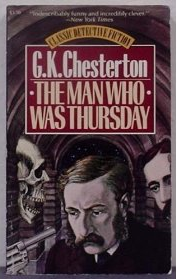
The Man Who Was Thursday. G.K. Chesterton.

First, it’s great that Amazon makes older books available for free, or sometimes 99 cents.

Second, Chesterton’s Orthodoxy is high on my list to read in 2010, but I thought I’d check out some of his fiction too.  I can tell I am going to like him already.  He is a great writer and this is a nice short read, with a few sections that certainly make you think.  Overall the book keeps you guessing as to what might be going on and how things will end.   And finally there is some good Christian allegory mixed in.

And finally, my quotes…  I need a way to get my Kindle clippings to go direct into an evernote not… I’ve seen a few scripts and hacks, but none of them look that promising.  For now it’s going to be a cut and paste.

  • “The soldier must be calm in the thick of the battle,” pursued the policeman. “The composure of an army is the anger of a nation.”
  • But even the moon is only poetical because there is a man in the moon.
  • “Because I am afraid of him,” said Syme; “and no man should leave in the universe anything of which he is afraid.”
  • He had found the thing which the modern people call Impressionism, which is another name for that final scepticism [sic] which can find no floor to the universe.
  • Bad is so bad, that we cannot but think good an accident; good is so good, that we feel certain that evil could be explained.

Little River 10 mile trail run…

Posted this on Dailymile and FB, but thought I’d put it up here too…

16F at the start, but my gear selection was pretty good and I wasn’t too cold and quickly warmed up to a nice temp. I love my buff! Used it as balaclava to start and then just covered the ears after the 1st couple miles.

I had hoped to break 9:00 pace but this is a very technical course. About 5 miles is on a tight mountain bike single track, and it’s really hard to get any speed there. (See the Garmin link below to see what I mean about the 2nd half of the course!)

Considering this was my 1st running race over 7 miles in several years, I am pleased as I was strong throughout even though I was pushing hard. (I have done adventure races that have had longer foot sections, and orienteering courses where I have been “running” longer times, but this was my 1st running race this long…)

The garmin data is here.

Here is a screen shot from the google earth import:

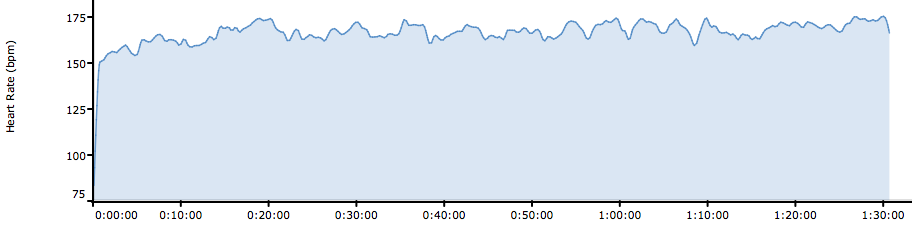
And here is my heart rate… This shows I really could not have gone a whole lot faster.  I was in the 165-175 range and that 175 is definitely pushing anaerobic.  I have not done a max heart rate test in a while, but I would think it is only 178 or so.  So the fact that I was above 165 for so long is a sign my vo2 max is doing pretty good.

The Gift of Asher Lev. Chaim Potok.

As soon as I finished My Name is Asher Lev, I wanted to dive right into the second book.  It was not available on the kindle, but I found my old paper back from many years ago.  The story picks up 20 years later than the 1st book finished… Another excellent read…

Quotes:

  • The seeing of God is not like the seeing of man.  Man sees only between the blinks of his eyes.  He does not know what the world is like during the blinks.  He sees the world in pieces, in fragments.  But the Master of the Universe sees the world whole, unbroken.  That world is good. Our seeing is broken.
  • A person has to have a reason for living, and the best reason is another person…
  • Are we so flawed that we can never truly know our own most secret motives?
  • Without man, what is God?  And without God, what is man?  Everyone needs the help of someone to complete the work of Creation that is never truly completed.
  • Art happens…. when someone interprets, when someone sees the world through his own eyes.  Art happens when what is seen becomes mixed with the inside of the person who is seeing it…  If an exciting new way of seeing an old object results… that’s the beginning of serious art…

My Name is Asher Lev. Chaim Potok.

Who knew when I saw Potok’s “The Chosen” on a friend’s coffee table I would end up reading nearly all of his books again.  (I read most of his books 10 or more years ago!)  He is an engaging story teller, and the Orthodox Jewish culture he immerses his readers in I find completelyfascinating.  “My Name is Asher Lev” is definitely one of my favorites, as it also immerses you in the world of art, which while I have always found fascinating I know very little about.

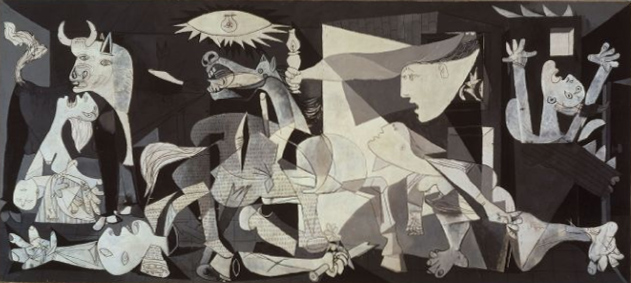
In the story Lev ends up painting a couple paintings that are devastating to his community and family (I don’t want to say any thing more as I hate spoilers!).  I found the following image that is supposed to be like one he painted, though I don’t know for sure where it came from.

Picasso’s Guernica comes up a few times as well, with the quote “You will take a journey to the Museum of Modern Art, you will go up to the second floor, and you will look at a painting called Guernica, by Picasso. You will study this painting. You will memorize this painting. You will do whatever you feel you have to do in order to master this painting.”

And finally my normal list quotes:

  • Every man is responsible for what he does, because he has a will and by that will he directs his life.
  • The candle of God is the soul of man.
  • A life should be lived for the sake of heaven. One man is not better than another because he is a doctor while the other is a shoemaker. One man is not better than another because he is a lawyer while the other is a painter. A life is measured by how it is lived for the sake of heaven. Do you understand me, Asher Lev?
  • If you want to know how to do a thing you must first have a complete desire to do that thing. Then go to kindred spirits—others who have wanted to do that thing—and study their ways and means, learn from their successes and failures and add your quota. Thus you may acquire from the experience of the race. And with this technical knowledge you may go forward, expressing through the play of forms the music that is in you and which is very personal to you.
  • No one will listen to what you have to say unless they are convinced you have mastered it. Only one who has mastered a tradition has a right to attempt to add to it or to rebel against it.
  • My father used to fast. I could never understand the point to it. I fasted a few times when I was young. But when I came to Paris I stopped because it meant nothing to me. It meant nothing to me when I lived in Berlin in the twenties and again in Paris in the thirties. I have had long discussions with the Rebbe about fasting. I have lost the faculty of appreciating such an act of faith.
  • It is both a weakness and a strength to be so stubborn.

p.s. this was my 1st full read on a kindle!