Lila. Robert Pirsig.

lila.jpg

This is Pirsig’s follow up to one of my all time favorites, Zen and the Art of Motorcycle Maintenance (ZAMM). After reading the Guidebook to Zen and ZAMM itself last year, I thought I’d finally dive into this one. It had gotten mixed reviews so I had hesitated for a while. After reading it, I can see why it got mixed reviews. Overall I enjoyed it, but it is not as cohesive as ZAMM, and certainly not the classic I consider ZAMM to be. I guess the main difference is that the narrative story that accompanies the development of the philsophy is just not as strong as it was in ZAMM. Additionally, the philosphy that is developed, while sound, does not hit home for me like ZAMM did.

I still have a lot of dog-eared pages, though not nearly as many as ZAMM (which is my most dog-eared book by far). Here area few notes and quotes on some of those dog-eared pages:

  • There’s an old analogy to a cup of tea. If you want to drink new tea, you have to get rid of the old tea that’s in your cup, otherwise your cup just overlows and you get a wet mess. Your head is like that cup. It has a limited capacity and if you want to learn something about the world you should keep your head empty in order to learn it. It’s very easy to spend you whole life swishing old tea around in your cup thinking it’s great stuff because you’ve never really tried anything new, because you never could get it in….

Kind of like the need for a “Zen” mind before trying something new…. Really trying it.

  • It’s a peculiarly American phenomenon, to catupult people suddenly into celebrity, lavish praise and wealth upon them, and then, at the moment they at last become convinced of their worth, try to destroy them. At their feet and then at their throats.

How true this is! And sad. (Though some celebrities bring it on themselves with their actions and behavior!)

  • And he goes on to say “They love you for being what they want to be but they hate you for being what they’re not.
  • Scientific truth has always contained an overwhelming difference from theological truth: it is provisional. Science always contains an eraser… Thus science, unlike orthodox theology, has been capable of continous, evolutionary growth.
  • On Roberts Rules of Order (which I still need to read!): No minority has a right to block the majority from conducting the legal business of the organizatio. No majority has a right to prevent a minority from peacefully attempting to become a majority.

Personally, I wonder how true this is. It is of course a big argument for non-believers to point back to cases where “the Church” had to change based on new scientific knowledge. But I tend to think that this is only a mis-interpretation of the Scriptures by the Church at that time…

  • There was a comment about Mark Twain and how he lived during the Victorian era, but was not Victorian. It just made me want to go back and read some Mark Twain again because it has been years!
  • The other intersting point, touched on throughough the book, is the division of “metaphysics of quality” into four categories, inorganic, biological, social, and intellectual. I won’t get into the metaphsyics part, but what I found interesting is that Pirsig argues that we have reached a stage where the intellectual category dominates (has a higher level of evolution), so therefore intellect can overthrow/overrule social static patterns. That is why the culture of Victorianism, ruled by strict social rules, faded and we moved on, at first to the “hippy” era and now, even later, to an era where intellectually we can argue away just about any social pattern. This of course creates a lot of discord between those holding on to the old static patterns of acceptable social conduct and those that are out pushing the limits.

So, I would recommend this book, but only if you are a fan of ZAMM.
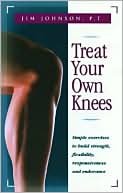
Treat Your Own Knees. Jim Johnson, PT.

knees.jpg

I read this on a quick plane trip to Boston, and it had some decent points. It is of course very very hard, if not impossible, to diagnose knee problems without an extensive in-person evaluation wth an O.S, D.O, or P.T. And even then, as in my case, it can be impossible to determine a true root cause. :-/

At any rate, Johnson has years of experience in treating knee problems, and has found four main areas that patients can work on to improve the pain level of knees and increase knee functionality:

  1. Strength
  2. Flexibility
  3. Proprioception
  4. Endurance

He gives simple exercises for each one — sometimes too simple depending on where you are with your knee and treatment and pain level. For example, on Strength, he uses the very simple “quad press” in which you lie or sit mostly reclined, and press down with extended leg onto a towel. Hold for a few seconds, release, and repeat up to 30 times. Johnson does site research that clearly shows such a simple exercise will increase quad strength over time, so it is a good exercise. But is it enough? That of course depends on where you are…

For flexibility, he lists the tried and true quad stretch, which is one I still use all the time, to try to give my knee cavity more space. I also supplement this with Yoga’s Hero pose. But I think other stretches, beyond just the quad, may be called for depending on your root cause of knee pain. For example, I have a tight ITB (just one of several bio-mechanical problems I have!), so ITB stretches are also part of my routine.

Proprioception is the abilty of your mind to know where and how your leg is placed. Standing on one leg and balancing is the exercise he uses to improve this ability. And if you can do that, try closing your eyes and counting to 30! I have been doing this one for a while, and I do believe it is beneficial. I also supplement it with Yoga’s Tree position. In Tree, you can look at a point in front of you (easier), or look at your finger tips (harder!)

The final item is endurance, and he suggests walking. Walking on a road, on a treadmill, in the water, wherever. I agree with this and have been walking more, though I do miss running. :-/ (I am running once or twice a week, up to 30 minutes, but I am so slow compared to before!)

I would add to both strength and endurance by stating that an Electro-stim unit such as the Compex or Globus are beneficial. I just realized I never blogged on my Compex unit, so I will try to do that soon. Briefly, the compex allows me to work on muscle strength and endurance without joint movement. For me, many of the strength exercises proscribed by my PT would irritate my knee. So I’ve been running the strength program on my quads and hams to build up the supporting muscles of the knee, in an effort to help solve some of my knee issues. I have not used the endurance program that often, but I have, and do believe it does help with muscular endurance as well.

Overall this is a quick read, and if you have been dealing with knee pain for some time, and have been trying to solve the problem by working with doctors, PT’s, or on you own, there probably isn’t that much new information here. But it does not hurt to read it, and perhaps incorporate some of his suggestions into your daily routine if you have strayed from any of them.

Broken vs. Unbroken People

I love to listen to Pastor Bob Coy’s Acitve Word podcasts when I travel, and recently he had the following to say about broken vs. unbroken people that he referenced from a Moody’s Magazine article.

It seemed worthy of posting here so I can reference it in the future.

Prideful and Unbroken Person Humble and Broken Person
focuses on the failures of others overwhelmed with a sense of their own spiritual need
maintains control (has to be their way) surrenders control and looks for the best way
feels confident in how much they know humbled by how much they have to learn
rebelious towards others in authority very submissive to authority
defensive when criticized receives criticizm with a hungry and open heart
works to maintain image, protect reputation dies to his own reputation
has a hard time saying “i am wrong” quick to admit failure and seek forgiveness
waits for others to come and ask for forgiveness takes initiative to be reconciled
believes the “ministry is priviledged to have me” believes “i don’t deserve to serve in this ministry”

If you hvae iTunes and want to check out the Active Word podcast, click here.

Long Distance Hiking. Lessons from the Appalachian Trail.

hike.jpg

Roland Mueser. 1998.

I’ve been reading this off and on the past several months, and finally finished it. Overall a good book, though it is starting to be dated in some areas, especially anything that has to do with gear technology.

Roland Mueser hiked the entire trail in the early 90’s, and then surveyed 125+ hikers that also thru-hiked that year after they all had finished, and compiled information on just about every aspect of long distance hiking, especially as related to the AT. Gear, food, sleeping, wildlife, planning, etc…

Much of the book is really good, but gear technology has changed so much, that many sections are definitely out dated now. Clothing, packs, footware, etc. are all much different than 15-20 years ago!

However, reading a book like this definitely makes me want to do the whole thing! I pretty much always have, but reading about it just makes my desire that much stronger. But with my family and job and knees, I doubt it will ever happen, but I can still dream. 🙂

Wolves of Calla, Song of Susannah, and The Dark Tower

  13721798.jpg13721808.jpg13721834.jpg

Well, I finished the last three books in the seven book series finally. I have to say that their appeal to me went down after book three as I got into books four, and especially five, six, and seven. I will say why just below, but in case you have not read them, my reasons could be seen as a SPOILER.

So don’t read any more if you don’t want that. 🙂

So, two major reasons:

1) First, and not as big an issue to me as the next reason, is that King started putting himself as a character into the books (metafiction). Again, not a huge deal, and it actually works in this particular story… But not a favorite technique of mine (unless the books are first person from the git-go).

2) Second, and more important to me, is that the series went from a combo western/epic fantasy book to much more of a horror genre, complete with vampires, a spider/man-child combo, etc. Of course horro is King’s speciality, so it is not surprising; but to me, I prefered it before when it was more western/fantasy.

Of course I continued to read, and was very interested in the outcome. King, as always, is a crafty story teller. So those two items aren’t the end of the world by any means, and I would still recommend the entire series, with caveats, for anyone that has time to read 3000 pages for entertainment and likes such stories. 🙂