Real Food. Nina Plank.

I saw this book mentioned on the google minimalist (running) list saying it was a bit more approachable than some other books on the paleo diet, though after reading this I don’t know how paleo it really is.  Guess I’d have to read a paleo book after all.  Or maybe it mentioned Weston Price and Price is not paleo??  I don’t know.  I have read so few food/nutrition books in the past few years that maybe it has all passed me by.  Guess I have become pretty comfortable with my diet!

This book touts moving back to the way food was before it was industrialized, including farm animals, milk, eggs, and produce.  Getting away from grain fed beef and chicken when that is not their natural diet, not eating farm raised fish, getting back to locally grown produce, etc.  And I’m all for that, though I don’t eat a lot of meat…  She was very into using butter — which I never used a whole lot of margin but only went for the real thing — butter is better!; whole milk — I normally do skim or 2% but am now considering sticking with just 2%; eggs – i love ’em — but only pastured so they can be omnivorous as they were ment to be.  She was against all industrial oils (which pretty much leaves olive oil as the only oil).  And all in all getting away from as much process and pre-packaged food as possible, which I already try to do.

Just a few quotes:

  • Is drinking milk unnatural? The critics say that cow milk was “designed” for newborn calves, not for humans. That’s true. But this observation does not prove that the human digestive system cannot, or should not, handle milk. After all, the tomato was designed to make more tomato plants, not pasta sauce.  [ i’ve been guilty of saying this in the past, but I would still say we shouldn’t drink it constantly… everything in moderation!]
  • Aren’t some fats unhealthy? Yes. It’s easy to remember the bad ones: they are the industrial fats recently added to our diet. The unhealthy fats are refined vegetable oils, including corn, safflower, sunflower, and soybean oil, and synthetic trans fats. Trans fats are formed by hydrogenation, in which unsaturated oils are pelted with hydrogen atoms to make an artificially saturated fat. That’s how they make firm margarine from liquid corn oil.
  • To reap all the flavor and health benefits of olive oil, buy the best oil you can afford, ideally extra-virgin, cold-pressed, and organic.
  • The sooner we ban trans fats— as Denmark has— the better.

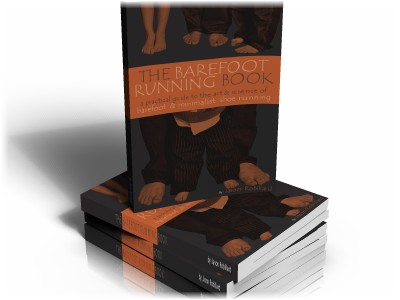
The Barefoot Running Book. Jason Robillard.

Jason is one of the contributors to the Google Minimalist list (http://groups.google.com/group/huaraches/) and when I saw he had a book coming out, even though it is a bit more for beginners, I thought I’d grab a copy.  Over all it is a good read, though it is definitely geared towards the newer barefoot runners out there.  I would definitely recommend it to you if you are in that camp — not withstanding his sense of humor!  😉

Quotes that are worth sharing:

  • Leonardo Da Vinci called the human foot “… a work of art, a marvel of engineering…”
  • wearing shoes decreases the runners ability to judge impact… As such, shod runners produce far greater impact forces [… than barefoot/minimalist]  (I can certainly attest to that, as I currently run barefoot, minimalist, and with traditional shoes…  I can definitely feel the difference.)
  • it will become increasingly difficult to run in traditional shoes.  Your feet will feel incredibly heavy and the rest of your body will rebel against the pounding…  (Another thing that I am finding very true…  Traditional shoes no longer feel comfortable to run in, and my shoes are trending more and more minimalist.  Luckily we are on the precipice of a large variety of minimalist options, something that has not been the case until very recently.)
  • “Each of us is an experiment of one – observer and subject making choices, living with them, recording the effects.” — George Sheehan

Thoughts worth sharing:

  • He brings up the analogy of baby formula vs. mother’s milk, and how an entire generation was lead to believe that formula is better.  But then over time that fallacy was proven, and now it is well known mother’s milk is better (as long as that is possible).  Are we witnessing the same thing with running shoes?  I’m a firm believer in the right tool (shoe) for the job (run/terrain), but also that the more minimalist the better!
  • He suggests running on hard surfaces such as pavement before grass and trails.  I am not so sure I agree.  While trails I would definitely say are “advanced,” I found my short 2-3 minute runs on grass a great way to start the foot strengthening process.   Yet at the same time, I do believe that forgiving surfaces will allow you to miss problems with your form and perhaps delay the transition to proper form…  Its also the case that wearing a minimalist shoe before you have good form can be a recipe for disaster.  So I would recommend 100% barefoot, hard surface running early.  But I also think foot strengthening via exercise, walking barefoot and various surfaces, and yes, running on grass, is good in the early stages.  Just be sure to mix in hard surfaces as well!

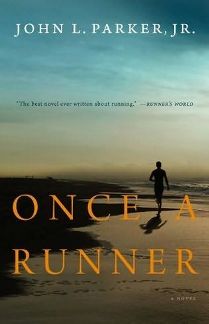
Once A Runner. John L Parker, Jr.

Wow, another running book.  Go figure.  🙂

This one is the first fiction running book I have read, and it is a great story about a college miler.  Beyond the fictitious story, you get a great view into the world of an elite level runner and some view into some of the more intense workouts.  It certainly captured my attention and kept me interested throughout.  And of course I as glad to see Cassidy, the main character, a fan of barefoot running.

Quotes:

  • A runner is a miser, spending the pennies of his energy with great stinginess, constantly wanting to know how much he has spent and how much longer he will be expected to pay. He wants to be broke at precisely the moment he no longer needs his coin.
  • He sought to conquer the physical limitations placed upon him by a three-dimensional world (and if Time is the fourth dimension, that too was his province).
  • If he could conquer the weakness, the cowardice in himself, he would not worry about the rest; it would come. Training was a rite of purification; from it came speed, strength. Racing was a rite of death; from it came knowledge.
  • She found it impossible to tell him that this simply wasn’t the way she had imagined it would be. She was not experienced enough to know that it rarely is.
  • There was no refuge in injury, his body could not be injured in this way. There was no refuge in mercy, there was nothing to forgive and no one to issue dispensation. And at last he saw: there was no refuge in cowardice, because he was not afraid. There was no alternative, it just had to be done.

Worth a read when you need to mix in something fast ,easy, and entertaining into a non-fiction reading list.

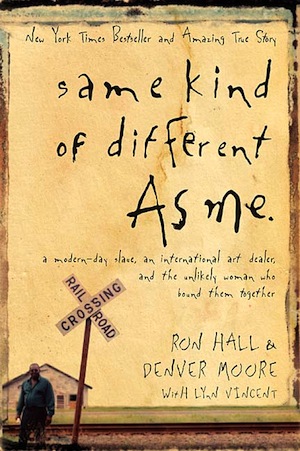
Same Kind of Different As Me. Ron Hall, Denver Moore.

This is another example of how dangerous the Kindle is!  Being able to sample a book, a book I probably would not have glanced at a 2nd time anywhere else, can get you hooked!  I saw this mentioned in blog post by John Piper, where all he said was:

If you want to crawl inside the possible world that opens when a dirt-poor, illiterate, former-share-cropin’, homeless 50-something enters the life of a swank, upscale, southern, Christian art dealer, read Same Kind of Different As Me. These two men tell their increasingly interwoven stories in alternating short chapters that kept me coming back night after night.

So I downloaded the sample, and was hooked a few minutes later.   It was really a great story, well told by the two men who are completely different and write in completely different ways.  Ron, the “rich art dealer,” really strikes a chord with me personally, in how he shows how easy it is to give charitably, but in a distanced manner where you don’t have to risk getting too close, to personally involved.   How true that is!

And Denver is full of wisdom, yet is a person you would never expect it from:

  • There was found in the city a certain poor man who was wise and by his wisdom he saved the city.
  • But you go on down to Louisiana right now, and take a drive on down the back roads in Red River Parish, and you might be able to see how a colored man that couldn’t read and didn’t have no radio, no car, no telephone, and not even ‘lectricity might fall through a crack in time and get stuck, like a clock that done wound down and quit.
  • the more I became convinced we’d enjoy life a whole lot more if we owned a whole lot less
  • on saying yes to being a friend: “Don’t catch and release no matter how difficult it gets.”
  • A successful person is one who is living a joyful life with the hand he or she was dealt.
  • A successful person is one who can thank God for nothin’, and then He’ll give him everything!

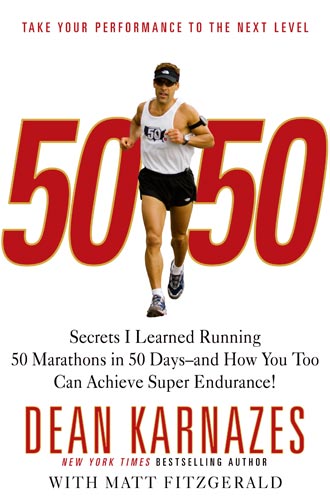
50/50: Secrets I learned running 50 marathons in 50 days…. Dean Karnazes.

After reading Ultramarathon Man, I thought I would read Dean’s second book, which details his journey of running 50 marathons in 50 days in 50 states.  I have to admit, this one did not grab my attention like the other.  I think it is due to the nature of most of the marathon’s — road runs which just don’t excite me.  And the few trail marathons that were thrown in were not of the same level of adventure as the runs in his other book which are more like the long adventure races I prefer.  Still, there were good moments and lots of good quotes, of which I’ll of course include a few.

On “The Awakening” statue:   Most statues, you look at. The Awakening forces you to look in.

(Pretty cool!)

More:

  • “Most people run a race to see who’s the fastest,” he said. “I run a race to see who has the most guts.” — Prefontaine
  • Treat yourself as an experiment of one. Don’t blindly copy the way others train. Try new workouts and methods often; keep those that work for you and discard the rest.
  • I love the motto:  “No Child Left Inside!”
  • Every runner is familiar with the sin of knowing better—of stubbornly pushing ahead despite warnings from the more sensible parts of our minds. The desire to keep running until the task is completed or the goal achieved is so great that it overrides our better knowledge and our self-protective faculties.
  • If everything you knew about life came from TV, your goal would be to live the easiest, most comfortable and unchallenging life you possibly could. You would believe that the only good feelings are sensual pleasures such as the taste of a good soft drink and the fun of driving an expensive car and lying on the beach.
  • … I found myself wondering why so many people like Kris are drawn to marathons and other such challenges these days. I can’t help thinking that the phenomenon is in part a largely unconscious backlash against comfort culture and the easy life. Heated seats and online shopping and robot vacuum cleaners have created a void that we’re all sensing. Our modern comforts and conveniences have accumulated to the point that they have stopped making us feel better and started making us feel worse. Some primal instinct lurking deep inside is trying to tell us that what is needed is a good, hard sweat—some struggle in our lives; some physical challenge.
  • The best way I know to overcome low motivation for running is to get back in touch with the source of my passion to run. Motivation and passion are somewhat different. Passion is an overwhelming love for the experience of a favorite activity. Motivation is a drive to engage in an activity based on some reward the activity offers beyond the simple enjoyment of the experience itself. When you have great passion for running, or anything else, you don’t need any extra motivation. But motivation without passion can only take you so far.
  • As Plato said, “Of all the animals, the boy is the most unmanageable.”
  • Rest was not an option. Endurance never sleeps.
  • He who suffers remembers.

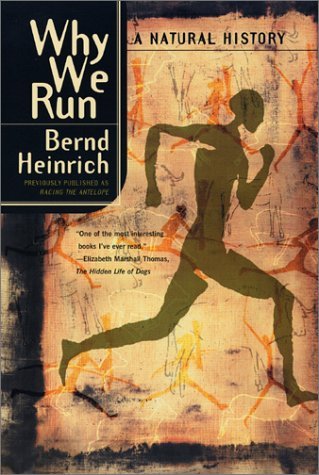
Why We Run. Bernd Heinrich.

It’s funny how a book may come at a time in your life when most appropriate.  I saw “Why We Run” mentioned on a mailing list of minimalist runners (barefoot, vibram five fingers, hauraches,  or minimal shoes), had a “sample” delivered via Amazon’s Kindle, and then had to read the whole thing.  You see, in a few weeks I am about to try my 1st “ultra,” my first running race that goes beyond the marathon distance of 26.2 miles.   Now, I have done longer distances on foot as part of Adventure Races or Rogaine’s (24 hour orienteering events), but I have never gone past 26.2 in a running race.  And the last trail marathon I completed, nearly 7 years ago really bothered my knee, and it has been a loooonnnnnggggg road back.

But here I am, just having finished a 7 mile trail race a month and half ago, and then a 10 mile trail race in the past two weeks, and then a 20 mile training “adventure run” in the past few days.  And in less than three weeks I will be attempting to finish 40 miles in Uhwarrie, a very rugged trail in the middle of North Carolina.  Here is the elevation profile to show you what I mean:

If you can get past the first few chapters of the book, which focuses on cooling, respiratory, fueling, and cardio-vascular systems in bugs and animals, with a little human running mixed in, it becomes a great read about Bernd Heinrich who is attempting his first ultra (at the 100k distance) at age 41, and not only that, but attempting to break the US record at the distance.  (I actually loved the sections on animals, but it may not be for everyone.)  Heinrich has studied different animals and how their bodies are suited for endurance, from moths, to bees, to antelope, to camels, and on and on, and goes through each animal and the pros and cons of the systems they have developed.  He then uses these aspects in his own training, which he calls an experiment of one.   Some of the experiments are crazy, when he tried to drink one beer each mile for 18 miles, or when he downed a quart of honey before heading out for a 20+ mile run.  Many of them were not successful, as you can imagine!

The book culminates with his race in the 100k.  I won’t give you the outcome here.  🙂

I had highlighted many quotes on the Kindle, and imported those into my Evernote note book, but I’ll just include some of the better ones here.  I’ve left out the ones I highlighted related to the science of training, for the most part.

  • I love running cross-country. You come up a hill and see two deer going, “What the hell is he doing?” On a track I feel like a hamster. —ROBIN WILLIAMS, film star
  • An anonymous runner captured the notion in this now-famous aphorism: “Every morning in Africa, an antelope wakes up. It knows it must outrun the fastest lion, or it will be killed. Every morning in Africa, a lion wakes up. It knows it must run faster than the fastest antelope, or it will starve. It doesn’t matter whether you’re a lion or an antelope—when the sun comes up, you’d better be running.”
  • We are, deep down, still runners, whether or not we declare it by our actions. And our minds, as much as our lungs and muscles, are a vital force that empowers our running. Whenever one of us jogs down a road or when we line up to race in a marathon, we are not only celebrating life in general and our individual aliveness but we are also exercising our fantasies while acknowledging reality. We are secure in the knowledge that there is no magic. Which is not to say the world is only of simple logic, because although it may be simple in its design, it is awesomely complex in its details.
  • There is nothing quite so gentle, deep, and irrational as our running—and nothing quite so savage, and so wild.
  • I wanted to do something different. However, that is a difficult thing if you see no opportunity. On the other hand, it is hard not to try when you think you can do something when you have a chance at success, even though it is often hazardous to strike out on one’s own. That seldom goes unpunished. Any mark of difference may become a target. Even my own father, to whom I owe so much, had taught me this harsh lesson.
  • “America is an experiment,” he said, and after a long pause continued, “where the driving force is individuals chasing money. I would not risk my bones for a society guided by this principle.”
  • The test is the race, where credentials mean nothing and performances everything.
  • Every parting gives a foretaste of death, every reunion a hint of resurrection. —ARTHUR SCHOPENHAUER, German philosopher
  • Plato, who participated in the Isthmian Games as a wrestler, as well as Socrates, who was said to keep himself in excellent condition by training in a gymnasium, emphasized the necessity of physical training in a sound education.
  • “The beaver,” we were told, “works when he works, plays when he plays, is strong in individual effort, yet labors for the community good.” The beaver cuts trees individually, yet its dams and lodges are built and maintained communally by the whole clan. Efforts from one generation of beavers contribute also to the well-being of future generations.
  • If we can’t find allies in one context, we will in another. But there is a prerequisite: in order to forge alliances, we first need worthy adversaries. Without adversaries, no alliances are necessary.
  • There is nothing that can make one feel smaller than seeing someone big, which is why many try to talk down those who are more capable than they are. In running, you can’t deceive yourself or anyone else.
  • although animals can reveal mechanisms, our performance, whether it is in a painting or in a race, is ultimately art because there is so much that varies.
  • Furthermore, the key to endurance, as all distance runners know, is not just a matter of sweat glands. It’s vision. To endure is to have a clear goal and the ability to extrapolate to it with the mind—the ability to keep in mind what is not before the eye. Vision allows us to reach into the future, whether it’s to kill an antelope or to achieve a record time in a race.
  • If some animals’ brain hormone production can be triggered by mere flashes of light and other numerous and seemingly trivial external cues, then it does not seem preposterous to consider that just maybe we can be molded by fierce dreams that allow us to perform what we’d otherwise be incapable of accomplishing.
  • Perhaps I had discovered my strength. To not use it fully to try for an inspiring goal seemed wasteful, if not disrespectful, like foolishly squandering a precious gift.
  • To psych oneself up takes self-delusion.
  • Not to give an inch is to give everything.
  • “Now if you are going to win the battle, you have to do one thing. You have to make the mind run the body. Never let the body tell the mind what to do. The body will always give up.” The body can handle only little steps. The mind can take great leaps.
  • “Suffering is the sole origin of consciousness,” Dostoyevsky wrote.

Wow, I better stop there…. Well worth the read if you are into running in any way!

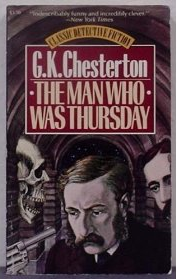
The Man Who Was Thursday. G.K. Chesterton.

First, it’s great that Amazon makes older books available for free, or sometimes 99 cents.

Second, Chesterton’s Orthodoxy is high on my list to read in 2010, but I thought I’d check out some of his fiction too.  I can tell I am going to like him already.  He is a great writer and this is a nice short read, with a few sections that certainly make you think.  Overall the book keeps you guessing as to what might be going on and how things will end.   And finally there is some good Christian allegory mixed in.

And finally, my quotes…  I need a way to get my Kindle clippings to go direct into an evernote not… I’ve seen a few scripts and hacks, but none of them look that promising.  For now it’s going to be a cut and paste.

  • “The soldier must be calm in the thick of the battle,” pursued the policeman. “The composure of an army is the anger of a nation.”
  • But even the moon is only poetical because there is a man in the moon.
  • “Because I am afraid of him,” said Syme; “and no man should leave in the universe anything of which he is afraid.”
  • He had found the thing which the modern people call Impressionism, which is another name for that final scepticism [sic] which can find no floor to the universe.
  • Bad is so bad, that we cannot but think good an accident; good is so good, that we feel certain that evil could be explained.

The Gift of Asher Lev. Chaim Potok.

As soon as I finished My Name is Asher Lev, I wanted to dive right into the second book.  It was not available on the kindle, but I found my old paper back from many years ago.  The story picks up 20 years later than the 1st book finished… Another excellent read…

Quotes:

  • The seeing of God is not like the seeing of man.  Man sees only between the blinks of his eyes.  He does not know what the world is like during the blinks.  He sees the world in pieces, in fragments.  But the Master of the Universe sees the world whole, unbroken.  That world is good. Our seeing is broken.
  • A person has to have a reason for living, and the best reason is another person…
  • Are we so flawed that we can never truly know our own most secret motives?
  • Without man, what is God?  And without God, what is man?  Everyone needs the help of someone to complete the work of Creation that is never truly completed.
  • Art happens…. when someone interprets, when someone sees the world through his own eyes.  Art happens when what is seen becomes mixed with the inside of the person who is seeing it…  If an exciting new way of seeing an old object results… that’s the beginning of serious art…

My Name is Asher Lev. Chaim Potok.

Who knew when I saw Potok’s “The Chosen” on a friend’s coffee table I would end up reading nearly all of his books again.  (I read most of his books 10 or more years ago!)  He is an engaging story teller, and the Orthodox Jewish culture he immerses his readers in I find completelyfascinating.  “My Name is Asher Lev” is definitely one of my favorites, as it also immerses you in the world of art, which while I have always found fascinating I know very little about.

In the story Lev ends up painting a couple paintings that are devastating to his community and family (I don’t want to say any thing more as I hate spoilers!).  I found the following image that is supposed to be like one he painted, though I don’t know for sure where it came from.

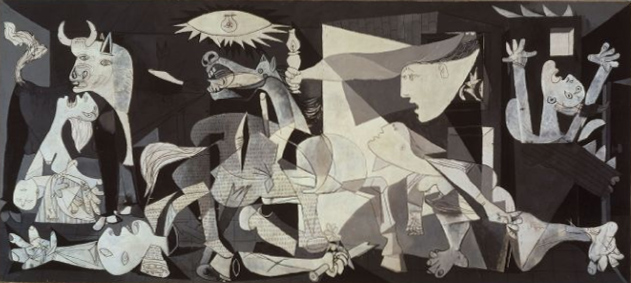
Picasso’s Guernica comes up a few times as well, with the quote “You will take a journey to the Museum of Modern Art, you will go up to the second floor, and you will look at a painting called Guernica, by Picasso. You will study this painting. You will memorize this painting. You will do whatever you feel you have to do in order to master this painting.”

And finally my normal list quotes:

  • Every man is responsible for what he does, because he has a will and by that will he directs his life.
  • The candle of God is the soul of man.
  • A life should be lived for the sake of heaven. One man is not better than another because he is a doctor while the other is a shoemaker. One man is not better than another because he is a lawyer while the other is a painter. A life is measured by how it is lived for the sake of heaven. Do you understand me, Asher Lev?
  • If you want to know how to do a thing you must first have a complete desire to do that thing. Then go to kindred spirits—others who have wanted to do that thing—and study their ways and means, learn from their successes and failures and add your quota. Thus you may acquire from the experience of the race. And with this technical knowledge you may go forward, expressing through the play of forms the music that is in you and which is very personal to you.
  • No one will listen to what you have to say unless they are convinced you have mastered it. Only one who has mastered a tradition has a right to attempt to add to it or to rebel against it.
  • My father used to fast. I could never understand the point to it. I fasted a few times when I was young. But when I came to Paris I stopped because it meant nothing to me. It meant nothing to me when I lived in Berlin in the twenties and again in Paris in the thirties. I have had long discussions with the Rebbe about fasting. I have lost the faculty of appreciating such an act of faith.
  • It is both a weakness and a strength to be so stubborn.

p.s. this was my 1st full read on a kindle!

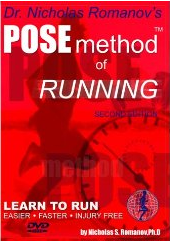
Pose Method of Running

Pictured are both the book and the DVD…  Both are somewhat expensive relative to most books and DVDs, so I would recommend spending a fair amount of time on the web site before purchasing, to make sure they are for you.

The Pose method is similar to Chi Running, which I read and reviewed here, though Pose is much more “scientific.”  Chi is kind of go with the flow, and use nature (gravity) and your body as you feel, while Pose feels and sounds more scientifically grounded.  At the end of the day, both forms are quite similar.  Both utilize a very slight forward lean so that you are working with gravity, not against it.  Both teach you to run without braking, by modifying your form.  (Forward lean is really not the best word or image for what is going on, but it is all we have…)

I’m working on many of the drills in the book and in the video.  I would definitely say the video is a must on some of the drills, as seeing them in action by a real person vs. just reading about them makes a huge difference in understanding exactly what must be done.

One cool thing is about 1/2 way through the book, when you still have not done any running or any drills, he tells you to go to a local race to watch.  Watch the differences between the elite runners and the back of the pack.  How quiet and efficient the fast runners are vs. how loud and clumsy the slow runners are.  Watch the heel strike of the slow runners vs. the ball of foot/mid foot strike of the fast runners.  Watch the amount of time the fast runners foot stays on the ground, which is tremendously minimal vs. the slow runners, which can seem like an eternity.  I happened to go to a race to watch my wife run, and it was amazing to see how accurate all of this was.

Quote: When you understand one thing through and through, you understand everything.  Shunyro Suzuki

(Thus the need for doing the drills over and over…)

I’m still working on the drills, but I would say the form as outlined is sound, and the drills should help you get there.  I especially like his stance on barefoot training (he is fore it)…  And I love jumping rope barefoot.