BioPrint

In my continuing effort to document things I tried before surgery, here’s a post on bioprinting.

I can’t recall exactly where I saw the information on bioprinting, but at any rate, it led me to a local rolfer who does it. I eventually did 10 rolfing sessions with her as well as the bioprint, and I’ll post on rolfing at some point.

The official web page for bioprints is www.biotronix.com.

After reading about it, I thought I’d give it a shot. Basically a bunch of sensors are placed on your body, several digital photos are taken, and then those photos are uploaded to biotronix, and a report is sent back. The report contains an analysis of where you are “off” and exercises you can do to try to correct some of those problems. By where you are off, I mean structural imbalances, such as a pelvis that tilts too much, a center of gravity that is off, etc.

You can view my report here.

Overall it’s a quick process and I thought the analysis was pretty accurate. It also (mostly) matched up with the analysis my PT had given. Since I had done yoga for a long time, I already knew several of my problem areas, and the bioprint found all of those, plus a few. The major area that it was off compared to what my PT said was my anterior pelvic tilt. My PT had me working on that extensively, while the bioprint said I was within range. However, I was just barely within their 10% guideline, so this was not really that far off from showing up as a problem on the bioprint.

The bioprint gives you a 10 week program of exercises to follow, and I don’t think anything other than very minor issues would actually change in such a short time. But I am a big believer in the power of yoga to fix alignment issues and strength imbalances over time, and the bioprint’s combinations of stretching one muscle while strengthening its opposite, is really not that different. Yoga of course is a whole body approach, although I think there are times when a yoga teacher will have you concentrate on one set of poses to solve a particular problem. But bioprints are very specific to the problems they find.

While I did the majority of the exercises in the program, and either combined them with or added them to, my PT exercises, I didn’t see the changes I had hoped for. I probably didn’t do them quite enough, because at times I was overwhelmed with the number of PT + bioprint exercises, while still wanting to get back to running and riding. However, I will start to do several of them again, once my knee heals enough from surgery.

I would like to see bioprint include a follow-up visit at the end of the exercise program, to re-evaluate your body and see if any changes have occured. You can always spend $150 for another print and report, of course, but it would be nice if they included that up front for an extra $50 or so.

If you are a person who does not know where your potential problem areas are, I don’t think the $150 would be a waste of money. It will show you some biomechanical issues that may be contributing to your knee (or other) problems.

My “bubble” burst!

Saturday I was at our annual home owners meeting, in someone elses house, and was flexing my knee a bit just standing there, when my bubble burst! Ok, so my bubble is the “pone” above the lateral portal. (The portal is where an arthoscopic insertion point is made.) This pone had been quite large and had been growing — I should have taken a picture of it — and my PT and Dr. had both commented on it as one of the larger ones they had seen. Both said that it would eventually go away, but neither said it would burst!

I literally heard some kind of pop and splat sound. I looked down and saw what appeared to be the inside of a cherry tomato, minus the seeds, lying on the floor. It took me a minute to realize there was liquid running down my leg too, and then I finally figured out what had happened. It was a bit embarassing to say the least! Thankfully, it had happened on hardwood rather than white carpet, so it was easy to clean.

I taped it with some gauze, but it continued to drain the rest of the day. And I kind of forced some drainage later that night by flexing it a lot and massaging the liquid out. I figured while it was open, I might as well let it flow. That way there’d definitely be no need to drain it later. The liquid was clear with a very slight red/pink tint, and odorless, so it wasn’t infected inside. I then taped it pretty good and it seemed sealed the next day.

Today (Monday), I called the Dr. to let him know what happened, and he wanted to see me to make sure all was ok. So he took a look and seems happy with the knee overall. Swelling way down, the fluid seemed benign, etc. He said I should limit knee flex the next few days — so no more cycling and knee flex stretches. This is in order to allow the portal to fully heal. He explained that he had to put the portal a bit further up than normal, in order to remove a “mass of tissue” as he called it today (plica) that was where the portal would normally be. So the portal is just above a bony protrusion, and its getting rubbed from the inside.

I also explained that I had a bit of a “catching” or “grating” feeling in the medial inferior patella area. I had actually gotten a bit sore here last week so had limited some of my PT. It got worse after the fluid drain. Some of that may be due to the taping — I think the tape limited the patella movement, so there was a bit more rubbing. Or it could just be that there’s less fluid in there cushinioning it now. He didn’t seem to concerned and said to just watch in the next few days to see if that dissipates.

After the doctor appointment, I had PT, and we just did some quad sets with electro stim and leg raises with 2 lbs ankle weights and electro stim. This was somewhat more limited of what we had originally planned in light of the fluid draining and Dr.’s orders to limit flexing the knee for a few days.

PT appointment

I met with S. again today, and she did patella mobilizations, knee flex stretches, and electro stim for 30 minutes. The 1st few minutes I did quad presses when the ES was activated, and then after that I did leg raises while contracting the quad when the ES was activated.

As far as knee flexion, she measured me at 132 degrees, which is much better than just 1 week ago. It’s still tender if you go that far but it is certainly getting better. Overall she seems pretty happy with my progress — she was very surprised that I’ve been using the R leg now going up and down stairs. (Down is a bit harder.)

She wants me to add a couple more leg raises to my work now — one lying on my R side, L leg drapped over the right, and lift the R leg; and the other lying on my L side and just raising the R leg.. I’ll see if I can find some pictures of these.

I’ve been pretty good about my workouts 2X / day:

– 6 min walk on treadmill @ ~ 3.4 pmh
– 5 min stationary bike
– 30 x 5 sec hold quad press
– 30 x 5 sec hold hamstring press
– 30 straight leg lifts
– 10 X knee flexions with an isometric push out b/w flexions
– a few down dogs thrown in here and there

I will start to increase the time on the treadmill and bike tomorrow.

2nd PT appointment

I had my 2nd PT appointment yesterday. My regular PT, B., is gone, so I met with S. She did some patella mobilizations, assisted knee flexion stretches, and then hooked me up to the electro stim for 25 minutes. This time ES was for strengthening, not reducing the swelling, and I did “quad presses” whenever the ES was sending stim to my leg and making the muscle contract. Normally with quad presses I don’t feel like I’m getting much done, but with the ES, there was some definite feelings of tiredness at the end. We also did a few straight leg raises while lying flat on my back, and I can start incorporating these into my home PT.

I’ve also upped my treadmill walk from 5 minutes to 6 minutes. I’ve left my cycling at 5 minutes as this is still a touch more difficult due to the amount of knee flexion needed, but this morning it did feel better so in the next day or two I’ll increase that as well.

2nd Post Op

I met with my OS again today, 11 days after my surgery. Over the weekend I had only done PT once each day instead of twice, and iced it 3 or 4 times instead of my normal 7 or 8 times, as we were busy running errands, seeing family, going to chruch, etc. And yesterday (Sunday), it got pretty sore in the middle of the day even though I don’t think I have used it that much. I actually took about 400 mg of ibuprofin. I’m not feeling 100% anyway, with a head cold and very light stomach quesiness, so maybe that’s related?

Over all the Dr. seems pretty happy with my progression. He also showed me where a plica was that he removed — something I saw in the RX but that I had missed in the 1st post op. It ran diagonally, with the high end on the lateral aspect of the knee, about midway on the patella, inferiorly, to the area of the patella tendon. I’ve been sore along the ITB, but also on the surrounding tissue. And I’ve got a lot of bruising in that area.

The Dr. said to just use my swelling (effusion) as my guide — not so much the pain/discomfort, as that will probably move around the next few weeks. But if after I do my PT, I’m more swollen than before, to back off a bit. He said I could start to increase my walk/cycle times a minute at a time, but to make sure I listen (or watch!) my body.

He said that this would not be a 2 – 3 week recovery as you often see for pro atheletes after a scope, because he had done more work, espeically with the plica removal and partition clean up. He expects me to start some light running in 2 to 3 weeks.

Progress Update

So since my PT appointment a few days back, I’ve stuck to the exercises I was given:

– 5 min stationary bike no resistence
– 5 min treadmill (at 3 – 3.5 mph),
– patella mobilization (medial and inferior)
– quad presses (30 x 5 sec hold)
– hamstring presses (30 x 5 sec hold)
– knee to chest (10 x 5 sec hold)

And I’ve been icing it 7 or 8 times a day.

I feel like I could walk and ride further, but I’m going to hold off. I don’t want to push it too much yet. There is still swelling and still some pain/discomfort. I usually feel stiff when I 1st start pedaling but then it loosens up rather quickly. Also, the patella mobilizations are still a bit tough to do because I’m still tender/sore.

I’ll see the Doctor on Monday, as well as the PT, so maybe I’ll be able to bump up the ride/walk times then.

Patt Strap

Another “tool” I used before I opted for surgery was the patt strap.

pattstrap.jpg

These are stretchy foam like bands that you wrap around your leg. The picture above shows it wraped over the patella tendon, but I used to wrap mine about 1″ above the top of the patella.
Supposedly, for ITBS, wrapping tightly 1″ above the knee puts enough pressure on the ITB to move the pressure point off the bony protrusion on the lateral aspect of the knee and therefore reduces/eliminates ITBS pain.

You have to get it pretty tight, and then they tend to roll a bit. These are generally more used for ITBS or patella tendonitis than for patella tracking issues, but I think I had a little bit of both going on.

I used these for a few months, sometimes just for the 1st 15 or 20 minutes of a run, and then would take them off. (They’d start to irritate me since I had to put them on so tight!) At 1st I tested these vs. the shields brace, but eventually started using these straps exclusively, as they were less likely to cause the patella to rub the femur like when I applied the shields brace buttress improperly. I could also wear these while biking, unlike the shields brace.

I eventually stopped using these straps as well as I neared and then reached my plateau of running 30 – 40 minutes and biking 60 minutes.

/Sean

Shields Patella Brace

As I said before, I should have started this knee blog a long time ago. So over the coming weeks, I’ll try to post about some of the things I’ve done over the past year+ as I’ve worked on this issue (chondromalacia patella, caused by patella formal tracking syndrome).

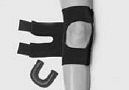
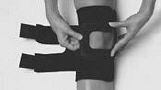
One thing we tried early on was the Shields Patella brace. This is a brace that wraps around the knee, and uses a “butress” to hold the patella in place. See the following pictures:

shield1.jpg   shield2.jpg  shield3.jpg

I actually think this brace was somewhat useful, but I only used it for a few months. It was really too tight to use while biking, but I was able to wear it while hiking and running. (Hiking up steep inclines or steps was somewhat uncomfortable.)

Early on when I was still pretty tender from the bone contusion on the underside of the patella and on the condyle femur, it seemed to keep the two bones from rubbing so much, so I was able to be more active.

As I got better, though, it seemed to cause more irritation than help. This was most likely due to putting the buttress in the wrong place. So to me, that is really key. You have to get it just right for it to work. I would recommend it to anyone that suffers from poor patella tracking, but that you should work with your PT the 1st few times to get it right.

This is an alternative to McConnell taping, which I only tried once. My PT thought the brace would be easier to use than having to tape the knee all the time, and that it would “hold” longer than tape, but I know several people have reported good success with taping. So I recommend trying both to see what works for you.

OS Diagnosis

I had forgotten to include the diagnosis and RX my OS gave me to give to my physical therapist:

diag: plica –
suprapatella partition
infrapatellar plica lateral

Rx: PT early scope rehab
advance activities accodring to effusion
2 x week 1 mo

To translate, the diagnosis explains the pictures I placed in an earlier post. And basically we are to “take it as it goes” in terms of swelling (effusion) and how my body feels…

First Physical Therapy Appt following Post-Op

I had my 1st physical therapy appointment today, meeting with Bruce up in Chapel Hill. Bruce is who I’ve worked with the past year or so, working on patella tracking (patella stretches, VMO strengthening, ITB stretches, etc.) so he knows my full history.

The 1st thing we did was take some measurements of both legs. “bopd” is the base of the patella.

  Right Left
8″ > bofp 19 3/4 21 1/2
6″ > bofp 18 19
4″ > bofp 15 3/4 17
2″ > bofp 14 1/4 14 1/2
bofp 14 13 1/2
2″ < bofp 13 1/8 13 1/4
4″ < bofp 12 3/8 12 1/2

So what this shows is that my Right thigh is significantly smaller than my left, and this stems from the past year with the injury, I’ve significantly used my left leg more, from everything to sitting down and standing up, hiking, steps, etc. We’ll need to work on this as the knee heals up and allows me to.

We also took some measurements. My R knee flexed at 100 degrees, while the L knee did 140.

Bruce then did a few minutes of patella mobilization, both medially and anteriorly.

I then did 5 minutes on the stationary bike with no resistance, and 5 minutes of treadmill with 0 incline, walking at about 3.0 mph.

We then did 20 minutes of elctrostim and ice simultaneously, mostly to help reduce swelling. In the future, we’ll use electrostim to assist in strengthening the R thigh.

For now, Bruce wants me to do the following: