Back in June, I decided to take the 100 straight push-up challenge. In hindsight, starting this at the beginning of a summer filled with lots of travel, both personal and business, was not a great idea. While I quickly worked up to week 5 without any problems, week 5 is VERY tough, and it did not help at all that I was missing many of the days, and even a complete week!
However, now that Septemeber is here and the kids are in school, our travel schedule should be much more sane, and I’m ready to recommit myself. So here it is, week 11 from when I originally started, but I am jumping back in with the week 5 workouts! Spreadsheet is here.
Wish me luck. 🙂
Once I can do 100 straight, I plan to work on 15 straight pull-ups!
Ayn Rand’s books, The Fountainhead and Atlas Shrugged, have come across my path several times over the past couple of years as books that were very influential in people’s lives — people like Alan Greenspan and other business leaders that I admire. They have been on my list to read for a while, but I kept passing them up a when I saw how long they were! However, since I did want to read them in 2008, I figured I’d better get started.
The version of The Fountainhead that I read had an introduction by Rand herself, that she wrote 25 years after the first publication. I have to admit that after reading it, I was a bit put off — or perhaps fired-up! — over it. Some of the things she said were incredible to me (and not in such a good way), while others were quite interesting…
For example, at some points in the introduction, Rand is awfully high on herself and her work. And that becomes largely apparent in the book’s hero, Howard Roark. I have always thought that humility is a virtue, while she thinks that humility is a “sin” (though a sin against oneself, not God). One example from the intro on this is the last paragraph:
It does not matter that only a few in each generation will grasp and achieve the full reality of man’s proper stature — and that the rest will betray it. It is those few that move the world and give life its meaning — and it is those few that I have always sought to address. The rest are no concern of mine; it is not me or The Fountainhead that they will betray – it is their own souls.
And then some interesting quotes from the intro:
On novels as they should be:
Novels, in the proper sense of the word, are not written to vanish in a month or a year. That most of them do, today, that they are written and published as if they were magazines, to fade rapidly, is one of the sorriest aspects of today’s literature, and one of the clearest indictments of its dominant esthetic [sic] philosophy: concrete-bound, journalistic Naturalism which has now reached its dead end in the inarticulate sounds of panic.
On Romanticism
Longevity — predominately, though not exclusively — is the prerogative of a literary school which is virtually non-existent today: Romanticism.
… It deals, not with the random trivia of the day, but with the timeless, fundamental, universal problems and values of human existence. It does not record or photograph; it creates and projects. It is concerned — in the words of Aristotle — not with things as they are, but with things as they ought to be.
I made a note to myself to make sure I read the intro again when I finished the novel, and I am glad I did. While some statements still are a bit off-setting to me personally, overall my perspective on it had changed for the better. I had hoped I would have the discernment to separate my personal views from those of hers, and in the end, I thought she did a fantastic job of portraying her views, ideals, and philosophy in the story itself. And that is what is most important. Not that I don’t agree with her on many points.
The basic premise of the book (and to a lesser extent her philosophy objectivism) is that man’s ego is the fountain head of all human progress. There is so much more to it, and Rand does an excellent job of presenting her ideas through the novel, and typically through dialogue rather than (long/boring) prose. Rand also explains that her main reason in writing is to “present the ideal man.” To do so, she has to define and present the characteristics which make him possible and which his existence requires… But she also wants to make sure the story is worth reading… “Is the pleasure of contemplating these characters an end in iteslf?”
While I don’t agree with several of her tenets, I thought the book was excellent. In some ways I’d like to add it to my all time favorites, but I need to wait a few years and read it again to see if it really stands the test of time.
One such tenet that I don’t care for his her idea that altruism is not a virtue. (In fact, her main character that dedicates her life to altruism ends up a wreck! As a side note, most of her characters are very black and white, with no shades of gray. While that is useful to expose archetypes through the novel, it is not very realistic.) The characters that do portray altruism always end up unhappy — because it becomes an ego driver in itself — the more they can help and give — the bigger their ego (wants to become). But they realize that one’s ego should not be the goal in altruism, and that begins to destroy their view of altruism and of themselves. I think this would go with Paul’s view of salvation by faith alone, not by works, so that none can boast… If any virtue is used to build ego, it is a recipe for disaster.
Another tenet that is hard for me to accept is that man’s ego is an ultimate virtue. However, she uses the term to mean more than what we normally associate with it — namely that it is remaining true to one’s ideals against the influence of others. I can agree with that. However, I think it is taken to an extreme. While we should not pander to everyone out there if they don’t live up to our ideals, it is not a sin to keep others feelings in mind. I can see that it is a fine line to walk — if you try not to hurt others, you may have to sometimes sacrifice some of your ideals. But then again, there are times when your ideals may be more important than how others feel, if they are pulling you from the ideal.
All in all a very thought provoking and provocative book that I highly recommend.
I had a ton of dog-eared pages for quotes, and I’ll include a few of them here.
1) From the intro, a quote from Nietzsche that she had originally planned to include as a preface to the novel, but that she took out because she was afraid the interpretation of the quote would not be what she desired by most readers. She goes off on Nietzsche a little — sometimes praising him — but more often bashing him — in discussing why she pulled the quote.
It is not the works, but the belief which is here decisive and determines the order of rank — to employ once more an old religious formula with a new and deeper meaning — it is some fundamental certainty which a noble soul has about itself, something which is not to be sought, is not to be found, and perhaps, also, is not to be lost. The noble soul has a reverence for itself. — Friedrich Nietzsche.
2) Rand used architecture as her motif, as the base of her story, and I felt like it was the perfect choice for what she wanted to portray. No other occupation lends itself so well to the story and ideals she presents.
The Parthenon did not serve the same purpose as its wooden ancestor. An airline terminal does not serve the same purpose of the Parthenon. Every form has its own meaning. Every man creates his meaning and form and goal. Why is it so important — what others have done? Why does it become sacred by the mere fact of not being your own? Why is anyone and everyone right — so long as it’s not yourself?…
3) One of the characters, Ellsworth Toohey, who happens to be the “anti-hero,” uses critics and editorials to shape the public in a mind numbing way — by promoting the average, the mediocre, or even the downright awful, all while criticizing true genius. The character is afraid of the genius because he can not control it. But I wonder how true this is today… How many people like a book, or a movie, or an album, because critics have raved on it?
“It is the critic’s job to interpret the artist .. even to the artist himself.”
4) Miscellaneous… Also on a book of Ellsworth’s.
He demonstrated that there was no such thing as free will, since men’s creative impulses were determined, as all else, by the economic structure of the epoch in which the lived.
5) This one goes along with the theme of “man worship” in the sense of admiring good work as performed by an individual:
People meant very little to Mike, but their performance a great deal. He worshiped expertness of any kind. He loved his work passionately and had no tolerance for anything save for other single-track devotions.
6) A few more, in which an ideal person should have an occupation that is not dependent in anyway on others:
If I found a job, a project, an idea or a person I wanted — I’d have to depend on the whole world. Everything has strings leading to everything else. We’re all so tied together…
Your life doesn’t belong to you if you’re really aiming high. [This is spoken to one of the anti-hero’s, not to the hero! ]
7) A few miscellaneous ones:
When facing society, the man most concerned, the man who is to do the most and contribute the most, has the least to say.
Integrity is the ability to stand by an idea. That presupposes the ability to think. Thinking is something one doesn’t borrow or pawn.
A quest for self-respect is proof of its lack.
I had so many more dog-eared pages, but I think that is enough for now. The Fountainhead is a long book, but it is a good book. And even if you don’t agree with Rand’s views on many subjects, as I suspect many of you won’t, anything that challenges your own views is worth a read in my opinion. This book will definitely do that if you give it a chance.
Based on a true story but fictionalized, this is the story of MIT students who counted cards in Vegas and made some good money. I won’t say more than that about the plot, but will say the movie was well done and I enjoyed it on my transatlantic flight from London to Cleveland.
It was cool to see Boston and Cambridge — MIT, the T, etc., on the big screen (err, laptop…).
Just one quote:
“Yesterday is history, tomorrow is a mystery”
I would like to read the book “Bringing Down the House” that this movie was based on.
Bach’s Concerto for Two Violins in D minor (bwv 1043) showed up at one point, so that is now in my monthly play list.
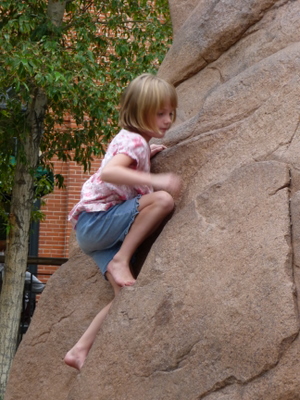
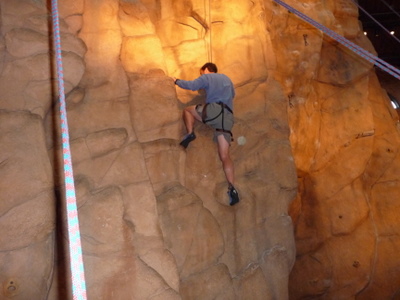
A few more pictures from last week in Colorado… We were at REI and found a bouldering rock, so Riley and I both climbed it. She was going to climb inside, but the rock was closed. We ended up going back on Friday since it was rainy out, and she was able to climb a little. When she saw the boy in front of her come down on the belay so fast, she didn’t want to go, but once I had the REI guy tell her she could come down slow, she did go up about 10 – 12 feet. She then wanted me to climb, and I made it up the 5.7 wall I had done about 10 years ago.
(Riley took about 30 pictures of me on the wall — she is a lot like her mother! 😉 )
When we decided to head to Colorado to visit Ben and Allison, I knew I wanted to attempt a 14,000 summit. The highest I had ever hiked before was to 12,000. Luckily, Ben was up for it too. We decided to wait a few days after arriving so I could acclimate to the altitude and get a few workouts in and short hikes in with the family. He had me running at 6,000 feet a few hours after we arrived!
We had looked through 14ers.com to decide on which ones were close enough and interesting enough to attempt. At first we looked at Grays and Torreys but I heard that was really busy and fairly tame. We also looked at Longs but that was a bit far away.
We decided on Bierstadt (14,060′), even though Ben had just done it recently, because if I found it easy enough to get to the top there, we could keep going along the Sawtooth Ridge and make it to Mt. Evans (14,264′), and bag two 14ers in one hike.
The definitive route guide for this hike is here, so I suggest going there for a more detailed description of the route. The site 14ers.com has excellent photos with the routes marked on them. I wish we had taken some of the photos with us as it would have helped us make better decisions on which routes to follow.
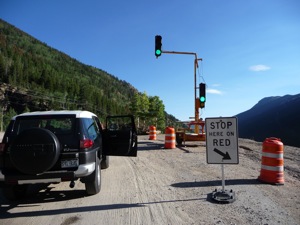
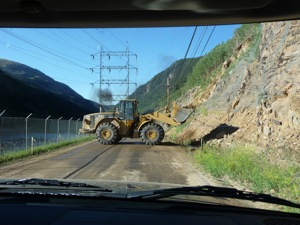
We got a bit later start from the house than we wanted, and then were held up by construction on the road from Georgetown to Guanella Pass. (Yes, I know the light is green in the picture, but it was red for at least five minutes and changed to green right after we had yelled down to some construction workers about it!).
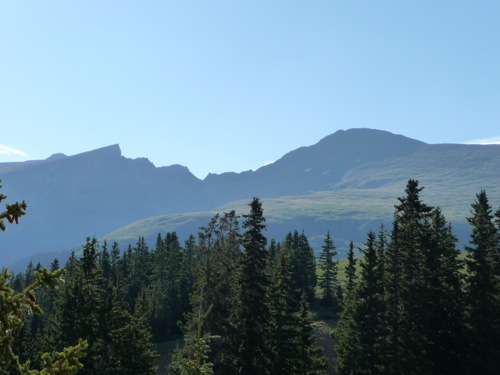
This is a view from the parking lot of Mt. Bierstadt on the right, and the Sawtooth ridge on the left. Evans is not visible here, but is behind the Sawtooth.
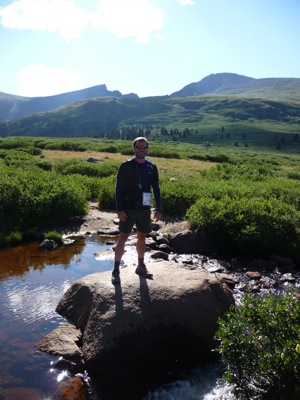
The hike starts off through a flat land that is fairly marshy, so they’ve built a board walk. Here is me on a rock in the middle of a stream crossing, with Bierstadt and Sawtooth in the background:
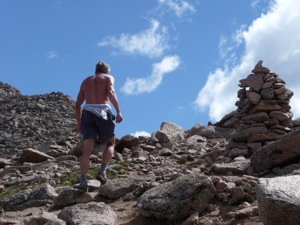
Near the top of Bierstadt, we were passed by this madman — no shirt, no water, no food. Most everyone else had on hats, gloves, and at least an outer shell! We ended up talking to to him for a bit when he was coming down, and he has climbed all 54 14ers in CO and has over 300 14er ascents! He just does it for fun — not training as an ultra runner or anything like that.
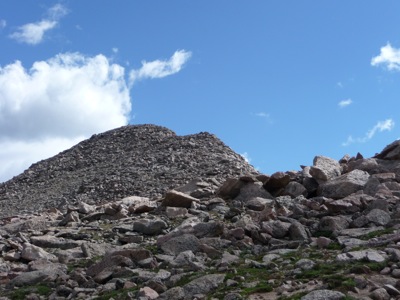
Bierstadt looks like a huge pile of rocks at the top — and it is. You can’t see the people in this downsized image, but they are tiny — so there is still a ways to go to the top from here!
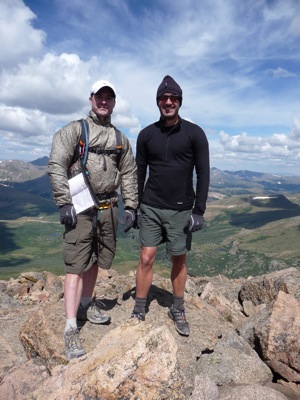
And here we are on top — what a view!
Top of Mt. Bierstadt
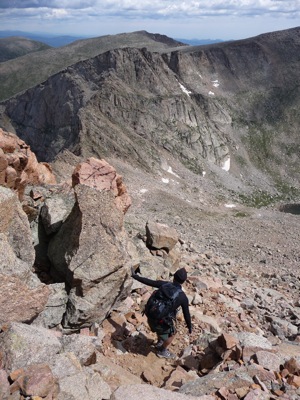
If you watched the video, you heard that we still weren’t sure if we were going to go on. Physically I felt fine — no tiredness from the climb and no feeling effects of altitude yet, so that was not the problem . The problem was that the climb down from Bierstadt and then the Sawtooth Ridge looked a bit difficult from where we were. But once we started down, to “scout it,” we eventually reached a point of no return! Photos never do justice to the steepness, but this is me climbing down from Bierstadt towards Sawtooth, and there is Ben way up high. He chose a higher route than I did.
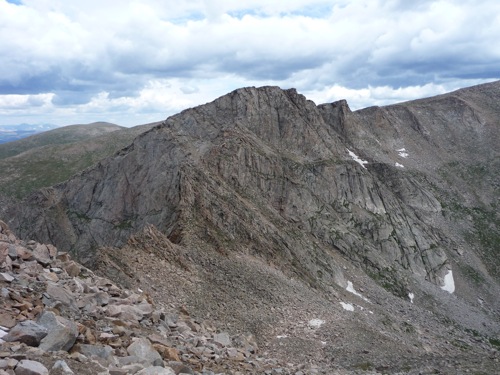
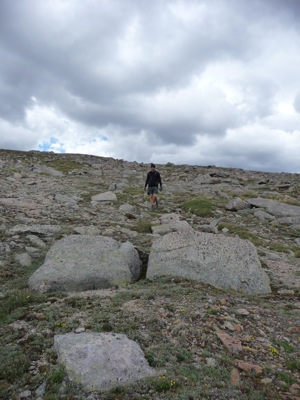
Here is a shot of the Sawtooth ridgeline… We eneded up going down pretty low by the three snow patches, before climbing back up through the notch to the far side. There were two people coming down behind us that we could see took the ridge line as the route an 14ers said to do. There were lots of cairns showing both routes, so you just need to make a decision and go with it. I think the way down was fairly fast for us, and then the climb up was not too bad, so I don’t know if it makes that much difference.
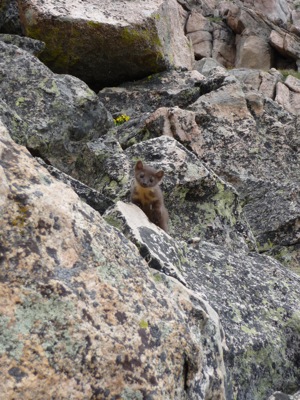
We saw a ton of wildlife on this hike — ealges, marmuts, chipmunks, a mountain goat, beavers, etc. Here are a couple shots:
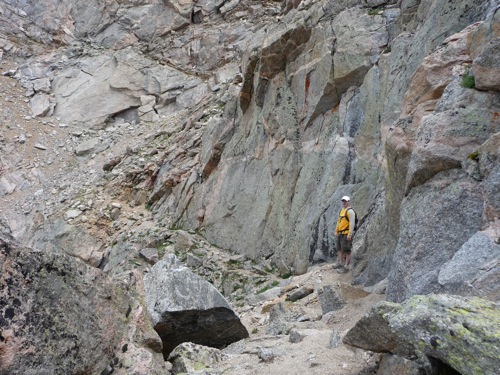
Once we climbed up through the notch to the backside of Sawtooth, it got a little hairy. I was slightly dizzy from the altitude, and it started to snow and get windy. Plus, the path up the backside is a lot of scree, and the space between the rock wall on your right and the 1000 foot drop on your left can be as small as a few feet! (Well, I don’t know for sure if it is 1000′ down, but it sure looks like a long ways, and after a 100 feet or so, it doesn’t really matter!) I should note that the folks we talked to and the 14ers web page all say the pictures make this section look worse than it is, and that is probably the case. While anyone with a fear of heights should not do this section, it never seemed that bad. I was mostly worried about my dizzyness and the snow!
Here is Ben at one point where the drop is just in front of him.
Once you round the sawtooth, you head up the tundra to find the trail going to Evans. I don’t have any photos from there as I was pretty hurting altitude wise at that time, and there really wasn’t much to see anyway. (Well, there are of course beautiful views all around, but not really different from what we had already seen.)
Top of Mt. Evans
While on top of Evans, the two hikers that had come behind us on Sawtooth came up. Turns out it was two women, and they had a car close by. I was sorely tempted to hike down with them and get a ride back towards our car, but I gave myself some time to sit and eat, and then decided we could make it back on foot. The snow had stopped and the weather had cleared, though mountain weather can change fast, we felt pretty sure we could make it back to the car without any problems.
One note is that there is a road to the top of Mt. Evans, so there are a lot of folks up there that drove. I normally am not crazy about such places, but in this case, there are only two out of 54 14ers that have roads to the top, so that is not too bad.
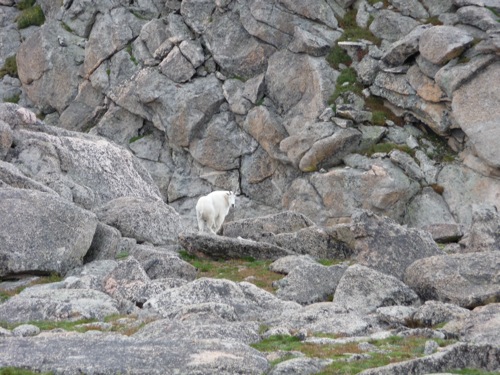
On the way back we came across a mountain goat — he wouldn’t let us get too close:
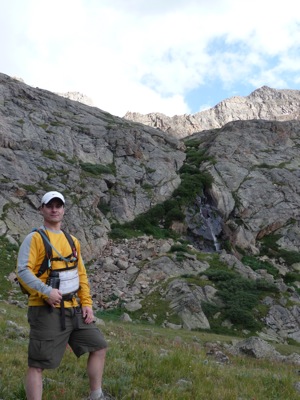
We came down the tundra and followed the water to the gully, where the route told us there was a class 2 scramble down. This section was fairly steep and has a ton of scree, so each of us had a few slides and falls. One thing that is funny here is that when we started the hike and were looking at the possible return paths the 14ers.com route was describing, I pointed at one and said no way, too steep. Turns out that was the one we came down! At the bottom there was a gorgeous waterfall, and a lady had solo hiked in and set up camp down there. She was off in the distance a bit so we didn’t disturb her — but what an awesome place to camp.
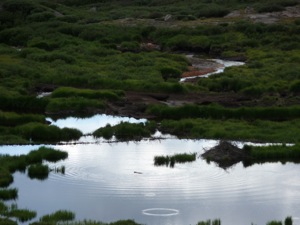
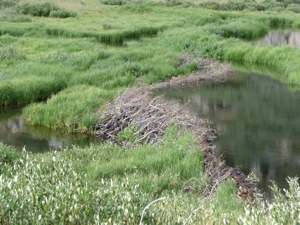
As we went further down, we came across beaver dams and even saw a beaver come out. The picture on the left has a beaver floating in the water (you have to look closely).
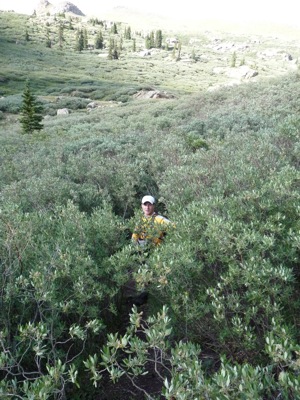
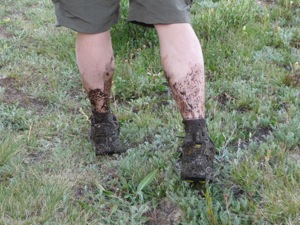
Just below the beaver dams, there is no set trail — it is willows and a lot of muck, and many self made paths trying to find ways around the muck. This section took us much longer than we thought. There were some sections where the willows were very thick and/or over our heads, and some of the muck was pretty deep.
We finally made it back to the car, where my altitude headache really started to make itself known!
There was an older man waiting for another hiker to come down, and he asked if we had seen him. We had in fact met him when we were on our way towards Mt. Evans and he was heading towards Sawtooth and Bierstadt in the opposite direction that we had come. We guessed it would have taken him longer to get to the parking lot at Guenalla Pass than it did us — at least we hope so! We had to leave before we ever found out.
We drove down and met Allison, Kelly, and all the kids in Idaho Springs and ate pizza at BeaoJo’s.
All in all, a great hike. I don’t know that I would do it again — mainly because there are so many other 14ers in CO that I would like to do and not that the Sawtooth section was that crazy. While it was a bit hairier than any hike I have done in the past – including the Grandfather Mountain Trail and even the class 2 scramble and 400 meter cable run on Half Dome, it wasn’t that bad. Definitely some class 3 in there, though, but mostly class 2.
Friends from CO had this from NetFlix while we were visiting, and I had not heard of it before then. The “visuals” were a bit surprising early on — but later they made more sense when we learned that it was a kind of brothel for a porn king. I did find the story a bit hard to follow early on, but as the movie progressed, the pieces fell together.
The story is based on a true heist that “went wrong in all the right ways” according to the tag line. Wikipedia has this line:
According to the producers, this movie is intended to reveal the truth for the first time,although it includes significant elements of fiction and the extent to which it represents historical fact is difficult to determine.
The movie was ok, but not as good as The Italian Job.
I thought this movie was pretty well done. Both sad and funny at the same time. And it makes me want to work on my own “bucket list,” though so far I have thought mostly of places I want to go, and not so much things I want to do. But I envision my list as a living dynamic list that will change over time, and I will start something soon.
Only a couple of quotes:
Carter Chambers: …. I can’t claim to understand the measure of a life, but I can tell you this: I know that when he died, his eyes were closed and his heart was open….
Edward Cole: I envy people who have faith, I just can’t get my head around it.Carter Chambers: Maybe because your head’s in the way.
“I understood how a man who has nothing left in this world still may know bliss, be it only for a brief moment, in the contemplation of his beloved. In a position of utter desolation, when man cannot express himself in positive action, when his only achievement may consist in enduring his sufferings in the right way – an honorable way – in such a position man can, through loving contemplation of his beloved, achieve fulfillment.”
— Viktor Frankl
He said this after suffering through the Nazi concentration camp of Auschwitz.
Ever since we started going up to the Seven Devils/Banner Elk area a couple of years ago, we have passed by the trail head for the Grandfather Mountain Profile Trail, and I have been waiting for my chance to go. The reviews online were a little confusing — one stating the trail was a little under 6 miles round trip, another stating it was over 11!
Well, we were up there again recently, and I got my chance. I had Kelly and the kids drop me off at the base of the trail. I knew I needed a permit, but I thought I might be able to get one at the base, and before I realized I could not, Kelly had driven off! The permits were just .7 miles up the road at an Exxon, so I began to run to it. About 1/2 way there, a lady I had seen and talked to at the based yelled from her car if I wanted a ride. It was kind of a dangerous place to stop, so I told her go up ahead of me to a pull out. By the time I got to her, it was only another couple tenths of a mile to the Exxon, but it was nice not to have to run all of the hill. I bought my permit for $5, got a map, and ran back to the start (all down-hill).
When most hikes are free, it may seem odd to pay $5 for the privilege. The cost goes into trail maintenance, and the trail is all on private property so there are no government funds like at state owned land. I can say that if all trails were this well maintained, I’d be happy to pay! There was almost no trash (I picked up the one piece I found), and the amount of work put into some of the stone work for stairs, erosion control, etc., was really amazing. Some of the stones that have been moved were just huge!
With map in hand, I realized why there was confusion in the trail distances… The “profile” trail is almost 3 miles up to the rest of the trail system on Grandfather Mountain, thus just under 6 miles round trip. Depending on what trails you take at the top, you can easily get to 12 miles or more. Looking at the map and all the trails, I had to make some decisions due to limited time. I decided to really push it and go for the swinging bridge, which was about 5 miles away. I had already gone about 1.5 miles to get my permit, and only had 4-5 hours total! I ended up running any of the flat sections or safe sections that I could. This was all good training for a 14,000-er attempt I hope to do in about 10 days in Colorado. (Though I am worried about how different the air at 14,000 will be than the 5500 most of this trail is at, it is the best training I could get here in NC.)
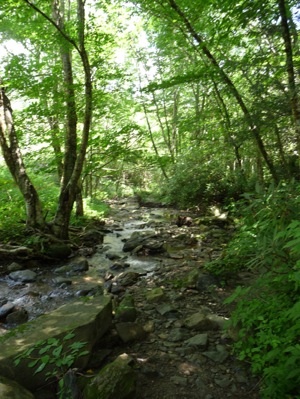
The beginning of the hike runs along highway 105 for a bit, and along a beautiful mountain stream.
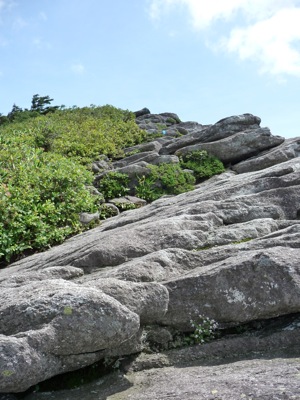
Once you turn up, you really go up — about 1700 feet in 2 miles, and parts of the trail are all rock:
That photo doesn’t do justice to the steepness — I guess they never do. And those rocks were really slippery, especially on the way down. I had forgotten my trekking polls, which made it that much worse.
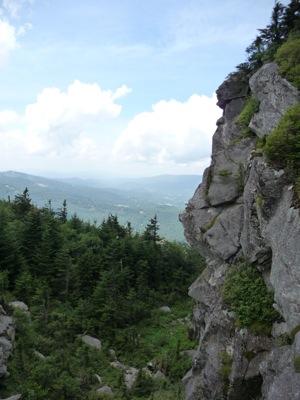
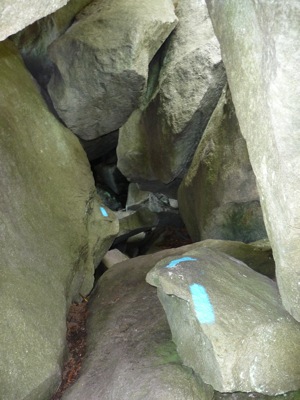
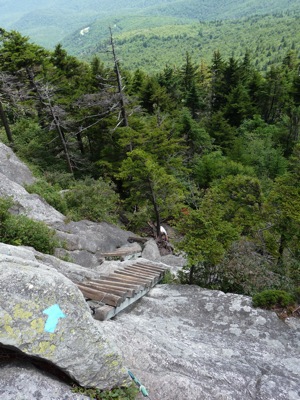
The hike became spectacular once getting off the profile trail, and hiking southwest towards the swinging bridge… About a half a mile or so on Grandfather Trail, and all of a sudden you are on top of all the rock formations that make Grandfather Mountain look like it does from the bottom. And the trail is literally on the ridge line, sometimes just feet from hundred foot (plus!) drops. There are cable runs, wooden ladders, and tunnels, as you can see in the photos below. This part of the trail had the most amazing views and rock formations I have seen since I hiked in Yosemite!
Yes, this is the trail… A ladder straight down, and then rocks (almost) straight down:
And then up a ridge:
And more down:
On the way up, there is one point where you can climb a ladder to McCrae Peak at 5939 feet, which has spectacular 360 degree views, where I took this video. The youtube quality is not great so some of the things I try to point out, you can’t really see. Oh, and later on, I found out the road on the backside is the blue ridge parkway.
This is actually the 4th EP in Jon Foreman’s solo series. I have become a huge Switchfoot fan over the past couple of years — they are the #1 band in my artist play count now, by a large margin!
This EP is the best of the 4 in the series in my opinion, and I’ve been listening to it a lot the past month or so. It certainly is the most religious of the four. Riley and Reece really like “Instead of a Show” and “House of God Forever,” both of which are taken almost straight from the Bible. “House of God Forever” is Psalm 23. If I could play guitar and sing, I’d love to sing that one in front of the Church one day!
Check out his myspace page to listen to the tunes.
On that page Foreman has a blog post with the following quote in it:
Lately music has been my compass: it’s neither the map, nor the road but a steady constant that can help me make sense of the both.
Most of the time, the songs that I write are more honest than I am. Sometimes I don’t play certain songs for people because I’m not ready for that sort of honesty.
I don’t write many happy songs, at least not lately. Which is odd because I’m a fairly upbeat guy. So I’ve got a few theories as to why this might be the case
It might be because life wears down on you. And you lose that part of yourself.
Or it could be because the songs are the only place where these types of ideas can find a release- like a dream where your subconscious is trying to tell you something.
Or perhaps I don’t write songs when I’m happy. You know, a celebration requires a few friends and depression requires solitude.
Either way songs have become my way of finding beauty in the midst of chaos and the pain. It’s a way of finding redemption for mistakes and regrets that I have.
I find that incredibly interesting to me personally, as even though I am very content and happy with life, my musical taste does tend to lean towards darker and more melancholy music. Some examples of this are Avett Brothers (though they have some very uplifting songs too, many have a twinge of sadness/longing in them); Pearl Jam; Leonard Cohen; Counting Crows; Dar Williams; Bob Dylan; etc. I do find some very uplifting songs from Switchfoot, though, like This is Your Life, The Beautiful Moment, Dare You to Move, etc.












 2sparrows
